Facing environmental racism: Extractivism and indigenous mobilizations in Peruvian Amazonia
Translated and edited by Cadenza Academic Translations
Translator: Julia Bilby, Editor: Isabelle Chaize, Senior editor: Mark Mellor
Pages 129 to 152
Cite this article
- BUU-SAO, Doris,
- Buu-Sao, Doris.
- Buu-Sao, D.
https://doi.org/10.3917/pox.131.0129
Cite this article
- Buu-Sao, D.
- Buu-Sao, Doris.
- BUU-SAO, Doris,
https://doi.org/10.3917/pox.131.0129
Notes
-
[1]
Guillermo Bonfil Batalla, “El concepto de indio en América: una categoría de la situación colonial,” Anales de antropología 9 (1972): 15–37. Christopher Columbus thought he had reached the Indies; “for years, the Council of the Indies created by the Spanish crown was tasked with governing the new continent by promulgating countless ‘Laws of the Indies.’ As for the indigenous people, they would forever be known as Indians.” Thomas Gomez, L’invention de l’Amérique: Rêves et réalités de la conquête (Paris: Flammarion, 1992), 104. Translator’s note: Unless otherwise stated, all translations of cited foreign language material are our own.
-
[2]
Rachel O’Toole, “Castas y representación en el Trujillo colonial,” in Más allá de la dominación y la resistencia: Estudios de historia peruana, siglos XVI–XX, ed. Paulo Drinot and Leo Garofalo, 48–76 (Lima: IEP, 2005).
-
[3]
Aníbal Quijano, “‘Race’ et colonialité du pouvoir,” Mouvements 51, no. 3 (2007): 111–18.
-
[4]
Colette Guillaumin, L’idéologie raciste: Genèse et langage actuel (Paris: Mouton, 1972).
-
[5]
David Sulmont and Juan Carlos Callirgos, “¿El País de Todas las Sangres? Race and Ethnicity in Contemporary Peru,” in Pigmentocracies: Ethnicity, Race, and Color in Latin America, ed. Edward Telles, 126–71 (Chapel Hill: The University of North Carolina Press, 2014).
-
[6]
Véronique de Rudder, Christian Poiret, and François Vourc’h, “Précisions conceptuelles et propositions théoriques,” in L’inégalité raciste: L’universalité républicaine à l’épreuve, ed. Véronique de Rudder, Christian Poiret, and François Vourc’h, 25–46 (Paris: PUF, 2000), 31.
-
[7]
Beth Conklin and Laura Graham, “The Shifting Middle Ground: Amazonian Indians and Eco-Politics,” American Anthropologist 97, no. 4 (1995): 696–710; Carmen Salazar-Soler, “La place de l’ethnicité dans les conflits miniers socio-environnementaux dans les Andes du Pérou: XXe–XXIe siècles,” IdeAs 8 (2016).
-
[8]
Kent H. Redford, “The Ecologically Noble Savage,” Cultural Survival Quarterly 15, no. 1 (1990).
-
[9]
See the discussion of the concept of ethnicity in the introduction to this special report.
-
[10]
David Naguib Pellow, “Environmental Racism: Inequality in a Toxic World,” in The Blackwell Companion to Social Inequalities, ed. Eric Margolis and Mary Romero, 147-64 (Malden, MA: Blackwell, 2005).
-
[11]
Sherry B. Ortner, “Resistance and the Problem of Ethnographic Refusal,” Comparative Studies in Society and History 37, no. 1 (1995): 173–93.
-
[12]
Leah S. Horowitz, “Interpreting Industry’s Impacts: Micropolitical Ecologies of Divergent Community Responses,” Development and Change 42, no. 6 (2011): 1379-91.
-
[13]
Martina Avanza and Gilles Laferté, “Dépasser la ‘construction des identités’? Identification, image sociale, appartenance,” Genèses 4, no. 61 (2005): 134–52.
-
[14]
Hélène Combes et al., “Observer les mobilisations: Retour sur les ficelles du métier de sociologue des mouvements sociaux,” Politix 93, no. 1 (2011): 7–27. The terrain and methods are presented in the second part of the article.
-
[15]
I wish to thank Clémence Léobal for supporting me in these reflections and for reviewing early versions of this text, as well as the anonymous reviewers for their evaluations, comments, and suggestions.
-
[16]
On the historical construction of a symbolic border between the Andes and the Amazon rainforest, see France-Marie Renard-Casevitz, Thierry Saignes, and Anne-Christine Taylor, eds., L’Inca, l’Espagnol et les sauvages: Rapports entre les sociétés amazoniennes et andines du XVe au XVIIe siècle (Paris: CNRS Éditions, 1986).
-
[17]
Gomez, L’invention de l’Amérique.
-
[18]
Frederica Barclay and Fernando Santos Granero, La frontera domesticada: Historia económica y social de Loreto, 1850–2000 (Lima: Fondo Editorial PUCP, 2002).
-
[19]
“They say there is a lot of gold in this river and that people who have ventured to exploit it have fallen victim to the savage Indians who live on its banks,” wrote the leader of an exploration party to the Pastaza River, where I conducted my study. “Exploración de los ríos Nanai, Itaya, Morona, Pastaza i Tigre por el 2° ayudante de la Comisión hidrográfica del Amazonas, don Gualterio R. Butt (1873),” in Colección de leyes, decretos, resoluciones i otros documentos oficiales referentes al departamento de Loreto, ed. Carlos Larrabure i Correa, vol. 3–4, 103–109 (Lima: La opinión nacional, 1905), 106–107.
-
[20]
Barclay and Santos Granero, La frontera domesticada.
-
[21]
Carolyn Merchant, The Death of Nature: Women, Ecology, and the Scientific Revolution (New York: Harper & Row, 1980).
-
[22]
Jason W. Moore, “The Capitalocene Part II: Accumulation by Appropriation and the Centrality of Unpaid Work/Energy,” The Journal of Peasant Studies 45, no. 2 (2018): 237–79; Malcom Ferdinand, Une écologie décoloniale: Penser l’écologie depuis le monde caribéen (Paris: Seuil, 2019); on the exposure of indigenous slaves and miners to toxic products in the mines of America, see François Jarrige and Thomas Le Roux, La Contamination du monde: Une histoire des pollutions à l’âge industriel (Paris: Seuil, 2017), chapter 2.
-
[23]
Robert D. Bullard, Dumping in Dixie: Race, Class, and Environmental Quality (Boulder, Colorado: Routledge, 2000); Joan Martínez-Alier, The Environmentalism of the Poor: A Study of Ecological Conflicts and Valuation (Cheltenham: Edward Elgar Publishing, 2002), chapter 8.
-
[24]
Juanita Sundberg, “Tracing Race: Mapping Environmental Formations in Environmental Justice Research in Latin America,” in Environmental Justice in Latin America: Problems, Promise, and Practice, ed. David V. Carruthers, 25–47 (London: The MIT Press, 2008), 40.
-
[25]
Eduardo Gudynas, “Extractivisms: Tendencies and Consequences,” in Reframing Latin American Development, ed. Ronaldo Munck and Raúl Delgado Wise, 61–76 (London: Routledge, 2018).
-
[26]
Murat Arsel, Barbara Hogenboom, and Lorenzo Pellegrini, “The Extractive Imperative in Latin America,” The Extractive Industries and Society 3, no. 4 (2016): 880–87.
-
[27]
Organic Law of Hydrocarbons no. 26221, article 13, 1993. On the history of the liberalization of the oil sector in Peru, see Jorge Manco Zaconetti, Privatización e hidrocarburos: mito y realidad; Perú, 1991–2002 (Lima: Fondo editorial UNMSM, 2002).
-
[28]
Anthony Bebbington et al., “Mining, Political Settlements, and Inclusive Development in Peru,” in Governing Extractive Industries: Politics, Histories, Ideas, ed. Anthony Bebbington et al., 23–71 (Oxford: Oxford University Press, 2018).
-
[29]
Aymara León and Mario Zúñiga, La sombra del petróleo: Informe de los derrames petroleros en la Amazonía peruana entre el 2000 y el 2019 (Lima: Coordinadora nacional de derechos humanos, 2020).
-
[30]
Interview with Gabriel Cahuaza, a villager from Capahuari aged around fifty. May 2014.
-
[31]
Alan García Pérez, “El síndrome del perro del hortelano,” El Comercio, October 28, 2007.
-
[32]
Óscar Espinosa de Rivero, “¿Salvajes opuestos al progreso? Aproximaciones históricas y antropológicas a las movilizaciones indígenas en la Amazonía peruana,” Antropológica 27 (2009): 123–68.
-
[33]
Alberto Chirif and Pedro García Hierro, Marcando territorio: Progresos y limitaciones de la titulación de territorios indígenas en la Amazonía (Lima: IWGIA, 2007), 105.
-
[34]
Law no. 22175 on indigenous communities and agrarian development of the forest promulgated in 1978, heading II, article 8. This is a revised version of the 1974 law, still in force today.
-
[35]
Chirif and García Hierro, Marcando territorio. On the ambivalent relationship of the military with minoritized groups, see Cecilia Méndez Gastelumendi, “Las paradojas del autoritarismo: Ejército, campesinado y etnicidad en el Perú, siglos XIX al XX,” Iconos. Revista de Ciencias Sociales 26 (2006): 17–34.
-
[36]
Juan Martín-Sánchez and Laura Giraudo, “De la ‘race indigène’ à l’essentialisme pratique: le rapprochement de l’Institut indigéniste interaméricain et de l’Organisation internationale du travail (1940–1957),” Critique internationale 86, no. 1 (2020): 45–65.
-
[37]
Bebbington et al., “Mining, Political Settlements, and Inclusive Development in Peru,” 55.
-
[38]
Guilláume Boccara, “Para una antropología del Estado multicultural bajo la globalización neoliberal: Algunas reflexiones teóricas,” in Reformas del estado. Movimientos sociales y mundo rural en el siglo XX en América Latina, ed. Antonio Escobar Ohmstede et al. (Mexico C. P.: Universidad Nacional Autónoma de México, 2010).
-
[39]
Doris Buu-Sao, “(Faire) participer en tant qu’indigènes: Gouvernement et contestation dans les usages de la consultation en Amazonie – Pérou,” Participations 3, no. 25 (2019): 33–58.
-
[40]
The study, which took around fifteen months from 2012 to 2014, consisted of two types of immersion: one alongside the leaders and allies of an indigenous organization during negotiations and mobilizations, the other in villages represented by this organization that are located near the oil site. Access to the area was first granted by the indigenous leaders, then renegotiated with the authorities and villagers. I used a range of methods: observations, interviews, questionnaires, genealogies, and activist and village archives. For an in-depth discussion of the background of the study, see Doris Buu-Sao, “Prendre le parti de l’enquête: Positionnements ethnographiques en terrain conflictuel,” Genèses 2, no. 115 (2019): 123–37.
-
[41]
Pierre Bourdieu, “Décrire et prescrire: Note sur les conditions de possibilité et les limites de l’efficacité politique,” Actes de la recherche en sciences sociales 38, no. 1 (1981): 69–73.
-
[42]
For an analysis of a similar situation in Andean Peru, see Mattias Borg Rasmussen, “Tactics of the Governed: Figures of Abandonment in Andean Peru,” Journal of Latin American Studies 49, no. 2 (2017): 64–82.
-
[43]
Emmanuel Soutrenon, “Le corps manifestant: La manifestation entre expression et représentation,” Sociétés contemporaines 31 (1998): 37–58.
-
[44]
Audrey Célestine, La fabrique des identités: L’encadrement politique des minorités caribéennes à Paris et New York (Paris: Karthala, 2018), 85.
-
[45]
Pierre Bourdieu, “Identity and Representation: Elements for a Critical Reflection on the Idea of Region,” in Pierre Bourdieu, Language and Symbolic Power, trans. Gino Raymond and Matthew Adamson, ed. John Thompson (Cambridge: Polity Press, 1991).
-
[46]
Liora Israël, “Usages militants du droit dans l’arène judiciaire: Le cause lawyering,” Droit et société 49, no. 3 (2001): 793–824.
-
[47]
David Dumoulin Kervran, “Les ONG latino-américaines après l’âge d’or: Internationalisation et dispersion,” in Amérique latine 2006, ed. Polymnia Zagefka, 31–50 (Paris: La Documentation française, 2006); Benjamin Moallic, “Sur ‘l’ONGisation des mouvements sociaux’: Dépolitisation de l’engagement ou évitement du social? Le cas du Salvador,” Revue internationale des études du développement 230, no. 2 (2017): 57–78.
-
[48]
Éric Cheynis, “Les reconversions dans l’associatif de militants politiques marocains: Ruptures, continuités et fidélité à soi,” Politix 102, no. 2 (2013): 147–73.
-
[49]
Laura R. Graham, “How Should an Indian Speak? Amazonian Indians and the Symbolic Politics of Language in the Global Public Sphere,” in Indigenous Movements, Self-Representation and the State in Latin America, ed. Jean E. Jackson and Kay B. Warren, 181–228 (Austin: University of Texas Press, 2002).
-
[50]
Beth A. Conklin, “Body Paints, Feathers, and VCRs: Aesthetics and Authenticity in Amazonian Activism,” American Ethnologist 24, no. 4 (1997): 711–37.
-
[51]
Biographies based on interviews conducted with the three subjects between 2012 and 2014.
-
[52]
A radio operator receives and sends communications where there is no telephone connection. A health worker (promotor de salud) has a medical kit and the skills to administer simple treatment or first aid.
-
[53]
Célestine, La fabrique des identités, 111.
-
[54]
Bourdieu, “Identity and Representation,” 224.
-
[55]
Fredrik Barth, “Introduction,” in Ethnic Groups and Boundaries: The Social Organization of Culture Difference, ed. Fredrik Barth, 9–38 (Long Grove, Illinois: Waveland, 1969).
-
[56]
The “area directly influenced” is an official category used by the Ministry of Energy and Mines to refer to residential groups over which an oil or mining concession is superimposed. These words and all the descriptions that follow are taken from observations recorded in a field journal between 2012 and 2014.
-
[57]
Doris Buu-Sao, “Devenir ouvriers en Amazonie: Entre travail industriel et vie de village,” Terrains & travaux 34, no. 1 (2019): 19–45. On the establishment of community enterprises in Peru and their presence in the Amazonian extractive context, see Doris Buu-Sao, “Indigènes et entrepreneurs: Le capitalisme au village,” Sociologie du travail 60, no. 3 (2018).
-
[58]
On the important role played by these practices, which sit somewhere between public negotiations and “veranda politics,” in the management of relationships with populations near extractive sites, see Jana Hönke, “Transnational Clientelism, Global (Resource) Governance and the Disciplining of Dissent,” International Political Sociology 12, no. 2 (2018): 109–24.
-
[59]
Interview with Jose Cariajano, adviser to the Federation of the Upper Pastaza, Andoas, 2013.
-
[60]
Frederica Barclay, “Economía extractiva y seducción en la Amazonía: Ensayo sobre la continuidad de los métodos empresariales en la Amazonía peruana,” in Articulando la Amazonía: Una mirada al mundo rural amazónico (Lima: Agencia Española de Cooperación Internacional para el Desarrollo, 2012).
-
[61]
These requirements embody the tension, in the history of the concept of representation, between the presentification of the absent and the exhibition of presence, between representation-mandate and representation-incarnation. Yves Sintomer, “Les sens de la représentation politique: Usages et mésusages d’une notion,” Raisons politiques 50, 2 (2013): 15–34.
-
[62]
Interview with Kevin Vasquez, villager and manager of the community enterprise, Andoas, 2013.
-
[63]
Anne-Christine Taylor, “Les versants orientaux des Andes septentrionales: Des Bracamoro aux Quijos,” in L’Inca, l’Espagnol et les sauvages, ed. Renard-Casevitz, Saignes, and Taylor.
-
[64]
Stuart B. Schwartz and Frank Salomon, “New Peoples and New Kinds of People: Adaptation, Readjustment, and Ethnogenesis in South American Indigenous Societies (Colonial Era),” in The Cambridge History of the Native Peoples of the Americas, ed. Frank Salomon and Stuart B. Schwartz, 443–501 (Cambridge: Cambridge University Press, 1999).
-
[65]
Interview with Gabriel Cahuaza, former apu and ex-leader of the Quechua Federation, Capahuari, 2014.
-
[66]
Suzana Sawyer, Crude Chronicles: Indigenous Politics, Multinational Oil, and Neoliberalism in Ecuador (Durham: Duke University Press Books, 2004), 87.
-
[67]
Jean-Noël Retière, “Autour de l’autochtonie: Réflexions sur la notion de capital social populaire,” Politix 16, no. 63 (2003): 121–43.
-
[68]
Regarding members of the rural working class who exploit autochthony capital to gain influence in local politics, Nicolas Renahy writes that “autochthony can only become capital in the public arena to the extent that political personnel recognize its value.” Nicolas Renahy, “Classes populaires et capital d’autochtonie: Genèse et usages d’une notion,” Regards sociologiques 40 (2010): 9–26, here 19.
-
[69]
Renahy, “Classes populaires,” 19.
1“In defense of Mother Earth,” “the indigenous peoples demand their rights.” Two placards, carried in 2012 at a demonstration near an oil site in Peruvian Amazonia, paint an image that is familiar in Latin America: indigenous peoples, victims of natural resource extraction on their land, taking action to defend the environment against industrial predation. In this article, I examine the role of racialization and ethnicization in the opposition to extractive policies in Amazonia. More precisely, focusing on how these processes affect forms of mediation between local inhabitants and the public authorities or companies, I show that racial categories are shaped by ways of governing nature, but also through their appropriation by minoritized groups. These ambivalent processes can fuel both collective mobilization and internal divisions.
Box 1. “Indigenous peoples” and the colonial legacy of racism in Peru
2Although people identified as indigenous are the primary victims of everyday racism, minoritized groups are increasingly choosing to mobilize as indigenous peoples. This process of ethnicization, by which “the attribution of or claim to ethnic origin becomes a crucial point of reference,” [6] is particularly visible in expressions of opposition to the extractive industries. It is often interpreted as the product of strategies to establish alliances, demand rights, and acquire legitimacy, [7] with indigenous leaders playing up to the Western image of “ecologically noble” [8] peoples.
3The fact that ethnicity (unlike race) is not explicitly based on biology or hierarchical classifications encourages the appropriation of ethnic categories by members of minoritized groups. Two elements complicate this ambivalent phenomenon of ethnicization, however. [9] The first is that the appropriation of indigenous identity is constrained by the public authorities. The authorities influence the dynamics of mobilization by formulating both the dominant racial categories and the extraction policies implemented on the land belonging to minoritized groups. I will refer in particular to the concept of “environmental racism,” which emphasizes the connections between racialization processes and unequal exposure to environmental pollution. [10] The second element is the existence, within groups affected by industrial pollution, of power relations and rivalries that are masked by the focus on a supposedly unified indigenous “resistance.” [11] The frequent but rarely studied divisions that arise within “communities” confronted by the extractive industries [12] help to shape the collective action of those living within them. The criteria used by the public authorities for identifying minoritized groups, the social image produced and promoted by spokespersons, and the multiple affiliations of the people being represented may all differ. [13]
4Starting from these hypotheses, this article examines the reciprocal connections between racialized extractive policies and mobilizations against them. After examining the racialized public action surrounding the extraction of natural resources, I study the social forces at work behind the production of a generic indigenous identity by protest mediators. I then explore the multiple social affiliations that lead to rival mediations. I draw on the ethnography of the area surrounding the oldest oil field in Peruvian Amazonia, which offers the opportunity to study the mobilizations through which an ethnicized social image is constructed, but also the everyday lives underlying multiple social affiliations. [14] This localized analysis, focusing on border zones far from administrative centers, provides nuanced insight into the effects of racialized public action. [15]
Racialized extractivism
5Many people do not know that the Amazon rainforest covers two thirds of Peru. It is difficult to access because the Andes separate it from the Pacific coast (where Lima is located). After colonization, Peruvian Amazonia became a space of radical otherness embodied by supposedly savage tribes (in contrast to the ideal of modernity pursued by the colonial and then Peruvian authorities). [16] The exploitation of Amazonia therefore takes place against the background of the colonial history at the root of environmental racism, while the implementation of extractive policies is accompanied by a racialized management of those living in the areas exploited.
The exploitation of Amazonia through the lens of environmental racism
6Amazonian oil extraction is part of a long line of initiatives to exploit the Amazon rainforest and its peoples. A predatory relationship with the rainforest developed right from the first decades after the conquest of the Americas. The conquistadors searched the area for fountains of youth, El Dorado, and the Amazons (the mythical people after whom the rainforest is named). [17] They were very often disappointed and the colonizers struggled to establish a long-term presence in the rainforest. In the mid-nineteenth century, the political elites of independent Peru intensified their efforts to “tame” Amazonia, seen as a geographical and social frontier that needed to be incorporated into the nation. [18] The authorities encouraged exploration by soldiers and scientists, who described the economic potential of its natural resources but also the dangers of the environment and the “savage Indians” [19] who lived there. Between the 1880s and 1910, the extraction of Amazonian rubber created an economic boom that contributed to the development of Amazonian towns and cities and the increasing role of the regional authorities. It also contributed, however, to the enslavement of an indigenous workforce for forced labor. [20] Sixty years after the rubber boom ended, the discovery of oil deposits revived the connections between Peruvian Amazonia and the globalized economy. The “oil lots” created by the Peruvian authorities and allocated as concessions to private companies divided the map of Amazonia into squares, often superimposed over indigenous territories.
7Extractive activities bear the marks of colonial history and its associated racist discourses. In fact, it was the Americas that first saw the emergence of a relationship with land based on the mass exploitation of a nature valued only for its resources. [21] This relationship is embodied in the plantation and mine economy, which combines expropriation, the exploitation of indigenous bodies and slaves, and their particularly high exposure to toxic products: [22] the elements of environmental racism. This concept was formulated in the United States to describe the situation of the Black families who suffered worse exposure to industrial toxicity than white families as a result of their housing and working conditions. It was also used with reference to Native American reservations facing problems from uranium mines and nuclear waste. [23] In Latin America, the production of racial categories determined both the distribution of access to land and natural resources and the dominant definitions of their exploitation. [24]
8The notion of “extractivism” refers to a way of managing nature that prioritizes the extraction of natural resources for the benefit of capitalist accumulation and the “development” of societies. [25] The “extractive imperative” [26] asserted itself in Peru from 1969, when a military regime came to power in a coup d’état. The regime nationalized the oil company operating at the time on the Atlantic coast and launched an underground exploration campaign in Amazonia. Two oil fields were discovered. The national company exploited the first, while the license to exploit the second (known as “lot 1-AB”) was granted to the US company Occidental Petroleum Corporation. Although these deposits were highly productive, they did not allow Peru to become a net exporter. When the military ceded power to civilians in 1980, the rate of prospection was slowing. The trend was reversed by the economic liberalization reforms introduced by the authoritarian regime of Alberto Fujimori (1990–2000). The new constitution, adopted in 1993 and still in force today, stipulates that natural resources are the “patrimony of the Nation” and that the state has a responsibility to “promote the sustainable use” of those resources (articles 66 and 67). Investment promotion laws ensure favorable fiscal conditions for companies in the oil sector as a “matter of national and public necessity.” [27] The Ministry of Energy and Mines and the state company Perúpetro, which is responsible for promoting and overseeing the oil industry, supervise the attribution of licenses and the enforcement of contracts signed with private companies. Despite the democratization seen in the 2000s, a model of extractivism favoring private investment with the aim of exportation persists: in 2012, the lots demarcated by Perúpetro covered 75 percent of Peruvian Amazonia. [28]
9The development of the extractive economy since the 1970s has primarily targeted rural areas populated by racially minoritized groups: nowadays, metal mines are concentrated in the Andes while the onshore oil and gas sites are all in Amazonia. The peoples of Peruvian Amazonia have been suffering pollution from extractive activities since the first oil well was drilled there in 1971. There have been almost five hundred oil spills in the region in the last twenty years, mostly in indigenous territory. [29] The Peruvian authorities authorize and encourage industrial activity in the Andes and Amazonia but rarely do anything about the pollution caused by extractive activities. Gabriel Cahuaza, a founding resident of a village located near one of the two oldest oil wells in the region, states that:
[In the 1980s and 1990s] the water was polluted by Occidental [Petroleum Corporation]. It was like seawater, very salty. When the children bathed in it, their skin peeled. [...] The animals were dying, they were all swollen... [Several times] oil spills reached this far. The fish couldn’t breathe any more. [...] We could no longer fish. We made a complaint, but we submitted it to the company [Occidental]; we didn’t know where to go. [30]
11Gabriel Cahuaza mentions two types of pollution: accidental oil spills and “salty” water caused by the discharge into rivers of the water that was extracted every day along with the crude oil. This water was full of heavy metals, hydrocarbons, and salt. This practice was illegal at the time in the United States, where the company was headquartered, but permitted in Peru. In the absence of representatives in the Peruvian government, the families had nobody to communicate with but the oil company, which did not respond to the complaint. The lack of public action against industrial pollution contrasts with the proactive public policies supporting mining and the extraction of hydrocarbons. It illustrates the environmental racism that characterizes extractivist policies in rural regions: the desire to “modernize” rural societies seen as under-integrated into the market economy, and therefore into civilization, is imbued with racist images that sometimes resurface in conflicts surrounding the development of the extractive economy. One example of this is the language used by President Alan García (2008–2012) when Amazonian organizations objected to decrees adopted to facilitate the concession of land to private interests as part of a free-trade treaty signed with the United States. In the face of this opposition, he compared the indigenous peoples of Amazonia to the “gardener’s dog” in the play by the Spanish playwright Lope de Vega, “who neither eats the cabbages nor lets others eat them.” [31] This comparison portrays the indigenous peoples as backward, incapable of exploiting their land, and mean, degrading them to the status of animals. [32]
The nationalization of indigenousness in the context of extraction
12Despite being underpinned by racist images, extractivist policies are accompanied by policies for the recognition of minority groups in Amazonia. Since independence, the Peruvian elites have made efforts to integrate these groups into the nation by encouraging private actors (missionaries, rubber entrepreneurs, etc.) to come and “civilize” them. Nevertheless, it has primarily been in periods when efforts to exploit nature have focused on Amazonia that policies specifically dedicated to the minoritized groups living there have been implemented. In 1974, while encouraging oil prospecting in Amazonia, the military regime introduced the legal status of “native communities.” This status guaranteed indigenous groups collective ownership of the land, but not the earth beneath it. The demarcation of community property followed an ambivalent logic in that it simultaneously helped to limit the extension of that property: “while the territorial ownership rights of the indigenous Amazonian populations were legally recognized, the remaining spaces without such recognition were made available for legal and unconditional possession by the state,” wrote anthropologists involved in the process. [33] The recognition of native communities defined, for the first time, a specifically Amazonian legal entity: these communities “have their origin in the tribal groups of the forest and are composed of families connected by the following elements: language or dialect, cultural and social traits, common and permanent ownership and usufruct of the same territory, […].” [34] Native communities were invited to form “ethnic federations” to facilitate communication with the Peruvian authorities. They were supported by anthropologists recruited by the military regime or by missionaries. [35] The ethnic federations helped to get native communities included on public registers and to create schools. For those faced with oil extraction on their land, the federations also played a sometimes critical role as intermediaries communicating with companies and with the authorities in charge of the sector.
13As the environmental impact of the extractive economy became apparent and local populations began mobilizing against it, the authorities in charge of the oil sector started to address the question of interaction with the indigenous populations in their protocols. This process, which began in the mid-2000s with the implementation of participatory mechanisms, culminated in 2011 with a decree issued by the Ministry of Energy and Mines establishing the right to prior consultation. This principle, introduced by International Labour Organization (ILO) Convention 169 on the rights of indigenous and tribal peoples, of which Peru became a signatory in 1993, was officially incorporated into national legislation by a law only promulgated in 2012, one year after the ministerial decree. These texts tightened the definition agreed by ILO experts [36] with the establishment of a Ministry of Culture database listing the indigenous peoples and their federations. Although prior consultation is meant to involve indigenous peoples in discussions regarding any public-action measure that might concern them, it has above all been used in relation to mining and oil projects: between 2013 and 2016 there were thirty-three consultations, thirteen concerning oil concessions and ten concerning mining concessions. [37]
14The consent of ethnic federations and the recruitment of state-trained indigenous interpreters as part of the prior consultation procedure evoke the “nationalization of indigenousness” characteristic of state multiculturalism, which aims to make state intervention in the social fabric less heavy-handed in the face of indigenous mobilizations. [38] But the appropriation of the consultation process by the institutions of the extractive sector, in what amounts to “an ethnicized pacification policy,” [39] does not guarantee the eradication of conflicts. This can be observed in the area around lot 1-AB, one of the two oldest oil concessions in Peruvian Amazonia. It was exploited by the American company Occidental Petroleum Corporation until 2000, when the license was bought by Pluspetrol, an Argentinean company active in Latin America and Africa. On the banks of the Pastaza, one of the three rivers in lot 1-AB, several dozen native communities have formed since the 1970s. They have joined forces in the Quechua Federation, which was set up to act as an intermediary between the villages and the Peruvian authorities in administrative procedures. Thanks to mobilizations that threaten to disrupt extractive activities, it is increasingly managing to challenge the public authorities about the environmental impact of oil extraction.
Performing indigenous identity in protests
15Alongside extractivist policies, the Peruvian Congress has enshrined the status of the indigenous Amazonian peoples in law, thereby encouraging the emergence of spokespeople for minoritized groups at various levels, from native communities to ethnic federations. Mobilizations against the extractive industries are therefore partly constrained by racialized extractivism, but they are also the result of the appropriation of racial categories by minoritized groups. A localized analysis of collective action by people affected by oil extraction on lot 1-AB reveals the ambivalence of racialization in these mobilizations. [40] At their heart lies the claim of a Quechua identity. It is “performed” on the stage of protest, in the theatrical sense of role-playing, but also the linguistic sense of the performative power of social classifications: [41] by taking ownership of the categories of public action, indigenous leaders produce the represented group before the state’s agents.
On the stage of protest: Establishing the unity of the Quechua people
16In June 2012 hundreds of people gathered in the village of Topal, a few kilometers from the Pluspetrol camp. Many arrived on a large boat. Men brandished spears on the prow and a voice was heard over the clamor: Daniel Cahuaza, vice-president of the Quechua Federation, announced over a megaphone that “the Quechua people have come to defend their rights” and sang “¡El pueblo unido jamás será vencido!” (“The people united will never be defeated!”). The leaders of the Quechua Federation and the village authorities wore crowns of feathers; many people had painted their faces with achiote (a natural pigment). Their appearance was intended to assert their identity as indigenous peoples of Peruvian Amazonia. Having suffered four decades of oil extraction they were demanding reparation, but also proper consideration from a state that had kept them in a situation of “abandonment” (a term often used to denounce the contrast between the support given to an extractive economy and the lack of will to guarantee the basic rights of local people). [42] It was not so much the number of participants as the orchestration of bodies that gave the demonstration its power. There were “mothers” carrying placards and representing women; some formed a team of cooks. Sick children were shown to civil servants as evidence of the damage caused by the oil industry and state abandonment. The men carried spears with the red-and-white Peruvian flag attached to the tip, symbolizing the potential violence of the protest group. [43] The image presented was, thus, of a determined and united Quechua people. At the end of the demonstration, a delegation (notably including the Minister of Energy and Mines and the Minister for the Environment) came to negotiate. The leaders of the Quechua Federation were rewarded by the creation of a “multisectoral commission” responsible for devising corrective and compensatory measures.
17The 2012 protest was the first demonstration managed by the Quechua Federation. Since then its leaders have organized around ten similar mobilizations intended to influence the Peruvian government’s responses to their demands. To rally dozens of villages located several days apart by boat, the leaders draw on their knowledge of the region and use the material resources provided by “assessors” (employees of NGOs that protect the environment or indigenous rights). The leaders also rely on the assessors’ technical expertise for evaluating the environmental impact of the oil business or deciding which legal strategy to implement. This combination of skills (interpersonal on the part of the indigenous leaders and technical on that of the assessors) allows the members of the Quechua Federation to carry out the essential “community work of definition of the self and others” [44] in order to produce a coherent social image of participants and their demands. This can be seen in the work to make the placards brandished at assemblies and in front of civil servants. They are made the day before by a group of young men, helped by the assessors who suggest ideas for slogans. Their juxtaposition against the journalists and officials who have come to talk helps to ensure consistency both in the messages expressed and in the identity of those carrying them (see Figure 1).
Placards at the June 2012 demonstration in Topal and numbered translations
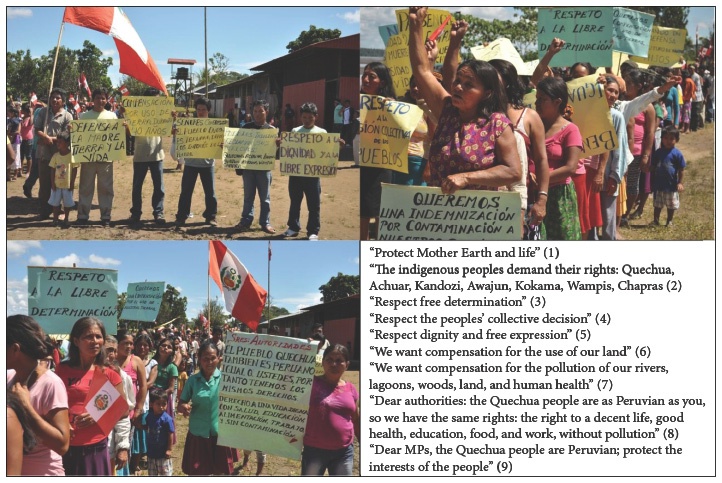
Placards at the June 2012 demonstration in Topal and numbered translations
18These placards assert minority affiliations that range from specific ethnic groups (2) to claims of generic indigenousness evoked for example by “protect Mother Earth” (1) or the reference to various features of the land (7). The homogenization of multiple ethnicities into the category of indigenous peoples justifies the demand for rights relating to free determination and participation (3 and 4), both principles protected by international legislation such as ILO Convention 169 (see above). However, the placards also assert that these peoples are part of the Peruvian nation and that they are therefore entitled to demand the same rights as the “authorities” to whom they are complaining (8 and 9). By combining claims of minority identity with expressions of national allegiance, the indigenous leaders and their assessors use official categories, at the national and international levels, to provide a legal basis for their demands. As in regionalist struggles, they therefore demonstrate the existence of a group whose boundaries are inspired by the dominant principles of division, even if this means transforming their stigmata into a positive emblem. [45]
The social drivers of protest representation
19When it was created, the Quechua Federation was not designed to fight the oil industry. Its purpose was to serve as an intermediary in dealings between the authorities and native communities (see above). When local communities mobilized for the first time against Pluspetrol in 2006, demanding more compensation, particularly in the form of jobs, for extraction on their land, nobody called on the Quechua Federation. The organization did not become involved until 2008, after the first confrontation between the police and protesters, during which an officer was shot and killed. When twenty-seven men were charged for offenses ranging from breach of the peace to homicide, the federation’s president, Andrés Cahuaza, was called in to organize their defense. Andrés contacted a lawyer, Eduardo Huamani, who was a member of an NGO that specialized in supporting indigenous activists charged with crimes. Eduardo advised emphasizing both the environmental impact and the fact that the accused were members of indigenous peoples. During the trial, the defendants gave their accounts to the jury in Quechua, wearing face paint or feather headdresses. Jesuits living in the native communities, anthropologists, and biologists all gave expert testimony about the situation of indigenous peoples affected by the oil industry. Eduardo and Andrés organized demonstrations in defense of the “incarcerated indigenous brothers” with the support of NGOs and other federations. Andrés spoke to the media wearing achiote face paint and pleaded the defendants’ cause to opposition MPs. This cause-lawyering strategy politicizes the judicial arena in that the defense’s legal arguments are inspired by the language of protest. [46] The politicization of the judicial arena was based, in this case, on the critical appropriation of ethnicization processes, with indigenous identity becoming a way of highlighting prejudice and justifying mobilization. The strategy was successful: in November 2009 the regional court of justice acquitted the accused on the grounds that marginalized indigenous populations had been engaged in “legitimate protest.”
20The trial, and Eduardo’s daily involvement, were crucial in the politicization of indigenous leaders. Eduardo, a lawyer’s son from an Andean town, had fought in radical left-wing groups in the 1990s during the conflict between the Peruvian armed forces and the guerrillas of the Shining Path and the Túpac Amaru Revolutionary Movement. Like many others, Eduardo had been stigmatized as a leftist and, following the logic of “NGOization,” [47] moved into defending indigenous rights as a way to convert his activism into a professional activity safe from accusations of terrorism. This conversion allowed Eduardo to remain “true to himself,” [48] leading him to share his political ideals with Andrés. Through contact with other NGO employees who sometimes shared this activist past and were working as assessors, Andrés adopted a protest style associated with a form of indigenous authenticity. He became comfortable using Quechua in public, a practice that is stigmatized in everyday urban life but valued in the protest world. [49] He never takes part in mobilizations or negotiations without his attire (face paint, toucan-feather headdresses given to him by leaders of other indigenous groups, jewelry made by women from communities along the Pastaza with beads bought in downtown Lima). These standardized symbols embody a generic indigeneity that serves to guarantee authenticity, and therefore also the indigenous leader’s legitimacy in the eyes of the employees of the NGOs supporting the movement, journalists, and government officials. [50]
21As president, Andrés is not an isolated leader: along with his nephew Daniel, vice-president of the Quechua Federation, and Eva Cahuaza, his cousin by marriage and the elected representative of the “indigenous mothers,” he is part of the team of “indigenous leaders” in charge of mobilizations. United by family ties and originally from villages along the Pastaza relatively far away from oil sites, they are all predisposed to acting as indigenous spokespersons due to their backgrounds (Box 2).
Box 2. The backgrounds of three Quechua leaders [51]
Eva was born in the early 1970s in Alianza Cristiana, a village co-founded by evangelist missionaries. She married a Quechua evangelist when she was thirteen and joined him in the Amazonian city of Pucallpa, where the Swiss evangelist mission was based. Her husband trained as a teacher while Eva learned to read and write in Spanish, becoming one of the few literate women in her circle. After spending two years teaching sewing to indigenous women invited to Pucallpa by the missionaries, she returned to live in a village near Loboyacu. North American missionaries from the Summer Institute of Linguistics (SIL), who had come to the region in the 1960s to 2000s, asked the couple and one of Eva’s brothers for help translating the Bible into the local Quechua language. Eva belongs to a relatively distinguished line, since her husband is a teacher and her brother (who received training from the SIL) is a nurse. She was elected an “indigenous mother” in 2012 and is backed by the evangelists who, during mobilizations, entertain the assemblies by organizing concerts of Christian songs in Quechua.
Daniel was born in 1980 in Alianza Cristiana. His father, Eva’s brother, became a nurse thanks to his SIL training. When he left school Daniel failed the entrance exam for a university in the region and went to live with an uncle for a few months, not far from the oil extraction sites. There, for the first time, he saw the pollution: “that was when I decided to fight for my people.” Daniel then met an Achuar woman and went to live in her village. He was made president of the Association of Pupils’ Parents (despite not having any children yet) and became a radio operator and health worker, [52] two roles for which he trained in towns in the region. He and his wife went to live in Alianza Cristiana because Daniel wanted to educate his son “from the earliest possible age.” He was quickly elected as apu (president of the native community). At that time his father was president of the Quechua Federation, until Andrés was elected in 2006. In September 2008, the vice-president stepped down and Daniel was chosen to replace him.
22These three leaders grew up away from the influence of the oil companies, which offer goods, services, and jobs as compensation for their presence (see below). This relative independence was consolidated by an experience of geographical mobility gained while working around the region (Andrés), working with the evangelists (Eva), or being the son of an evangelist and training in an urban environment (Daniel). This mobility allows them to access resources independently of the oil companies, which is less common in villages near the site. They have developed a taste for travel, the ability to communicate with people from other social backgrounds, and an inclination toward acting as spokespersons, be it to decide on the correct translation of a verse from the Bible into Quechua (Eva) or to represent the village as apu (Daniel). These experiences of mobility facilitate their interactions with qualified assessors from Lima or even Europe. They are more likely to identify as “indigenous,” a category that is much more valued by those outside native communities (evangelists, NGO employees) than in their places of origin. By taking advantage of this category in international (ILO Convention 169) and national law, the Quechua leaders establish their legitimacy as spokespersons in the eyes of the representatives of the Peruvian state.
The internal boundaries of ethnicity
23Are the categories of “indigenous” and “Quechua” relevant in the eyes of the people the leaders seek to represent? It is well established that the fabric of ethnicized identity responds “to a double issue of legitimacy: [...] appearing representative in the eyes of both the public authorities and the members of the group one seeks to represent.” [53] By claiming a collective identity, the representatives not only give existence to the represented group, but also seek to impose upon the group “common principles of vision and division, and thus a unique vision of its identity and an identical vision of its unity.” [54] Nevertheless, observation of everyday life in the villages represented by the Quechua leaders reveals that there is not necessarily a consensus regarding where the boundaries delimiting an ethnic group should be drawn: [55] there may be disagreements, affecting the group’s modes of political existence and action.
Grassroots distrust: Rivalries, multiple affiliations, and defections
24The villagers often express distrust toward the leaders of the Quechua Federation. Criticism generally focuses on the suspicion that the leaders and their assessors are receiving an undue share of resources in the name of the villagers. The distrust is fed by rivalries within the represented group, particularly between the villages of the Upper Pastaza, which are close to the oil site, and those located downriver, from which the main leaders of the Quechua Federation come (see above, Box 2). Doubts and criticisms of this kind were voiced by the people of Soplín (the official headquarters of the Quechua Federation) in 2014. Those living downriver reproach the leaders for favoring the villages of the Upper Pastaza, which are the sole beneficiaries of mobilizations primarily leading to remediation measures and financial compensation for the communities near the oil site. Conversely, those living upriver accuse the Quechua Federation of not taking their perspective sufficiently into account even though they are the ones who are “in the area directly influenced [by the concession], [56] the true hosts,” in the words of a villager from Capahuari. The apu answered that “this is where the pollution is, [...] it is our decision whether we mobilize or not.” The Federation is perceived as a distant entity in the upriver communities, which believe that they alone have the legitimacy to make decisions because they are “most affected”; those living downriver are like intruders coming to meddle in matters that do not concern them.
25Geographical distance aggravates the divide between upriver and downriver: it is a long day’s travel by boat between the Upper Pastaza (home to the seven communities where the oil concession is located) and the villages downriver. However, the distance is above all a social one: proximity to the oil concession changes lifestyles, particularly relationships to work and consumption practices. When Pluspetrol bought the license to exploit lot 1-AB in 2000, it was the first company to have a community relations service responsible for implementing a corporate social responsibility (CSR) program. In particular, this program involved access to unskilled jobs on the oil site (pruning, road maintenance, etc.). These temporary jobs were initially offered by the companies subcontracted to complete the work. From 2008, however, “community enterprises” became the main channel for accessing jobs on the oil site. These are enterprises founded by at least 60 percent of the members of a native community. Employment is distributed on a rotating basis between all the members. Community enterprises are primarily created close to mining and oil concessions: the companies have appropriated the system and turned it into a community relations mechanism, suggesting to the locals that they create community enterprises to get easier access to labor jobs.
26All the villages of the Upper Pastaza have established community enterprises over the last ten years. The majority of the inhabitants regularly get income from the oil sector through these enterprises. Salaried work is changing consumption patterns: rice and pasta are replacing cassava and plantains; industrial beer is gradually replacing that made by local women using fermented cassava; and televisions, hi-fi systems, and even motorbikes are appearing in villages. The villages are adopting elements of the worker’s life, from the organization of collective projects to the construction of homes and the organization of domestic space. This interpenetration of manual labor and village sociability is causing the inhabitants of the Upper Pastaza to increasingly see themselves as “workers” and not just indigenous people. [57]
27The villagers’ transformation into workers reduces their inclination to challenge an industry on which they are more and more dependent, especially as this trend is accompanied by daily interactions with Pluspetrol’s community relations service. This service allows inhabitants to request ad-hoc individual aid (medical care from the Pluspetrol clinic, air transport to the city for medical or administrative reasons, etc.) and negotiate agreements establishing the list of material goods and services that the company agrees to give them as compensation for carrying out activities on their land. In a continuum of clientelist practices, these interactions open the way for informal negotiations of favors with influential people in the village in order to limit opposition from the locals. [58] It was in this context that an organization specifically representing the upriver villages was created in 2007. The six villages that joined it wanted their own representative body to negotiate with the oil company.
We, the inhabitants of the Upper Pastaza, of the border, we wanted to create the Federation of the Upper Pastaza [...]. The benefits are for those who live here. Not for those who come from the Marañón [a river into which the Pastaza flows] and want to benefit. [59]
29The organization’s style of action resembles a “proximity-based approach.” Its process of solicitation differs greatly from the more protest-based approach of the Quechua Federation. The only NGO that financially supports the Federation of the Upper Pastaza is Caritas, a Catholic foundation that carries out projects funded by the oil company. The funding chain for the organization is therefore primarily linked to the oil site. Its primary objective is peaceful negotiation to obtain tangible goods, such as computers for schools or, more rarely, grants for university study. According to Frederica Barclay, this is a “seduction technique” increasingly employed by oil companies, which use donations to obtain the support of influential community figures and those close to them. [60] Thus, several close relatives of leaders of the Federation of the Upper Pastaza have got permanent jobs on the oil site, but also in the Pluspetrol offices as supervisors, employees in the community relations service, or nurses. This arrangement encourages those living closest to the oil site to challenge the collective identity formulated by the leaders of the Quechua Federation.
Geography of rivalries between upriver and downriver
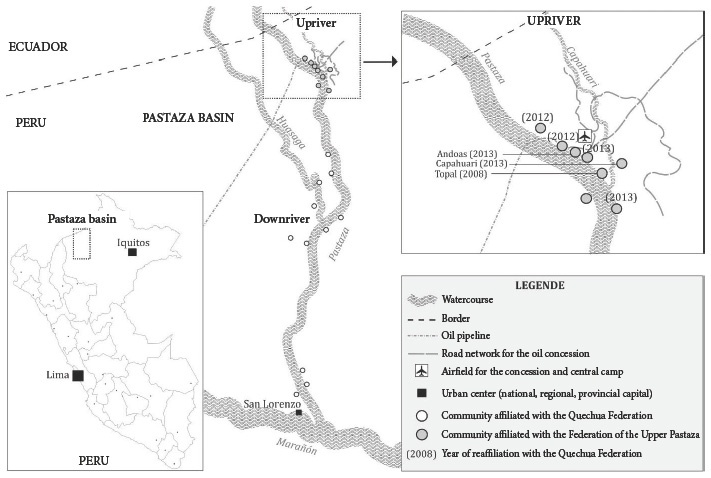
Geography of rivalries between upriver and downriver
The ethnicization of differences
30The rivalries between upriver and downriver communities and the creation of competing organizations triggered by the presence of the oil site in the Upper Pastaza area are sometimes justified in terms of ethnicity. The inhabitants of upriver communities are more inclined to criticize the remoteness of the leaders, who almost always come “from downriver”: leaders must both be here, physically present in person or via intermediaries, and be from here, with their roots in the communities that they seek to represent. [61] Beyond the geographical criterion, the inhabitants refer to ethnic boundaries to justify the creation of rival organizations. For example, in the words of Kevin Vasquez:
Why be with the Quechua Federation? Why can’t we, the people of Andoas, manage our own area ourselves? “Andoas” [the name of the village and the oil site] comes from “Andoas” [the ethnic group]. Can we not manage our own resources? Why must we rely on outsiders [to do it]? [62]
32Identified by Jesuit missionaries as an ethnic group distinct from the Quechua people, the Andoas inspired the name of the first mission in the Pastaza area, founded in 1708. The descendants of the Andoas abandoned their language (Shimigae) and integrated into the Quechua population. [63] In 1953 the SIL missionaries only encountered a handful of Shimigae speakers, the last of whom died in 2012. Nevertheless, the inhabitants of the Upper Pastaza are once again identifying as Andoas. We can analyze this process in terms of “ethnogenesis,” a concept that emphasizes the adaptability of populations racialized by the colonial powers: in response, they modify their definition of themselves, redrawing the boundaries of ethnic categories. [64] The reference to Andoa identity serves to justify the creation of the Federation of the Upper Pastaza, as seen in this comment by Gabriel Cahuaza, apu of Capahuari and vice-president of the Quechua Federation until 2006:
It was better to form a new organization specifically for the Andoas. The Quechuas of the Lower Pastaza do not share the customs of the Upper Pastaza. They have a different way of speaking. [...] It has always been their custom to threaten, to kill people. We are not like that, we do not have that custom. [...] In the past, my father told me, people from here would row to Yurimaguas to get salt. Then they would row along the river for three months. [...] On the way, the people of Soplín would be waiting for them in silence, [...] and they would kill. They would steal their salt. [...] When they saw a man with his wife or his daughter, they would kill him to take them. [65]
34Gabriel paints a picture of downriver inhabitants whose ancestors would readily kill for women or salt, a rare commodity at the time. In his eyes, this past is still relevant: those living downriver are still the descendants of warlike societies. By assigning the downriver inhabitants a status of “other” associated with violence, he is engaging in a kind of ethnicization of difference according to which the downriver villages are the custodians of a “custom” and a history entirely at odds with upriver cultural practices.
35Nevertheless, the Federation of the Upper Pastaza does not claim to represent any particular ethnicity. Although its president is Quechua, several of his colleagues describe themselves as Achuar, including José Cariajano, one of the elders of the village of Andoas, who serves as an adviser. The Federation distances itself from the system of representation adopted by the Quechua Federation, whereby affiliation with an ethnicity serves as the basis for a network of organizations, from individual native communities to the Interethnic Association for the Development of the Peruvian Forest, which is organized at the national level and represents a generic indigenous identity. The pluriethnicity claimed by the leaders thus becomes the foundation for a different style of action and mediation.
36The coexistence of rival organizations is also seen in the Ecuadorean Pastaza among the villages near an oil concession: while an older organization emphasizes the unity of the indigenous peoples against the oil industry, a parallel organization, formed by communities near the concession, prefers to negotiate in order to obtain services and favors from the companies. The sometimes confrontational, sometimes friendly coexistence of these organizations demonstrates that “indigenous identity [is] anything but stable” [66] and that identity-based processes of mobilization are not set or predictable. They collide and interact with the divisions cultivated by the CSR arrangements and with the rivalries that fuel movements of division but also unity: on both sides of the border, the villages that have a adopted a proximity-based approach to the oil industry are able to reconcile, even temporarily, with protest organizations. Allegiances are in fact relatively fluid. In the wake of the 2012 demonstrations in Topal (an upriver village mainly founded by downriver families that only remained a member of the Federation of the Upper Pastaza for a short time), almost all the upriver communities rejoined the Quechua Federation. For two years the apus of the Upper Pastaza welcomed Andrés and encouraged their villagers to participate in mobilizations, primarily because these were seen as a way of obtaining financial compensation and jobs for the community enterprises, particularly to clean up the polluted sites.
37Underlying differences remained, however, influencing the negotiations with the public authorities. This was particularly the case during the prior consultation that Perúpetro was obliged to carry out (see above) in preparation for the expiry of Pluspetrol’s exploitation license and the signing of a contract with a new company. The Quechua Federation made the consultation conditional upon the satisfaction of the demands expressed during the mobilizations. These included an assessment of the environmental and social impact, clean-up of polluted sites, and compensation for occupying and polluting the land. With the civil servants of Perúpetro desperate to conclude the consultation in time to renew the license, authorities from the upriver villages contacted them to start a parallel consultation process on the basis that they were most affected. Working closely with the old leaders of the Federation of the Upper Pastaza, they created the Interethnic Organization of the Upper Pastaza, which also followed a de-conflictualized approach and highlighted the Andoa identity to justify its distance from the Quechua Federation. This parallel consultation eventually allowed Perúpetro to claim that the consultation process had been completed, despite the breakdown of negotiations with the Quechua Federation. As a result of the politicization of ethnicity and the ethnicization of local rivalries, the proximity-based approach resurfaced and allowed the Peruvian authorities to ensure that extraction continued.
38In the play of interactions between the public authorities, villagers, and their representatives, racialization produces ambivalent effects. The exploitation of Amazonian oil at the expense of the indigenous peoples of the region, supported by extractive policies that give priority to private investment, can be interpreted as a form of environmental racism. However, there are also parallel policies that recognize minority groups as legal subjects in the form of “native communities” (1974 statute) and “indigenous and tribal peoples” (ILO Convention 169), including those issued by the Ministry of Energy and Mines, which is in charge of extractive policies (2011 decree). While the development of the extractive industry combines the exploitation of peripheral territories with the racialization of their inhabitants, representatives fighting against industrial pollution make use of the dominant categories of ethnicity. The “indigenous peoples” demand the right to live in a protected environment by asserting an ontological link with “Mother Earth” as the ancestral inhabitants of these lands. The racialized image of people deemed to be in a “natural” state, considered “backward” or inferior by the ruling white elites, is thus reappropriated and given new meaning. However, ethnicity can also be used by rival groups who want to preserve peaceful relationships with companies because they are invested in an everyday existence shaped by labor and the clientelism of the companies. These internal divisions play into the hands of the extractive policies, in that public officials use them to circumvent the most critical indigenous representatives and establish the legitimacy of the oil projects. The ethnographic approach, focusing on the territories where indigenous organizations are based, thus shows how everyday social interactions, affinities, and hostilities influence the ways in which the racialized categories of public policy are used in collective action.
39The remarkable effects of the ethnicization of environmental struggles become clearer when we consider the “autochthony capital” exploited by intermediaries for minoritized groups, in other words all the resources that come from belonging to local relationship networks and that substitute, in part, for economic and cultural capital. [67] On the one hand, the value of autochthony capital relies on a minimum of recognition from dominant groups. [68] On the other hand, it is also the result of internal legitimacy battles within dominated groups. Thus, the appropriation of ethnic categories by minoritized intermediaries is the product both of interactions with majority groups and power struggles within minoritized groups. By employing the dominant categories of ethnicity, indigenous leaders hope to influence extractive and environmental policies in border territories. However, their capacity to establish themselves as legitimate representatives also depends on relationships maintained at the “grassroots” level with local people, whose varied experience of the extractive industry fuels multiple affiliations. In the twofold hierarchical and relational interpretation permitted by the notion of autochthony capital, ethnicity thus appears in all its ambivalence and tension. [69] It is a weapon of the weak made available by racialized public action, which enables the construction of a people united in the fight against environmental racism. In association with the other affiliations that it subsumes, however, in particular those related to geography and the experience of labor, ethnicity can also justify divisions. More malleable than other categories (gender-related, professional, or geographical), which it tends to outweigh, ethnicity seems to provide particularly strong fuel for power struggles based on internal divisions. It thus contributes to the emergence of a form of collective action stripped of conflict.