Manuscript(s) Matter: Paleography, Philology and Resistance to Theory
Pages 265 to 286
Cite this article
- BAJETTA, Carlo M.,
- Bajetta, Carlo M..
- Bajetta, C.-M.
https://doi.org/10.3917/etan.733.0265
Cite this article
- Bajetta, C.-M.
- Bajetta, Carlo M..
- BAJETTA, Carlo M.,
https://doi.org/10.3917/etan.733.0265
Notes
-
[1]
Images from this manuscript are available at https://specialcollections-blog.lib.cam.ac.uk/?p=8524 (last visited April 2020). For a comprehensive catalogue of the coats of arms, crests, and other heraldic devices that have been stamped by British owners on the outer covers of their books (together with the bibliographical sources of the stamps), see Morris and Oldfield.
-
[2]
Abbreviations in the original text expanded as italics.
-
[3]
The database (which includes one new item and about 60 copies of letters not mentioned in the 1999 edition) is part of the ongoing project to publish a new edition of Ralegh’s works, currently under review.
-
[4]
See also McGann 2014, 197: “a document is a specific material object that has passed through a particular, if also vastly complex, transmission history; on the other hand, the interpreter of the document is equally, codependently shaped to a specific moment, location, and set of interests. Reception history is merely (exactly) transmission history unfolding through a different phase space, and both are functions of particular acts of reading.”
1It is probably the paleographer’s fate: there are more things in heaven and earth than are dreamt of in our philology. One keeps meeting with texts and objects which seem to challenge traditional notions of, and pre-conceptions about, a literary work and its physical embodiments. This is particularly true of the early modern period, which saw the development of several manuscript forms, and a multiplicity of uses of the handwritten texts produced either in scriptoria or by individuals (see e.g. Hobbs, Woudhuysen 1996, Marotti, Schurink).
2The analysis of sixteenth- and seventeenth-century manuscripts, and a concrete attention to the complex relation between texts and what Jerome McGann (1991, 77-83) has called their “bibliographic code,” may help to highlight some of the limitations of the literary theories which have informed both literary criticism and editorial practice. Overall, this should not surprise. On the one hand, this period has always been central to Anglo-American thought on texts (see Greetham 1999; Murphy; see however Turner, 80-81). On the other hand, as McGann, again, has pointed out,
until the early decades of the twentieth century what we now call literary and cultural studies was called philology, and all its interpretive procedures were clearly understood to be grounded in textual scholarship. But twentieth-century textual studies shifted their center from philology to hermeneutics, that subset of philological inquiry focused on the specifically literary interpretation of culture.
4As these pages will endeavour to demonstrate, looking at the relationship between paleography and “theory” from this perspective can be fruitful indeed, especially from the point of view of the often-controversial issue of emendation and of the identification of any “authorial voice.”
Manuscripts and theory
5A number of recent studies have examined in extenso the relationship between textual scholarship and critical thinking (see e.g. Cerquiglini; Nichols 1990 and 1997; Greetham 1999; Turner; McGann 2014; Pollock et al.; Hui), and one may perhaps be pardoned if a somewhat simplified picture is given here. In his Literary Theory, Terry Eagleton has suggested that the critical approaches which have dominated the last two centuries could be roughly summarised in three phases. A concern with the author (Romanticism and the nineteenth century) was followed in more recent times by an almost exclusive concern with the text (New Criticism, but also, implicitly, Close Reading, Structuralism, and its filiations perhaps up to Deconstructionism), and this was followed, in turn, by a marked attention to the reader (Reception Theory). This scheme, it could be argued, does not easily accommodate a number of critical methods, including political and contextual approaches such as Leah Marcus and Thomas Corns’s work on seventeenth-century poetry. It does not accommodate, in fact, the re-discovery of the feminine which has characterised a number of seminal works from Germaine Greer’s anthology Kissing the Rod (1982) and Antonia Fraser’s 1984 volume, to James Daybell’s more recent explorations of women’s letter-writing (2012), all of which have now become crucial to Renaissance studies (for a recent survey of this theme see Loomba and Sanchez 2016; more specifically on manuscripts studies see Burke and Gibson 2005). Such a short summary may also prove problematic when it comes to tackling Marxism, as well as Psychoanalysis, New Historicism, the recent developments of “Affective” criticism and Eco-Criticism or the studies by such eclectic scholars as Frank Kermode or Roy Strong. Eagleton’s summary, nonetheless, may still provide us with a useful framework to analyse the present state of English studies and philology (cf. also Greetham 1998, 264-66). What it evidences, in fact, is that a marked, almost inescapable, split between “author,” “text” and “reader” has characterised the scholarly productions of our recent past, and that this is still palpable today. Such an insistence on one element of literary communication is, in fact, clearly visible in some contemporary critical trends, such as, for example, “Material Studies” or “Thing Theory”.
6Clearly, the study of literary manuscripts has not been immune from the influence of theory, and their analysis has often reflected the dominant critical vogue of the time. One may think, for example, of what was frequently defined as the “great era” of Renaissance paleography, the mid-twentieth century. The New Critical approach to literature brought closer attention to “the words on the page.” Consequently—and in this case more or less independently from the diktat of New Criticism—what has been termed the “Greg and Bowers” school focused mainly on the reconstruction of a “perfect” text, and this is perhaps another reason why New Criticism, as David Greetham once noted (1999, 126-28; 195), was a curious bedfellow of New Bibliography.
7In a rather different way, the influence of Barthes and Foucault ran much deeper: having reduced the writer to an “authorial figure” and the text to a similarly Foucaultian “on dit,”—something which “is said”—meant fully revising the idea of authorial intentions (Greetham 1999, 197; cf. also Bajetta 2006) which in many ways has contributed, at least in the twentieth century, to a significant reduction of interest in the manuscript page—or to a reductionist “social” view of the authorial nature of some handwritten documents (cf. Daybell 2012, 14-15).
Manuscripts: theory and practice
8In his In Praise of Scribes, Peter Beal has provided a simple and pragmatic synthesis of what should be a scholar’s attitude when faced with an early modern document: “What is this manuscript trying to tell us? Why is it constituted the way it is? What can we understand from it about the circumstances of, and reasons for, its production? And how should we be dealing with this evidence?” (Beal v). Such an approach has many advantages, as one can understand from the following example.
Elizabethan Manuscript gift volumes
9Cambridge University Library Add. MS 8915 still preserves its original vellum binding. It is decorated with an oval gilt arabesque centrepiece and an asymmetrical stamped gilt frame containing a small crown, a leopard and the words “ELIZABETHA REGINA.” [1] Traces of its green silk laces are still visible. Its title, written on the spine, “Orationes et carmina Acadamiae Cantabrigensis Ad Elizabetham Reginam, 1564,” was most likely added later: it is inaccurate not only in its spelling of “academia” but also in the reference to “orationes.” This volume contains, in reality, a collection of poems in Greek, Hebrew, English, Aramaic, macaronic and Latin. Some folios present a very elegant mise en page, but one can find sections where the penmanship is far from spotless. This is the case, for example, of the English verses on fols. 91v-92 and the Latin couplets on fol. 153, both written in a rather cursive secretary hand, as well as of the poems entered by members of Pembroke College (fols. 121-30v). In the latter section, blottings, insertions, and very evident erasures can be seen on most pages; sometimes the scribe even struck through entire lines (cf. fols. 121, 122r-v, 125, 126r-v, 127, 128r-v, 129r-v and 130, all transcribed by the same hand). On the whole, the duct in this quire is more oblique than in the other sections; even the titles appear to have been penned rather carelessly.
10The binding and the contents of this volume suggest that it was connected to the Queen’s visit to Cambridge in 1564 (Goldring et al., I:373-437). This volume, however, is certainly not a highly refined product. It quite probably never made its way into the Royal collection now at the British Library. Was it ever presented to Elizabeth? Was it really intended for the Queen’s eyes? No analysis of the material features of this manuscript can lead to conclusive answers. The binding looks contemporary, yet it is definitely not what one may term a thing of beauty. It was not a book Elizabeth would have appreciated: it was known—at least to her courtiers—that the Queen disliked vellum and had a penchant for red velvet—one notable example is her copy of the English Bible now at the Folger Shakespeare Library (shelfmark: STC 2099, Copy 3; see also Knight, 27-29 and William Cecil’s letter to Richard Howland in Goldring et al., II:569). The Cambridge book, in short, does not fit the “typical” image of a presentation copy. Could the Cambridge manuscript be an ex-post collection of the verses written for Queen’s visit? Such collections, in fact, were typically exhibited in the streets of the city. They could have been collected in a memorandum book for the University (cf. Archer and Knight; Bajetta 2019).
11It is only by reading through the narrative of Elizabeth’s visit to Cambridge that one can make sense of the physical features of this volume. A detailed narration of “The Queen’s entertainment at Cambridge” can be found in a manuscript in the Cambridge University Archives, and is printed in Nichols’s Progresses. This narrative, and a note in another Cambridge manuscript, unequivocally identify this book as the one which, in 1564, was “delyvered vnto master Secretorye” (i.e., William Cecil, then Secretary of State and Chancellor of the University) and was carried by him “in his owne handes” while the Queen was making her progress around the colleges (Cambridge University Archives, Misc. Collect. 4, fol. 74v, also printed in Goldring et al., I:417-18). Cecil presumably kept it thereafter, since the manuscript was part of the Burghley sale of 1687 (Goldring et al., I:418, note 184).
12So, even if the Cambridge congratulatory verses did not reach the Queen’s library shelves, they were certainly intended as a gift for her. Once this is ascertained, one begins to make sense of some of the material features of this book. What, to use Beal’s terms above, this manuscript is “trying to tell us” is that it is a presentation copy—even if, at first glance, it may not look like one. What we may consider a rather poor binding was in fact one of the earliest Cambridge examples of the use of gold leaf: an effort was clearly made to produce something special (Goldring et al., 418, note 184). This book testifies to an important moment for the life of the University: the first Royal visit to the University in Elizabeth’s reign. The verses contained in the manuscript were in all likelihood composed and copied in the space of just three weeks, and many people penned their own compositions. The corrections visible throughout the volume, then, were intended to be an improvement (although not necessarily in terms of elegance). Each college seems to have appointed a corrector who revised its section and amended some faults (usually in metrical scanning and Greek accents; Leedham-Green iii) There is, ironically, a genuine touch of the academics’ obsession with their own effort and disdain for mundane formality: the Cambridge scholars seemed to have preferred a corrected copy, however inelegant, to a fine-looking book.
13As has been illustrated elsewhere, the evidence of the Cambridge manuscript, as well as of many other books from Westminster School, Oxford, and Eton, which sometimes present similar (though not always so evident) features, is certainly telling. One would often be tempted to consider an elegant binding and a formal mise en page as a clear sign of presentation, but this was not always the rule (see Bajetta 2001; Scott-Warren). Form, in other words, mattered much less than one may be inclined to think. This entails that, almost paradoxically, the very idea of a “presentation copy” was and should be linked to intention: this book is meant to be a gift. In a process akin, in a way, to linguistic aktualisace or “foregrounding” (cf. Procházka et al. 2010, 196, note 4), the gesture matters more than the object, or, as Jerome McGann has stated, this is one of those “bibliographical codes” which “lay bare their devices” and “announce that they are executing a ‘non-natural’ language system” (2014, 169).
14The Cambridge book, and its attempts at amelioration, can remind us of a crucial element. Apparatuses frequently try to be as concise as possible; cases such as that of the Cambridge manuscript, however, may call for the registering in extenso of errors and corrections, or at least for a detailed note on the mise en page of certain sections. The registering of specific variants, spellings and/or corrections, besides representing an editor’s obsession with detail, could be quite important for scholars working on, say, the state of Greek studies at the Universities. That much scholarship has been based on printed rather than manuscript texts, in fact, may also have been linked to the paucity of information in this respect—and, ultimately, to the scarce attention paleographers have devoted to a proper registering of the original emendations in these volumes (see Binns 1978; Bajetta 2019).
Hermeneutic gaps
15An accurate description of manuscripts, and even of specific textual loci can therefore be of paramount importance to scholars, and this even quite apart from the problem of emendation per se. Analysing the physical embodiment of the text is something that can provide important elements for the understanding of any literary piece. In this respect, much work has been done over the last three decades, especially on manuscript verse miscellanies—one needs only to recall the important books by Mary Hobbs, Henry Woudhuysen, Peter Beal, Harold Love, Steven May and Arthur Marotti. Many scholars have emphasised, among other things, the social dimension of textual production, and therefore the importance of not looking at texts in isolation. As they have argued—and as Joshua Eckhardt has recently done extensively in his Manuscript Verse Collectors and the Politics of Anti-Courtly Love Poetry (2009)—looking at the collocation of one given set of verses in a miscellany can be very rewarding. One should bear in mind, however, how these volumes were produced. Jonathan Gibson has demonstrated that many sixteenth- and seventeenth-century miscellanies (such as, for example, Folger Shakespeare Library, Washington, MS V.b.198) were not assembled in the way one may think was natural for them to be:
Space, then, matters even in hermeneutical terms. The fact that two poems appear, say, on a conjugate leaf of a handwritten volume does not indicate that the two poems were necessarily meant to be near. “Social” readings of manuscript texts, then, should always take into consideration material evidence, as well as ensure they do not omit elements such as foreign language texts, for example, which can be crucial for the construction of meaning (cf. Bajetta 2010).Intellectual groups may not have been copied seriatim, or one after another in the sequence visible in the manuscript. Indeed, roughly contemporary texts can be widely separated in space across the manuscript, while texts spatially close in the manuscript may have been copied many years apart. In deciding whether or not groups of texts were copied in seriatim, it will be useful to know whether or not the manuscript was copied into a prebound book or loose sheets. If the miscellany was started in a prebound “paper book” (bound either by the compiler or bought from a stationer), its compiler is likely to have used what I have elsewhere called “blank casting off:” he or she or they will have started two or more sequences of texts in the manuscript, separated by blank pages (perhaps including sequences beginning at both ends of the manuscript). This was a popular way to collect texts of different kinds, such as secular and religious verse in the same manuscript […].
Editing non-English texts
16Sometimes, though, the foreign language texts one may want to reproduce can pose a real challenge, as witnessed by the following case. At the beginning of 1583, Don Antonio—the exiled King of Portugal, then in Paris—sent an extravagant Italian letter in his own hand to Queen Elizabeth I. The latter is addressed in the letter as “Serenissima Maesta,” but a second persona is added to the Royal image, that of a tender but also dangerously powerful woman patron. This was “la bella molinara,” the beautiful miller who could reduce a man’s soul to airy powder, and who could give Antonio power to fight against not only Philip II but the whole world. This is the text of Don Antonio’s holograph missive, dated “di paris 19 di ianaro” (Cecil Papers 185/130):
ringrazio il caso[,] la fortuna[,] bella amichevole molinara del mio core, chi mi ha cossi acomodato, a quella restaro obligatissimo á quella aficionatissimo, lei sola sara mio dolce amor, a lei si sacrificarano li miei pensieri, et vostra Maesta serenissima fachia quel che sarà sirvita. Solo con la mia amata e dulcissima molinara mi faro forte non solo contra il povero filipo ma contro il mundo tuto.
18The Italian may at first glance seem quite erratic, and one would be tempted to normalise the spelling and tidy up this text considerably. “Obligatissimo” and “aficionatissimo” look too similar to Spanish (“obligado” and “aficionado”) or Portuguese (“obrigado” and “afeiçoado”); “Filipo” is clearly influenced by “Felipe,” and “mundo” is just regular Spanish or Portuguese. Emending what one may consider as patent mistakes in this letter, however, would just obscure the curious, but powerfully suggestive and unique, Portuguese-Spanish-Italian language of this missive. To provide but an example, “obligatissimo,” is not necessarily influenced by Spanish or Portuguese. It is a very common spelling in sixteenth- and seventeenth-century Italian, as witnessed by its occurrence, for example, in Vasari’s Vite (1550, p. 733, sig. z3) and in Galileo’s letters (32). When editing this missive, then, one should bear in mind that, like many other Renaissance men and women (including his addressee, Queen Elizabeth), Don Antonio had quite probably a very reasonable working knowledge of Italian. One should really sift all the existing evidence before emending what seems “wrong” in this text.
19A different case is that presented by a holograph Italian letter of Queen Elizabeth I, written to Alessandro Farnese (1545-1592), Prince and later Duke of Parma (now British Library, Cotton Charter IV.38[1]). Its incipit may seem rather confused (cf. Elizabeth I, 135-45; reproduced at 138-39).
| Ca Signor duca | My De [ar] Lord and Duke |
| Sig Illustrissimo Cugino | ‘my Lord. \Most Illustrious Cousin/ |
| My mi par e parso molto strano Cusino mio Caro che | To me It app \appeared/ to me \very/ strange, my Dear Cousin that |
| tardauate il scrivermi per il negotio del Grifino et bodman | you were so late in writing back to me concerning the affair of Grifino and Bodman. [2] |
20Here and elsewhere in the letter, one can observe a number of false starts, currente calamo corrections and later insertions. In the manuscript, in fact “Ca” appears slightly above the cancelled “Signor duca” as if Elizabeth had not quite made up her mind whether to keep “Caro” (“Dear”) or not for the new opening. Quite probably, after this, she went on with “Signor Duca” and wrote the first three lines—probably going back to review them shortly thereafter. Looking at “è parso molto strano,” in fact, one may note that “molto” and “e parso” were apparently inserted at separate moments, just like “Illustrissimo Cugino.”
21One may just imagine Elizabeth chewing her pen, trying to find a good Italian opening (“Caro,” “Carissimo,” “Illustrissimo”?), and not quite succeeding. Could this hesitation be considered as typical of a person writing a text in a foreign language? The analysis of the historical context proves that this is not the case. At about this time, notwithstanding Elizabeth’s attempts to avoid a direct conflict, there was a real and serious threat of open war with Spain. Parma had recently promised peace through at least three different sets of emissaries; the situation, however, was indeed quite intricate, and the English Queen, whose Italian was rather good (see Elizabeth I, 2017, 22-28), had at this time little idea of how to deal with such an offer (cf. Elizabeth I 2017, 135-37). Farnese, incidentally, was at this time both “Prince” and “Duke” (he had just inherited the title after the death of his father); for Elizabeth he may have been an “Illustrious Cousin” (as most European Princes), but probably not a very “Dear” one. Even if the Queen, in fact, had not realised that Farnese’s proposals for peace were just a delaying tactic, she might have known that while promising peace on one side, he was also in correspondence with Mary Queen of Scots (cf. The National Archives, Kew, State Papers, 53/15, fol. 2; Elizabeth I, 162 note 52).
22In sum, Elizabeth’s corrections and apparent hesitation at the start of her letter, are not a sign of linguistic inability. They point to something typical of Elizabeth: her notorious indecision when having to tackle an international crisis. Even quite apart from the significance of the multiple incipits, the draft copy and its various layers of correction may in this case provide much additional information. Printing only the final version, a copy of which is extant among the Spanish state papers (Archivo General de Simancas, Secretaría de Estado, Negociación de Flandes, 592/17), or merely providing a brief account of the draft in the apparatus criticus would just either obliterate or minimise the writing process, which, in this case, can be of interest to historians and literary scholars alike.
Missing letters and an author’s “voice”
23The example of Sir Walter Ralegh’s œuvre can perhaps be a good case in point to demonstrate how editing should always be based on case-by-case analysis rather than general considerations. This corpus is riddled with doubtful poems and spurious prose texts, and even the undoubtedly “genuine” works pose a number of problems. Some poems seem to owe much to some (mostly unidentified) continental sources, others may be the fruit of a collaboration with his cousin Sir Arthur Gorges (see Gibson 1999). In addition to this, critics are faced with some tracts, such as the one on the war (or “peace,” as we find in some contemporary witnesses; cf. e.g. British Library Add. MS 48062, fol. 370) with Spain “and the protection of the Netherlands,” which have come down to us in late manuscripts and printed volumes. These, it seems, were heavily edited by some of Ralegh’s late seventeenth- and eighteenth-century “admirers,” who sometimes appear to have inserted notes and translations to the original texts (cf. e.g. Ralegh 1829, 8:299-316, and British Library, Add. MS 48062, fols. 370-85; Cambridge University Library, MS Ee. 2.32, fols. 109r-27v.). His most famous book, the History of the World, presents a plethora of borrowings from biblical, classical and other sources, which are sometimes quite difficult to disentangle from the base text. Quite significantly, scholars such as Nicholas Popper have identified what has been termed the “collaboration between Ralegh and the sources he collected” as the distinctive trait of this work (Popper 33). To make matters worse, this book may not be the product of Ralegh alone: Ben Jonson once remarked that “the best wits” of England were employed in writing that book (see Popper 32-33 and ff. for a thorough discussion on this point).
24All this is something which the editors of the standard 1829 Oxford edition—the only “modern” edition to date—seem to have ignored. In order to disentangle borrowings from originals, imitation from innovation, in order even to understand what Ralegh wrote and what others wrote for him, one evidently needs a reliable language corpus which can help us to retrieve his “voice.” One may immediately suggest turning to Ralegh’s letters, which are frequently holograph, and pose little questions of authorship. The problem is: how representative of Ralegh’s language and ideology are these? It has been observed, in fact, that most of these letters are of a “business” nature, and that they are disappointingly dry when one thinks of a real “Renaissance man” such as Ralegh. Can we really use them when looking for any “authorial language”? What follows is a series of considerations deriving from the arrangement of the known missives—those included in Latham and Youings’s edition (Ralegh 1999), together with some later additions—in a database arranged by dates, places of writing, topics and the names of the repositories where these documents are currently located. [3]
25Examining and ordering evidence such as the names and number of the addressees, for example, one sees that Ralegh’s first and most important interlocutor, Sir Robert Cecil, stands out immediately among the recipients with about 90 items out of a total of 230. One may object that this is simply due to the good fortunes of the Cecil archives at Hatfield House. Letters to Cecil, though, while clearly very numerous at Hatfield, appear also in other repositories including the National Archives and the British Library (Fig. 1a & 1b). In addition to this, one should note that, as shown in Fig. 2a & 2b, the corpus of Ralegh’s correspondence described in the 1999 edition includes most of the predictable addressees (Edmund Spenser being a notable but explainable exception; cf. Hadfield, 1:172-73). In fact, we can find here several courtiers, men of state, friends and relatives, and practically all the people who are known, from other sources, to have frequented him (compare, e.g., the list in Fig. 2a & 2b with Wallace 1959; Williams 1988; Nicholls and Williams 2011; Gallay 2019; for an evaluation of recent biographies see Bajetta 2018).
Ralegh’s letters – Repositories

Ralegh’s letters – Repositories
Ralegh’s letters – Repositories

Ralegh’s letters – Repositories
Ralegh’s letters – Addressees
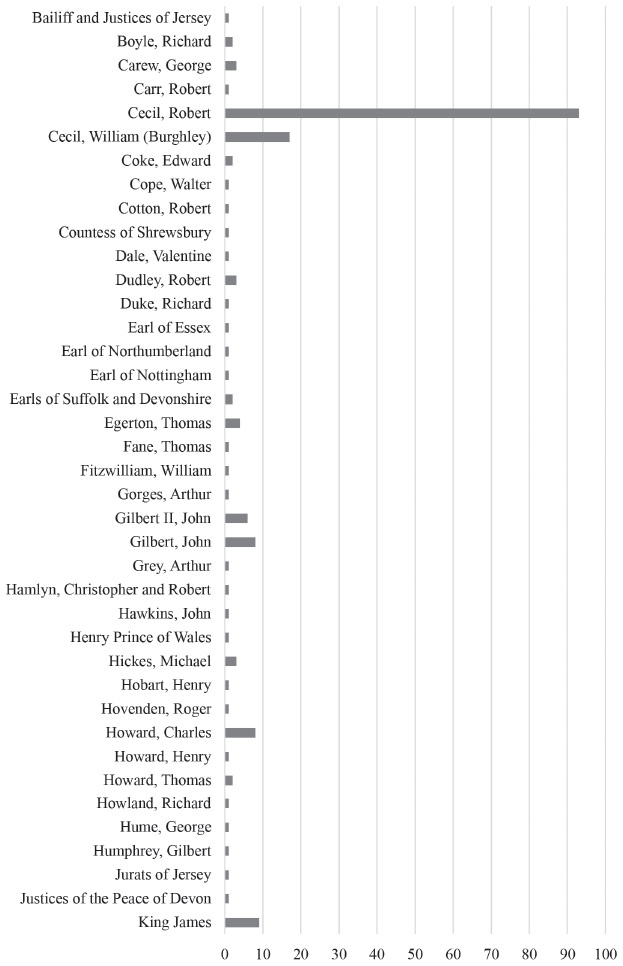
Ralegh’s letters – Addressees
Ralegh’s letters – Addressees

Ralegh’s letters – Addressees
26There are exceptions, of course: in 2009 Christie’s sold a holograph letter from Ralegh to the Countess of Shrewsbury, the formidable “Bess of Hardwick” (see Woudhuysen 2009). Most of Ralegh’s associates and acquaintances, however, are included in this corpus; and if, say, Lord Cobham (with 9 items) gets more letters than Lady Ralegh (with 6) this is hardly surprising. Ralegh certainly loved his wife, but their relationship, notwithstanding the fact that they were often separated, was unlikely to engender a large body of correspondence (cf. Beer 2004): he wrote on very special occasions—including, most sadly, the death of their son (Ralegh 1999, 353-56).
27We have only one letter to Queen Elizabeth, but this is, again, hardly surprising. Ralegh, we should remember, was very close to her for about twelve years. When he was away, he wanted her to feel he was away, and when he was sent away, he wrote to others so that they could let her majesty know. His most passionate narration of his misfortunes—the letter in which he described his despair at seeing Elizabeth riding past Durham House while he was on house arrest—was in fact sent to Robert Cecil, and was backed up by a missive penned by Sir Arthur Gorges who invited Cecil to pass on the message (Ralegh 1999, 70, no. 46).
28There is a limit to the misfortunes of archives. While Ralegh must have written to his wife or the Queen on other occasions, it is doubtful that a very large number of documents is missing. Ralegh was not Sir Christopher Hatton or the Earl of Essex, whose passionate letters to Elizabeth constituted a crucial part of their elaborate game of courting their sovereign. He probably preferred to write poetry to her (something which, with less success, Essex did as well; see Lacey; May 1980 and 1999), and he certainly knew very well which occasions were fit for writing and which were not.
29One feels that the “business” nature of Ralegh’s correspondence is, in fact, not a result of the nature of the archives where we find most of his signed and holograph missives. On the one hand their topic, all in all, could have caused most of these letters to be considered as “State Papers,” thus ending up in the archives of the Lord Secretary, among the State Papers proper, and in collections which are related to these, such as the Cotton and Lansdowne Manuscripts at the British Library. Certainly, though, the “business” orientation of Ralegh’s correspondence is quite evident. We can see that the busiest periods for his correspondence are not, as one would imagine, the dramatic years of 1592 (his first imprisonment in the Tower), 1603 (the start of his long incarceration after the accusations of treason) and 1618 (the year of Ralegh’s abortive voyage and of his execution), but 1594 and 1601 (see Fig. 3). The year 1594 was a very busy period in the organisation of the first Guiana expedition, while in 1601 (the year of the Essex rising, mentioned in one letter only), Ralegh was dealing with his lands in Ireland, the defence of the English coast, and the events surrounding the battle of Kinsale (Nichols and Williams 89-90; 169-70). One may note that these topics were not perceived as particularly interesting by contemporary and/or later collectors: no copies of these missives, in fact, appear to be extant (cf. Fig. 3). Guiana, Ireland: in a sense, it is Ralegh the coloniser whom we see emerging from his correspondence in these years—which is, quite intriguingly, one of the most distinctive features of Ralegh’s life, as Alan Gallay has recently argued.
Ralegh’s letters – peak years

Ralegh’s letters – peak years
30Interestingly, even a preliminary attempt at classifying the topics of Ralegh’s letters can evidence that the largest group of these is related to business, while the second most common topic among them is patronage. Again, we know that the latter was an important element of Ralegh’s career at court (Fig. 4). While patronage may indeed sound as a promising topic for someone interested in Ralegh’s literary output, given its relation with the world of art, one may be disappointed to find Sir Walter’s “business tone” in practically all of this section of the correspondence. As a matter of fact, Ralegh was frequently interceding for others—and this was a rather unpoetical activity: it was a game of money and power (cf. nos. 11, 14, 17, 21, 24, 32, 34, 35, 62, 64, 65, 67, 72-74, 76, 83, 84, 92, 94, 97, 99, 100, 116, 127, 163, 186 in Ralegh 1999).
Ralegh’s letters – topics

Ralegh’s letters – topics
31The data presented so far evidence that the missives which are now extant may represent a significant portion of what must have been the corpus of Ralegh’s correspondence. They also prove, however, that in most of his letters—though by no means in all of them—Sir Walter was showing just one side of his character. This, all in all, is unsurprising, and rather typical of public figures: Elizabeth—whose postscripts, however, could be very personal—and the two Cecils being notable contemporary examples (cf. Elizabeth I, 2000, 2017; Evans 2018; Alford 2008; Handover; Read. On Robert Cecil’s affectionate words to Bess Ralegh see Nicholls and Williams 168-69).
32The fact that the majority of Ralegh’s letters were written in a style that probably mirrored his desire to affirm his “public” self suggests that one should be wary of using this corpus as a highly reliable tool for attribution. While certainly very large and extremely useful in terms of grammar, lexis, recurring phrases, and ideology, the language of Ralegh’s correspondence is only in part comparable to the one he used in his creative works. The letters, thus, could constitute a “control group” of texts with a marked “voice” of their own, which, for attribution purposes, should be used at times separately and at times alongside the much more imaginative and varied use of language found in Ralegh’s holograph prose and poetry.
Conclusion: resisting theory
33As James Daybell has suggested, the “analysis of physical characteristics must reside alongside and complement literary, stylistic, linguistic, historical and more recent gender-based approaches to letters in order to understand them more fully” (Daybell 2009, 649). Certainly, given the current wave of theoretical approaches including “Material Criticism,” “Thing Theory” and even “New Philology” (see Nichols 1990, 1997; Miller 2013; McGann 2014; Pollock et al.; Hui), and keeping in mind the cases of the documents analysed above, one may want to state this slightly differently. Looking at manuscripts should always involve deciphering situations as well as handwritings, and reading into texts as well as into material features.
34As Philip Gaskell once observed, “every textual situation is unique” (6), and the cases presented in this article just bear witness to how much this is literally true. The Cambridge book described above is quite different from similar presentation copies from Oxford, Eton or Westminster School. In fact, it is quite risky to generalise about verse collections and commonplace books. As Joshua Eckhardt’s analysis of the circulation of poetry in the seventeenth century has shown, and as Noah Millstone’s analysis of scribal pamphleteering in the early Stuart era demonstrates, any given miscellany may have been produced with a particular purpose in mind, and every letter represents a different textual situation (see also May and Bryson’s study of verse libels of this period, as well as May and Marotti’s edition of British Library Add. MS 82370, and Daniel Starza Smith’s work on the Conway Papers). Letters can provide linguistic evidence, but one should be aware of what corpus one is analysing: holograph does not always mean “authorial” in the fullest sense.
35While there seems to be little need for a radical “un-editing” of English Renaissance texts, one can clearly see that a case-by-case approach to emendation should always be preferred. Theoretical generalisations on manuscript texts as well as on the material features of manuscript volumes frequently lead to forgetting crucial details. To revert to Peter Beal’s question, all books and texts have different stories to “tell.” These stories may have a similar beginning, but the narrative is always different, and always fascinating.
36Of course, though, speaking of “voice,” “narrative,” or “story” entails another important theoretical point. The split between “author,” “text” (including the “material text”) and “reader” is perhaps one of the least productive features of modern and contemporary criticism. Looking at early modern manuscripts always entails a more comprehensive approach. This, however, is not just a manuscript scholar’s task. It is something we all, as literary scholars, ought to do. We should look at texts in manuscripts both as material objects and living texts, as something inscribed within a transmission process which entails a complex series of intertwined factors: human agency, writing tools and materials, contingency, individual and social histories, and the dynamics of reception and interpretation of the written word. Only by doing this will we be able to recover the full picture. Such a perspective, in fact, is certainly beneficial to historical and cultural (lato sensu) studies, as Arnaldo Momigliano asserted long ago in his Contributo alla storia degli studi classici (1955), where historical scholarship was seen as chiefly grounded in “philology,” intended as close attention to the received text (cf. Miller 2015). [4]
37It is quite a demanding task, but certainly worthwhile. When looking at very complicated textual situations, when dealing with the various aspects connected to “manuscript matter,” one might not always be able to make sense of all the minute scraps of evidence one encounters. Certainly, though, the insistence on detail rather than on theoretical generalisation frequently leads to exciting discoveries. Such an attitude, as Ronald McKerrow once observed (60), may ensure we are not left with individual, impressionistic opinions of an author’s work, but find gratification in what we do:
although too much study of other people’s opinions about a great writer may easily lead to boredom and to loss of interest in the writer himself, one’s own investigations and attempt to form one’s own opinions never do this. Rather, the further one goes, the more interesting does the subject of one’s enquiry become.
Bibliography
Manuscripts
- Cambridge, Cambridge University Library, MS 8915.
- Cambridge, Cambridge University Library, MS Ee. 2. 32.
- Cambridge, University Archives, Misc. Collect. 4.
- Hatfield (Herts.), Hatfield House, Cecil Papers 185/130.
- Kew, The National Archives, State Papers, 53/15.
- London, British Library, Cotton Charter IV.38 (1)
- London, British Library, Add. MS 48062.
- London, British Library, Add. MS 82370.
- Simancas, Archivo General, Secretaría de Estado (Negociación de Flandes), 592/17.
- Washington DC, Folger Shakespeare Library, MS V.b.198.
Other primary sources
- The Holie Bible. London: Richarde Iugge, 1568 (the copy consulted is the one owned by Elizabeth, Washington, Folger Shakespeare Library, STC 2099 - Copy 3).
- Elizabeth I. Collected Works. Eds. Leah S. Marcus, Janel Mueller, and Mary Beth Rose. Chicago and London: U of Chicago P, 2000.
- Elizabeth I. Elizabeth I’s Italian Letters. Ed. and transl. Carlo M. Bajetta. New York: Palgrave Macmillan, 2017.
- Galilei, Galileo. Scienza e Religione: Scritti Copernicani. Ed. Massimo Bucciantini and Michele Camerota. Rome: Donzelli, 2009.
- Ralegh, Walter. The Works of Sir Walter Ralegh, Kt.: Now First Collected. Oxford: Oxford UP, 1829.
- Ralegh, Walter. The Letters of Sir Walter Ralegh. Ed. Agnes Mary Christabel Latham and Joyce A. Youings. Exeter: U of Exeter P, 1999.
- Vasari, Giorgio. Vite de’ Più Eccellenti Architetti, Pittori e Scultori Italiani. Florence: Lorenzo Torrentino, 1550.
Other printed sources
- Alford, Stephen. Burghley: William Cecil at the Court of Elizabeth I. New Haven, CT: Yale UP, 2008.
- Archer, Jayne Elisabeth and Sarah Knight. “Elizabetha Triumphans.” The Progresses, Pageants, and Entertainments of Queen Elizabeth I. Eds. Jayne Elisabeth Archer, Elizabeth Goldring, and Sarah Knight. Oxford: Oxford UP, 2007. 1-23.
- Bajetta, Carlo M. “The Manuscripts of Verse Presented to Elizabeth I. A Preliminary Investigation.” The Ben Jonson Journal 8 (2001): 147-205.
- Bajetta, Carlo M. “The Authority of Editing: Thoughts on the Function(s) of Modern Textual Criticism.” Textus 2 (2006): 305-22.
- Bajetta, Carlo M. Review of Joshua Eckhardt’s “Manuscript Verse Collectors and the Politics of Anti-Courtly Love Poetry.” Notes and Queries, n.s., 57 (2010): 584-86.
- Bajetta, Carlo M. “Sir Walter Ralegh (Raleigh).” Oxford Bibliographies in British and Irish Literature. Ed. Andrew Hadfield. New York: Oxford UP, 2018, http://www.oxfordbibliographies.com/document/obo-9780199846719/obo-9780199846719-0110.xml
- Bajetta, Carlo M. “Elizabeth I and Sir Walter Ralegh’s Classics: The Case of Sophocles.” Oedipus at Colonus and King Lear: Classical and Early Modern Intersections. Ed. S. Bigliazzi. SKENÈ - Journal of Theatre and Drama Studies. Skenè Studies I.2 (2019): 61-85.
- Beal, Peter. In Praise of Scribes: Manuscripts and Their Makers in Seventeenth-Century England. Oxford: Clarendon Press, 1998.
- Beer, Anna. Bess: The Life of Lady Ralegh, Wife to Sir Walter. London: Constable, 2004.
- Binns, J.W. “Latin Translations from Greek in the English Renaissance.” Humanistica Lovaniensia 27 (1978): 128-59.
- Burke, Victoria E. and Jonathan Gibson (eds.). Early Modern Women’s Manuscript Writing. Aldershot: Ashgate, 2005.
- Cerquiglini, Bernard. In Praise of the Variant: A Critical History of Philology. Transl. Betsy Wing. Baltimore, MD: John Hopkins UP, 1999.
- Corns, Thomas N. Uncloistered Virtue: English Political Literature, 1640-1660. Oxford: Clarendon Press, 1992.
- Daybell, James. “Material Meanings and the Social Signs of Manuscript Letters.” Literature Compass 6.3 (2009): 647-67.
- Daybell, James. The Material Letter in Early Modern England: Manuscript Letters and the Culture and Practices of Letter-Writing, 1512-1635. Basingstoke: Palgrave Macmillan, 2012.
- Eagleton, Terry. Literary Criticism: An Introduction. Oxford: Blackwell, 1997 (2nd rev. ed.).
- Eckhardt, Joshua. Manuscript Verse Collectors and the Politics of Anti-Courtly Love Poetry. Oxford: Oxford UP, 2009.
- Evans, Mel. “Styling Power: A Corpus-Linguistic Approach to the Correspondence of Queen Elizabeth I.” Elizabeth I in Writing. Eds. Donatella Montini and Iolanda Plescia. New York: Palgrave (coll. Queenship and Power), 2018. 59-82.
- Fraser, Antonia. The Weaker Vessel: Woman’s Lot in Seventeenth-Century England. London: Weidenfeld and Nicolson, 1984.
- Gallay, Alan. Sir Walter Ralegh: Architect of Empire. New York: Basic Books, 2019.
- Gibson, Jonathan. “French and Italian Sources for Ralegh’s ‘Farewell False Love.’” The Review of English Studies 50.198 (1999): 155-65.
- Gibson, Jonathan. “Casting off Blanks: Hidden Structures in Early Modern Paper Books.” Material Readings of Early Modern Culture: Texts and Social Practices, 1580-1730. Eds. James Daybell and Peter Hinds. Early Modern Literature in History. Basingstoke: Palgrave Macmillan, 2010. 208-28.
- Gibson, Jonathan. “Synchrony and Process: Editing Manuscript Miscellanies.” Studies in English Literature 1500-1900 52.1 (2012): 85-100.
- Goldring, Elizabeth, Faith Eales, Elizabeth Clarke and Jayne Elisabeth Archer (eds.). John Nichols’s The Progresses and Public Processions of Queen Elizabeth I: A New Edition of the Early Modern Sources. 5 vols. Oxford: Oxford UP, 2014.
- Greer, Germaine et al. (eds.). Kissing the Rod: An Anthology of Seventeenth-Century Women’s Verse. London: Virago, 1988.
- Greetham, David. Textual Transgressions: Essays Toward the Construction of a Biobibliography. New York: Garland, 1998.
- Greetham, David. Theories of the Text. Oxford: Oxford UP, 1999.
- Hadfield, Andrew. Edmund Spenser: A Life. Oxford: Oxford UP, 2012.
- Handover, Phyllis Margaret. The Second Cecil. The Rise to Power, 1563-1604, of Sir Robert Cecil, Later First Earl of Salisbury. London: Eyre & Spottiswoode, 1959.
- Hobbs, Mary. Early Seventeenth-Century Verse Miscellany Manuscripts. Aldershot: Scolar Press, 1992.
- Hui, Andrew. “The Many Returns of Philology: A State of the Field Report.” Journal of the History of Ideas 78.1 (2017): 137-56.
- Knight, Sarah. “Texts Presented to Elizabeth I on the University Progresses.” A Concise Companion to the Study of Manuscripts, Printed Books, and the Production of Early Modern Texts. Ed. Edward Jones. Oxford: John Wiley & Sons, 2015. 21-40.
- Lacey, Robert. Robert, Earl of Essex: an Elizabethan Icarus. London: History Book Club, 1970.
- [Leedham-Green, E.S.] Verses Presented to Queen Elizabeth I by the University of Cambridge, August 1564. Cambridge University Library MS Add. 8915. Cambridge: [Cambridge University Library], 1993.
- Loomba, Ania and Melissa E. Sanchez (eds.). Rethinking Feminism in Early Modern Studies: Gender, Race, and Sexuality. London and New York: Routledge, 2016.
- Love, Harold. Scribal Publication in Seventeenth-Century England. Oxford: Clarendon Press, 1993.
- Marcus, Leah S. The Politics of Mirth. Jonson, Herrick, Milton, Marvell, and the Defence of Old Holiday Pastimes. Chicago and London: U of Chicago P, 1986.
- Marotti, Arthur F. Manuscript, Print, and the English Renaissance Lyric. Ithaca and London: Cornell UP, 1995.
- May, Steven W. “The Poems of Edward De Vere, Seventeenth Earl of Oxford and of Robert Devereux, Second Earl of Essex.” Studies in Philology 77 (1980): 1-132.
- May, Steven W. The Elizabethan Courtier Poets: Their Poems and Their Contexts. Asheville: Pegasus Press; U of North Carolina at Asheville, 1999 (2nd revised reprint).
- May, Steven W and Arthur F. Marotti. Ink, Stink Bait, Revenge, and Queen Elizabeth: a Yorkshire Yeoman’s Household Book. Ithaca, NY: Cornell UP, 2014.
- May, Steven W and Alan Bryson. Verse Libel in Renaissance England and Scotland. Oxford: Oxford UP, 2016.
- McGann, Jerome J. The Textual Condition. Princeton: Princeton UP, 1991.
- McGann, Jerome J. A New Republic of Letters: Memory and Scholarship in the Age of Digital Reproduction. Cambridge, Mass.: Harvard UP, 2014.
- McKerrow, R.B. “The Relationship of English Printed Books to Authors’ Manuscripts during the Sixteenth and Seventeenth Centuries.” Studies in Bibliography. Ed. Carlo M. Bajetta. 53 (2000): 1-65.
- Miller, Peter N. (ed.). Cultural Histories of the Material World. Ann Arbor: U of Michigan P, 2013.
- Miller, Peter N (ed.). Momigliano and Antiquarianism: Foundations of the Modern Cultural Sciences. Toronto: U of Toronto P, 2015.
- Millstone, Noah. Manuscript Circulation and the Invention of Politics in Early Stuart England. Cambridge: Cambridge UP, 2016.
- Morris, John and Philip Oldfield. British Armorial Bindings, <https://armorial.library.utoronto.ca/>, 2012- (last accessed 1 June 2018).
- Murphy, Andrew. “The Birth of the Editor.” A Concise Companion to Shakespeare and the Text. Ed. Andrew Murphy. Oxford: Blackwell, 2007. 93-109.
- Nicholls, Mark and Penry Williams. Sir Walter Raleigh in Life and Legend. London: Continuum, 2011.
- Nichols, S.G. “Why Material Philology?” Zeitschrift für Deutsche Philologie 116 (1997): 10-30.
- Nichols, S.G. (ed.). “The New Philology.” Special issue of Speculum 65.1 (1990).
- Pollock, Sheldon, Benjamin A. Elman and Ku-Ming Kevin Chang (eds.). World Philology. Cambridge, Mass.: Harvard UP, 2015.
- Popper, Nicholas. Walter Ralegh’s History of the World and the Historical Culture of the Late Renaissance. Chicago and London: U of Chicago P, 2012.
- Procházka, Martin, Malá Markéta and Pavlíná Šaldová (eds). The Prague School and Theories of Structure. Interfacing Science, Literature, and the Humanities 1. Göttingen: V & R Unipress, 2010.
- Read, Conyers. Mr. Secretary Cecil and Queen Elizabeth. London: Cape, 1965.
- Schurink, Fred. “Manuscript Commonplace Books, Literature, and Reading in Early Modern England.” Huntington Library Quarterly 73.3 (2010): 453-69.
- Scott-Warren, Jason. Sir John Harington and the Book as Gift. Oxford: Oxford UP, 2001.
- Starza Smith, Daniel. John Donne and the Conway Papers: Patronage and Manuscript Circulation in the Early Seventeenth Century. Oxford: Oxford UP, 2014.
- Turner, James. Philology: The Forgotten Origins of the Modern Humanities. Princeton: Princeton UP, 2014.
- Wallace, Willard Mosher. Sir Walter Raleigh. Princeton, N.J.: Princeton UP, 1959.
- Williams, Norman Lloyd. Sir Walter Raleigh. 2nd ed. London: Cassell, 1988.
- Woudhuysen, H.R. Sir Philip Sidney and the Circulation of Manuscripts, 1558-1640. Oxford: Clarendon Press, 1996.
- Woudhuysen, H.R. “Unprosperous and Blasted Fortune.” The Times Literary Supplement (29 May 2009): 25.