Reconsidering Benedictine manuscript production in the thirteenth century : The case of Stavelot-Malmedy
Pages 781 to 809
Cite this article
- SNIJDERS, Tjamke,
- Snijders, Tjamke.
- Snijders, T.
https://doi.org/10.3917/rdn.407.0781
Cite this article
- Snijders, T.
- Snijders, Tjamke.
- SNIJDERS, Tjamke,
https://doi.org/10.3917/rdn.407.0781
Notes
-
[*]
Tjamke Snijders, Postdoctoral Fellow, Research Foundation Flanders (FWO)/Ghent University, Sint-Pietersnieuwstraat 35, 9000 Ghent, Belgium.Tjamke.Snijders@UGent.be
-
[1]
The following abbreviations are used : AE (Archives de l’État), BAV (Bibliotheca Apostolica Vaticana), BL (British Library), BM (Bibliothèque Municipale), KBR (Koninklijke Bibliotheek/Bibliothèque Royale Albert Ier), MC (Musée Condé), SPK (Staatsbibliothek Preussischer Kulturbesitz), PL (Patrologia Latina), MGH (Monumenta Germaniae Historica).
-
[2]
D. N. Bell, « The Libraries of Religious Houses in the Late Middle Ages », in The Cambridge History of Libraries in Britain and Ireland, vol. I (to 1640), E. Leedham-Green and T. Webber ed., Cambridge, Cambridge University Press, 2006, p. 126.
-
[3]
A. Derolez, B. Victor and L. Reynhout, Corpus catalogorum Belgii : The Medieval Booklists of the Southern Low Countries. 2 : Provinces of Liège, Luxemburg and Namur, Brussels, Paleis der Academiën, 1994, p. 212 (Nomina librorum sancti Laurentii in suburbio Leodii) and p. 169 (Anno incarnationis Domini millesimo CV scrutato armario sancti Remacli hi libri inventi et hic annotati sunt). For the development of monastic libraries and catalogues, see most recently D. NebbiaiDalla Guarda, Le discours des livres. Bibliothèques et manuscrits en Europe, ixe-xve siècle, Rennes, Presses universitaires de Rennes, 2013.
-
[4]
A. Derolez, B. Victor and L. Reynhout, Corpus catalogorum Belgii 2 (see n. 3).
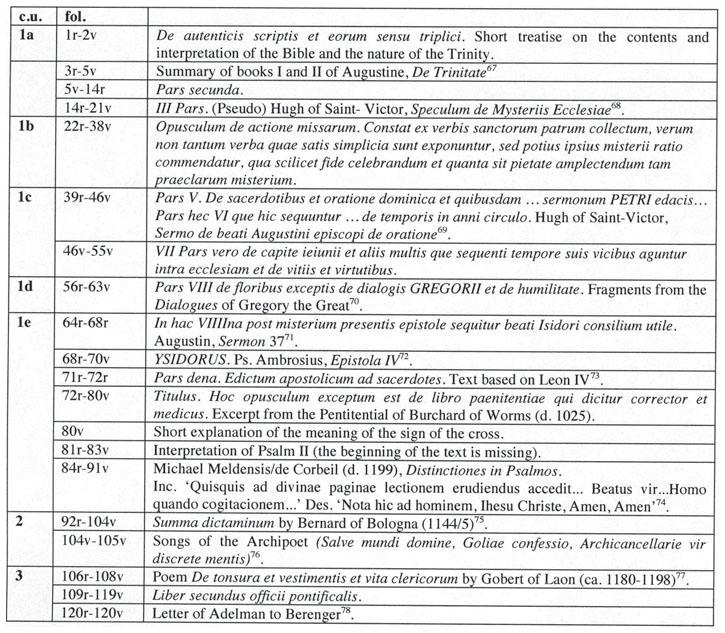
-
[5]
As has been remarked by A. Vauchez, « The Religious Orders », in The New Cambridge Medieval History, vol. V (c. 1198 – c. 1300), D. Abulafia ed., Cambridge, Cambridge University Press, 2008, p. 221-222 ; also see J. van Engen, « The ‘Crisis of Cenobitism’ Reconsidered : Benedictine Monasticism in the Years 1050-1150 », Speculum, 61-2, 1986, p. 269-304.
-
[6]
E. Jordan, « Shared Rule, Separate Practice ? Assessing Benedictine Economic Activities in Flanders During the Thirteenth Century », Revue bénédictine, 115-1, 2005, p. 187-204 « demonstrates the clear absence of a uniform ‘Benedictine’ response to the various economic shifts which impacted the thirteenth century » in Flanders (p. 189).
-
[7]
The one exception is num. 117, Helpricus cum arithmetica et somnio Scipionis et Macrobio (A. Derolez, B. Victor and L. Reynhout, Corpus catalogorum Belgii 2 (see n. 3), p. 173).
-
[8]
Trans. D. J. Defries, Constructing the Past in Eleventh-Century Flanders : Hagiography at Saint-Winnoc, Unpublished dissertation Ohio State University, Ohio, 2004, p. 214.
-
[9]
Florence, Biblioteca Medicea Laurenziana, Ashburnham 1899 (second half of the ninth century) and Brussels, KBR, 20791 (tenth century).
-
[10]
The three codices are Vatican City, BAV, Reg. Lat. 615 (last quarter of the tenth century) ; Brussels, KBR, II 1180 (ca. 1049-1080 : Vita sancti Remacli nova) ; Chantilly, MC, 740 (1071-1105 : Liber miraculorum eius cum vita abbatis Popponis). It should be noted that Bamberg, Staatsbibliothek, E.III.1 is a Stavelot manuscript from the first half of the tenth century and devoted to Remaclus, but it was probably no longer in Stavelot-Malmedy by 1105 (see F. Leitschuh and H. Fischer, Katalog der Handschriften der Königlichen Bibliothek zu Bamberg, Bamberg, Staatsbibliothek, 1887-1912 (repr. 1966), p. 269).
-
[11]
S. Vanderputten and T. Snijders, « Echoes of Benedictine Reform in an Eleventh-Century Booklist from Marchiennes », Scriptorium, 63-1, 2009, p. 79-88.
-
[12]
Th. Gottlieb, Über mittelalterliche Bibliotheken, Leipzig, Harrassowitz, 1890, p. 284-290. As a general strategy of classification, an average was taken of manuscripts of which the dating was uncertain (for example, a thirteenth- to fourteenth-century manuscript was placed half in the thirteenth century and half in the fourteenth ; a thirteenth- to fifteenth-century manuscript was placed in the fourteenth).
-
[13]
A. Derolez, B. Victor and J.-W. Klein, Corpus catalogorum Belgii : The Medieval Booklists of the Southern Low Countries. 4 : Provinces of Brabant and Hainault, Brussels, Paleis der Academiën, 2001, p. 251-284.
-
[14]
Compiled from A. Derolez, B. Victor and W. Bracke, Corpus catalogorum Belgii : The Medieval Booklists of the Southern Low Countries. 7 : The Surviving Manuscripts and Incunables from Medieval Belgian Libraries, Brussels, Paleis der Academiën, p. 251.
-
[15]
See F. Baix, « L’hagiographie à Stavelot-Malmédy », Revue bénédictine, 40, 1950, p. 144.
-
[16]
Bamberg, Staatsbibliothek, Misc. Hist 161 (E.III.1) (early tenth century, with additions up to the early eleventh century) ; Vatican City, BAV, Reg. Lat. 615 (shortly after 972/980) ; Brussels, KBR, II 1180 (ca. 1048-1071).
-
[17]
S. Balau, Étude critique des sources de l’histoire du pays de Liège au Moyen Âge, Brussels, Hayez, 1902-1903, p. 226 ; F. Baix, « L’hagiographie » (see n. 15), p. 147-162.
-
[18]
S. Balau, Étude critique (see n. 17), p. 219.
-
[19]
Only Berlin, SPK, Theol. Lat. Quart. 201 contains the lives and passions of Peter and Paul, Nicasius, Quirinus and Justus. The luxurious codex was created around the second quart of the twelfth century, most likely under the abbacy of Cuono (1124-1128), the community’s first abbot from Malmedy.
-
[20]
The preserved manuscripts that can be dated to the first half of the twelfth century are Vatican City, BAV, Vat. Lat. 08557-58 (Bible) and 08567 (Haimo), Brussels, KBR, 2034-35 (Sacramentary), 4335-36 (Lectionary), 19600 (Gregory the Great, Regula pastoralis), 19623-26 (De viris illustribus), II 1181 (Passionary). Created before Wibald’s time were Manchester, John Rylands Library, Lat. 93 (1117-1130, Hieronymus : In XII prophetas minores), Chantilly, MC, 739 (1100-1125, Lives of Audoenus and Eligius) and Berlin, SPK, Theol. Lat. Quart. 201 (see note 20).
-
[21]
A. Derolez, B. Victor and L. Reynhout, Corpus catalogorum Belgii 2 (see n. 3), p. 174-175.
-
[22]
Liber vitae patrum opere Georgi Florenti Gregori Toronici, in MGH, SSRM, vol. I, W. Arndt and B. Krusch ed., Hannover, 1885, p. 212. See for example the treatment of Remaclus in Brussels, KBR, II 1181.
-
[23]
M.-R. Lapière, La lettre ornée dans les manuscrits mosans d’origine bénédictine (xie-xiie siècles), Paris, Les Belles Lettres, 1981 (Bibliothèque de la Faculté de philosophie et lettres de l’Université de Liège, 229), p. 247.
-
[24]
Wibald died on July 19, 1158. His brother Erlebald is first named abbot of Stavelot-Malmedy in charters from 1159 (J. Halkin and C.-G. Roland ed., Recueil des chartes de l’abbaye de Stavelot-Malmedy, vol. I, Brussels, Librairie Kiessling et Cie, P. Imbreghts successeur, 1909, p. 477).
-
[25]
For similar burial strategies, see A.-J. Bijsterveld, « Royal Burial Places in Western Europe : Creating Tradition, Succession and Memoria », in Living Memoria. Studies in Medieval and Early Modern Memorial Culture in Honour of Truus van Bueren, R. D. Weijert e.a. ed., Hilversum, Verloren, 2011, p. 25-44.
-
[26]
Ph. Jaffé, Monumenta Corbeiensia, 1, Berlin, Apud Weidmannos, 1864, p. 607-608 (ante altare beati Petri et Remacli) ; Ph. George, « Les reliques de Stavelot et de Malmedy à l’honneur vers 1040 : Dedicatio et Inventio Stabulensis », Revue d’histoire ecclésiastique, 99, 2004, p. 358, n. 56 (retroque altare praescriptorum apostolorum in sublime).
-
[27]
See A.-J. Bijsterveld, Do ut des. Gift Giving, Memoria, and Conflict Management in the Medieval Low Countries, Hilversum, Verloren, 2007, esp. p. 214.
-
[28]
See S. Vanderputten, « Death as a Symbolic Arena : Abbatial Leadership, Episcopal Authority and the ‘Ostentatious Death’ of Richard of Saint-Vanne (d. 1046) », Viator, 44, 2013, 29-48.
-
[29]
Vita Popponis abbatis Stabulensis auctore Everhelmo, in MGH, SS, vol. 11, p. 315. See Ph. George, « Un moine est mort : sa vie commence. Anno 1048 obiit Poppo abbas Stabulensis », Le Moyen Âge, 108, 2002, p. 504-505.
-
[30]
This is probably the Liber miraculorum eius [scil. S. Remaclus] cum vita abbatis Popponis in the 1105 booklist (see n. 10).
-
[31]
For the importance of lineage and succession see A.-J. Bijsterveld, Do ut Des (see n. 27), p. 200 ; G. Althoff, Verwandte, Freunde und Getreue : Zum politischen Stellenwert der Gruppenbindungen im früheren Mittelalter, Darmstadt, Wissenschaftliche Buchgesellschaft, 1990, p. 55-76.
-
[32]
J. Halkin and C.-G. Roland ed., Recueil des chartes de Stavelot-Malmedy (see n. 24), p. 479.
-
[33]
E. F. Arnold, Environment and the Shaping of Monastic Identity. Stavelot-Malmedy and the Medieval Ardennes, Unpublished dissertation University of Minnesota, 2006, p. 121-122 (now published under the title Negotiating the landscape. Environment and monastic identity in the Medieval Ardennes, Philadelphia, University of Pennsylvania Press, 2012).
-
[34]
Wibald was born in 1098 and died in 1158, whereas his brother Erlebald died only in 1193. When he staged an elevation of relics in 1185 (cf. infra), he must have been well into his seventies or even eighties.
-
[35]
For a short description of the codices that are discussed in this article, see the appendix.
-
[36]
Wibald died on July 19, 1158. His brother Erlebald’s abbacy is traditionally situated from 1158 to 1192, as the 15th century Stavelot Obituary mentions his abdication in 1192 and his death in 1193 (see U. Berlière, « Abbaye de Stavelot-Malmédy », in Monasticon Belge, vol. 2, U. Berlière ed., Maredsous, Abbaye de Maredsous, 1928, p. 67 and 86). However, a list of abbots drawn up under the abbacy of Nicholas (1246-1248) on the flyleaf of Liège, AE, Principauté de Stavelot 841, states that Erlebald’s abbacy only lasted for 32 years, and that of his successor Gerard of Vianden († April 19, 1210 according to J. Halkin and C.-G. Roland ed., Recueil des chartes de Stavelot-Malmédy (see n. 24), p. XL) for 19 years. Erlebald is first named the abbot of Stavelot-Malmedy in 1159 (see n. 25), which means he must have abdicated in 1191 instead of 1192. Gerard then reigned from 1191 until his death in 1210.
-
[37]
Acta Sanctorum Jan. II, p. 638 ; also Acta Sanctorum Oct. VIII, p. 333-334.
-
[38]
F. Baix, « L’hagiographie » (see n. 15), p. 146-147.
-
[39]
Ph. George, « Erlebald († 1193), gardien des reliques de Stavelot-Malmedy », Le Moyen Âge, 90-3-4, 1984, p. 380-382.
-
[40]
Berlin, SPK, Theol. Lat. Quart. 201 fol. 102v : He sunt reliquie. in scrinio novo rogationum.
-
[41]
Ph. George, « Erlebald » (see n. 39), p. 378-380.
-
[42]
F.-A. Villers ed., Histoire chronologique des abbés-princes de Stavelot et Malmedy, vol. I, Liège, L. Grandmont-Donders, 1878, p. 146-147.
-
[43]
F.-A. Villers ed., Histoire chronologique (see n. 42), p. 151-152.
-
[44]
Ibid., p. 157.
-
[45]
G. Schuind, Stavelot-Malmedy. Une principauté ecclésiastique de l’Ancien Régime, Stavelot, Havelange-Gillard, 1914, p. 81-82.
-
[46]
It should be noted that Brussels, KBR, 4335-36 dates from the first half of the twelfth century. It resembles Vatican City, BAV, Vat. Lat. 8557-8558, Berlin, SPK, Theol. Lat. Quart. 201 and Brussels, KBR, 104-105 (which was produced in 1139). See A. Fingernagel, Die illuminierten lateinischen Handschriften süd-, west- und nordeuropäischer Provenienz der Staatsbibliothek zu Berlin - Preussischer Kulturbesitz, 4.-12. Jahrhundert, Wiesbaden, Harrassowitz, 1999, p. 83.
-
[47]
A. Derolez, B. Victor and L. Reynhout, Corpus catalogorum Belgii 2 (see n. 3), p. 170, nr. 13.
-
[48]
A. J. Duggan, « A Becket Office at Stavelot : London, British Library, Additional MS 16964 », in Omnia disce - Medieval Studies in Memory of Leonard Boyle, O.P., A. J. Duggan, J. Graetrex and B. Bolton ed., Aldershot, Ashgate, 2005, p. 162.
-
[49]
See the appendix ; A. J. Duggan, « A Becket Office » (see n. 48), p. 163 and 175. For depictions of Thomas Becket and their purposes see J. Barrau, Bible, lettres et politique. L’Écriture au service des hommes à l’époque de Thomas Becket, Paris, Classiques Garnier, 2013, esp. p. 263-275.
-
[50]
A. J. Duggan, « A Becket Office » (see n. 48), p. 177-179.
-
[51]
For Thomas Becket see J. Barrau, Bible, lettres et politique (see n. 49).
-
[52]
M. Coens, Recueil d’études bollandiennes, Brussels, Société des Bollandistes, 1963, p. 225-240.
-
[53]
London, BL, 18031 fol. 1r-8v. The importance of these saints is highlighted with a different ink color.
-
[54]
A. J. Duggan, « A Becket Office » (see n. 48), p. 181.
-
[55]
For De Sully’s sermons see N. Bériou, L’avènement des maîtres de la Parole. La prédication à Paris au xiiie siècle, Paris, Institut d’Études Augustiniennes, 1998, p. 21-30.
-
[56]
S. Chase, Angelic spirituality. Medieval perspectives on the ways of Angels, New York, Paulist Press, 2002, p. 121-122.
-
[57]
Cf. the manuscript catalogue of the British Library (http://www.bl.uk/catalogues/manuscripts).
-
[58]
In the eighteenth century, several monasteries from the Low Countries possessed relics of St Thomas, but nothing definite is known about relics in Stavelot-Malmedy. See M. Huglo, « Les reliques de Thomas Becket à Royaumont », Revue bénédictine, 115-1, 2005, p. 437.
-
[59]
M. Manitius, Die Gedichte des Archipoeta, München, Georg D. W. Callwey, 1929, p. 23-28.
-
[60]
Trans. by E. H. Zeydel ed., Vagabond Verse. Secular Latin Poems of the Middle Ages, Detroit, Wayne State University Press, 1966, p. 61-61.
-
[61]
M. Manitius, Die Gedichte (see n. 59), p. 9-12.
-
[62]
A. Derolez, B. Victor and L. Reynhout, Corpus catalogorum Belgii 2 (see n. 3), p. 171-172.
-
[63]
For attitudes towards reform and innovation in the twelfth century see G. Constable, « Renewal and Reform in Religious Life : Concepts and Realities », in Renaissance and Renewal in the Twelfth Century, R. L. Benson, G. Constable and C. D. Lanham ed., Toronto, Buffalo and London, University of Toronto, 1991, p. 37-67.
-
[64]
There are multiple examples of action taken against libraries as a part of an ideological struggle, both in the Middle Ages (such as the sack of the library of Córdoba by Ferdinand III in 1236) and in the nineteenth and twentieth centuries (for example in the decades that followed 1933) (J. Raven, « Introduction : The Resonances of Loss », in Lost Libraries. The Destruction of Great Book Collections since Antiquity, J. Raven ed., Hampshire and New York, Palgrave Macmillan, 2004, p. 11 and 23 ff.). There are also examples of texts being destroyed by a monastic official because they were not deemed suitable for the monastic community, for example in mid-twelfth century St.-Laurent (Th. Haye, « Die verlorene Bibliothek des Reiner von Lüttich : Produktion und Überlieferung lateinischer Literatur des hohen Mittelalters in der Perspektive monastischer Individualisierungstendenzen », Historisches Jahrbuch, 125, 2005, p. 39-65, esp. p. 45). However, this is one of very few examples of « censored » monastic texts from the studied region, so that the phenomenon may not have been widespread.
-
[65]
See T. Snijders, Manuscript Communication. Visual and textual mechanics of communication in hagiographies from the Southern Low Countries, 900-1200, Turnhout, Brepols, forthcoming.
-
[66]
E. Jordan, « Shared Rule, Separate Practice ? » (see n. 6), p. 197-200.
-
[67]
PL, 42, col. 819-853 ; Corpus Christianorum, Series Latina, 90.
-
[68]
PL, 177, col. 335.
-
[69]
PL, 176, col. 977-986 (De modo orandi).
-
[70]
PL, 77, col. 317-329, 357, 365-368, 373-376, 380-381, 400-408 and 300-301 ; PL, 66, col. 188 and 194 ; PL, 77, col. 281-284 (in order of appearance).
-
[71]
PL, 38, col. 222-235.
-
[72]
PL, 17, col. 749-752 ; Clavis Patristica Pseudoepigraphorum Medii Aevi, vol. 2, p. 286.
-
[73]
PL, 115, p. 675, 684.
-
[74]
See Bonaventura, Opera omnia, Ad Claras Aquas [Quarrachi] prope Florentiam, Ex Typographia Collegii S. Bonaventura, 1882-1902, vol. VI, p. III. There is a link from Michel de Corbeil to the scholastic milieu of Laon through the figure of Adam of Courlandon, see C. Giraud, « Le rayonnement scolaire de Laon au xiie siècle, de maître Anselme à Adam de Courlandon », Bulletin de la Société historique de Haute-Picardie, 19, 2013, special issue : Laon, grand foyer culturel européen au Moyen Âge, p. 129-144. Thanks to the anonymous reviewer of Revue du Nord for this reference.
-
[75]
See A.-M. Turcan-Verkerk, « Le liber artis omnigenum dictaminum de maître Bernard (vers 1145) : états successifs et problèmes d’attribution », Revue d’histoire des textes, 5, 2010, p. 99-158 and ibid., 6, 2011, p. 261-328.
-
[76]
M. Manitius, Die Gedichte (see n. 59), p. 9-12.
-
[77]
Gobertus Laudunensis, De tonsura et vestimentis et vita clericorum, ed M. Helin, Le Musée Belge, 34, 1930, p. 135-160.
-
[78]
PL, 143, col. 1289-1296.
-
[79]
Gregory the Great, Dialogues, A. De Vogüé ed. and P. Antin trans., 3 vol. (Sources chrétiennes, 251, 260, 265), Paris, Cerf, 1973-1980.
-
[80]
Ephraemi Syri opera omnia, vol. 3, J. S. Assemani ed., Rome, 1746, p. 579-581 and 606-607.
-
[81]
Th. F. Glick, S. J. Livesey and F. Wallis ed., Medieval Science, Technology, and Medicine. An Encyclopedia, New York, Routledge, 2005, p. 293.
-
[82]
MGH, SS Rer. Germ., vol. 17, p. 27.
-
[83]
MGH, Libelli de lite imperatorum et pontificum, vol. 2, p. 449-464.
-
[84]
A. J. Duggan, « A Becket Office » (see n. 48), p. 162.
-
[85]
Gli uomini illustri. De viris illustribus, A. Ceresa-Gastaldo ed., Florence, Nardini, 1988.
-
[86]
Epistola Bern Abbatis, in Veterum scriptorum et monumentorum historicorum, dogmaticorum ad res ecclesiasticas monasticas et politicas illustrandas collectio, vol. 1, E. Martene and U. Durand ed., Rouen, 1700, p. 390.
-
[87]
A. J. Duggan, « A Becket Office » (see n. 48), p. 161-182.
-
[88]
PL, 49, col. 53-475.
-
[89]
PL, 49, col. 477-1328.
-
[90]
M. Coens, Recueil d’études (see n. 52), p. 239.
-
[91]
For a more detailed description of this manuscript, see F. Bougard, P. Petitmengin and P. Stirnemann, La bibliothèque de l’abbaye cistercienne de Vauluisant. Histoire et inventaires, Paris, CNRS-IRHT, 2012, p. 179-183.
-
[92]
Ibid., p. 183.
-
[93]
Ibid.
1The libraries of Benedictine abbeys are one of the key sources for the intellectual history of eleventh- and twelfth-century Western Europe [1]. Not only did their owners enjoy a virtual monopoly on the written word that made them the prime commentators on the developments of their age, they also undertook to preserve and classify their knowledge. The resulting libraries could range from a small stack of manuscripts to collections of volumes that ran in the hundreds, both reflecting and shaping the economic, social, political and religious environment that confronted their creators and administrators [2]. As the years unfolded, books were added to the library or given away, moved to other locations, rewritten, rebound, stolen or destroyed. As such, the composition and development of a monastic library constitutes a material commentary that can equal the power of expression of the manuscript texts themselves.
2The development of a monastic library can be studied through its booklists and catalogues, in combination with sporadic references to manuscripts in extant chronicles, letters and charters. Most attention is usually paid to the catalogues that claim to list all manuscripts of a certain community. A good example of such a claim comes from the early thirteenth-century catalogue from the abbey of Saint-Laurent in the diocese of Liège, which lists « the names of the books of Saint-Laurent in the suburbs of Liège ». A second example is the catalogue from the double monastery of Stavelot-Malmedy (also called St Remaclus after its patron saint) in the dioceses of Liège and Cologne. This catalogue states that « by means of a careful examination of the library of St Remaclus, the following books were found and have been recorded here, in the year of the incarnation of Our Lord 1105 » [3]. From the last quarter of the twelfth century onwards, may abbeys stopped producing library catalogues, which makes the development of Benedictine libraries increasingly difficult to study. From the bishopric of Liège, for example, only the early thirteenth-century catalogue from Saint-Laurent has been preserved, next to a short list of schoolbooks from an unknown institution [4].
3This relative dearth of booklists is one reason that the thirteenth-century Benedictines in that bishopric have so far remained understudied. A second reason is the assumption that thirteenth-century Benedictines were going through a severe institutional crisis that shifted the intellectual initiative to the Mendicant Orders and the secular clergy [5]. Even though the general validity of this hypothesis has been recently challenged, the crisis of Benedictine cenobitism is usually seen as the reason for the perceived drop in Benedictine manuscript production during the thirteenth century [6].
4However, it is inherently problematic to directly equate the information from library catalogues with book production and -possession in Benedictine institutions. In spite of the reassuring titles that suggest « careful examinations » and exhaustive cataloguing efforts, it is unusual for high medieval library catalogues to actually present a comprehensive list of all the books that a community possessed. In Stavelot-Malmedy, for instance, not a single work by a classical author is mentioned in the 1105 catalogue, although its monks studied the classics intensively [7]. This is powerfully illustrated by the feverish nightmare of a mid-eleventh-century novice who was being educated in Stavelot, who cried out on his sickbed that « a phalanx of demons imitated the faces of Aeneas and Turnus and other men from Virgil, and that his spirit was assailed by them, who were intimately familiar to him in his education » [8]. Indeed, some high medieval manuscripts with classical texts have come down to us from Stavelot. Among them are a ninth-century copy of Valerius Maximus’ Facta et dicta memorabilia, as well as a tenth-century fragment of Virgil’s Aeneid [9]. Apart from these classical works, other books are missing from the Stavelot catalogue. The community possessed at least three manuscripts in which their patron Saint Remaclus took center stage, but the booklist only mentions the two latest acquisitions : the Vita sancti Remacli nova (a title that in itself implies the existence of an unnamed older Vita) and the Liber miraculorum eius cum vita abbatis Popponis [10]. As such, the catalogue that claims to be exhaustive in fact presents its audience with a carefully constructed selection of Stavelot-Malmedy’s actual possessions. Other communities took this practice even further and deliberately emphasized that they possessed multiple copies of books that fitted their ideological identity, while forbearing to mention books that detracted from this ideal [11].
5As a consequence, such booklists must be interpreted as attempts to inscribe the monastic institution into a distinct ideological framework, rather than as administrative tools. Their unsuitability to serve administrative purposes is further elucidated by their material characteristics. First of all, booklists were typically included in prestigious manuscripts, the unblemished pages of which make clear that they could not be freely consulted. For instance, the 1105 catalogue from Stavelot-Malmedy can be found in a fairly large Bible that was luxuriously executed by Stavelot’s top scribes and illuminators – a prestigious manuscript intended for ceremonious use. Secondly, the preserved catalogues tend to be laid out in such a way that there was no room to insert additional acquisitions to the library. As a result, these catalogues present us with a « snapshot » of a community’s book collection – a picture that was taken in soft light and through a colored filter. It could be meant to dazzle a specific audience with the sheer number of a community’s possessions, with its spiritual excellence, with its solid grounding in a specific school of thought, or perhaps with the breadth of its intellectual pursuits. Whatever its exact purpose(s) may have been, the catalogues did not try to make an enumeration of books for purely administrative purposes. So when monks largely stopped producing them in the thirteenth century, it meant only that they no longer saw the value of inserting an ideologically charged snapshot of their library into a prestigious manuscript, not that they stopped producing manuscripts or stopped cataloguing them in (perhaps less durable) ways.
6An analysis of the libraries and intellectual life of thirteenth-century Benedictines therefore has to rely to a large extent on the testimony of preserved manuscripts. The obvious problem here is the discrepancy between the number of preserved codices and the estimated total contents of a library. For example, some 50 extant manuscripts that are known to have been in the possession of Stavelot-Malmedy were produced between the eight and the eleventh century. Yet the 1105 catalogue lists about 283 manuscripts, which means that roughly one sixth of Stavelot’s documented manuscripts in the early twelfth century has been preserved (graph 1) [12]. These numbers are not unusual compared to other Benedictine monasteries from the bishopric of Liège. The ratio of preserved manuscripts to catalogued manuscripts in early thirteenth-century Saint-Laurent is approximately 1/2, but that number declines to around 1/22 for the library in Lobbes, a monastery that was burned down more than once [13].
Preserved Benedictine manuscripts from the prince-bishopric of Liège [14]

Preserved Benedictine manuscripts from the prince-bishopric of Liège [14]
7A closer look at graph 1 reveals that the thirteenth century is curious in more than one respect. Not only are few library catalogues preserved, there is a sharp drop in the number of preserved manuscripts as well. This indicates an extremely important, multi-faceted shift in Benedictine library management. On the one hand, using booklists had outlived its usefulness for these communities. At the same time, the drastic reduction in the number of preserved manuscripts might indicate one of two things. First, a relatively large number of thirteenth-century manuscripts may have been destroyed or otherwise become lost. If so, there must have been something about these codices that made them less likely to survive – they might have been carelessly produced, or their contents may have been quick to become outdated, contested, or otherwise thought unsuitable for later audiences. Alternatively, thirteenth-century Benedictine monks may actually have produced fewer codices than before, because they were unable to produce or buy them on the same scale as before, because they did not require any new books, or because they had lost some of their interest in books. Of course, a combination of a reduced production with higher loss rates is equally possible, and perhaps the most likely.
8This article will investigate this complex issue of thirteenth-century book production in Benedictine houses through the case-study of Stavelot-Malmedy during the long thirteenth century, beginning with the abbacy of Erlebald in 1158 and ending with the death of abbot Gilles of Falkenstein in 1307. Stavelot-Malmedy is an example of a monastery that possessed a well-stocked library during the twelfth century, ostensibly lacks a thirteenth- or fourteenth-century catalogue and seemingly experienced a sharp drop in book production during the thirteenth century : no more than seven codices have been preserved from the 149 years under consideration. As such, the evolution of Stavelot-Malmedy’s library seems fairly typical. This contribution will examine the contents of the extant thirteenth-century manuscripts as well as their relation to the monastic library as it was represented in the 1105 booklist. Its goal is to try and investigate the trends in library management in thirteenth-century Stavelot and relate them to the intellectual and spiritual priorities of this monastic community.
Contextualizing the manuscripts
9Manuscript production in Stavelot-Malmedy was strongly interconnected with the community’s broader social-political context. As was typical for most Benedictine communities, Stavelot-Malmedy used manuscripts as a tool to try and resolve the conflicts that faced the community, especially in cases where the intercession of patron Saint Remaclus could be beneficial. Multiple codices were produced that proudly narrated his deeds and miracles in the face of intractable enemies. Yet Stavelot-Malmedy was atypical in that its most dangerous enemy appeared to be hiding within its own ranks.
10In 938, the monasteries of Stavelot and Malmedy were merged into a double monastery under a single abbot [15]. This was not to the liking of the monks of Malmedy, who kept trying to tear themselves away from Stavelot and re-establish themselves as an independent monastic community in its own right. This recurrent motif in the history of Stavelot-Malmedy had a profound influence on its hagiographical production. Between 938 and 1071, three luxurious manuscripts tried to position Saint Remaclus as the one element that united the two houses [16]. They emphasized that Remaclus had founded both monasteries and that he was their shared patron saint, using hagiography as a connector between Stavelot and Malmedy. Yet the efforts were to no avail, as the monks from Malmedy proudly proclaimed their independence from Stavelot in 1065. Since they could no longer count on the protection of Remaclus, the Malmedy monks started to re-imagine the legends of two other saints they adopted as their patrons : Quirinus and Justus [17]. Hagiography had now become a tool to divide the houses, but it was once again unsuccessful, for six years after Malmedy and Stavelot went their separate ways the Stavelot monks managed to convince emperor Henry IV to undo the separation. They ascribed their victory to St Remaclus and immediately wrote a report of his triumph. They added this report to one of the older Remaclus manuscripts, produced a separate manuscript that revolved around the events of 1071, sent a copy to the monastery of Fosses, and possibly to other institutions as well [18]. In this way, a triumphant Stavelot-hagiography came into existence of which multiple copies have been preserved. It differed sharply from Malmedy’s hagiographical attempts, which had failed in their objectives and have only been preserved sporadically [19]. By the end of the eleventh century, hagiography could no longer function to unite the two abbeys.
11In the decades that followed the re-attachment of Malmedy to Stavelot, a period of relative peace and prosperity started to unfold, especially under abbot Wibald (1130-1158). He consciously played down the role of the patron saints within the community. No new codices with the lives of Remaclus, Quirinus, Justus, or similar saints seem to have been produced, as they could only serve to inflame lingering resentments. Instead, the community shifted its attention to the visual arts and less combustible genres. Under Wibald, the double monastery acquired Bibles, works by Hieronymus, Gregory the Great and Haimo [20], and the abbot himself was primarily known for his fascination with Marcus Tullius Cicero [21]. The few hagiographical manuscripts that were produced between 1071 and 1158 consciously de-emphasized the saints’ potential to promote hierarchical thinking and power struggles. Instead, the saints were presented as almost interchangeable parts of the saintly community, who all represented the same saintly essence in a different guise and thus promoted the peace of equality rather than the constant struggle of hierarchy [22].
12Several scholars have remarked on the relative indistinctiveness of the manuscripts that were created in twelfth-century Stavelot. It is very hard to point to elements that are particular for Stavelot at this moment in time. The patron saints largely disappear from the codices, and the style of the initials and miniatures is so divergent that art historians have been unable to place them within the context of a coherent scriptorium. It has therefore been proposed that most of Stavelot’s books may have been bought rather than produced, and perhaps even stemmed from secular workshops [23]. I would argue that it seems hardly coincidental that the manuscripts that were produced or bought under Wibald stand out with inconspicuousness. After more than a century of using patron saints as weapons in the power struggle between Stavelot and Malmedy, Wibald obviously preferred all-purpose manuscripts without local catches, and filled his library with interesting yet innocuous genres and layouts. As a result, it is virtually impossible to pinpoint a distinct « Stavelot style » under abbot Wibald, and the existence of a « Malmedy style » is even less of a certainty.
Manuscript production during the long thirteenth century
13When Wibald died in 1158 on his way back from Constantinople, his younger brother Erlebald took over the reins of Stavelot-Malmedy. Although he seems to have been a good abbot, he was not quite in his brother’s league. He first appears as abbot in 1159, the year he repatriated Wibald’s body to have it buried properly [24].
14This burial provides us with an interesting view of Erlebald’s power strategy as abbot of Stavelot-Malmedy [25]. First of all, he chose to lay his brother to rest in front of the High Altar, next to Saint Remaclus [26]. This was a powerful statement from a political and spiritual as well as from a hagiographical point of view. The ceremony lasted for two days and involved the bishop of Liège as well as multiple abbots and a large crowd of clerics and interested laymen. The place near the Altar guaranteed that Wibald’s earthly remains were present during the daily miracle of the Mass, during which the monks of Stavelot were visually reminded of Wibald’s greatness, thus ensuring his everlasting commemoration [27]. Last but not least, Wibald’s burial was an essentially hagiographical performance, as it visually associated him with Saint Remaclus. In fact, this burial was not the first time that an abbot of Stavelot attempted to link one of his recently deceased predecessors to the community’s patron saint. The Stavelot monks had been trying for over a century to associate the famous reform abbot Poppo I (987-1048) with Remaclus, an attempt that had succeeded quite well. The connection was first suggested by Poppo himself, who foresaw he would be venerated as a saint after his death and planned his funeral accordingly [28]. One of his decisions was to be buried in the crypt that he had built himself, following the example of Remaclus, who had been buried in the oratory he had been constructing. His biographers had taken it upon themselves to play on the likenesses between Remaclus and Poppo, exclaiming how lucky Stavelot was to have both as protectors and explaining that the two abbatial saints worked together as a team [29]. This link between Saints Remaclus and Poppo became so firmly entrenched in the collective consciousness of Stavelot’s monks, that they not only considered Poppo as Stavelot’s « second founder », but also produced two manuscripts that were dedicated to the abbeys two founders. The first of these was created between 1071 and 1105, and contained the ‘Triumph’ of Remaclus (BHL 7141) with the life of Abbot Poppo (BHL 6898) [30]. So when a few decades later Erlebald buried his brother Wibald next to Remaclus, he was associating him with this long-standing ideal of abbatial sainthood.
15Of course, these proceedings were not entirely disinterested on Erlebalds part. In adulating his brother he was not just placing one individual on a pedestal. The centrality of the lineage in high medieval thought meant that to exalt Wibald was to exalt his entire family – and most particularly Erlebald, the carnal brother who was also Wibald’s spiritual successor [31]. This was a particularly effective way of legitimizing his own position as abbot. It shows that Erlebald had adopted a calculating approach to the use of Stavelot-Malmedy’s local saints. This is made even more clear by his foundation of a hermitage in the village of My, in the same year he buried Wibald. In the charter that confirmed the establishment, the saints play only a subsidiary role. The authority invoked to defend the hermitage, for example, is that of the advocate rather than of Saint Remaclus [32]. In sharp contrast to the hagiographical aplomb that surrounded Wibald’s burial, Erlebald here treats Remaclus with a disregard that borders on disdain. Scholars have construed this charter as a turning point in the monastery’s history, reflecting changes in archival and scribal practices as well as an apparent end of the age of saintly power [33]. Yet there are other charters from Erlebald’s reign that do invoke the saints, and the role of hagiography was not yet fully played out, as we will see. Instead, I would argue that the contrast between the saintly burial and the secular foundation illustrates the extent to which the use of Stavelot-Malmedy’s patron saints had ceased to be a matter of course. Over the centuries, their biographies had become connected to memories of past struggles, which turned them into the hagiographical equivalent of an armed grenade. They were to be used sparingly, and very cautiously.
16It therefore deserves close attention that Erlebald in his old age seems to have tried to reinforce the links between Saint Remaclus, Abbot Poppo, and his own family even further [34]. First of all, the Stavelot monks procured a new copy of the manuscript that combined the « Triumph » of Remaclus (BHL 7141) with the life of Abbot Poppo (BHL 6898). This manuscript, preserved as Liège, AE, Principauté de Stavelot 841 [35], is written in a hand that can be dated to the late twelfth or early thirteenth century, which points to the later years of Erlebald (1158/9 – 1191/2), reviving the ideal of saintly abbots in Stavelot during a time in which his own death was drawing near ; or else to the abbacy of Gerard of Vianden (1191-1210) [36].
17Erlebald also staged an elevation of Malmedy relics. Interestingly, its circumstances echo an elevation of Malmedy’s saints that was staged by Poppo in 1042 ; only three months after the tomb of Remaclus had been rediscovered. According to the Bollandists, Poppo had organized the elevation because the people in their ignorance had started to murmur, both privately and publicly, about the relics that were kept in Malmedy. Some of them had even affirmed that Malmedy did not own the authentic relics of Quirinus and Iustus [37]. After a consultation with the monks and lay brothers of the monastery, Poppo had decided to organize a solemn elevation of whatever relics the Malmedy shrine should prove to contain. It turned out to be not just the hoped-for relics of Quirinus and Iustus, but also two teeth of Saint Peter and the casula of Saint Ouen – which conveniently counterbalanced the two teeth of Saint Peter and casula of Saint Remaclus that were in Stavelot’s possession – as well as the relics of other, unknown saints [38]. Through the elevation, Poppo restored Malmedy’s credibility as a cult site, be it of lesser importance than Stavelot itself and thereby redefined the delicate hagiographical balance between the two abbeys. In 1185 a problem similar to that facing Poppo seems to have suddenly reared its head. The local populace apparently asked Erlebald to investigate the relics that were kept in Lisieux, a dependency of Malmedy. Like Poppo, Erlebald responded with an elevation of the church relics and a detailed inventory [39]. The abbot also elevated the relics of Malmedy, probably around the third quarter of the twelfth century. Once again this was done with the express intent of boosting Malmedy’s position as a cult site : Erelebald had a portable new shrine made, in which the relics of the saints could be carried around to bless the crops during the rogation days [40]. This enterprise explicitly targeted the local farmers and landowners, as it tied their livelihood to the power of Malmedy’s saints to care and protect. Erlebald’s attempts to boost Malmedy’s standing as a cult site were continued by his successor Gerard, who in 1207 elevated the relics of Quirinus and Nicasius, ordered them to be displayed publicly during feast days, and had a new shrine made [41].
18In short, the hagiographical production in Stavelot-Malmedy between 1130 and 1207 was characterized by a disinclination to use the monastery’s patron saints (and especially Remaclus) in such a way that it could acerbate the lingering tensions between the houses. This policy was relaxed somewhat under Erlebald, who wished to promote the ideal of saintly abbacy through the burial of his brother, link himself to Poppo and Remaclus, and may have counteracted this through increased attention for Malmedy’s status as a cult site in his later years. Yet he did not want to exalt the patron saints in and for themselves, as can be shown both from the 1159 foundation. Neither did he continue the old tradition of creating luxurious codices with the lives and passions of Stavelot-Malmedy’s patron saints.
19After 1207, the internal tensions between Stavelot and Malmedy became less significant because of a rapid succession of seemingly disappointing abbots and external enemies that required the community’s full attention. Abbot Adelardus (1210-1222) was unpopular enough that the monks of Stavelot-Malmedy filed a complaint against him with the pope, who officially reprimanded the abbot in 1219 for having alienated the abbey’s possessions [42]. He must also have been a lax disciplinarian, because his successor Frederic of Stone (‘de Petra’, 1222-1245) had only held the abbacy for eight months when the abbot of Saint-Trond was called in to help restore the discipline. Not much later, Frederic got embroiled in a heated conflict with Countess Ermesinde, which led to frequent pillaging missions, the burning of 156 houses, and interventions of the pope as well as from the Imperial princes on behalf of the monastery. Abbot Nicholas (1246 ?-1248) seems to have been deposed [43], and his successor Henry of Guelders (1248-1274) was attacked by his brothers in an attempt to force him to appoint them to the abbey’s advocacy. Henry, who was also functioning as bishop of Liège, was deposed from both offices in 1274. John of Engien (1274-1281) also combined his abbacy with the episcopal see and was forced to spend the greater part of his time on episcopal problems : as soon as one war was over, the disgruntled Henry of Guelders invaded Liège with an army of his own [44]. The last thirteenth-century abbot of Stavelot, Gilles of Frankenstein (1281-1307) had to deal with treason perpetrated by his own brother. This chain of consecutive difficulties detracted from the abbey’s standing, and by 1336 no more than 25 monks still inhabited the double monastery [45].
20Two centuries earlier, the monks would have been sure to engage saints Remaclus and Quirinus in at least some of these incidents. However, the thirteenth century left us no texts or manuscripts that point in that direction. The production of Liège, AE, Principauté de Stavelot 841 seems to have been the last convulsion of local hagiography in medieval Stavelot-Malmedy. Instead, the seven manuscripts that have been preserved from the long thirteenth century continue in the tradition of Wibald and Erlebald, yet begin to infuse the old practices with a curious mix of new subjects, new ideas and new genres.
21An important part of the newly produced manuscripts were liturgical and patrological works [46]. I will provide a short description of these various codices, an interesting part of which is that they invariably combine the traditional texts with contemporary letters, poems, predictions and offices. This combination of old and new texts was far less common in Stavelot’s eleventh- and twelfth-century manuscripts, and it should be seen as a largely thirteenth-century development.
22First of all, London, BL, Add. 16606 can be dated to the abbacies of Erlebald or Gerard. It contains a copy of the Dialogues of Pope Gregory the Great (fol. 1r-90r), which may have been copied from the manuscript with the Dialogus Gregorii that was mentioned in the 1105 catalogue [47]. It is a manuscript that shows neither great craftsmanship nor great riches, but it was executed on good quality parchment (excepting a large tear in fol. 70) and evenly illuminated with simple initials in red ink, which were later traced with silver. The Dialogues are followed by six homilies attributed to Ephrem the Syrian (fol. 90v-112r) and a couple of slipshod early thirteenth-century additions on the codex’ last, blank pages : the prediction of catastrophic events because of an alignment of all the planets in the constellation of Libra in 1229, the poem that Henry IV wrote to his treacherous son in 1106, a letter of Sigebert of Gembloux in reaction to the Pope’s attempt to enlist the Count of Flanders on a crusade against Liège, and a responsory for the feast of Gregory together with the leaf from an old missal.
23London, BL, Add. 16964 was produced around the last quarter of the twelfth century by at least three scribes [48]. The codex contains the complete texts of the Institutions and Conferences of John Cassian (fol. 5v-248r). According to the 1105 catalogue, Stavelot-Malmedy did not yet possess any works of Cassian in the early twelfth century – a remarkable omission. With the strong upsurge in popularity of the desert fathers in the twelfth century, the monastery apparently became interested in Cassian’s codification of wisdom from the desert that pertained to the organization of monastic communities (the Institutions) as well as the perfection of the monastic individual (the Conferences).
24After the scribes finished Cassian, one of them added a thin quire at the front of the codex in which he had gathered some excerpts that pertained to the works of Cassian (fol. 1r-4v). This quire almost functions as some kind of foreword to the rest of the manuscript, as it contains both praise and criticism of the Institutions and the Conferences. Yet the scribe’s innovation fell somewhat flat, because he did not manage to entirely fill the thin quire he had prepared, leaving a jarringly blank space of two and a half pages (fol. 4r-5r) between his collected fragments and the beginning of the Institutions. This problem was solved by another contemporary scribe, who filled the empty folios with an office for Saint Thomas Becket, which was exactly the right length for the purpose, and which is among the earliest derivatives of the Canterbury material [49]. Duggan has pointed out that the manuscript was created between ca. 1175 and 1200, although Abbot Erlebald was unlikely to have supported the veneration of Becket because he served and supported the Empire like his older brother had done before him. She hypothesizes that the Becket office might have been incorporated secretly into the manuscript during Erlebald’s abbacy. This may be true to the extent that the scribe may have omitted to ask his abbot for explicit permission to emendate the Cassian codex with an office for Becket. However, an equally elegant and much simpler solution would be that Becket office was added to the codex after Erlebald’s death around 1193 [50]. Whether the office was added after 1193 or not, the fact that it was incorporated into the manuscript shows a remarkable interest for a brand new saint on the part of at least one Stavelot monk [51].
25London, BL, Add. 18031-32 is a missal in two volumes from the late twelfth or the first half of the thirteenth century. Judging from the 1105 catalogue, Stavelot already possessed at least fifteen other missals, such as the Missalis Idesboldi, the Missalis Stephani, the Missalis Rogeri and the Missalis Rotberti, as well as some more common volumes such as a Missalis cottidianus. This already impressive collection was now extended with yet another large missal in two volumes, illuminated with copious gold leaf, smartly executed initials and one splendid miniature of Christ on the cross. The contents of this manuscript fit the established pattern of de-emphasizing the role of local saints. Maurice Coens has already remarked that the litany in this manuscript is very short [52]. In the tenth century, the Stavelot litany had counted 200 saints among whom Remaclus, Quirinus and Nicasius. A litany from the fourth quarter of the eleventh century listed 78 saints among whom Remaclus, Quirinus and Justus. Yet the litanies in London, BL, 18031-32 only give 27 names, with Remaclus as the only local saint. The absence of any of Mamedy’s saints is equally visible in the calendars that preface both volumes. They only list the following saints as important enough to receive a major feast [53] : a range of Biblical figures (Christ, Mary, the Apostles, John the Baptist, the archangel Michael and Mary Magdalene), three universal saints (Stephan protomartyris, Bishop Nicholas and Laurentius), two local bishops (Servatius and Lambertus), one bishop of Reims (Remigius), patron Saint Remaclus, and the dedication of the monastery of Stavelot itself. No Quirinus, Justus, Nicasius or any of Malmedy’s saints are mentioned, and the actual texts that are dedicated to Remaclus are once again remarkably bland, lauding him in the most general of terms without touching on his specific importance for Stavelot and Malmedy. In the late thirteenth or early fourteenth century, a few contemporary saints were added to the codex, among whom Thomas Becket, as well as Francis of Assisi [54]. These contemporary and universal saints were slowly taking over from Stavelot-Malmedy’s traditional network of locally rooted saints.
26Metz, BM, 1232 again displays Stavelot-Malmedy’s growing predilection for new and sometimes explosive writings from contemporary authors. It contains a short fragment of an old community of prayer that proves the manuscript’s Stavelot origins (fol. 2r-v), and continues with the sermons of Peter Lombard (c. 1096-1164), the famous Magister of the Notre Dame in Paris (fol. 3r-85v). The codex then features a catalogue of the sermons by Maurice de Sully (d. 1196), who was Bishop of Paris and a great admirer of Pope Alexander III and his Bishop Thomas Becket (fol. 86). De Sully was apparently viewed as someone of authority in Stavelot-Malmedy, as the manuscript contains a list of all his sermons that were aimed at the general public on feast days (festivis diebus ad populum dicendi) and those for the feasts of all apostles, confessors, martyrs and virgins [55]. After a short explanation of Salomon’s contribution to the Bible, the manuscript closes with De sex alis cherubim, which is usually ascribed to Alan of Lille (ca. 1128-1202) but is in fact largely copied from Hugh of St Victor’s De arca Noe (ca. 1096-1144) [56].
27Thus far, we have seen the regular appearance of Thomas Becket in the codices. His feast day was added to the Missal, the Cassian manuscript contained a complete Office for Becket so that his feast day could be celebrated during Matins and the Metz manuscript features one of Becket’s most eloquent defenders. London, BL, 16607 proves that the regular appearance of Becket in the thirteenth-century codices from Stavelot-Malmedy was no coincidence. It gives a description of Thomas’ « Life and Passion » that was compiled from the lives by Edward Grim, Herbert of Bosham, and William of Canterbury (fol. 1r-16r) [57]. Judging from the hand, it was written during the first half of the thirteenth century and has been subdivided into eight lectiones by a contemporary hand (fol. 1r-v). It was combined with a Life of Saint Francis of Assisi (fol. 17r-23r) that appears to be based on the Life by Bonaventura, which was begun in 1260 and shown to the General Chapter in 1263. Indeed this text was added much later to the codex. Its scribe ruled the remaining parchment differently from that of Thomas’ life and uses a late thirteenth-century formal Gothic script. The incorporation of these two texts into London, BL, 16607 indicates that Stavelot-Malmedy was not just interested in Thomas, but may have harbored a broader fascination for contemporary (male) saints [58].
28Finally, Brussels, KBR, 2067-73 is a complex, composite manuscript that contains a mixture of excerpts and sermons from various authors. Some of the excerpts are patristic in nature, such as Augustine’s De trinitate and extracts from Gregory’s Dialogues, but the largest part of the codex is filled with late twelfth-century texts, such as De tonsura et vestimentis et vita clericorum by magister Gobert of Laon (ca. 1180-1198), the Summa dictaminum by Bernard of Bologne (1144/1145), various texts by Hugh of St. Victor (d. 1144) and the Distinctiones in Psalmos Distinctiones in Psalmos by Michael Meldensis/de Corbeil (d. 1199). Even more importantly, the codex contains three of the oldest copies of the works by the so-called Archpoet : the poem Archicancellarie, viris maior ceteris that was addressed to Reinald of Dassel (ca. 1120-1167) ; the poem Salve mundi domine, Cesar noster, ave that was addressed to Frederic Barbarossa, and the poem Estuans intrinsecus that has become known as the Confessio Goliae through its Carmina Burana incarnation. This is one of the most famous secular poems from the twelfth century, in which the Archpoet lauds women, gambling, and alcohol, in 25 verses that are written in the format of a confession, thereby parodying the genre. Most of its verses contain worldly sentiments that cannot be traced back to the eleventh- or twelfth-century manuscripts from Stavelot, but reveal a new disposition towards the outside world :
| Estuans intrinsecus [59] | Confessio Goliae or Vagabond’s Confession [60] |
| (5) Via lata gradior more iuventutis, | Down the highway broad I walk, like a youth in mind, |
| Inplico me viciis immemor virtutis, | Implicate myself in vice, virtue stays behind, |
| Voluptatis avidus magis quam salutis, | Avid for the world’s delight, more than for salvation, |
| Mortuus in anima curam gero cutis. | Dead in soul I care but for body’s exultation. |
| (7) Res est arduissima, vincere naturam, | ‘t Is most difficult indeed, overcoming Nature, |
| In aspectu virginis mentem esse puram ; | Keeping pure our mind and thought near a girlish creature, |
| Juvenes non possumus legem sequi duram | Young like me, one can’t observe rules that are unfeeling |
| Leviumque corporum non habere curam. | Can’t ignore such shapes and curves, tempting and appealing. |
| (12) Meum est propositum in taberna mori | In the tavern let me die, that’s my resolution |
| Ut sint vina proxima morientis ori. | Bring me wine for lips so dry at life’s dissolution. |
| Tunc cantabunt letius angelorum chori : | Joyfully the angel’s choir then will sing my glory : |
| « Sit deus propitius huic potatori ». | « Sit deus propitius huic potatori. » (may God be well-disposed towards this drinker) |
29The poems of the Archpoet have only been preserved in three manuscripts that predate the fourteenth century, of which the Brussels manuscripts is one of the most important [61]. That indicates how truly exceptional it was for a thirteenth-century monk to copy these poems and bind them into a manuscript. Together with Stavelot’s predilection for the stories that surrounded Thomas Becket, Francis of Assisi, and the latest treatises and sermons from Paris, Poitiers, Laon and Bologna, it shows a taste for the new and for innovative adaptations of the old genres that had been read for centuries in all Benedictine institutions.
Intellectual trends and priorities
30From the seven manuscripts that have been preserved, we can attempt to draw some tentative conclusions about the spiritual and intellectual priorities of Stavelot-Malmedy’s thirteenth-century monks. First of all, there is no evidence of a traditionalist reaction to the emergence of Cistercians, mendicant orders, or scholastic modes of thought. The Gregory manuscript seems to have been the only copy of an existing manuscript in the possession of Stavelot-Malmedy. All other texts, including those of Cassian, look like they were new additions to the library. In fact, the monks from Stavelot-Malmedy seemed more concerned to establish their Benedictine identity in 1105, when they incorporated numerous texts in the list that showcased their traditional values, including at least four copies of the Rule of Benedict and two commentaries on that Rule [62]. Such manuscripts have not been preserved from the thirteenth century, so there is little evidence that Stavelot-Malmedy was retreating on an isle of « Benedictine-ness », indulging in the conservative monastic reaction that is sometimes attributed to thirteenth-century black monks [63]. Instead, the old belligerence of the patron saints had been long left behind, and even the mid-twelfth-century cautious use of the patrons seems to have become a thing of the past. The thirteenth century concentrated on spectacular contemporary saints instead of dwelling on local stories. At the same time, the old homilies by Church Fathers were largely replaced by the writings of contemporaries, often from a scholastic background. All of these texts were frequently spiced with short texts that border on the frivolous : astrological predictions, emotional poems by the Emperor and entertaining songs.
31Are these few extant manuscripts representative for the manuscript production in thirteenth-century Stavelot-Malmedy ? The answer must necessarily remain hypothetical, yet there are a few indications that point in the direction of an answer. To begin with, it cannot be convincingly argued that the innovativeness of the preserved manuscripts is a mirage that is created by a systematic loss of the more traditional manuscripts. There seems to be no reason why manuscripts with (for example) Church Fathers should have become lost in much greater numbers than manuscripts with newer texts. Instead, it can be supposed that the thirteenth-century monks had stopped making new, luxurious copies of texts that they already possessed in highquality copies that were produced under Wibald and his predecessors. A simple lack of funds may be the key explanatory factor here, as the thirteenth century was, after all, a fairly difficult period for the monastery.
32If we extrapolate the early twelfth-century losses to the thirteenth century, the estimate would be that for the seven preserved manuscripts, about 40 others have been destroyed. This number may be even higher, as I speculated earlier about two reasons that might have caused relatively large-scale losses of thirteenth-century codices. The first hypothesis was that the contents of the thirteenth-century manuscripts somehow increased their chances of being destroyed [64]. We have seen that the bulk of the eleventh and twelfth-century codices focused on patrology, liturgy and hagiography without much attention for contemporary authors. There is no evidence of Bernard of Clairvaux, Hugh of Saint-Victor, Peter Abelard or other twelfth-century celebrities, as Wibald effectively toned down the formerly belligerent nature of the manuscripts in his abbey by concentrating on innocuous classical authors and traditional genres. Yet the thirteenth-century manuscripts are filled with contemporary authors, strong and controversial political opinions, as well as provocative poems. If the contents of the lost manuscripts were similar to that of the preserved volumes, it is not unthinkable that they may have been censured more radically than their predecessors. On the other hand, graph 1 does not suggest that the thirteenth-century losses in Stavelot-Malmedy were more extensive than in other monasteries from the prince-bishopric of Liège. As a result, it seems unlikely that a prudish tidying mania somehow destroyed a great many of Stavelot-Malmedy’s codices.
33A second hypothesis was the possibility that economic hardships induced the monks to use parchment of inferior quality and not use expensive pigments to create fine illuminations, resulting in ‘cheap’ manuscripts that may have been guarded less carefully than those of other centuries. This hypothesis cannot be confirmed or rejected, yet it should be noted that none of the preserved manuscripts are truly luxurious. Most were produced on good-quality parchment with illuminations that were smart but not extravagant, but the manuscripts from Brussels, Metz and Liège were not illuminated and produced on parchment of relatively low quality. The Liège manuscript, for example, shows holes in the margins (fol. 7, 37, 54, 55) and tears that were carefully stitched together before the scribe started his work (fol. 11, 12, 20, 25, 30, 31, 36, 38, 56). Perhaps a conscious choice was made to create spend few resources on these manuscripts. Perhaps the monastery could not at that moment afford a more luxurious codex. Whether policy or poverty influenced these manuscripts most is impossible to say [65]. The end result, however, was a batch of manuscripts that were of low quality and thus may have been guarded less enthusiastically than their more luxurious brothers.
Liège, AE, Principauté de Stavelot 841, fol. 20

Liège, AE, Principauté de Stavelot 841, fol. 20
34This indicates that a low number of preserved thirteenth-century codices was at least partially caused by a drop in production. Graph 1 indicated that this might very well be the case in most Liège monasteries, although there is some significant variance between the various abbeys. It is, for example, useful to distinguish between institutions that were founded in the seventh and eighth centuries (Stavelot-Malmedy, St.-Hubert and St.-Trond), tenth-century Gembloux, and the eleventh-century foundations of St.-Jacques and St.-Laurent. In the eleventh century, production seems to have been dominated by Gembloux, which accounts for 43 % of all extant codices. This was probably the result of its very prolific Abbot Sigebert (ca. 1030-1112). In the twelfth century, the young monasteries St.-Laurent and St.-Jacques quickly filled their libraries with all kinds of manuscripts. St.-Trond and St.-Hubert, which either had not produced much in the past or (more likely, given their tumultuous histories) had lost many of their manuscripts, were now attempting to catch up with their energetic new neighbors, whereas the monasteries that had been producing and/or buying a relatively large number of manuscripts in the eleventh century were falling back in the twelfth – a classic case of the dialectics of progress. The thirteenth century is subsequently characterized by a drop in production in all monasteries except for St.-Jacques. From a purely quantitative perspective, Stavelot thus was a fairly typical example of Benedictine library management in the high medieval episcopate of Liège.
35This brings us back to the lack of preserved thirteenth-century library catalogues in Stavelot-Malmedy and elsewhere. As we have seen, a fall in the production of new manuscripts was in itself no reason to stop producing catalogues, as these were not meant as administrative tools but to make a statement about the intellectual or spiritual state of a community. Stavelot’s booklist of 1105 inscribed the community into an old Benedictine tradition. However, the thirteenth-century manuscripts seemingly sidestepped that tradition to try and keep pace with the times, embracing new thoughts and genres instead of clinging to tradition. If this interpretation of the preserved manuscripts from Stavelot-Malmedy is correct, they would not have drawn up a new catalogue of the hundreds of traditional volumes in their library because that would not have furthered the monks’ goal of appearing innovative and flexible.
36This very limited case study thus suggests that we might have to reverse the old assumption that Benedictines stopped producing catalogues because they were overcome by crisis, decadence and conservative backlashes. From a financial point of view, it has been shown that many communities of black monks deftly adapted to the economic shifts of the thirteenth century, compensating for the decrease in donations through purchases and reclamations of land, the construction of canals, and the acquisition of privileges such as the right to collect tolls and organize markets [66]. The case of Stavelot-Malmedy suggests that this innovativeness was not restricted to monetary issues. The monks probably stopped producing old tools for their spiritual and intellectual self-representation not because they resisted the thirteenthcentury developments, but because they embraced them.
Conclusion
37The seven manuscripts that have been preserved from the monastery of Stavelot-Malmedy between 1158 and 1307 both mirrored and shaped the intellectual and spiritual perspective of its users. They show that the community did not cling to a monolithic strategy to try and overcome the difficulties it faced, but that it kept varying its approach. They first changed their hagiographic strategies. The initial provocativeness of the saints’ lives they produced morphed into cautious and calculated references to their patron saints in the mid- to late twelfth century. From about 1210 onwards, they disregarded their old patron saints to a remarkable extent. This development was likely caused by a desire to stabilize the relations between Stavelot and Malmedy, together with a need to start concentrating on external enemies instead of internal struggles.
38Secondly, the monks seem to have produced fewer manuscripts, and certainly turned their attention to new texts, thoughts, saints and genres. Just like some monasteries were more economically innovative than others, there may well have been a significant variance in the amount of cultural innovativeness among various thirteenth-century Benedictine abbeys. If so, the community of Stavelot-Malmedy was probably among those who viewed the new developments appreciatively, though they did not use their best parchment or their best scribes when they copied less traditional texts, placing a higher value on the contents of these texts than on their presentation. As such, the institutional difficulties of the thirteenth century caused the monks of Stavelot-Malmedy to embark on an intellectual and spiritual exploration that stood in sharp contrast to the traditionalism that it had embraced in more prosperous times.
A short description of the quoted manuscripts
Brussels, Royal Library Albert I, 2067-73
39Place and date : On the flyleaf, a thirteenth-century hand jotted down a request for prayers from St Remaclus, patron saint to Stavelot-Malmedy (Sacerdos dei remacle pastor egregio ora p[ro] nob[is]) and a later hand added the ex-libris Liber monasterii Stabulen[sis]. The manuscript is a thirteenth-century composite.
40Composition : The codex consists of a flyleaf plus three codicological units (fol. 1-91, 92-108, 109-120). The first codicological unit is subdivided into five blocks (fol. 1-21, 22-38, 39-55, 56-63, 64-91). It is a chaotic volume of irregular quires with multiple single leafs. The collation is (IV +3)11 + V21 + (VI-2)31 + (IV-1)38 + IV46 + (IV-1 +2)55 + IV63 + (III +9)78 + (VI +1)91 ; IV99 + (III +3)108 ; (IV +3)120.
41Measurements : The parchment measures 21.5x15.7 cm. In the various codicological units, the text is written in long lines or in two columns of 18 by 5.7cm, on 32 to 63 lines with 290 to 1,480 words per page.
42Contents : [67], [68], [69], [70], [71], [72], [73], [74], [75], [76], [77], [78]
Liège, archives de l’Etat, Principauté de stavelot 841
43Place and date : Towards the end of the twelfth century, written in a single hand. A list of the abbots of Stavelot-Malmedy was added on fol. 2r, and a contemporary hand added the header Liber. s[an]c[t]i. Remacli. at regular intervals throughout the codex.
44Composition : The codex is produced as a single codicological unit (fol. 3-56), to which a flyleaf was attached that contains the nomina abbatum Stabulensium (fol. 2). The subsequent quires are quaternions (fol. 3-50) followed by one trinion (fol. 51-56). The collation is 12 ; 6.VIII50 + VI56.
45Measurements : The parchment measures 22,2 by 14,5 cm. The text is written in long lines of 18,5 by 11,0 cm, which contain 29 lines of texts. There are on average 290 words per page.
46Contents :

London, British Library, additional 16606
47Place and date : The codex can be dated to the second half of the twelfth century on paleographical grounds. The header Lib[er]. s[an]c[t]i. Remacli. is written in the main hand on fol. 7v-8r, 15v-16r, 23v-24r, 31v-32r, 38v-39r, 47v-48r, 55v-56r, 63v-64r, 71v-72r, 79v-80r, and 85v-86r. A fourteenth-century hand added the ex-libris Iste liber p[er]tinet monasterio sancto Remacli Stabulensis. on fol. 115v.
48Composition : The codex is produced as a single codicological unit (fol. 1-115), to which one leaf from a tenth-century missal is added as the back flyleaf (fol. 116). The first 80 folios of the codex are composed of a steady alternation of ternions (quires that consist of three folded bifolios) and quinions (of five folded bifolios), followed by a binion, three quaternions, and a last ternion. The collation is III6 + V16 + III22 + V32 + III38 + V48 + III54 + V64 + III70 + V80 + II84 + 3.IV109 + III115 ; (I-1)116.
49Measurements : The parchment measures 28,5 by 26,5 cm. The text is written in two columns of 22,5 by 7 cm, which contain 32 lines of text. Hand A writes an average of 310 words per page.
50Contents : [79], [80], [81], [82], [83]

London, British Library, add. 16607
51Place and date : The life of Francis of Assisi seems based on the text that was finished by Bonaventura in 1263, which is the terminus post quem for this part of the manuscript. The hand dates to the late thirteenth or the fourteenth century. The hand of the life of Thomas Becket is older, perhaps dating to the early thirteenth century. On fol. 23r is written : Lib[er] eccl[es]ie sci R[em]acli i[n] Stabl[aus].
52Composition : The original binding can no longer be ascertained. The codex has been so heavily damaged that most folios are fragments of original parchment that are pasted « into » a paper sheet, which are bound together. Nevertheless, there are two clear codicological units : fol. 1-16 (the life of Thomas Becket), which is mutilated at the end, and fol. 17-23 (the life of Francis of Assisi), where the beginning is missing. Both units have their own patterns of ruling.
53Measurements : The parchment measures 32,0 by 21,0 cm. The text is written in two columns of 25,5 by 8 cm, which contain 42 lines of text and approximately 510 words per page.
54Contents

London, British Library, add. 16964
55Place and date : This codex was probably produced during the last quarter of the twelfth century in Stavelot [84]. A thirteenth or fourteenth-century hand added the exlibris Iste liber pertinet ecclesie sancti Remacli in Stabulaus.
56Composition : The codex consists of one codicological unit, with a break between 167 and 168. The collation is II4 + 20.IV164 + (IV-1)167 + 9.IV239 + (V-1)248.
57The insertion of the Life of Thomas Becket (fol. 4r-5r) in the codex must have come about in the following steps :
- Scribe A began his copy of Cassian on the first verso of his quire.
- After Cassian had been completed, scribe C decided to add a thin quire in front of the codex, which contained some introductory texts (fol. 1-4). These texts run from fol. 1v to halfway fol. 4r. This left blank space from fol. 4r to fol. 5r (the first recto of the work on Cassian).
- A different contemporary scribe (possibly B) added the Life and Passion of Thomas Becket on the empty space at the end of the introductory quire (fol. 4r-4v) and continued on the first page of the next quire (fol. 5r). This guest text welds the two codicological units together.
58Measurements : The parchment measures 34.5 by 24.5 cm. The text is written in two columns of 21,5 by 9 and 21.5 by 9.5 cm, which contain 36 lines of text. The different hands all average 340 to 375 words per page.
59Contents [85], [86], [87], [88], [89]

London, British Library, additional 18031 and 18032
60Place and date : Based on the script, these volumes were produced in the late twelfth or the first half of the thirteenth century. Maurice Coens places the volumes « towards the end of the twelfth century » [90].
61Composition : Volume 18031 consists of three codicological units : (fol. 1), fol. 2-13, fol. 14-21, fol. 22-266. Quire formula : 1, II5, IV13 ; IV21 ; 28.IV245, 2.III266. Volume 18032 consists of four codicological units : fol. 1-8, fol. 9-34, fol. 35-259, with an inserted quaternion (fol. 251-258). Collation : IV8 ; 3.IV32 + I34, 18.IV178, (IVf. 186 is a repair)186 + 2.IV202 + (IV + 1leaf 205 is a later addition)211 + 4.IV243, (IV + IVpost 250)259.
62Measurements : The parchment measures 30.5 by 20 cm. The text is written in long lines of 23.5 by 13,5 cm, which contain 27 lines of text, and averages 200 words per page.
63Contents : Missal.
Metz, Bibliothèque Municipale, 1232 [91]
64Place and date : The manuscript has traditionally been dated to the early thirteenth century, but has been re-dated to 1160-1200 by Bougard and Petitmengin. Fol. 3r contains a seventeenth-century ex-libris of Maria Vallis Lucentis (the Cistercian abbey of Vauluisant, diocese of Sens) and the library number 146. However, the binding of the codex indicates that the codex was produced in Stavelot-Malmedy, as the second flyleaf (fol. 2) contains eleventh- to twelfth-century fragments from a rotulus of prayer association that was issued by Stavelot (Titulus sancti Petri et Sancti Remacli in Stablaus…).
65Composition : This volume consists of two flyleaves (fol. 1, 2) followed by two codicological units : fol. 3-85 (116-1170) and 86-120 (1185-1200). The first codicological unit is divided into three blocks : fol. 3-34, fol. 35-54, fol. 55-85. Collation : 11 + 12 + 5.IV42 + VI54 + IV62 + (III +1)69 + 2.IV85 ; 4.IV117 + (II-1)120.
66Measurements : The parchment measures 22 by 15.5 cm. The text is written in two columns of 18,0 by 5 cm, which contain 37 lines of text and averages 450 words per page.

Publisher keywords: hagiography, High Middle Ages, manuscript studies, monastic history, Southern Low Countries, thirteenth century
Uploaded: 07/07/2015
https://doi.org/10.3917/rdn.407.0781