Science, celebrity, diplomacy: The Marcellin Berthelot centenary, 1927
- By Robert Fox
Pages 77 to 115
Cite this article
- FOX, Robert,
- Fox, Robert.
- Fox, R.
https://doi.org/10.3917/e.rhs.691.0077
Cite this article
- Fox, R.
- Fox, Robert.
- FOX, Robert,
https://doi.org/10.3917/e.rhs.691.0077
Notes
-
[*]
Robert Fox, Museum of the History of Science, Broad Street, Oxford OX1 3AZ, Grande-Bretagne.
E-mail: robert.fox@history.ox.ac.uk -
[1]
A collection of Berthelot’s speeches at these and other celebratory events is in a folder of “Notes écrites par Monsieur Berthelot” in his personal file in the Archives of the Académie des sciences, Paris.
-
[2]
For an unsigned account of the banquet, with a selection of the speeches, including Berthelot’s, see: Banquet offert à M. Berthelot, Revue scientifique, 4th ser., 3 (1895), 466-474. The banquet and its significance are discussed in Jean Jacques, Berthelot: Autopsie d’un mythe (Paris: Belin, 1987), 209-218 and Jacqueline Lalouette, La querelle de la foi et de la science et le banquet Berthelot, Revue historique, no. 608 (1998), 825-844.
-
[3]
1851-1901: Cinquantenaire scientifique de M. Berthelot, 24 novembre 1901 (Paris: Gauthier-Villars, 1902), 11 and (for Berthelot’s speech) 75-78.
-
[4]
As President of the Council of Ministers, Clemenceau fulfilled essentially the role of Prime Minister.
-
[5]
For this and other biographical information, I have drawn freely on the extensive secondary literature on Berthelot, including Augustin Boutaric, Marcellin Berthelot (Paris: Payot, 1927); Albert Ranc, Pour connaître la pensée de Marcelin Berthelot (Paris: Bordas, 1948); Daniel Langlois-Berthelot, Marcelin Berthelot: Un savant engagé (Paris: JC Lattès, 2000); and Jean Balcou (ed.), Marcelin Berthelot (1827-1907): Sciences et politique (Rennes: Presses universitaires de Rennes, 2010); as well as Jean Jacques, Berthelot: Autopsie d’un mythe, cited above (note 2). An earlier, indispensable source is the extended biographical memoir written by Berthelot’s pupil Émile Jungfleisch: Notice sur la vie et les travaux de Marcelin Berthelot, Bulletin de la Société chimique de France, 4th ser., 13 (1913), i-cclx.
-
[6]
As an example of Brunetière’s many statements, see his La Science et la religion: Réponse à quelques objections (Paris, 1895).
-
[7]
Souscription internationale du monument Marcelin Berthelot. Siège central de la souscription: Ligue française de l’enseignement, 16 rue de Miromesnil, Paris 8e (1908). Copy in the folder “Obsèques, centenaire, médaille” in Berthelot’s personal file in the Archives of the Académie des sciences.
-
[8]
Monument Marcelin Berthelot: Cérémonie de la Sorbonne, 3 octobre 1908. Discours de MM. Dessoye, Léon Bourgeois, Raymond Poincaré, Armand Fallières. Ode de M. Edmond Blanguernon (Corbeil: Imprimerie Veuve Drevet et fils, 1909).
-
[9]
Discours prononcés à l’inauguration du monument élevé à la mémoire de Marcelin Berthelot à Paris: Le dimanche 20 mai 1917 (Paris: typ. Firmin-Didot, 1917), with photographs of the ceremony and the statue available in the Gallica digital library, Bibliothèque nationale de France. The speeches were by Paul Painlevé (who was Minister of War at the time), Charles Richet, Armand Gautier, Émile Boutroux, and Maurice Croiset. The full-length statue was one of many that were melted down during the German occupation in the 1940s. Only the head, now in a courtyard of the Collège de France, was salvaged.
-
[10]
Charles Moureu, La Chimie et la guerre: Science et avenir (Paris: Masson, 1920). The volume was published in a series of books under the general heading “Les leçons de la guerre,” intended to explore the lessons to be drawn from the war as a guide to future actions.
-
[11]
Dix ans d’efforts scientifiques et industriels: 1914-1924 (Paris: Chimie et industrie, 1926). Published under the general editorship of Jean Gérard.
-
[12]
Louis Lumet, Pasteur: Sa vie, son œuvre (Paris: Hachette, 1922).
-
[13]
Maurice Deschiens, L’apothéose de Pasteur: Les fêtes nationales du centenaire de la naissance de Pasteur, Chimie & Industrie, 9, no. 6 (June 1923), 1057-1075. For a later, commemorative volume recording the events of the week, see also: République française. Ministère du Travail, de l’Hygiène, de l’Assistance et de la Prévoyance sociales, Livre d’or de la commémoration nationale du centenaire de la naissance de Pasteur, célébrée du 24 au 31 mai 1923 (Paris: Imprimerie nationale, 1928).
-
[14]
Although most of the exhibits were of French origin, Italy and Czechoslovakia had pavilions of their own, and Brazil, Poland, Romania, and Switzerland were among countries that were well represented; see Exposition internationale du centenaire de Pasteur (Loi du 13 juillet 1922). Hygiène scientifique et appliquée. Science, industrie, habitation, alimentation, agriculture, sports. Catalogue officiel (Strasbourg: Commissariat de l’Exposition, 1923).
-
[15]
Comptes rendus hebdomadaires des séances de l’Académie des sciences, 144 (25 March 1907), 665-667 (665). Chauveau delivered an even fuller eulogy at the annual public meeting of the Académie later in the year; see Comptes rendus […], 145 (2 December 1907), 965-974.
-
[16]
Anon., Marcelin Berthelot, The Times Literary Supplement, no. 272 (29 March 1907), 100.
-
[17]
Séance de l’Académie française du 2 mai 1901: Discours de réception de M. Berthelot. Réponse de Jules Lemaître (Paris: Ancienne Librairie Lecène, Oudin et Cie; Société française d’imprimerie et de librairie, 1901).
-
[18]
In a rich and growing literature on the work of Otlet and La Fontaine, the pioneering work of W. Boyd Rayward remains indispensable; see in particular Rayward, The Universe of Information: The Work of Paul Otlet for Documentation and International Organization (Moscow: VINITI for the International Federation for Documentation, FID, 1975). More recent studies include Françoise Levie, L’Homme qui voulait classer le monde: Paul Otlet et le Mundaneum (Brussels: Les Impressions nouvelles, 2006) and Alex Wright, Cataloging the World: Paul Otlet and the Birth of the Information Age (Oxford: Oxford University Press, 2014). Sylvie Fayet-Scribe, Histoire de la documentation en France: Culture, science et technologie de l’information 1895-1937 (Paris: CNRS Éd., 2000) sets the initiatives of Otlet and La Fontaine in the wider context of the history of bibliography and information retrieval. In Robert Fox, Science without Frontiers: Cosmopolitanism and National Interests in the World of Learning, 1870-1940 (Corvallis, OR: Oregon State University Press, forthcoming, 2016), I discuss the initiatives as a facet of the broad tide of internationalist and largely pacifist sentiment before the First World War.
-
[19]
On the founding of the International Research Council and the international unions for the different sciences, see Frank Greenaway, Science International: A History of the International Council of Scientific Unions (Cambridge: Cambridge University Press, 1996), 19-59.
-
[20]
Anon., Paul Kestner: Society medallist 1920, Journal of the Society of Chemical Industry. Special Jubilee Number. July 1931, 98 and the obituary, also unsigned, Paul Kestner, Chimie & Industrie, 35 (May 1936), 1009-1010.
-
[21]
Danielle M. E. Fauque, Jean Gérard, Secretary-General and driving force of the International Chemical Conferences between the wars, in Masanori Kaji Yasu Furukawa, Hiroaki Tanaka, Yoshiyuki Kikuchi (eds.), Transformation of chemistry from the 1920s to the 1960s (Tokyo: Japanese Society for the History of Chemistry, 2016), 42-49. Proceedings of the International Workshop on the History of Chemistry 2015, Tokyo (IWHC 2015 Tokyo); open access: http://kagakushi.org/iwhc2015/proceedings. See also the unsigned obituaries: Jean Gérard, Chimie & Industrie, 76 (November 1956), 1017-1018 and Jean Gérard, 1890-1956, Bulletin de l’Association des anciens de l’Institut chimique de Nancy et de l’École nationale supérieure des industries chimiques, no. 12 (December 1956), 6-7. The speeches delivered on 16 April 1929 at the dinner to mark Gérard’s admission as Chevalier in the Legion of Honour are also of interest: En l’honneur de M. Jean Gérard, Bulletin de la Société de chimie industrielle (April-May-June 1929), 20-30.
-
[22]
Jean Gérard, fondateur de l’UFOD, Documentation en France, no. 6 (1956), 24th year, 1-4. Biographical notices on Kestner and Gérard in Chimie & Industrie, 38, no. 3bis (September 1937), 7-8.
-
[23]
Ulrike Fell, Disziplin, Profession und Nation: Die Ideologie der Chemie in Frankreich vom Zweiten Kaiserreich bis in die Zwischenkriegszeit (Leipzig: Leipziger Universitätsverlag, 2000), 164-250 and Id., Quelle liaison entre la science et l’industrie ? La Société de chimie industrielle entre les deux guerres, in Ulrike Fell (ed.), Chimie et industrie en Europe: L’apport des sociétés savantes industrielles du xixe siècle à nos jours (Paris: Éditions des archives contemporaines, 2001), 70-95. For studies that explore the context of the founding of the society, see Danielle M. E. Fauque, French chemists and the international reorganisation of chemistry after World War I, Ambix, 58 (2011), 116-135; and Michel Letté, Chimie, chimistes et rationalisation sous les auspices du ministre du Commerce et de l’Industrie Étienne Clémentel (1917-1919), Revue d’histoire des sciences, 69, no. 1 (2016), 19-40.
-
[24]
Fell, Disziplin, Profession und Nation, op. cit. in n. 23, esp. 164-250.
-
[25]
Hippolyte Sébert, La documentation technique et industrielle, Le Génie civil, 72, 38th year (25 May and 1 June 1918), 375-378 and 393-396.
-
[26]
Hippolyte Sébert, L’Office central de documentation technique et industrielle: Son importance pour les laboratoires, Recherches et inventions, new ser., no. 5 (15 December 1923), 153-159. See also the report on a meeting held, at Sébert’s initiative, under the auspices of the Société d’encouragement pour l’industrie nationale in July 1922: L’organisation de la documentation technique et industrielle en France, Bulletin de la Société d’encouragement pour l’industrie nationale, 121st year (August, September, October 1922), 778-788. Sébert had founded the Bureau bibliographique de Paris in 1898 and integrated it in Otlet’s system as a source of information about industrially related publications in France. Sébert’s contributions are discussed in Fayet-Scribe, op. cit. in n. 18, esp. 61-96.
-
[27]
Paul Kestner, Son programme, Chimie & Industrie (December 1917), 7-9. The article appeared in this unnumbered preliminary issue of Chimie & Industrie, printed and widely distributed as publicity for the journal. The first normal issue appeared in June 1918.
-
[28]
Jean Gérard, L’organisation d’un office national de documentation chimique, Chimie & Industrie, 11, no. 3 (March 1924), 599-603.
-
[29]
Wilhelm Ostwald, Denkschrift über die Grundung eines internationalen Instituts für Chemie (Lepizig: Akademische Verlagsgesellschaft M.B.H., 1912).
-
[30]
Kestner to Fourneau, 10 January 1922, Archives of the Société chimique de France (cited hereafter as “SCF Archives”), file “Maison de la Chimie.” In his letter, Kestner stated that he now agreed that the new institution should be devoted to chemistry alone. I am grateful to Danielle Fauque for facilitating my access to these and other documents in the SCF’s keeping.
-
[31]
Gérard to Fourneau, 23 April 1923, SCF Archives, file “Maison de la Chimie.” Fourneau, whose letter has not survived, had evidently said that the Poulenc chemical company was willing to make 25,000 francs available to the project.
-
[32]
Camille Matignon, L’œuvre de Marcelin Berthelot, Chimie & Industrie, 16, no. 1 (July 1926), 145-149; Paul Sabatier, Marcelin Berthelot et la synthèse chimique, Chimie & Industrie, 17, no. 1 (January 1927), 145-147; Raymond Poincaré, Un grand citoyen: Berthelot, Chimie & Industrie, 17, no. 2 (February 1927), 321-326; Aristide Briand, Un bel exemple d’activité intellectuelle, Chimie & Industrie, 17, no. 3 (March 1927), 497-499; Gustave André, Marcelin Berthelot et la chimie végétale, Chimie & Industrie, 17, no. 4 (April 1927), 673-680; Henry Le Chatelier, Marcelin Berthelot et les explosifs, Chimie & Industrie, 17, no. 5 (May 1927), 849-851. What had now become an orchestrated campaign in favour of Berthelot culminated in a lengthy article by Matignon, published in three parts between July and September 1927 as L’œuvre de Marcelin Berthelot et l’opinion des chimistes étrangers, Chimie & Industrie, 18, nos. 1, 2, and 3 (1927), 145-155, 329-337, and 513-525.
-
[33]
The Chemists’ Club 1898-1948: Fifty Years of History. 50th Anniversary. December 9, 1948 (New York, n.d.), 10.
-
[34]
Royal Society Minutes of Council, 13 (1926-32), 2 (meeting of Council, 2 December 1926), 6-7 (20 January 1927), and 24-25 (24 March 1927).
-
[35]
The report of the Chemical Committee, which had been endorsed by the Federal Council of Pure and Applied Chemistry, was published in the Royal Society Minutes of Council, 13 (1926-32), 7 (20 January 1927).
-
[36]
Chemical Society, “Minutes of Council Meetings,” vol. 12, meetings on 22 April 1926, 17 March 1927, 16 June 1927, and 20 October 1927. The minute books are in the library of the Royal Society of Chemistry.
-
[37]
A decision reported in the minutes of a meeting of the Council of the RIC on 8 April 1927. See the report cited in the next footnote.
-
[38]
Royal Institute of Chemistry, “Council Minute Book,” no. 19, Report on meeting of Council, 8 April 1927. The proposal that the Institute should raise a “small fund” for transmission to the Société de chimie industrielle as “a tribute to the memory of Marcelin Berthelot” was made by the metallurgist Sir Robert Hadfield. The minute books are in the library of the Royal Society of Chemistry, London.
-
[39]
Pope to Gérard, 24 March 1924, IUPAC archives, II.4 (Bureau Correspondence, 1924-1927). The IUPAC archives are in the Othmer Library of Chemical History, Chemical Heritage Foundation, Philadelphia.
-
[40]
Pope to Noyes, 26 March 1924 (copy), IUPAC archives, II.4 (Bureau Correspondence, 1924-1927).
-
[41]
Parsons to Gérard, 18 May 1926, IUPAC archives, II.3 (Bureau Correspondence, 1924-1927).
-
[42]
Parsons to Gérard…, see n. 41.
-
[43]
On the events that culminated in Germany’s membership of IUPAC, see Roger Fennell, History of IUPAC 1919-1987 (Oxford: Blackwell Science, 1994), 26-32.
-
[44]
For evidence of the interest that Sabatier’s lecture aroused, see the unsigned editorial in Industrial and Engineering Chemistry: News Edition, 4, no. 18 (20 September 1926), 1. The lecture (which had been delivered in French) appeared soon afterwards as “La chimie moderne et Marcelin Berthelot,” Journal of Chemical Education, 3 (October 1926), 1099-1102. The publication of a text in a foreign language in the Journal of Chemical Education was exceptional. The editor assured readers that it would not become normal practice but that Sabatier’s eminence and the importance of his lecture made this a special case (ibid., 1095).
-
[45]
“Memorial planned to famous chemist. American participation in move by France to honor Marcelin Berthelot is urged. Compared to Pasteur,” unsigned article in New York Times, 24 September 1926.
-
[46]
“Maurice Léon, 72, attorney, author,” unsigned obituary in New York Times, 11 October 1952. On the difficult negotiations concerning the war loans, see Yves-Henri Nouailhat, La France et les États-Unis: Août 1914-avril 1917, 2 vols. continuously paginated (Lille: Service de reproduction des thèses, université de Lille-III, 1977), vol. 1, 147-197.
-
[47]
See, for example, the supportive comment in Atherton Seidell, La Maison de la Chimie, Industrial and Engineering Chemistry: News Edition, 4, no. 19 (10 October 1926). Seidell was a chemist and, in 1935, a prominent figure in the founding of the Documentation Institute, renamed in 1937 the American Documentation Institute and now (since 2011) the American Society for Information Science and Technology.
-
[48]
On the friendship between Claudel and Philippe Berthelot, which had begun more than twenty years earlier when their diplomatic careers had brought them together in China, see Auguste Bréal, Philippe Berthelot (Paris: Gallimard, 1937), 59-61 and 80-81 and Jean-Luc Barré, Le Seigneur-chat: Philippe Berthelot, 1866-1934 (Paris: Plon, 1988), 185-187.
-
[49]
“Pour la réalisation de l’action départementale,” typescript, 2 janvier 1927, SCF Archives, file “Maison de la Chimie.”
-
[50]
The volume eventually appeared as the luxurious and weighty Centenaire de Marcelin Berthelot: 1827-1927 (Paris, 1929), to which I refer frequently in subsequent notes. Despite the date of publication on the title page, printing of the volume was not completed until the very end of 1930, as the words on the last page, “Achevé d’imprimer le XXVIII décembre MCMXXX sur les presses de l’Imprimerie de Vaugirard, Paris,” indicate.
-
[51]
The prices appear in copies of the publicity literature, now in the SCF Archives, file “Maison de la Chimie.”
-
[52]
The members of the Comité d’organisation, along with those of the Comité de patronage (comprising French and foreign ministers and ambassadors), the Comité d’honneur (with over two hundred leading members of the French scientific community), and the Comité d’action (composed mainly of newspaper proprietors), are listed in Centenaire de Marcelin Berthelot, op. cit. in n. 50, 649-660.
-
[53]
Gérard to Fourneau, 19 January 1928, SCF Archives, file “Maison de la Chimie.”
-
[54]
Fourneau to Gérard, 1 March 1927, SCF Archives, file “Maison de la Chimie.”
-
[55]
Gérard to Fourneau, 2 March 1927, SCF Archives, file “Maison de la Chimie.”
-
[56]
Lucien Chassaigne, L’ouverture de la souscription française pour l’édification de la Maison de la Chimie, Chimie & Industrie, 17, no. 6 (June 1927), 1025-1031.
-
[57]
The committees are listed, with their members, in Centenaire de Marcelin Berthelot, op. cit. in n. 50, 545-681.
-
[58]
In Centenaire de Marcelin Berthelot, op. cit. in n. 50, 519-536, Ranc’s lectures are frequently referred to as highlights in events organized to rally support in the provinces.
-
[59]
A description of the events of 23-26 October, with texts of the speeches and an excellent photographic record, is in Centenaire de Marcelin Berthelot, op. cit. in n. 50, 55-142. See also Jean Voisin, Le centenaire de Marcelin Berthelot, Chimie & Industrie, 18, no. 5 (November 1927), 904-925.
-
[60]
Most of the addresses (many of them illuminated) are reproduced in Centenaire de Marcelin Berthelot, op. cit. in n. 50, 237-488.
-
[61]
For the members of the delegation, which included Fritz Haber and Walther Nernst, in addition to Schlenk as its head, see Centenaire de Marcelin Berthelot, op. cit. in n. 50, 173.
-
[62]
Ce matin a été posée la première pierre de la Maison de la Chimie, L’Intransigeant, 27 October 1927, 1 and: Pose de la première pierre de la Maison de la Chimie, Chimie & Industrie, 18, no. 5 (November 1927), 920-924. Also Centenaire de Marcelin Berthelot, op. cit. in n. 50, 57 and 129-137 (for the speeches by Agache and Zumeta) and the photographs facing page 56. The foundation stone, in which Herriot sealed a copy of the proceedings on vellum, is now lost.
-
[63]
Sous le rempart d’Athènes was first published in the 1 December 1927 issue of La Nouvelle revue française: Revue mensuelle de littérature et de critique, 29 (1927), 705-722, although Claudel’s accompanying “Explications préliminaires” had already appeared in the newspaper L’Intransigeant, 26 October 1926, 1. The text and the “Explications” were reprinted unchanged in Paul Claudel, Sous le rempart d’Athènes: Pour le centenaire de Marcelin Berthelot (Paris: Gallimard – Éditions de La Nouvelle revue française, 1928) and in Cantate à trois voix suivie de Sous le rempart d’Athènes et de traductions diverses (Paris: Gallimard – Éditions de La Nouvelle revue française, 1931), 93-159. For the text in the current Pléiade edition of Claudel’s theatrical works, see Paul Claudel, Théâtre, ed. Didier Alexandre, Michel Autrand, and others, 2 vols. (Paris: Gallimard, 2011), vol. 2, 557-571. This edition also includes the “Explications,” Claudel’s address at the funeral of Philippe Berthelot (November 1934), a brief additional note by Claudel on pages 1309-1314, and helpful explanatory notes and commentary by Catherine Mayaux on pages 1626-1632. Earlier Pléiade editions of Claudel, Théâtre (1947-48, 1956, 1964-65, and 1967) include Sous le rempart d’Athènes, though with less useful additional material.
-
[64]
Claudel evidently invited Tailleferre to compose the music during a transatlantic voyage from the USA to France in 1927. See: Entretiens avec Germaine Tailleferre recueillis par Georges Haquard, Intemporel: Bulletin de la Société nationale de musique, 3 (July-September 1992): http://mediatheque.ircam.fr/HOTES/SNM/ITPR03HACQ.html.
-
[65]
Cited in Catherine Mayaux’s commentary, op. cit. in n. 63, 1629.
-
[66]
Bulletin de la Société de chimie industrielle (July-August-September 1927), 55. Britain did not appear on the list of 33 foreign countries that had made donations by 10 October 1927. The contribution of 1m francs by Sir Robert Mond (see below) evidently arrived at a later date.
-
[67]
A detailed list of donations to this date from both French and foreign sources is in Centenaire de Marcelin Berthelot, op. cit. in n. 50, 683-706.
-
[68]
Judith Ewell, Venezuela: A Century of Change (London: C. Hurst & Company, 1984), 61-93.
-
[69]
On the economic context and Zumeta’s activities as a representative of Venezuela’s interests in inter-war Europe, see Luis Ricard Dávila, César Zumeta (1863-1955) (Caracas: Editora El Nacional and Banco del Caraibe, 2006), 95-117.
-
[70]
Centenaire de Marcelin Berthelot, op. cit. in n. 50, 508-509.
-
[71]
Philippe Berthelot, Edouard Beneš, Toasts prononcés à Prague le 12 octobre 1927 (Prague: Orbis, 1927). 150 numbered copies of this unpaginated record of the speeches were printed.
-
[72]
Centenaire de Marcelin Berthelot, op. cit. in n. 50, 512-513. The ceremony took place on 16 October.
-
[73]
Foreign celebrations are described in Centenaire de Marcelin Berthelot, op. cit. in n. 50, 491-515; those in France and the French colonies on pages 519-541.
-
[74]
Notables attend Berthelot dinner, New York Times, 26 October 1927, 21. Claudel flew to Washington, with his daughter, specially for the event; see Washington Post, 22 October 1927, 7.
-
[75]
Centenaire de Marcelin Berthelot, op. cit. in n. 50, 500-501. The text of Armstrong’s lecture, Marcellin Berthelot and synthetic chemistry: A study and an interpretation, was published in Journal of the Royal Society of Arts, 76 (30 December 1927), 145-171.
-
[76]
Centenaire de Marcelin Berthelot, op. cit. in n. 50, 498-499.
-
[77]
Ibid., 499 and 505.
-
[78]
New York Times, 27 October 1927, 7.
-
[79]
The difficulty of securing premises for the Maison de la Chimie is evident in the unsigned article: La Maison de la Chimie, Bulletin de la Société de chimie industrielle (April-May-June 1929), 31-32. See also Fell (2000), op. cit. in n. 23, 305-308 and André Boullé, Les Origines de la Maison de la Chimie: Étude historique (Paris, n.d.), 19-24.
-
[80]
On the planning of the Maison de la Chimie and the services that were installed there, see Danielle Fauque, La documentation au cœur de la réorganisation de la chimie dans l’entre-deux-guerres: Rôle des sociétés savantes et institutions françaises dans le contexte international, Revue d’histoire des sciences, 69, no. 1 (2016), 41-75 (66-71) and Boullé, op. cit. in n. 79, 33-45.
-
[81]
See, for example, the unsigned article: L’agencement du mobilier des bureaux et de l’amphithéâtre par les Établissements Flambo, Chimie & Industrie, 32 (October 1934), separately paginated special issue, 47-50; also the photographs in the article by Louis Hauzeur, cited in note 83, below.
-
[82]
The death of Camille Matignon on 18 March 1934 had already deprived the project of another committed champion. That of Kestner followed on 11 April 1936.
-
[83]
Louis Hauzeur, L’inauguration de la Maison de la Chimie, Chimie & Industrie, 33, no. 1 (January 1935), 199-221.
-
[84]
Boullé, op. cit. in n. 79, 39-40.
-
[85]
Fell (2000), op. cit. in n. 23, 309.
-
[86]
Royal Society Minutes of Council, 14 (1932-36), 167 (25 October 1934); Chemical Society, “Council Minutes,” vol. 15, January 1934-December 1936, minutes of meeting on 15 November 1934; Royal Institute of Chemistry, “Council Minute Book,” no. 25, 299, minutes of meeting of Council, 19 October 1934.
-
[87]
Boullé, op. cit. in n. 79, 46-47.
-
[88]
Nicola Parravano, Le conquiste della chimica, in Atti del Xo Congresso internazionale di chimica: Roma, 15-21 Maggio 1938-XVI, 5 vols. (Roma: Tipografia editrice Italia, 1938-1939), vol. 1, 35-48 (36).
-
[89]
Boullé, op. cit. in n. 79, 44-45.
-
[90]
See Danielle Fauque, Introduction: Aux origines de la Maison de la Chimie, Revue d’histoire des sciences, 69, no. 1 (2016), 5-17.
Marcellin Berthelot: Savant and secular sage
1By the time of his death in 1907, Marcellin Berthelot was no stranger to celebrations. Since the early days of the Third Republic, he had played a leading role in many of the ceremonies through which successive republican governments had sought to endorse their allegiance to the ideals of free thought and reason exemplified in science. He was a leading organizer of the events that marked the hundredth birthday of the chemist Michel-Eugène Chevreul in 1886, and at the unveiling of statues of Claude Bernard (in 1886), Antoine-Laurent de Lavoisier (1900), and his long-standing friend Ernest Renan (1903) he was in his element, always eloquent and ready to promote the cause of the scientism to which he was wedded throughout his life. [1] Fulsome recognition had come his way too, first in 1895 at a banquet in his honour in the working class Parisian district of Saint-Mandé [2] and then, in 1901, at an even grander celebration to mark the fiftieth anniversary of the publication of his first scientific paper. The setting this time was the main amphitheatre of the Sorbonne, and the gathering, presided over by the President of the Republic and attended by representatives from over 25 countries, had the character of a great state occasion. [3]
2A man who had served the interests of the Republic and of science with such distinction was a natural candidate for the state funeral that he was granted on his death six years later. Berthelot was not the first scientist to receive such a funeral during the Third Republic: Bernard (1878), Chevreul (1889), Paul Bert (1890), and Louis Pasteur (1895) had already been honoured in this way. But he had the unique distinction not just of being buried in the Panthéon but of being buried there with his wife, who had predeceased him by a matter of hours. Once again, the academic and republican elite turned out in force. Professors processed in the gowns appropriate to their faculty, and a large crowd watched Armand Fallières (as President of the Republic), Georges Clemenceau (as President of the Council [4]) and a procession of ministers, senators, and prefects make their way to the Panthéon, to hear the funeral oration by the Minister of Public Instruction, Berthelot’s political kindred spirit Aristide Briand. [5]
3Despite the splendour of Berthelot’s funeral, not everyone shared the official enthusiasm for his legacy. Berthelot, in fact, was a profoundly divisive figure. The Catholic literary critic Ferdinand Brunetière was expressing a hostility common on the conservative right when he led the attack on the whole tradition of free thought that Berthelot embodied and on science as a guide to conduct and the purpose of human existence. [6] But in circles wedded to his leftist secular agenda, Berthelot’s reputation survived strongly. It was the militantly anti-clerical Ligue française de l’enseignement that launched a national subscription to raise funds for a monument in his memory in 1908, [7] and it was in an elaborate ceremony at the Sorbonne that the nation’s academic and political elites joined forces in support of the project. [8] In the event, the monument was not erected until 1917, when it was inaugurated in a small square adjacent to the Collège de France. Under the cloud of war, speeches, a parade of 10,000 schoolchildren, and the presence of the President of the Republic Raymond Poincaré made for a dignified occasion, though one with no great pomp. [9] In the circumstances, a more elaborate inauguration would probably have been judged inappropriate. But the delay and relatively subdued nature of the event also suggest that, a decade after his death, Berthelot’s stock as a scientist may have begun to fall, as the chemical atomic theory, which he opposed in his early career and about which he remained persistently sceptical, gained ground.
4However his scientific reputation may have evolved, Berthelot re-emerged spectacularly as a public figure in the mid-1920s. In the very different circumstances of a troubled post-war Europe, the catalyst for the renewed interest in him was the centenary of his birth in 1927. The principle of celebrating a scientific centenary was in itself unremarkable. National sentiment after the defeat of Germany in the First World War had borne notable fruit in an enhanced sensitivity to the distinction of French science and the need for it to be honoured. Among the more sober fruits of the sensitivity were Charles Moureu’s La Chimie et la guerre (an account of the contributions of France’s chemical laboratories to the war effort) [10] and a magisterial two-volume account of the work of the French chemical industry between 1914 and 1924, published under the auspices of the Société de chimie industrielle. [11] But the most glittering celebrations of French science in the early post-war years were those that marked the centenary of the birth of Louis Pasteur in 1923.
Posthumous portrait of Marcellin Berthelot, c.1928, by Herman Salomon

Posthumous portrait of Marcellin Berthelot, c.1928, by Herman Salomon
The pharmaceutical entrepreneur and collector Henry Wellcome commissioned the portrait, from a photograph of Berthelot, for the Wellcome Historical Medical Museum in December 1927. The portrait, in oil on canvas (106.5 x 76 cm), is now in the Wellcome Library, London, along with a portrait of Daniel Berthelot that Wellcome commissioned at the same time. In commissioning the portrait, Wellcome conveyed his profound admiration for Berthelot’s achievements as a chemist.5The tone of the Pasteur centenary was set by the publication of a substantial new biography, [12] a flood of ephemeral literature, and Pasteur’s being chosen as the first Frenchman since the Emperor Napoleon III to be portrayed on a stamp, one that circulated in different denominations and a variety of colours for the next nine years (Fig. 2). Across France, locally organized receptions, lectures, and special meetings of societies too vied for attention, reaching a climax in May 1923 (five months after the true centenary) with a week of events formally designated as a “commémoration nationale.” The week began with a ceremony in the Sorbonne at which the representatives of more than fifty foreign delegations spoke or presented congratulatory addresses. [13] From there, many of those attending (including the President of the Republic, Alexandre Millerand) moved on to locations associated with Pasteur’s life. An important stop was in his native Franche-Comté region. But the more poignant destination was Strasbourg, the setting for an international exhibition about Pasteur’s work and a new memorial, inaugurated with nakedly patriotic intent in a city restored to France after more than forty years under German control. [14]
Postage stamps issued to mark the Pasteur and Berthelot centenaries, 1923 and 1927
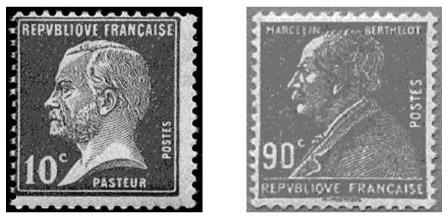
Postage stamps issued to mark the Pasteur and Berthelot centenaries, 1923 and 1927
The Berthelot stamp, which incorporated the portrait by Jules-Clément Chaplain (see Fig. 3), was issued on 7 September 1927 and withdrawn at the end of 1932. 90 centimes was the international tariff for a post-card. The Pasteur issue went on general sale on 25 May 1923, initially with values of 10 centimes, 30 centimes, and 50 centimes. Other values followed, and the stamp was finally withdrawn in 1932. Pasteur and Berthelot were the first two Frenchmen to be represented on a stamp since the Emperor Napoleon III.6While the Pasteur centenary served as a precedent and model for the celebration of Berthelot four years later, it hardly explains why the events of 1927 were executed on a scale that matched, and even arguably surpassed, those of 1923. Essential to the explanation were, of course, Berthelot’s contributions to chemistry, which had been duly recognized in the obituaries that followed immediately on his death. As president of the Académie des sciences, the pathologist, veterinarian, and exact contemporary of Berthelot, Auguste Chauveau, had spoken of the “imperishable” glory that would be eternally associated with his name. [15] And across the Channel an unsigned obituary in the Times Literary Supplement had conveyed international recognition of his eminence, describing him as “perhaps the greatest chemist of his age.” [16] In French eyes, however, there was far more to Berthelot than scientific eminence alone. He was a long-serving senator (from 1881) and one of the country’s two general inspectors of higher education with responsibility for science (from 1876 to 1888), and he served briefly as Minister of Public Instruction (in René Goblet’s cabinet, between December 1886 and May 1887) and later of Foreign Affairs (from November 1895 to March 1896, under Léon Bourgeois). As an historian, he wrote on ancient and medieval alchemy and the work of Lavoisier, and articles by him on the political and cultural aspects of science brought him celebrity with a reading public that was variously entranced or appalled by the relentlessly secular tone that ran through his public statements. Berthelot was, in short, what we should now call a “public intellectual.” A man of such visibility and versatility, who “knew many things, and all of them well” (in the words of the TLS obituary), was a natural candidate for the rare honour of election, as a scientist, to the Académie française, where he was received as successor to the mathematician Joseph Bertrand in May 1901. [17]
Bibliography, politics, and the shadow of war
7Even these gauges of eminence, however, are far from the whole story. The grandeur of the 1927 celebrations would have been inconceivable had the centenary not been yolked, late in the day, to an essentially French response to international anxiety about the escalating volume of scientific literature and the multiplicity of locations and languages in which the literature was published. The challenge was a long-standing one. Before the First World War, the Royal Society Catalogue of Scientific Papers (covering papers published between 1800 and 1900) and the annual British-based International Catalogue of Scientific Literature (launched in 1901) had done something to facilitate access to publications across the whole range of scientific disciplines. And even more ambitiously, in Belgium in 1895, Paul Otlet and Henri La Fontaine, both of them lawyers by training, had launched their Universal Bibliographic Repertory as a way of ordering information from millions of sources in all spheres of human knowledge. [18]
8The Belgian project had got off to a brisk start, and procedures were quickly in place for the submission of references to its headquarters in Brussels, the Institut international de bibliographie. In meticulous detail, Otlet specified the way in which information about a book or article should be entered on record-cards of standard format. International coordination was essential, and a succession of conferences on bibliography and documentation, the first of them in Brussels in 1895, helped to ensure the uniformity on which the usefulness of the records depended. By 1914, the Repertory had become a valuable resource. But the war cruelly intervened. It did more than make work in Brussels virtually impossible; it also undermined the very principle of international cooperation and sowed enduring sentiments ranging from reserve and suspicion to outright hostility between the scientific communities of the Allied and Central Powers. As the war drew to a close, opinions within the national academies of the Allied Powers hardened to a consensus that Germany should be punished for what were seen as its criminal acts, notably in the use of gas warfare. That view took concrete form at three major meetings in London, Paris, and Brussels between October 1918 and July 1919. At the last of these, in Brussels, it was finally decided that German (as well as Austrian, Hungarian, and Bulgarian) scientists should be excluded for twelve years from the newly formed International Research Council and its affiliated disciplinary unions. [19] In circumstances of such mutual hostility, progress in scientific documentation that rested on cooperation between the former enemy nations risked appearing a pipedream.
9While Germany’s exclusion left its mark across the spectrum of the sciences, no science was more affected than chemistry. In this of all disciplines, what hope was there for improved finding aids and effective access to the world’s chemical literature when Germany, a leading force in both academic and industrial chemistry, was relegated to the side-lines? In France, two men who were later to have prominent roles in the preparations for the Berthelot centenary felt the point particularly keenly: Paul Kestner and Jean Gérard. Both Kestner and Gérard were from the east of France, the region most affected by the war. Kestner, in his mid-fifties in 1918, was from Alsace; a native of Mulhouse, he had gone on to a senior position in the Kuhlmann chemical company in Lille before starting companies of his own and devoting himself, after the war, to research and the public life of chemistry. [20] Gérard, just 28 when the war ended, belonged to a younger generation. After studying at the highly respected Institut chimique of the University of Nancy, he had stayed in Nancy as assistant to the Nobel prize-winner Victor Grignard, and it was Grignard who brought him to Paris in 1915 to undertake war-work on poison gases. [21] In Nancy, Gérard had laid other foundations that were to serve him well in the international sphere. Especially important was an involvement in student affairs that led to his appointment as president of the Confédération internationale des étudiants, a federation of student bodies of which he was effectively the founder. [22]
10The mixture of patriotic sentiment and a more focussed concern for the welfare of French chemistry that united Kestner and Gérard found expression in the young Société de chimie industrielle, founded in 1917 with Kestner as its first president and Gérard as its general secretary. The creation of the new society recognized both the centrality of the French chemical industry in the war effort and the importance the industry would necessarily have once peace was restored. [23] As Ulrike Fell has observed, it also contributed to an ongoing fragmentation of the nation’s chemical community, once served by a single all-embracing national society, the Société chimique de France, but now with allegiances divided between a number of societies, including the Société de chimie physique (founded in 1908) and the Société de chimie biologique (1914). [24] Advancing specialization and the difficulty of promoting new types of chemistry within the cumbersome structures of the Société chimique de France made the growth of these new societies inevitable. But with fragmentation there came a weakening of the sense of community among chemists and an aggravation of the problems of bibliography and documentation that so exercised Kestner and Gérard.
11As thoughts turned from war to peace, rather uncoordinated initiatives kept documentation at the forefront of scientists’ and engineers’ concerns. At a congress of French engineers in the spring of 1918, the elderly general Hippolyte Sébert returned to a long-standing personal preoccupation in urging the creation of a documentary service for French engineers and industrialists. [25] The field was one in which he already had significant achievements to his credit. As an associate of Otlet since 1895, he had already urged the establishment of such a service, and he now used his authority as a respected member of the Académie des sciences to promote the cause, most conspicuously through the Société d’encouragement pour l’industrie nationale. [26] For chemists, however, it was the Société de chimie industrielle that emerged as the main driving force.
12From the start, Kestner saw a library and “office de documentation” as essential to the new society’s activities. [27] But what he originally conceived as a resource for members in France alone soon evolved into a more ambitious venture, limited to chemistry but with an international mission in the manner of the Universal Bibliographic Repertory of Otlet and La Fontaine. With Gérard an ever more prominent influence, the international dimension grew in importance as part of what took shape during the early 1920s as a far larger plan for a world centre for chemistry with a comprehensive library and other services on which chemists everywhere would be able to draw. [28] Such a plan had deep roots going back to at least 1912, when Wilhelm Ostwald had published a memorandum urging the creation of a similar institution, which he thought might be appropriately located in Brussels. [29] Ostwald’s initiative, however, had fallen victim to the war, and bitter post-war animosity between the former Allied and Central Powers made its resurrection virtually impossible.
13It took someone with Gérard’s exceptional entrepreneurial skill to reformulate the pre-war project (though with Ostwald now ignored) and guide its passage from aspiration to reality. Essential to his achievement was the influence he had acquired through his appointment, in 1919, as the first general secretary of the International Union of Pure and Applied Chemistry (IUPAC). The position brought him into close contact with the leaders of world chemistry. It also facilitated alliances with influential figures in French chemistry and the chemical industry who shared his patriotic intent that the Maison de la Chimie (as the proposed institution was routinely called by 1921) should be in Paris and that its various activities should reinforce France’s central position in the world of learning.
New project, old tensions
14Inspired by Gérard, but with Kestner, Ernest Fourneau (the general secretary of the Société chimique de France), and Charles Moureu (from his powerful position as professor of organic chemistry at the Collège de France) all in strong support, the proposal quickly acquired momentum. Once an idea that the project should embrace physics as well as chemistry had been abandoned, [30] the focus of fund-raising turned resolutely to the chemical community, in particular to potential patrons in the chemical industry. Talk of a possible donation of 25,000 francs by the Poulenc company augured well. [31] But more substantial contributions were hard to find. Early hopes of reviving the interest that the Belgian industrialist Ernest Solvay had shown in Ostwald’s pre-war project did not survive Solvay’s death in May 1922. And by the mid-1920s escalating costs and the still fragile post-war economy were making fund-raising more difficult than ever. It was in response to this challenge that the masterstroke of associating the proposal for a Maison de la Chimie with the Berthelot centenary was conceived, very probably towards the end of 1925 and almost certainly by Gérard. Once the new joint plan became public, as it did from April 1926, the initial sense of purpose returned. In July, as part of the nascent two-pronged initiative, the first of a number of articles by eminent authors drawing attention to Berthelot’s work appeared in Chimie & Industrie, the monthly journal of the Société de chimie industrielle. [32] And by the autumn, foreign chemical societies and other organizations were being asked to send representatives to a conference in Paris at which the plans for both the centenary and the Maison de la Chimie were indissolubly linked.
15A prime target for fund-raising was necessarily the American chemical community, centred on the American Chemical Society, now fifty years old and with a membership of 15,000. There, however, the Parisian venture elicited polite encouragement rather than wholehearted support. An important reason for American reticence was the existence, since the beginning of the century, of US-based initiatives for dealing with the problem of documentation. One of the earliest responses had been the establishment in 1901, by the Chemists’ Club in New York, of a Bureau of Chemical Information to which members were asked to submit references to books and articles that they had read. [33] Although an informal system of information-gathering on these lines had soon proved inadequate, the merger of the Club’s library with that of the American Chemical Society in 1912 had created a combined collection of 8,800 volumes that met the needs of most working chemists. Armed with that resource, few in the American chemical community saw any great advantage for their own work in a library and documentation service across the Atlantic.
16In Britain too, a lukewarm response reflected a preference for developing existing provision. In January 1927, the Council of the Royal Society agreed easily enough to the invitation from the Académie des sciences for it to send representatives to Paris for the centenary. But, on the advice of the society’s Chemistry Committee, the Council resolved to take no action on the subscription in favour of the Maison de la Chimie. [34] The committee’s view was that the libraries of the Chemical Society and the Patent Office, together with abstracting services available under the joint aegis of the Chemical Society and the Society of Chemical Industry, already fulfilled the essential functions of the proposed Parisian institution. It followed that any new funds should be spent on improving metropolitan and provincial chemical libraries in Britain. [35] The Council of the Chemical Society showed the same coolness. Alacrity in agreeing that the Society should be represented at the centenary and a decision to prepare a congratulatory address for transmission to the Berthelot committee contrasted with prevarication on the question of a donation (which seemingly it never made) to the Maison de la Chimie and the “International Office of Chemistry.” [36] In a similar spirit, the Council of the Society of Chemical Industry “deferred consideration of the proposal.” [37] And even the Royal Institute of Chemistry, which subsequently broke ranks to the point of sending £10 towards the cost of the celebrations, was careful to stipulate that the sum was not to be seen as a contribution to “the establishment of an international Chemistry House.” [38]
17Underlying the air of benign indifference in the USA and Britain were divergences of opinion with regard to an enterprise so strongly marked not just by its French roots but, more specifically, by the cast that Gérard had given it. Writing in March 1924, as president of IUPAC, the professor of chemistry at Cambridge, William Pope, felt obliged to remind Gérard, his general secretary, that the leading national chemical societies of Britain and the USA, as well as of France, must be involved in any discussions about the further development of abstracting journals. It was essential, in Pope’s view, that societies’ existing efforts should not be overlooked in the push for the service that Gérard wanted to locate for the same purpose at the Maison de la Chimie. [39] Another source of unease in the British and American communities turned on the question of the admission of Germany to IUPAC. From the start, Germany and the other Central Powers had been excluded, as they had been from the International Research Council. But their admission was recognized to be simply a matter of time. By 1924 (and probably earlier) possible steps towards the ending of the boycott were already under active debate in the international chemical community. There, they provoked varying degrees of plain speaking, though always in recognition of the inevitability of Germany’s eventual reintegration.
18Within IUPAC, feelings were broadly divided between those who wished to see Germany admitted without delay (a view held uncompromisingly by William A. Noyes, a long-serving professor at the University of Illinois Urbana-Champaign and former president of the American Chemical Society) and the French and Belgian communities, who were broadly opposed to immediate action. Between the two camps stood Pope, a moderating influence who understood French and Belgian sensibilities on the German question rather better than Noyes. Two days after his letter to Gérard, Pope wrote to Noyes, with a warning against what he saw as Noyes’s excessive attempts at coercion:
“Candidly, I think that your continuous and persistent efforts to persuade our French colleagues to do what they have not done spontaneously are likely to retard the return of cooperative effort. The French and the Belgians feel more strongly than we do on the German question and they resent and suspect propositions by an Englishman or an American which involve inviting German collaboration; we had much better leave such matters alone and so do nothing to hinder the action of time in bringing back more normal relationships.” [40]
20Two years later the matter remained no less delicate. If anything, in fact, it had acquired a new urgency. By now, the Locarno treatises of October 1925, opening the door to the normalization of relations between the Allies and Germany, had been signed and were to come into effect in the following September, a few days after Germany’s admission to the League of Nations. The summer months of 1926 too were notable, for the abandonment of the exclusion of the Central Powers from the International Research Council (not that Germany accepted membership of either the IRC or its successor from 1931, the International Council of Scientific Unions, until after the Second World War). Through the mid-1920s, tensions and uncertainties abounded, reflecting those on the larger stage of international politics. In May 1926, as a letter to Gérard from the influential long-serving secretary of the American Chemical Society (ACS), Charles L. Parsons, shows, reconciliation between conflicting views was no easy matter: French unease, on the one hand, and German resentment at the country’s exclusion from IUPAC, on the other, called for sensitive handling. [41] Parsons’s position, apparently like that of his fellow leading members of the ACS, Harrison Hale and the current president James Flack Norris, was one of resolute opposition to German membership until the necessary preliminary steps of Germany’s admission to the League of Nations and a consequent amendment of IUPAC’s statutes had been completed. His assessment of prevailing American opinion with regard to Germany was intended to reassure Gérard, and it presumably did so. As Parsons reported, at a recent discussion in Washington, he, Hale, and Norris had firmly resisted the suggestion of Pope’s successor as president of IUPAC, the Dutch chemist Ernst Cohen, that German chemists coming to Philadelphia for the fiftieth-anniversary meeting of the American Chemical Society later in the year should be allowed to attend the forthcoming seventh IUPAC conference in Washington as well. The conference duly went ahead without a German presence.
21In circumstances of such division, Parsons understandably endorsed his letter to Gérard “PERSONAL AND CONFIDENTIAL,” and under the cloak of confidentiality he pulled no punches in castigating those in the American chemical community who were seeking to move too quickly:
“I haven’t a doubt that W. A. Noyes and a few of those who follow him may prove troublesome, but I think you can forget them. The American chemists are ready at any time, in the interests of international science, to work cooperatively where we must with the Germans. The Germans will never have in this country nearly so much influence as those whom we know are our real friends. We shall never sacrifice any of our self-respect in order to have them with us, and we do not consider the chemists of Germany any more omniscient than those of England, France, Italy, or America. Whenever they themselves are ever ready to forget in scientific dealings that there has been a war, we will treat them on the same basis, at least officially.” [42]
23There could have been no firmer endorsement of Pope’s advocacy of a resolute but unrushed approach to the easing of Germany back into the international fold. And it worked. Germany was formally welcomed as a full member of IUPAC at the Liege conference in 1930. [43]
24In this and probably other ways, Pope’s diplomatic skills and Parsons’s opposition to Noyes’s headstrong approach helped to maintain business-like and at least superficially cordial relations between Gérard and the more impetuous Americans with whom he had to deal. Through it all, Gérard’s position never wavered: with characteristic pragmatism, he recognized that American support was indispensable if the middle course of controlled German reintegration, which he favoured, was to win the day. With the Berthelot centenary and the Maison de la Chimie project also on his mind, a planned first visit to the USA in September 1926, to attend the meeting of the American Chemical Society in Philadelphia and the IUPAC conference that followed in Washington, would have been an important next step. It was a major disappointment that his wife’s serious illness that summer prevented him from going. The French colleagues who did make the trip, however, were well briefed.
25At the ACS meeting, a widely publicized lecture on Berthelot’s chemistry by Paul Sabatier, Nobel Prize-winner with Victor Grignard in 1912, served as something of an opening salvo on the American front. [44] Although Sabatier does not appear to have mentioned the Maison de la Chimie in his lecture, he had evidently talked about it to good effect in private discussions, and he continued to press the case later in the month as a member of the French delegation attending the IUPAC conference in Washington. But even more important contacts were made in New York, when just before their return to Europe five senior members of the delegation, including Sabatier and Gabriel Bertrand of the Institut Pasteur, lunched with a distinguished gathering of sympathetic scientists, bankers, and businessmen. [45] The main speaker at the luncheon was the Francophone New York attorney Maurice Léon. Born in Beirut and educated in Paris before emigrating to America in his teens in 1894, Léon is said to have played a key role in securing the first US war loans, totalling $35m, for the French government in 1914 and 1915. [46] He now emerged as the leading American champion of the Berthelot celebrations and the Maison de la Chimie project. [47]
26The cause could not have had a more effective transatlantic spokesman than Léon. And it was to be further strengthened from December 1926 by the appointment of the poet and playwright Paul Claudel as France’s Ambassador to the United States. Claudel came to Washington, where he arrived in March 1927, not just as an eminent Frenchman with a sympathetic, though always clear-eyed understanding of America but also as a long-standing close friend of Berthelot’s third son Philippe, himself a senior diplomat and a poet. [48] The alliance was a powerful one that drew Claudel and important figures in the elevated cultural circles he frequented into the project.
Propaganda and delivery
27Despite the conspicuous generosity of certain contributors, the overall American response (like the British) fell short of wholehearted support. Gérard, however, was undeterred. Despite the rather late start for such an ambitious initiative, his administrative efficiency and relational skills found characteristic expression in a plan of campaign at home and abroad that he had been piecing together since late in 1925. A lengthy typed document dated 2 January 1927 outlining not only the national administrative structure but also the initiatives to be encouraged in the individual departments of France bore the thumbprint of Gérard’s ambition and attention to detail. [49] In accordance with an intricately planned timetable, each department would be expected to set up a committee for the celebration and to appoint “propagandistes” who would encourage subscriptions towards the Maison de la Chimie through approaches to local public figures and a programme of lectures by professors and teachers. Even in primary schools, teachers were to promote the interest of children in their charge, through the medium of cheaply produced images, “images d’Épinal,” suitable for purchase by families of even modest means. Soon the plan embraced the preparation of posters, slides for the use of lecturers, radio programmes, and a variety of publicity literature adapted to different levels of understanding. There was even to be film material, which does not seem to have materialized, and a commemorative stamp, which did (see Fig. 2). Among the more substantial mementoes, a specially commissioned engraving of Berthelot in his laboratory could be had for 50 francs (though twice that for a copy signed by the artist, Lucien Jonas). Medals too were available in a variety of qualities. The Paris Mint issued a modified version of the medal originally struck for the Berthelot celebrations of 1901 (see Fig. 3), and a Lalique medal in glass was offered at 100 francs. These, though, were modest purchases by comparison with the “Livre d’or” (offered at a pre-publication subscription price of between 500 and 600 francs, according to the binding) [50] or a bust of Berthelot sculpted by Léopold Bernstamm, in models ranging from plain plaster at 625 francs to bronze at 7,500 francs. [51]
The obverse and reverse of a bronze commemorative medal (70 x 57 mm) issued by the Paris Mint, 1927

The obverse and reverse of a bronze commemorative medal (70 x 57 mm) issued by the Paris Mint, 1927
The obverse was identical to that of the medal by Jules-Clément Chaplain issued on the occasion of the Berthelot celebrations of 1901. The reverse replaced the allegorical scene of Berthelot and two female figures, one a Marianne representing France, the other representing science as the guide of humanity, that had appeared on the 1901 medal.28The pace of the early weeks of 1927 never slackened. A distinguished organizing committee, with Gérard as its secretary-general, maintained relentless pressure. While Gérard was the prime driving force, the commitment and scientific and political eminence of its president, Paul Painlevé, as both a leading mathematician and a senior Minister (of War), reinforced the seriousness of the enterprise. Among the fifteen vice-presidents (in a committee of over 150 members) were virtually all the leaders of French chemistry. These included a core group that was to play an especially prominent role in the celebrations: Auguste Béhal (professor of organic chemistry in the Paris Faculty of Pharmacy) and Camille Matignon (professor of inorganic chemistry at the Collège de France), as well as Moureu, Kestner, and Kestner’s successor as president of the Société de chimie industrielle, Donat Agache. [52]
29Beneath the appearances of unity, however, divergences of objective were evident. Reservations seem to have circulated, in particular, in the higher reaches of the Société chimique de France. Georges Urbain, the society’s president from 1926 to 1928, would have preferred to see money spent on laboratory provision, rather than on the centenary or the Maison de la Chimie project. [53] Equally troubling was the unease of Ernest Fourneau, the long-serving secretary general of the society (from 1920 to 1932). Fourneau believed that the campaign in favour of the centenary was “too vast” and potentially wasteful in its policy of targeting small contributions that would be expensive to collect. At least, as he put it in a letter to Gérard on 1 March 1927, it appeared too vast and was likely to arouse a hostile reaction in circles already uneasy about Gérard’s build-up to the events planned for October. [54] Although the comment had the air of friendliness, there was a dark warning in Fourneau’s advice: “N’oubliez pas toutes les critiques dont vous avez été l’objet.”
30Gérard’s reply was lengthy and unapologetic. Fourneau, he insisted, had been misinformed by an unnamed colleague (quite possibly Urbain) who had maintained “une sourde hostilité pour me remercier du travail que j’ai fourni à son égard.” [55] In any case, fund-raising and publicity would not be left to Gérard alone. They would be the responsibility of a committee in which Gérard would work with his closest collaborators: the chemist and senior figure in the Kuhlmann company Albert Ranc, the general secretary of the Ligue de l’enseignement Léon Robelin, and Daniel Berthelot, the second of Marcellin’s four sons, now a professor in the Faculty of Pharmacy and member of the Académie des sciences. The plan would then be submitted for governmental approval by the chemist Jacques Cavalier, director of higher education in the Ministry of Public Instruction, and finally for approval by a finance committee and the national standing committee for “fêtes et cérémonies.”
31The elaborateness of Gérard’s response showed how keenly he had felt Fourneau’s criticism. But planning proceeded regardless, reaching a crescendo on 5 May 1927 at a gathering in the Sorbonne, at which the campaign for raising funds within France was formally launched. [56] The ceremony was addressed by leading advocates of the project (including Painlevé and, in absentia, the President of the Council Raymond Poincaré) and attended by ambassadors and ministerial representatives from some twenty countries, delegates of the main societies and federations of French chemists and industrialists, and members of Berthelot’s family. After a show of such influential support, there was no turning back. By October, committees for the centenary had been established in 59 countries, and committees in virtually every French department were planning fund-raising events. [57] In the provinces as in Paris, teachers, professors, and industrialists all played their part, along with prefects and other senior governmental officials. While the levels of response varied, audiences across France seem to have been ready to attend lectures on Berthelot’s life and work, many of them given by Ranc, who travelled tirelessly, speaking in almost thirty departments in the months preceding the centenary. [58]
32The celebrations began on Sunday 23 October and were planned to occupy the next three days. [59] The programme was packed. On the Sunday evening, a reception in the Sorbonne in which senior administrators and professors in the university system entertained the delegates from some sixty nations got things off to a sedate start. This gave way, on Monday, to an intense day of visits, first to an exhibition in the Faculty of Pharmacy (where Berthelot had held the chair of organic chemistry from 1859 to 1876, in its earlier designation as the École supérieure de pharmacie) and then to the Collège de France (where he had taught from 1863 until his death). A programme of speeches allowed for welcomes in both locations and eulogies of Berthelot as a benefactor of humanity, both materially and in bringing peoples and nations together (a point given added significance through being voiced by Wilhelm Schlenk, speaking as the head of the German delegation and president of the Deutsche Chemische Gesellschaft). A more intimate occasion was the unveiling of a plaque on the house in the rue Saint-Martin where Berthelot had lived between 1852 and 1861. But formality and splendour resumed later in the day, at a reception in the Hôtel de ville, followed by an evening ceremony in the Sorbonne, where the President of the Republic, Gaston Doumergue, led scientists and political figures in paying homage to Berthelot. In addition to the usual speeches, this was the occasion for the handing over, one by one, of the 239 addresses, often elaborately illuminated, that the foreign delegations were invited to present. [60] Among the addresses were three from Germany: from the city of Berlin, the University of Heidelberg, and a joint address from the Deutsche Chemische Gesellschaft, the Verein Deutscher Chemiker, and the Deutsche Bunsengesellschaft (see Fig. 4). For a country of such scientific importance, the number of addresses was not large. The size of the eleven-man German delegation too was modest, significantly smaller than the delegations from Belgium, Italy, or Spain for example. [61] But what mattered at a delicate phase in the process of reconciliation was that, however discretely, Germany was present.
Joint address from the Deutsche Chemische Gesellschaft, Verein Deutscher Chemiker, and Deutsche Chemische Gesellschaft, signed by Wilhelm Schlenk, Alfred Stock, and Walther Nernst, as the current presidents of the three societies

Joint address from the Deutsche Chemische Gesellschaft, Verein Deutscher Chemiker, and Deutsche Chemische Gesellschaft, signed by Wilhelm Schlenk, Alfred Stock, and Walther Nernst, as the current presidents of the three societies
The address was presented at the ceremony in the Grand Amphithéâtre of the Sorbonne on 24 October 1927. It was one of three offered by representatives of the German chemical community, out of a total of 239 from all over the world. The address and a significant (though not large) German presence at the centenary celebrations marked an important stage in Germany’s post-war reintegration in international chemistry.33Thereafter, the celebrations became, if anything, even grander. On Tuesday 25 October, a sumptuously decorated Panthéon was the setting for a “pieux pèlerinage” of governmental and civic figures and members of the national delegations. Here speeches by Raymond Poincaré and the Argentinian Minister of Foreign Affairs and distinguished naturalist and engineer, Angel Gallardo, put the emphasis on Berthelot’s role as a civilizing force for all humanity. A luncheon for 1,200 in the Galerie des batailles at Versailles and an evening of ballet and music at the Paris Opéra followed. On the next morning, in a relatively simple ceremony, Édouard Herriot, Minister of Public Instruction, laid the foundation stone of the Maison de la Chimie on the place d’Iéna, close to the Trocadéro Palace on the hill of Chaillot. He, Donat Agache (in the name of the French contributors), and the distinguished Venezuelan diplomat César Zumeta (speaking for the foreign subscribers) made speeches appropriate to the occasion, infused with universalist rhetoric and presenting chemistry as a fount of well-being for all humanity. [62] Now, it was the turn of the Institut de France to receive the delegations and other guests for luncheon at the Château de Chantilly, the house and park bequeathed to the Institut by the duc d’Aumale on his death in 1897.
34As the day of the laying of the foundation stone, 26 October was always intended to end on a note of conspicuous ceremony and elegance. And it did, at a theatrical and musical evening in the Élysée Palace, hosted by Doumergue. The highlight of a glittering occasion was the first performance of Sous le rempart d’Athènes, written by Paul Claudel, now in the early months of his six years as ambassador in Washington. [63] The piece, directed by Louis Jouvet and with music composed (at Claudel’s request) by Germaine Tailleferre and played by the French Radio Orchestra, [64] had been suggested and essentially commissioned by his friend Philippe Berthelot. The action, such as it was, centred on an exchange between two residents of Athens (a “Paphlagonian” and a young girl) and a blind stranger arriving beneath the walls of the city in search of the tomb of Hermas, an imaginary philosopher plainly embodying the qualities of Marcellin Berthelot. The stranger’s questioning of the Athenians about the nature of truth and perception elicited a vision of Hermas as a philosopher who achieved his understanding of matter through the rigorous application of reason rather than the undisciplined vagaries of observation alone. Science in Hermas’s hands was a matter of interrogation, necessitating an active reaction to nature that went beyond that of the mere “spectator.” In the words of the stranger, “Il faut créer pour comprendre,” a sentiment that evoked Berthelot’s work of synthesis as opposed to the essential but more limited task of analysis.
35It is hard to imagine that the audience at the Élysée Palace would have perceived the full significance of exchanges of such extreme abstraction. The stranger’s ability to “see” despite his lack of sight and the evocation of Hermas’s path to truth might have turned some particularly alert minds to the parallels with Berthelot. But the “philosophical conversation” (Claudel’s term) must have remained an enigma for all but the most attuned observers. Claudel himself, who was in New York on the day of the performance (see below, note 74), acknowledged the point some years later, when he recalled: “Il est loyal d’ajouter qu’elle [la pièce] a excité alors la stupéfaction générale et que les survivants en ont gardé encore aujourd’hui une impression mêlée à la fois d’ahurissement et d’indignation.” [65] The words appear strong, but the fact remains that Sous le rempart d’Athènes was performed on only one other occasion, when it was read at the Comédie française in June 1939.
Chemistry and the new world order
36How might we judge the success of the centenary celebrations? They had certainly been conducted with both dignity and an opulence worthy of the man. And by the criterion of the financial support they received, they succeeded triumphantly. Just under 15m francs had been collected by October 1927, [66] and continued fund-raising brought the figure to 24,895,242 francs by 31 October 1930 (see Table 1). The pattern of support, though, was uneven. Within France, receptions, public ceremonies, and other celebratory initiatives had been organized in 81 of the country’s 89 departments, and between them departmental committees had raised a total of over 5m francs, in addition to almost half a million francs coming from the twenty arrondissements of Paris. [67] Support from companies allowed the industrialized departments of the Rhône, Pas-de-Calais, Saône-et-Loire, and Haut-Rhin to make particularly large contributions of between 335,000 and half a million francs. But where fund-raising depended on small personal donations or civic budgets, the sums were far more modest. At the bottom of the scale, the rural auvergnat department of the Haute-Loire could not raise more than 4,000 francs, and of another twenty departments none contributed more than 10,000 francs.
Countries contributing more than 150,000 francs


Countries contributing more than 150,000 francs
The total of foreign contributions on this date was 11,684,486 francs, drawn from 64 countries. Contributions from France and the French colonies stood at 13,210,756 francs, making a total of 24,895,242 francs.37Among foreign countries, Great Britain and the USA contributed over a million francs each, though in different ways. The British contribution consisted almost entirely of a donation by Robert Mond, the son of Ludwig Mond and a director of the Brunner Mond chemical company, whose sympathy for a French initiative drew on his marriage (to his French second wife, Marie-Louise Guggenheim) and his living much of his later life in Dinard. The American contribution, by contrast, came from more diverse sources; prominent among them were the bankers and financiers J. P. Morgan & Co. and some notable individual benefactors, responding almost certainly to badgering by Maurice Léon. Of other leading national contributions, the large sums donated by Latin American countries are striking. All of Venezuela’s 978,952 francs came from the government, and an overwhelming proportion of the smaller but still substantial sums contributed by Colombia, Argentina, Chile, Peru, and (to a lesser extent) Brazil likewise drew on governmental resources. The political motives behind the Latin American donations were plain. In this, the Venezuelan government’s interest was typical. It reflected a new modernizing spirit that foresaw the transformation of the country’s economy from a dependence on agricultural exports to one founded on the vast oil deposits that had been discovered in the Lake Maracaibo basin during the First World War. By the mid-1920s, a rapidly rising Gross Domestic Product already held out the promise of unprecedented prosperity. In what Judith Ewell has called a “fever of political freedom,” [68] it only remained to consolidate the status and access to foreign capital that were essential to Venezuela’s acceptance as a full participant in the post-war world order. César Zumeta’s long-term residence abroad (between 1915 and 1932), with a mission to represent his country in major capitals and, in Geneva, at the League of Nations, was a measure of Venezuelan determination. [69] In this respect, his prominence in the Berthelot centenary, in all probability encouraged by a personal contact in diplomatic circles with Philippe Berthelot, sat comfortably within his profile of responsibilities.
38Other Latin American countries had not experienced the same shock of unanticipated wealth that had marked Venezuela. Yet most were set, like Venezuela, on the path to an economy founded on industrialization or the export of natural products. And they had political aspirations to match, in various forms of nationalistically fired assertiveness and a resolve to emerge from the political instability and intermittent conflict, both internal and with other Latin American nations, that had dogged most of them since the later nineteenth century. The mix of a quest for modernity and the resolve to assert their nationhood made an international venture such as the Maison de la Chimie an attractive one. That the venture emanated from France, a country with a revolutionary past and no history of unwelcome interference in the affairs of Latin America, gave it added merit.
39The responses of a number of European nations were also strongly coloured by the post-war restructuring of international relations. Long-standing Franco-Polish ties and French sympathy for the cause of Polish independence (achieved in the immediate aftermath of the war) explain a strong contingent and a generous contribution from Poland. Soon after the centenary, they also fired a gracious celebratory event in the Polytechnic School in Warsaw, attended by the Polish President, Ignacy Moscicki, who had pursued his political activities in parallel with a career as a notable academic chemist. [70] Even more evident were the national priorities that lay behind the exceptional level of participation by Czechoslovakia. No country had been more affected by the transformed political order. Since the declaration of the new state’s independence in October 1918, engagement in international ventures, especially ones that bore the modernizing associations of science, had done much to promote the cause of Czechoslovak integration in the community of nations (exemplified in the country’s early membership of the League of Nations). It had also, and quite crucially, served to advance the quest for recognition as a unified state in the face of internal economic, linguistic, and cultural divisions that tried the nation’s founding father and first, charismatic president T. G. Masaryk through to his retirement on health grounds in 1935.
40During and since the war, Czechoslovakia’s interests had been a pillar of French foreign policy. And it was a measure of this special relationship that in his capacity as the Czech foreign minister Edvard Beneš followed the plans for the events of 1927 closely. As the centenary approached, Philippe Berthelot combined tourism and diplomacy with what appears to have been a warm personal friendship with Beneš during a ten-day stay, along with his wife, as a guest of the Czechoslovak Republic. A dinner on 12 October in Prague Castle was the occasion for to asts and speeches of mutual admiration not only between the two men but also between two nations united in their love of liberty and shared republican ideals. [71] A few days later, another elaborate ceremony, this time in the Prague Pantheon, the National Museum’s hall of fame for celebrated Czechs, marked the departure of the Czechoslovak delegation for Paris. Declarations of Franco-Slav friendship (still a live memory from the war) were again to the fore, along with aspirations for the Maison de la Chimie to become “un temple de cette solidarité commune dont le monde a tellement besoin” and a closing rendering of the Marseillaise. [72]
41The exceptional level of Czechoslovak commitment had its material expression in the government’s donation of 500,000 francs towards a national contribution of just over 700,000 francs. This was half as big again as the next largest sum contributed by a European country, that of Belgium: 446,908 francs, of which 100,000 francs came from the government. Thereafter, Poland (with 381,136 francs, with about four-fifths donated by the government and the Ministry of Military Affairs) and Sweden (343,000 francs, all of it from banks, industrial interests, and individuals) were the only European nations to raise more than 300,000 francs. At the lower end of the scale, several national contributions (including those of Australia, Mexico, and South Africa) did not exceed ten thousand francs. The size of these smaller sums invariably went hand in hand with indifference bred of geographical distance and remoteness from French culture, circumstances that only a politically motivated government or exceptionally committed industrial or individual donors might have overcome.
42The disparity between the financial contributions of different nations and, within France, of departments was less marked with regard to the many lectures and festive occasions that local committees promoted at home and abroad. These activities took place wherever such a committee could muster the resources. Some of them were conceived on a grand scale. [73] A much-publicized highlight of the American programme was a glittering banquet at the Ritz-Carlton Hotel in New York, addressed by Maurice Léon and Paul Claudel, on the day of the centenary, 25 October 1927. [74] By contrast, the restrained nature of British interest was exemplified in there being only one significant event, a lecture by Henry Armstrong at the Royal Society of Arts in November 1927, with Pope, Mond, and the French ambassador in attendance. [75] Much farther down the list of contributors, other countries mounted initiatives of at least equal importance. A typical instance was Estonia, a nation with strong political incentives following the independence it had achieved after the First World War. In the face of grave economic difficulties and a multiplicity of competing priorities, an Estonian contribution of 10,000 francs by the government, with an additional 5,244 francs coming from a variety of local sources, represented a significant achievement. So too did ceremonies attended, and often addressed, by ministers, foreign dignitaries, and senior members of the academic and industrial communities in Tartu in May 1927 and Tallinn in October. [76] A similar pattern of serious engagement was evident elsewhere in the newly independent states liberated from Russian control in the wake of the Russian revolution and other post-war adjustments. On or close to the date of the Berthelot centenary, Latvia, Lithuania, and Finland all backed modest, mainly governmental donations with lectures and other celebratory events at which the countries’ presidents and other major public figures were present. [77]
The legacy: A home for chemistry
43By the time the delegates and high officials dispersed at the end of October 1927, Jean Gérard could look back on the celebrations as a job well done. The financial contributions had been generous, and a varied pattern of governmental support and local initiatives had succeeded in raising the profile of Berthelot as at once a great chemist, a noble spirit, and a symbol of France’s finest cultural achievements. But Gérard had always seen the Maison de la Chimie as his supreme objective. He had never lost sight of the obstacles he faced on the path to that achievement. And, to the end, the obstacles did not go away. On 17 October, with days to go before the events in Paris, a now distinctly unfriendly Charles L. Parsons had written to Secretary of State Frank B. Kellogg urging that America should take no part in the project. According to an unsigned report in the New York Times, Parsons had objected to the Maison de la Chimie as “a veiled attempt by France to obtain control of the world’s chemical organizations” in both science and commerce. [78] We do not know how, or whether, Kellogg responded. But Parsons’s letter was a reminder of the unhealed divisions with regard to the Parisian initiative, divisions that broad support for the more limited objective of a celebration of Berthelot had served to conceal.
44The carefully orchestrated good will that bathed all the ceremonies in Paris ensured that scepticism of the kind that Parsons appears to have voiced seldom surfaced publicly. Yet scepticism was a nagging presence. When, in the course of the stone-laying ceremony on 26 October, Donat Agache insisted that France’s sole aim was the promotion of international collaboration and that it had no aspiration to hegemony, he was responding, by implication, to reservations that seem to have been widely shared among chemists in the USA and Britain. Other worries, though, weighed more heavily. Among the most pressing of these was uncertainty surrounding the future of the intended site, an area of 4,000 sq metres on the so-called “Terrain des phares,” occupied at the time by a number of public services that were destined for rehousing elsewhere. A formal agreement to cede the site had been finalized in mid-October 1927, and Painlevé’s prominence in the current Poincaré administration offered some reassurance that the project would be carried through as planned. But critics of the Maison de la Chimie within France were soon at work.
45The Berthelot celebrations were barely over when public accusations of excessive generosity in the choice of such a valuable and prestigious location (said to be worth between 14 and 16 million francs) began to stimulate second thoughts. [79] By the spring of 1928, to the consternation of some of the international donors and despite protests by Gérard, the administrative council of the Maison de la Chimie was having to consider an alternative site, half the size and less well situated, in the boulevard Arago adjacent to the gardens of the Paris Observatory. Soon another possible location, at the junction of the avenue des Champs-Élysées and the avenue Friedland, was also in play. But size again made it unsuitable. Along the way, other options, in the former Austrian Embassy in the Hôtel Matignon in the rue de Varenne, and the premises of the financially vulnerable Collège Sainte-Barbe in the Latin Quarter were considered, and abandoned. Finally, the choice fell on the Hôtel de La Rochefoucauld d’Estissac in the rue Saint-Dominique, an eighteenth-century property offering a site of 4,800 sq metres, including a courtyard and garden.
46Once the purchase of the property by the government was finalized in October 1929, planning could begin. Even now, though, the pace was slow. An initial proposal that the premises might be shared with an international student residence under the aegis of the Ministry of Public Instruction raised new problems. And it was not until February 1931 that the whole building was allocated to the Maison de la Chimie. Once the status and autonomy of the institution had been assured by further agreements in August 1931, the installation of the library and other services finally moved ahead with the resolution that the project required. [80] Three years of preparation followed, culminating in a building that was at once an art deco showpiece and an intensely practical facility. As the journal of the Société de chimie industrielle, Chimie & Industrie conveyed understandable pride in the scale and innovatory character of what had been achieved. And the praise was justified. From the minutest details of the office furniture, telephone network, kitchen facilities, and lecture-theatre to the behind-the-scenes provision for the storage and delivery of books, the Maison de la Chimie stood at the cutting edge of modernity. [81]
47No pride, of course, could have been greater or more merited than Jean Gérard’s. It is no slight on the contributions of his close collaborators, especially Paul Kestner and Camille Matignon, to say that the conception of the Maison de la Chimie was in large measure his. No less importantly, the passage from conception to reality owed much to the tenacity and organizational skills with which he had navigated the choppy waters of economic crisis and divergent national interests after 1927. Yet, to the very end, what should have been the triumphant culmination of Gérard’s efforts was dogged by misfortune. The formal inauguration of the building, planned for 19 and 20 October 1934, had to be postponed following the assassination of King Alexander I of Yugoslavia and the French Minister of Foreign Affairs, Louis Barthou, in Marseille on 9 October. By the time the ceremonies eventually took place, between 30 November and 2 December 1934, the occasion had been clouded by another death, that of Philippe Berthelot on 22 November. [82] Nevertheless, the inauguration went ahead, in the presence of the President of the Republic, Albert Lebrun, the ambassadors of Belgium, Poland, and Argentina, and the delegates of as many nations, societies, and other official bodies as were able to arrange representation at rather short notice. [83]
48The three days of receptions, luncheons, and speeches got the Maison de la Chimie off to a dignified start, and gradually the various services began to function. By 1936, 1,300 journals were available for abstracting and public use in the Centre de documentation, along with 10,000 books and a comparable number of brochures and more ephemeral items. [84] Acquisition costs were kept low: most of the books and journals came not as purchases but as donations from the Société de chimie industrielle and the other chemical societies that now had their administrative offices in the building. [85] But the unevenness of the support both within France and internationally was a continuing source of anxiety. Although the number of readers rose, it was persistently modest: 1,395 in 1935, 2,061 in 1938. And it is hard to judge what use was made of the Maison de la Chimie’s other resources, especially the translation service and photographic studio. But these ambitious technical facilities seem to have proved less attractive than the lecture theatre and other rooms in a building whose sparkling interior and furnishings made letting for meetings and other activities unrelated to chemistry a potential money-spinner.
49Despite careful budgeting, the world-wide economic difficulties of the 1930s had grave consequences for an institution that depended heavily on donations, in particular on subscriptions channelled through the Société des amis de la Maison de la Chimie. And the continued coolness of nations that had shown ambivalence from the start did not help matters. British reticence, for example, was as evident as it had been a decade earlier. The Royal Society, Chemical Society, and Royal Institute of Chemistry all agreed to send representatives to the inaugural ceremony in 1934, as they had done to the centenary celebrations in 1927. [86] But the societies’ records contain no sign of interest, still less of material support, once the ceremony was over. British engagement remained, as it had always been, a personal rather than institutional affair. Now as in 1927, it was limited essentially to the support of the conspicuously francophile Robert Mond, a leading figure in the Société des amis (which he had been instrumental in founding in 1934) and a correspondingly great loss when he died in 1938. [87]
50No individual benefactor, however, even one as wealthy as Mond, could have provided the financial security that Maison de la Chimie needed if it was entirely to fulfil its mission. The respect for the institution that the prominent Italian chemist Nicola Parravano expressed in his opening address as president of the tenth congress of IUPAC in Rome in 1938 was genuine, and there were many in the circles of international chemistry that he frequented who shared his admiration for what had been achieved in Paris, especially in documentation. [88] Warm words, though, could do little. In the absence of ministerial subsidy and with the Rockefeller Foundation one of several organizations that declined to help, the financial losses mounted. [89] The programme of lectures and conferences remained strong, journals and books arrived in the library, and both France’s chemical societies and IUPAC benefited from the elegant setting in which they now had their headquarters. But in a decade marked by economic and political challenges of every kind, funding was a constant preoccupation.
51The same financial constraints that Gérard had to take into account in his management of the Maison de la Chimie also made life difficult for IUPAC and the Société de chimie industrielle. Gérard, though, was not one to give in. Even when war came, he worked on tirelessly, and the Maison de la Chimie functioned throughout the Nazi occupation of Paris. It did so, however, in conditions of extreme difficulty. After the end of hostilities, with Gérard removed for political reasons, it only partially recovered, and years of increasingly spasmodic accessions to the library since 1945 closed with the sale of the collection to the new University of Orsay in 1964. [90] The sale struck at the heart of what from the start had been the institution’s primary mission. The Maison de la Chimie had aimed high, and its aspiration to offer documentary services to chemists and the chemical industry throughout the world had expressed the highest internationalist ideals. But the gnawing realities of unresolved financial hardship and competing national interests had always weighed heavily. Under the blow of the Second World War, those realities prevailed, and a remarkable venture in the history of scientific documentation and information retrieval came to an end.
Acknowledgements
This article has its origins in a paper that I gave at the conference “Autour du fonds imprimé de la Maison de la Chimie: Réorganiser la chimie au sortir de la Grande Guerre (1918-1927),” held at the Université Paris Sud, Orsay on 19 and 20 November 2009. In preparing that paper and since, I have received generous help and advice from David Allen, Library Collections Coordinator at the Royal Society of Chemistry. Elsewhere, in Oxford and London, the Bodleian Library and British Library have been essential resources. But the article could not have been written without two periods of research and writing at the Chemical Heritage Foundation’s Othmer Library of Chemical History in Philadelphia. The first of these was made possible by a grant from the CHF for a two-week visit in April 2010. I then spent the fall semester of 2013, as the Gordon Cain Distinguished Fellow, in the CHF’s Beckman Center. I am grateful to Ronald Brashear, Arnold Thackray Director of the Othmer Library for helping to make these stays possible; to Carin Berkowitz for her support and leadership as Director of the Beckman Center; and to the CHF’s archivist Andrew Mangravite for guidance, especially with regard to the IUPAC papers in his care. Finally, my thanks go to two anonymous referees, whose comments have been crucial in helping me to rethink parts of the article.Publisher keywords: International Union of Pure and Applied Chemistry (IUPAC), Jean Gérard, Maison de la Chimie, Marcellin Berthelot, Paul Claudel, Philippe Berthelot, Société de chimie industrielle

This article is available in open access under our model Subscribe To Open.
Uploaded: 07/19/2016
https://doi.org/10.3917/e.rhs.691.0077