Violence, Aggressive Behaviors, Sport and Physical Activities. A Confrontation of Points of View
Staps
2016/2 No 112
138 pages
Cite this issue


Correlations between types of aggression based on player’s role*
* All correlations are significant at p < .01


The different types of aggressiveness while practicing sports games
The illicit form of aggressiveness sanctioned by the game code is either oriented towards the completion of the task (instrumental aggressiveness) or non-operating and reserved for the expression of a dissatisfaction (affective aggressiveness): in both cases, it is psychologically relevant (related to frustrations, the stakes of a game, an aggressive behavior a priori, etc.). Licit aggressiveness, explicitly expected in the play contract, is relevant in a motor way: it consists either of gestures supporting motor action which are not sanctioned, or of motor actions in themselves (praxic aggressiveness) through praxemes (defining the tactic relations in opposition situations) and motor counter-communication (defining the technical relations in opposition situations).

The licit forms of aggressiveness used by karateka, whether convicts or club members. We can notice three distinct elements: licit praxic aggressiveness, licit kinesic aggressiveness, bows. The number of the practitioner is recorded and compared with the total number of practitioners in the session, the level of aggressiveness recorded for each item of observation, the number of total motor situations he/she was in, the possible level of illicit aggressiveness he/she displayed, whether he/she used it or not
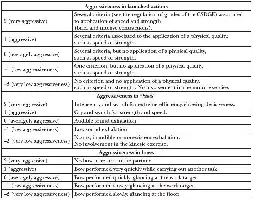
Presentation of possible examples of evaluation criteria enabling to fill the observation grid. The examples target the forms of praxic and kinesic aggressiveness (launched actions “kiais”), as well as bows

Observations of all the launched actions expressed in “kihon,” alone or targeted, conventional or free attacks and in “kata,” for populations of convicts and club members of both sexes. They show significant disparities depending on the observed populations

Observations of all the “kiais” expressed in “kihon,” alone or targeted, in conventional or free attacks and in “kata,” for populations of convicts or club members of both sexes. They show significant disparities depending on the observed populations

Observations of all the bows performed before and after practices of “kihon,” alone or targeted, conventional or free attacks and “kata,” for populations of convicts or club members of both sexes. They show significant disparities depending on the observed populations
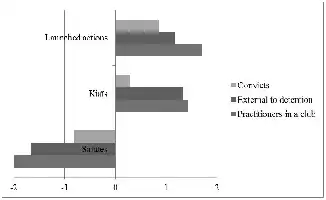
Emphasis on the significant disparities, between both the types of practitioners and the observed items. We can notice that convicts get significantly less involved in the forms of aggressiveness brought into karate practice than club members. The same is true regarding the practice of bows, for which convicts show less respect and consideration than club members

Characteristics of Participants (Study 2. Badminton)
Data are presented as mean; median [range].


Effect of Gender on the Level of Perceived Pleasure in Table Tennis (TT)*,**
* Score is significantly low in relation to equal distribution (Chi-squared test, p < .05)

