Balancing Conservation and Community Welfare
Enhancing the Management of Marine Protected Areas in Indonesia
- By Muhammad Syukri,
- M. Sulton Mawardi,
- Lia Amelia,
- Annabel Noor Asyah,
- Made Anthony Iswara,
- Coordination : Oskar Lecuyer
- and Emmanuel Fourmann
Pages 1 to 40
Cite this chapter
- SYUKRI, Muhammad,
- MAWARDI, M. Sulton,
- AMELIA, Lia,
- ASYAH, Annabel Noor,
- ISWARA, Made Anthony,
- Coordination : LECUYER, Oskar
- and FOURMANN, Emmanuel,
- Syukri, Muhammad.,
- et al.
- Syukri, M.,
- Mawardi, M.-S.,
- Amelia, L.,
- Asyah, A.-N.,
- Iswara, M.-A.,
- Coordination : Lecuyer, O.
- and Fourmann, E.
Cite this chapter
- Syukri, M.,
- Mawardi, M.-S.,
- Amelia, L.,
- Asyah, A.-N.,
- Iswara, M.-A.,
- Coordination : Lecuyer, O.
- and Fourmann, E.
- Syukri, Muhammad.,
- et al.
- SYUKRI, Muhammad,
- MAWARDI, M. Sulton,
- AMELIA, Lia,
- ASYAH, Annabel Noor,
- ISWARA, Made Anthony,
- Coordination : LECUYER, Oskar
- and FOURMANN, Emmanuel,
Notes
-
[1]
https://worldpopulationreview.com/country-rankings/countries-by-coastline, assessed July 4, 2023.
-
[2]
https://www.fao.org/3/cc0461en/online/sofia/2022/capture-fisheries-production.html, assessed July 4, 2023.
- [3]
-
[4]
KKP stands for Kementerian Kelautan & Perikanan, which translates to Ministry of Marine Affairs and Fisheries
-
[5]
BPS stands for Badan Pusat Statistik, which translates to Central Bureau of Statistics
-
[6]
During the examination of the mean differences in poverty rate between 2010 and 2015 in MPA and non-MPA villages, it was observed that the reduction in poverty rate in MPA villages from 2010 to 2015 is significantly less compared to non-MPA villages.
-
[7]
The test result suggests that MPA villages has significantly higher increase in the Gini Index compared to non-MPA villages.
-
[8]
BKKPN stands from Balai Kawasan Konservasi Perairan Nasional, which translates to National Marine Conservation Area Agency
-
[9]
RT (Rukun tetangga) refers to the smallest administrative unit within a village. It is a neighborhood unit consisting of a group of households.
-
[10]
RW (Rukun warga) is a higher-level administrative unit consisting of several RTs within a village.
-
[11]
One of the authors of the paper, Amher Hakim, is the high rank officer at the Ministry of Marine and Fisheries (MMF) who is directly responsible on supervising the operation of all MPA under the MMF.
1 – Introduction
1 The marine sector plays a crucial role in supporting the livelihood of individuals, especially in Indonesia. With a coastline of 99,083 kilometers, Indonesia is the second-longest in the world after Canada [1]. Its fish capture production in 2020 stood at 6.43 million tons, ranking it as the second largest globally after China [2]. Approximately 90% of the economic activities of its 12,510 coastal villages have a link with the marine sector [3]. This sector sustains a considerable fraction of the population, with coastal fishermen households growing from 963,540 in 2019 to 1,020,048 in 2021. The number of sea fishermen was reported to be around 2,925,818, making up 2.23% of the total 131.05 million working people (KKP & BPS, 2021) [4], [5].
2 However, there exists a stark paradox. Despite the wealth of marine resources, coastal areas still grapple with high poverty rates. Extreme poverty in these areas in 2021 was 4.19%, slightly higher than the national average of 4% (Kompas, 2022). Of the 10.86 million impoverished individuals nationally, about 12.5 % (1.3 million people) live in coastal regions. This poverty statistic has been stable, if not slightly worsening, over the past decade.
3 On a provincial level, the KKP’s Marine and Fisheries Community Welfare Index indicates that, out of 34 provinces, 12 fall under the ‘maintenance’ category, with the remaining provinces needing improvement. The indicators that must be prioritized to enhance welfare quickly encompass five social fields, including aspects such as business institutions, revitalization of traditional communities, and economic indicators, including exchange value and average income (KKP).
4 Several regulatory frameworks emphasize the importance of the marine sector for people’s welfare. Article 33 of Indonesia’s Constitution entrusts the state with controlling and utilizing natural resources for the public’s prosperity. Law No. 32 of 2014 Regarding Maritime Affairs directs marine resource use for economic growth, welfare distribution, and coastal and marine ecosystem preservation. Law No. 27 of 2007 underscores the sustainable management of coastal zones and small islands for public prosperity, incorporating community participation, and national legal norms. Furthermore, Article 5 of Government Regulation (PP) No. 62 of 2010 detail the establishment and utilization of conservation areas and small outer islands, emphasizing community participation, welfare, and environmental conservation.
5 Specific to Marine Protected Areas (MPAs), Indonesia’s marine protected areas management policy focuses on two main themes, which are, to conduct and ensure sustainable management as well as utilization of conservation areas for the communities that live nearby. The latter theme includes sustainable fisheries, ecotourism, and other community-based environmental services aside from its function as a source of germplasm for the development of marine and fisheries research (KKP, 2020).
6 This paper will examine the status and challenges of improving the welfare of the poor coastal communities living near MPA. The main argument of this paper is that despite a comprehensive legal framework designed to uplift the livelihoods of coastal inhabitants, empirical observations suggest these regulations are not effectively achieving their intended goals. This is partly because of poor governance of MPA by paying attention more on the quantity than the quality of governance.
MPA designated by the Ministry of Marine Affairs and Fisheries until 2021

MPA designated by the Ministry of Marine Affairs and Fisheries until 2021
2 – Methods
7 This study employs a mixed method, combining qualitative and quantitative analysis. The qualitative data collection was conducted in three MPA locations in Savu Sea, Nusa Penida and North Minahasa (see Figure 2). The three MPAs were chosen purposively to represent a well-established MPA (Savu Sea), a fast-growing MPA (Nusa Penida), and an MPA in the early-stage of development (North Minahasa). Indonesian MPA is organized into several zones, with the core zone as no take zone. This specific zone has the biggest potential negative effects on coastal community’s livelihood. Hence, to assess how MPA institutions have interacted with the community, in each MPA one village closest to the core zone was selected.
Qualitative data collection locations

Qualitative data collection locations
8 The qualitative data was collected utilizing three data collection methods, comprising focused group discussion (FGD), in-depth interviews, and desk study. Five FGDs were conducted with participants from each village, with men and women and participant from poor and non-p in each village within the three MPAs, with separate sessions for men and women as well as participants from poor and non-poor households. To gain insights into the management of MPAs in each location, one FGD session was conducted with MPA stakeholders at the district level. In addition to FGD, in-depth interviews were also conducted with informants from national to village levels. The informants were the policy makers, experts and NGO at the national level; MPA managers, local governments, private sectors, and NGO at regional levels, and poor and non-poor household, community figures, and village government at village level. Lastly, a comprehensive review of MPA policy documents was conducted.
9 In addition to qualitative data collection and analysis, this study employs quantitative data analysis by utilizing secondary data from various surveys and census, including National Socio-Economic Survey (Susenas), Indonesia Family Life Survey (IFLS), and Village Potential Census (Podes), to examine the welfare and inequality in MPA and non-MPA areas in Indonesia. The survey and census data provide valuable information on factors such as expenditure, education, access to basic amenities, infrastructure, and financial support from time to time.
10 It is important to note that the availability of summary data at village-level, to represent villages near MPA areas, is not always available in all surveys or censuses. Podes data provides data summary at the village-level, but IFLS and Susenas data offers data summary at subdistrict-level and district-level, respectively.
11 This study acknowledges the multidimensional nature of poverty and adopts the World Bank’s definition of poverty, which comprises three key components: opportunity, empowerment, and security (IBRD, 2000). The areas to be measured in terms of opportunity in this study include access to education, credits, cellular phone signal, and alternative livelihoods. Empowerment focuses on indicators such as community participation, interaction of political and social processes, and social inclusion. Security encompasses aspects like access to social safety nets and healthcare services.
3 – Effective and Balanced Management of MPA : Lesson Learned
12 Management by state institutions is still the common feature of MPA everywhere. However, in many cases, as will be discussed shortly, the involvement of community and other parties have been initiated. Many scholars have discussed the paramount role of community participation in managing MPA. Community participation is not only important for instrumental reasons, that the community can perform some roles to help governing the MPA, but also for ethical and political reasons, namely because the MPA is located in their environment to which their livelihood is reliant.
13 In the context of Indonesian policy, participatory management, namely involving people in stages of management processes, has been institutionalized mainly in rural governance (Antlov 2019, Syukri 2022), and has long been practiced in many development activities, such as in education, health, developing various small-scale infrastructures etc. (Syukri et al. 2014). Although participatory approach in governance and development has been common, the contrasting trend emerged in the second period of Susilo Bambang Yudhoyono administration (in office 2004-2009, 2009-2014) and became stronger in the period of Joko Widodo (Jokowi) regimes (in office from 2014-2019, and 2019-2024). In the Jokowi administration, the role of the state has increased to a certain level that many scholars referred it as a New Developmental state (Warburton 2016, Syukri 2022). This concept highlights the greater and decisive role of the government in many aspects, especially in infrastructure and economic development. Relevant to the natural resources management in general and protected areas in particular, the dominant role of the government is epitomized in the entire aspects of MPA managements from designing, establishing, planning the activities, the implementation, and monitoring and evaluation. In the whole process the national government takes full responsibility.
14 In addition to be more participatory, the good MPA management has also paid as much attention to biodiversity conservation as to socioeconomic welfare of the people living in coastal areas near to MPA. Focus on sustainable fulfillment of the needs of the indigenous and local community, the poor and vulnerable people, for example, had been mentioned as one of the Aichi Targets (Target 14), and continue to be reiterated in the new Kunming-Montreal Global Biodiversity Framework (target 9-13). However, in many cases, as will be shown shortly, there are disconnection or discrepancies between the ideal type of MPA governance and the reality on the ground.
3.1 – Learning from Indonesian cases
15 Existing studies highlight this disconnection, particularly in the Indonesian context. Amkieltiella et al., (2022) laud Indonesia’s expansion of its MPA coverage but caution against the poor quality of management within these regions. Similarly, Kusumawati and Huang’s study (2015) in Weh Island, Indonesia, found that MPAs established through bottom-up processes and managed by local communities were more successful than top-down, centrally managed ones. Such findings suggest the importance of incorporating local perspectives and active participation in MPA management.
16 Perception of the MPA’s effectiveness also differs among stakeholders. According to Rosadi et al. (2022), influential stakeholders, directly involved in MPA management, believe in its effectiveness in improving community welfare. In contrast, less influential stakeholders, including the community itself, perceive no impact on their welfare. King, Adhuri, and Clifton (2022) further emphasize this, arguing that resilience-based management must account for local politics and power dynamics to truly understand the impacts and trade-offs for stakeholders.
17 These studies collectively underscore the need for MPA management to improve both conservation and socio-economic outcomes. However, the current regulatory framework and implementation often prioritize the former over the latter, turning the supposed balance into a mere showcase. Studies report that only about a third of MPAs in Indonesia are well-managed by the government’s standards (Amkieltiella et al., 2022). The government has shown immense orientation towards increasing MPA numbers without due attention to their management quality. In this context, quantity seems to overshadow quality.
18 While social aspects, including concerns for coastal community welfare and livelihoods, are accommodated in MPA management guidelines, empirical evidence suggests this is mostly theoretical. In practice, MPAs are more geared towards ecological-related goals, often sidelining social targets. This disconnects between theory and practice raises important questions about the efficacy and purpose of MPAs. It calls for a more balanced approach to MPA management, one that does not sacrifice community welfare at the altar of conservation.
3.2 – Lessons from Global Experiences
19 While focusing on local contexts and challenges is crucial, gleaning insights from global experiences can provide valuable lessons and strategies for better MPA management in Indonesia. Globally, MPAs serve as vital conservation and management tools in the face of increasing environmental pressures. Their successful implementation can support biodiversity conservation, coastal management, and livelihood protection. However, challenges, such as lack of resources, community engagement, and capacity-building, can hinder their effectiveness, particularly in developing countries like Indonesia.
20 For example, Tanzania and Zanzibar have shown that poverty often forces communities to violate MPA rules, undermining conservation efforts (Tobey & Torell, 2006). However, it was found that MPAs with more prolonged investment and greater resources saw increased community support and a more positive perception. This finding suggests that Indonesia could benefit from sustained resource allocation and commitment to MPAs to attain conservation and development goals concurrently. In Mozambique, the significance of substantial community involvement in the selection of marine conservation tools was highlighted (Rosendo et al., 2010). This engagement helped to alleviate poverty and ensure sustainable resource use, a lesson that can be applied to Indonesia, where including a broader range of marine conservation approaches and local views can strengthen MPA management.
21 Experiences from Brazil, which like Indonesia, underwent significant political changes, including the decentralization of authority and integration of coastal management into national policies (Wever et al., 2012). However, persisting issues like institutional and legal weaknesses, resource user conflicts, and government mistrust have continued to pose challenges. To address these, enhancing community knowledge, capacity, and official ecosystem protection support is crucial. This experience could be beneficial for Indonesia, indicating the importance of actively involving local communities in MPA management and harnessing their unique capabilities.
22 In developed countries like those in the Mediterranean, MPA management has shown that these areas can have significant socio-cultural impacts, alongside their environmental benefits (Badalamenti et al., 2000). This underscores the importance of considering the unique characteristics of coastal areas in MPA planning and management, an approach that could be advantageous for Indonesia. In the United Kingdom, studies emphasize the importance of understanding coastal zone processes in depth to inform future strategy planning (Bailey & Nowell, 1996). This multi-faceted approach could provide valuable insights for Indonesia, highlighting the need for a comprehensive understanding of coastal processes and community dynamics in MPA management. Finally, rigorous monitoring, as practiced in Portugal, has been instrumental in assessing changes in fisheries activities and evaluating the impact of MPAs on fishing communities (Batista et al., 2015). Such monitoring, coupled with comprehensive data collection, can inform effective MPA management in Indonesia.
23 By considering these global insights and experiences, Indonesia can enhance its MPA management, bolstering both environmental and socio-economic outcomes. This involves commitment to resource allocation, community empowerment, and flexibility in management approaches. Success will ultimately rely on Indonesia’s commitment to continual learning, adaptation, and collaborative action, ensuring MPAs serve as effective tools for both conservation and community welfare improvement.
4 – MPA in Indonesia: An Overview
4.1 – Policy Perspective: Maritime and Conservation Area Development in Indonesia
4.1.1 – Maritime Development Policy in Indonesia
24 Over the past near decade since Indonesian President Joko “Jokowi” Widodo regime came to power in 2014, the Indonesian government has begun to pay more attention to the development of marine and coastal areas. This can be seen from several policies and programs that encourage the improvement of the Indonesia’s economy through the development of maritime areas. President Jokowi even issued Presidential Regulation Number 16 of 2017 concerning Indonesian Maritime Policy. It contains an ambitious vision, which is to make Indonesia a World Maritime Axis.
25 Indonesia is expected to become a maritime country that is advanced, sovereign, independent, strong, and able to make a positive contribution to regional and world security and peace in accordance with national interests. To actualize this, 12 targets have been compiled which are the main missions of Indonesia’s maritime policy. One of the missions is to achieve equitable prosperity for coastal communities and small islands. Furthermore, Indonesia’s maritime policy is structured based on seven main pillars, where one of the pillars also elaborates on the importance of improving people’s welfare in maritime affairs, namely pillar number 4 which focuses on the marine economy and infrastructure and increasing welfare. The government has even prepared a comprehensive strategy to achieve the welfare of the community, especially by focusing on supporting fishermen, fish cultivators, and salt farmers. These strategies include: (a) building facilities and infrastructure in developing businesses; (b) capability and capacity building; (c) provision of access to science and technology, information, land, and financing; (d) expansion of employment and business opportunities, particularly in the fisheries, energy and marine tourism sectors; and (e) improving management of marine resources for marine tourism for coastal communities and small islands.
26 It does not stop there. In the 2021-2025 Indonesian Maritime Policy Action Plan which is aligned with the development agenda in the 2020-2024 National Medium-Term Development Plan (RPJMN), there are programs and activities that aim to develop areas to reduce inequality and ensure equity. The facts mentioned above provide a clear picture of how increasing people’s welfare and reducing inequality in coastal areas has become one of the main focuses of marine development in Indonesia and is formalized in the form of policies and regulations.
4.1.2 – Conservation Area Development Policy in Indonesia
27 In line with maritime development policies, regulations regarding marine protected areas also indicate the importance of improving people’s welfare. This is illustrated by several regulations which form the legal basis for the management of marine protected areas. Law no. 31 of 2004 concerning fisheries, in the consideration section states that in the context of implementing national development, the management of fish resources needs to be carried out as well as possible. The management should be based on justice and equity in resource utilization by prioritizing expanding employment opportunities and increasing the standard of living for fishermen, fish cultivators and/or other parties that related to fishery activities and fostering the preservation of fish resources and their environment. This statement clearly aligns the position of efforts to improve people’s welfare with efforts to create sustainable fish resources and the environment. Furthermore, in article 6 paragraph 2 of the Law, it is stated that the management of fisheries for the benefit of fishing and fish farming must consider customary law and/or local wisdom and pay attention to community participation.
28 The mandate to accommodate community participation is also stated in Law no. 27 of 2007 concerning Management of Coastal Zone and Small Islands. In article 4 it is stated that the management of coastal areas and small islands is carried out with 4 objectives, two of them are to: (1) strengthen the participation of the community and government institutions and encourage community initiatives in managing coastal resources and (2) increase social value, economy and culture through community participation in the utilization of coastal and small island resources. Article 63 paragraph 1 even states that the government and regional governments are obliged to empower the community to improve their welfare.
29 The various legal foundations used as the basis for the management of conservation areas clearly mandate the importance of improving community welfare and involving the community in the management and utilization of coastal areas. However, such messages are lost in translation when the Ministry of Marine Affairs and Fisheries (MMF) developed the technical guidance of the Law in the form ministerial regulations. In the Regulation of the Minister of Marine Affairs and Fisheries of the Republic of Indonesia No. 31/PERMEN-KP/2020 concerning Management of Conservation Areas, it states that the objectives of managing conservation areas are for (1) protection, preservation and utilization of biodiversity and/or fish resources; and/or (2) protection, preservation and utilization of traditional cultural sites. This is in stark contrast to the previous Ministerial Regulation, namely the Regulation of the Minister of Maritime Affairs and Fisheries of the Republic of Indonesia No. 02 of 2009 concerning Procedures for Designating Marine Protected Areas which states that two of the four objectives of implementing conservation areas are (1) preserving local wisdom in managing fish resources in and/or around water conservation areas; and (2) improving the welfare of the community around the water conservation area. This reduction in meaning on the importance of community welfare is reflected in the conditions on the ground that people living in conservation areas have no better livelihood conditions than people living in non-conserved or non-marine areas, the topic to which we will comeback shortly.
5 – Result
5.1 – Indonesian Coastal Communities Welfare Overview
30 As an archipelagic country with around 17,504 islands and having a marine area of 5.8 million km2 or 71% of the total area, makes Indonesia’s marine very rich in biodiversity and fisheries resources. This is supported by the fact that Indonesia marine area is located in the Coral Triangle location, where it is estimated that around 2.5 million hectares of coral reefs live in it and are home to very diverse marine creatures. Indonesia is also known as the second largest producer of fishery products in the world after China. This can be seen from the fishery production figures which tend to be high, both for marine fisheries and marine culture. It was recorded that in 2020 the volume of marine fisheries production reached 6,989,090.36 tons. As for marine culture, it reached 8,499,280.75 tons (KKP, 2022). With all of the potentials that possessed by the Indonesia marine area, it can actually strengthen the welfare of coastal communities. But in reality, there are still many of them who live below the poverty line.
31 In Indonesia, there are around 52,329 coastal villages with 2,359,264 marine fishermen and 280,652 marine cultivators in 2021 (KKP, 2022). Nevertheless, the Indonesian Maritime and Fisheries Community Welfare Index in 2021 only reached 60.31, while the highest index was 100.00. Added to this is the fact that the contribution of fisheries GDP to national GDP in the 4th quarter of 2021 is only 2.80%. This percentage is still far below the GDP contribution generated by the agriculture, livestock, hunting and agricultural services sectors which contribute 7.95% to national GDP (KKP, 2022).
32 This means that comprehensive improvements are still needed so that the welfare of marine and coastal communities increases every year. The low level of welfare of coastal communities in Indonesia, especially those who work as fishermen, is caused by several factors such as limited access to capital, difficulty obtaining fuel, limited fishing gear and uncertain weather conditions that determine the course of shipping (Sugiharto et al., 2022, chap. 72). Other influencing factors are the limited use of technology to predict the weather and the lack of access to work safety insurance which often hinders fishing activities considering that fishermen’s performance is very dependent on good weather (Hanri et al., n.d., p. 9).
5.2 – Areas near MPAs face deteriorating socioeconomic conditions as indicated by rising inequality and a less substantial improvement in poverty rates
33 Ensuring decent welfare and living conditions for communities near MPAs is of paramount importance for several reasons. Firstly, these communities often rely heavily on the natural resources provided by the marine environment for their livelihoods, such as fishing, tourism, and other marine related activities. Supporting their well-being equally contributing to the sustainability of their livelihoods and help preserve the biodiversity of marine ecosystems. Secondly, communities near MPAs play a crucial role in conserving and managing the protected areas. They safeguard the environment and have local knowledge that can contribute to effective conservation practices (Ferse et al., 2010).
34 However, despite the significance of ensuring the welfare of communities near MPAs, it is concerning to observe deteriorating socioeconomic conditions among populations residing in areas near MPAs in Indonesia. These communities face higher levels of poverty and declining socioeconomic conditions, as shown in various indicators. One of the indicators is the percentage of individuals in the bottom 20% of expenditure. A higher proportion of individuals living in MPA districts falls under the bottom 20% (Quintile 1) of expenditure bracket compared to those residing in non-MPA districts from year to year (see Figure 3).
Population expenditure quintile by district proximity to MPAs(1),(2)

Population expenditure quintile by district proximity to MPAs(1),(2)
Notes:(1) MPA district: District with at least one MPA village. 104 MPA districts out of 514 districts.
(2) MPA village: Villages within 2 km from MPAs or adjacent to MPA village with fish capture as main livelihood sector
35 Another crucial indicator that reflects the socioeconomic disparity are the poverty rate and Gini Index. The poverty rate measures the proportion of population living below the poverty line, while Gini Index assesses expenditure or income inequality, which provides further insights into the socioeconomic condition of communities near MPAs.
36 Figure 4 shows that, on average, poverty rate in MPA villages is higher than non-MPA villages. Both MPA and non-MPA villages experienced a decline in poverty between 2010 to 2015, suggesting an improvement in population economic conditions. However, MPA villages had a less substantial decline [6] in poverty compared to the non-MPA villages. In contrast, the average Gini Index increased from 2010 to 2015 in both MPA and non-MPA villages (see Figure 5). It indicates a rise in expenditure inequality within both regions. However, MPA villages witnessed a greater increase [7] in the Gini Index compared to non-MPA villages. These findings highlight the urgent need for targeted interventions and support to improve the socioeconomic conditions of the communities residing near MPAs to address poverty and reduce inequality. Failure to address these challenges may result in further marginalization and hinder the conservation effort in these areas.
Mean poverty rate in 2010 and 2015 by village proximity to MPAs

Mean poverty rate in 2010 and 2015 by village proximity to MPAs
Mean Gini Index in 2010 and 2015 by village proximity to MPAs
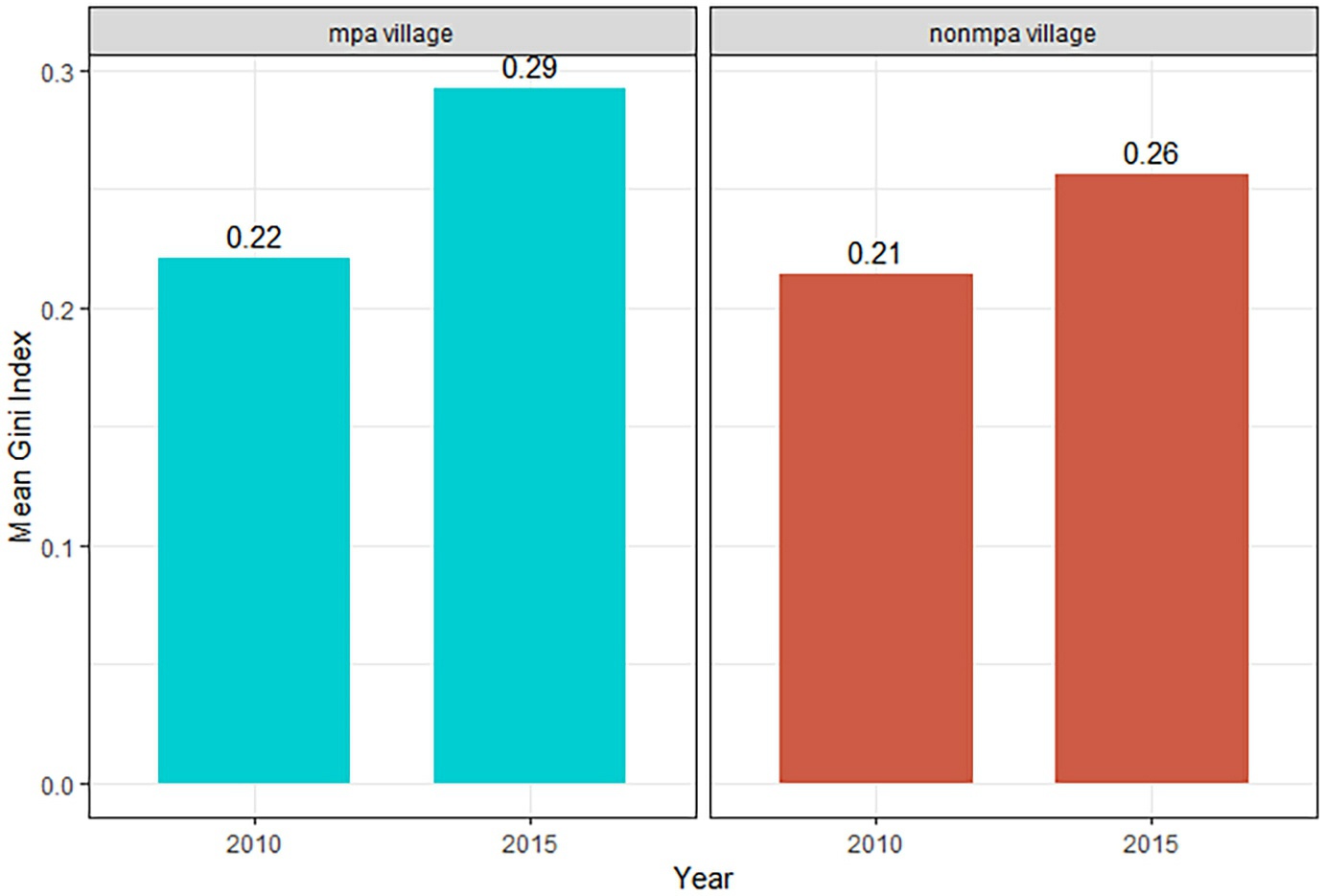
Mean Gini Index in 2010 and 2015 by village proximity to MPAs
37 The relationship between poverty rate and Gini Index is also examined to identify patterns or potential associations between changes in poverty rates and expenditure inequality during specified period of time. The relationship between poverty rate and Gini Index at the village level suggests a very weak and almost no linear relationship between poverty and Gini Index in MPA villages in 2010 and 2015 (see Figure 6A). It indicates that the changes in poverty rates in MPA villages are not strongly associated with changes in expenditure inequality. However, it is worth noting that there is a change in the correlation coefficient’s direction, shifting from negative in 2010 to positive in 2015 in MPA villages.
38 Meanwhile, the correlation coefficient between poverty rates and Gini Index of non-MPA villages in 2010 and 2015 are still considered weak but stronger compared to MPA villages, as depicted in Figure 6B. The negative correlation coefficients in 2010 and 2015 in non-MPA villages imply an inverse relationship between poverty and expenditure inequality, with higher poverty rates associated with lower expenditure inequality, and vice versa.
The relationship between poverty and Gini Index in MPA villages (A) and non-MPA villages (B)

The relationship between poverty and Gini Index in MPA villages (A) and non-MPA villages (B)
Notes:There are around 2,000 mpa villages out of almost 80,000 villages in total, but the number may vary from year to year due to the creation of new villages
5.3 – Access to basic amenities, financial support, and infrastructure in areas near MPAs exhibits disparities, and the development of alternative livelihoods poses challenges for these regions
39 The challenges faced by communities residing near MPAs in Indonesia are multifaceted. Limited access to basic amenities and infrastructure, and a lack of financial resources contribute to their struggles. The disaggregated data from Susenas and Podes shows that disparities in accessing basic amenities, infrastructure, and financial support are more evident in areas near MPAs. The data shows that the locations near MPAs do not show a tendency to catch up with national or non-MPA areas in access to infrastructure, as demonstrated in Figure 7A, Figure 8A, and Figure 8B.
Households with adequate sanitation (A) and high school gross enrollment ratio (B) by district proximity to MPAs(1),(2)

Households with adequate sanitation (A) and high school gross enrollment ratio (B) by district proximity to MPAs(1),(2)
Notes:(1) ADEQUATE_SANITATION: sanitation facilities that meet the standards for the both the upper and lower structures.
(2) GER HIGH: The ratio of the population attending high school to the total high school-age population.
The availability of strong phone signal (A) in the villages and the average number of Community Credit Bank (B) by village proximity to MPAs(1),(2)

The availability of strong phone signal (A) in the villages and the average number of Community Credit Bank (B) by village proximity to MPAs(1),(2)
Notes:(1) INFRA_SIGNAL: strong handphone signal.
(2) ECON_BPR_N: The number of Community Credit Bank.
40 MPA districts continue to face challenges in accessing adequate sanitation, with a lower percentage of households having access compared to national or non-MPA districts (see Figure 7A). Furthermore, there has been limited progress in improving this condition from 2020 and beyond, as evidenced by the stagnant trend depicted in the line chart. In terms of public infrastructure, Figure 8A shows that MPA villages consistently face a lack of reliable phone signal. Moreover, there is no evidence of significant progress in bridging the gap between MPA and non-MPA villages, raising concerns about communication accessibility in MPA villages and highlighting the need for improvement.
41 Examining the financial landscape, the financial support available to community residing in MPA villages is insufficient, as indicated by the limited number of community credit banks in MPA villages (see Figure 8B). Despite the challenges of limited access to essential resources, the population residing in MPA districts exhibits comparable or even higher levels of participation in various stages of education, such as high school, as seen in Figure 7B, when compared to national or non-MPA districts.
42 In both MPA and non-MPA villages, the agriculture, fisheries, and forestry sectors continue to be the primary sources of livelihood. Figure 9 shows that from time to time, the most common agriculture, fisheries, and forestry commodities in both village types are rice, food crops, and plantation (such as rubber, palm oil, coffee, cocoa, coconut, cloves, tobacco, and sugarcane), with fish captures being more prevalent in villages near MPAs.
Main commodity of villages with agriculture, fisheries, and forestry as the main sectors, categorized by village proximity to MPAs

Main commodity of villages with agriculture, fisheries, and forestry as the main sectors, categorized by village proximity to MPAs
43 Although MPAs often impose fishing restrictions or regulations within their boundaries to protect marine biodiversity and promote sustainable fishing practices, there does not appear to be a noticeable reduction in fish captures activities in MPA villages, as shown in Figure 9 above. Instead, there seems to be an increase in this activity. This can be attributed to several factors. Firstly, the locations of MPAs may be distant from the areas where people engage in fishing activities, resulting in minimal direct impact on their fishing practices. This inference is supported by the findings from a qualitative assessment regarding the MPA in Sabu Raijua district. In the case of the MPA near Sawu Island in Sabu Raijua district, the MPA serves as a core zone located in the open sea, where fish capturing activities are not likely. This zone is intended for cetacean conservation, as suggested by one of the informants from Balai Kawasan Konservasi Perairan Nasional (BKKPN) [8] in Kupang City:
“If it’s for the core zone, it is a no-take zone. Whatever activities the community has, they are not allowed to go there. It is specifically for research purposes. As for the impact on the community, in terms of economy, it has not been measured yet. But in Sawu (sea) itself, the conservation target is primarily focused on marine mammals. This is because Sawu is a migration route for marine mammals, including whales and dolphins. Therefore, this large core zone aims not only to protect fisheries resources but also to preserve marine mammal populations. The community rarely engaged in activities within the core zone even before 2014 (re: designation of MPA) because it is in the open sea. However, it is possible that large vessels from outside conduct activities there.”
45 Secondly, the lack of noticeable reduction in fishery activity may suggest that the enforcement of fishing restrictions within MPAs may be inadequate or insufficiently implemented (Yu et al., 2022). Lastly, depending on the duration of each MPA’s existence, the implementation of MPAs may not lead to a systematic drop in total catch or an increase in travel distance due to the spillover of fish and other harvestable species (Kerwath et al., 2013).
46 Nevertheless, even though there is no decrease in fishery activity within areas near MPAs, the creation of MPAs can result in the reallocation of rights, presenting a mixture of benefits and disadvantages for the stakeholder engaged. MPAs may benefit local fisheries through fish spillover, resulting in increased catch (García-Rubies et al., 2013; Kerwath et al., 2013). The qualitative assessment found that the MPA near North Minahasa district had increased local fish catches, with the widely held perception that the fish spillover effect is the contributing factor to this increase, as suggested by informants during data collection:
47 “Since the establishment of MPA (a type of core zone), it has become easier to find fish. The marine habitat has become healthy overall. There are now plenty of fish, so we no longer need to travel far to search for them” (Informant from non marginal community member, [02/02/2023])
“We truly feel the benefits of the restricted zones. In those prohibited zones, fish are able to spawn and grow. Once they reach maturity, they migrate to the zones allowed for fishing. That is where we catch them. The fish are now bigger and ready to be caught. There are more fish now. The benefits are indeed significant”
49 However, the fish spillover effect is typically experienced over an extended period rather than immediately. Therefore, MPA authorities need to consider short-term compensation or explore alternative livelihood options to address the displacement of rights to access resources. Diversification into alternative livelihoods can offer a potential solution to alleviate the strain on fisheries and the resource. Some alternative livelihood strategies include tourism, seaweed farming, agriculture, and handicraft production (Leisher et al., 2007).
50 Developing alternative livelihoods for those living near MPAs can be challenging in practice. For instance, tourism does not always significantly improve the economic well-being of communities near MPAs and often serves as a secondary income source rather than a primary alternative livelihood (Pham, 2020; Pham-Do and Pham, 2020). However, other studies have found that community incomes from alternative livelihoods, particularly in tourism, have increased (Driml, 1999; Merino et al., 2009). Data from Podes shows that there has been a growing trend of marine tourism activity in MPA villages over time, with a higher percentage of these villages utilizing sea resources for tourism compared to non-MPA coastal villages, as shown in Figure 10A. However, it is important to test and measure the impact of MPAs on tourism activity to ensure that marine tourism is related to MPAs and not merely reflecting external changes.
The percentage of coastal villages utilizing sea resources for tourism (A) and the average number of midwives by village proximity to MPAs(1),(2)

The percentage of coastal villages utilizing sea resources for tourism (A) and the average number of midwives by village proximity to MPAs(1),(2)
Notes:(1) MARINE_TOURISM: Coastal village utilizing sea resources for tourism.
(2) HEALTH_MIDWIFE_N: The number of midwives.
51 Qualitative data collected in Sabu Raijua, Nusa Penida, and North Minahasa indicated a lack of formal alternative livelihoods strategies being promoted by MPA authorities, as suggested by informants below. However, in the case of Nusa Penida, while the direct connection between MPAs and the growth of tourism remains unclear, it is noteworthy that tourism has emerged as a significant economic driver in the local economy.
52 “Surely, we predict that the establishment of MPAs will not be able to satisfy the entire community. Yet, the hope is that it can also benefit the community. So, the community’s livelihoods must be truly strengthened. Due to zoning restrictions, the community must be resilient. Alternative livelihoods should be sought for them. Because it is something new for them. We shouldn’t just impose restrictions without providing solutions for them.” (Informant from Nongovernmental organization in North Sulawasi, [31/01/2023])
“There is actually a lot of potential in Sabu. There are resources that can be utilized by the local community. There are still plenty of fish there. However, due to limited utilization, the economic condition doesn’t change much. So, I think it would be better to diversify the range of economic activities there”
5.4 – Areas near MPAs show higher participation in poverty alleviation programs and face challenges in healthcare accessibility
54 Safety nets to support the communities near MPAs, including cash transfer, are crucial to ensure the communities’ well-being and security (Fletcher and Büscher, 2020; de Lange et al., 2023). This support is a potentially powerful mechanism for facilitating shifts in fishing practices or limitations on resource access. These measures are expected to maintain social stability, alleviate poverty, and reduce inequality of communities near MPAs. Furthermore, these forms of support have potential to reduce environmentally damaging development models and extractive industries as livelihood alternatives. Findings from similar cash-transfer programs implemented to address poverty in Indonesia suggests that cash transfer support can contribute to conservation efforts, including the reduction in deforestation rates (Ferraro and Simorangkir, 2020).
55 In MPA districts, the percentage of households receiving assistance from Program Keluarga Harapan (PKH, an Indonesian version of the conditional cash transfer) or local government program is higher compared to non-MPA districts, as evidenced by the data presented in Figure 11A. This finding suggests that the program effectively targets poor households in areas where poverty is more prevalent, as depicted in Figure 3 and Figure 4. However, due to limited data availability, it is unclear whether the assistance received by households near MPAs, other than PKH, is specifically aimed to compensate for the conservation program or if it plays role in conserving marine areas.
Households accepting social stimulus (A) and population with government-funded healthcare program coverage (B) by district proximity to MPAs(1),(2)

Households accepting social stimulus (A) and population with government-funded healthcare program coverage (B) by district proximity to MPAs(1),(2)
Notes:(1) BANSOS: acceptance of Program Keluarga Harapan, a conditional cash transfer program or local government stimulus program.
(2) HEALTH_INSURANCE: individual ownership to govt-funded health care insurance program, that is BPJS or Jamkesda
56 Shifting the focus to the realm of healthcare, the accessibility and coverage of health services present a contrasting picture. Starting from 2020, the percentage of individuals who are covered by government-funded healthcare programs in MPA districts is lower than those residing in non-MPA districts (see Figure 11B). However, the gap is beginning to narrow the following year. Furthermore, the discrepancy in access to healthcare resources is evident in Figure 10B revealing that MPA villages have fewer midwives on average than national or non-MPA villages, highlighting inadequate access to healthcare services in areas near MPAs. Geographical factors can play a role in this condition as communities near MPAs usually are situated in remote or isolated areas that may lack healthcare facilities.
5.5 – Community involvement in areas near MPAs demonstrates mixed levels, with the existence of gender disparities
57 Community participation residing in areas near MPAs is crucial for effective and sustainable conservation efforts. It ensures that local communities are active partners in the management of natural resources, which can lead to improved livelihoods, social well-being and long-term biodiversity resilience (Rahman et al., 2022; Shah et al., 2019). Community participation creates opportunities for dialogue, knowledge sharing, and collective decision-making, empowering individuals and communities to voice matters that affect them.
58 While quantitative data on community participation in marine conservation areas is limited, the level of participation can be inferred from IFLS data on individuals’ involvement in general community activities at subdistrict level. This information provides valuable insights into the extent of engagement of communities near MPAs. Findings suggest that individuals living in subdistricts near MPAs have lower levels of participation in community activities, including voluntary labor and voting (see Figure 12B and Figure 12C). However, their participation rates in community meetings in various levels, that is household, RT [9], RW [10], village, subdistrict, and Village Advisory Board activities are relatively higher than those residing in non-MPA subdistricts, as depicted in Figure 12A. These results indicate a mixed pattern of community involvement in subdistricts near MPAs, with lower participation in some activities but higher participation in community meetings. To better understand this phenomenon, further research is needed to identify the specific dynamics influencing community participation near MPAs and to develop targeted strategies that promote inclusive engagement.
The percentage of population participated in community meetings (A), voluntary labor (B), and voting (C) by subdistrict proximity to MPAs(1),(2),(3),(4),(5),(6),(7)

The percentage of population participated in community meetings (A), voluntary labor (B), and voting (C) by subdistrict proximity to MPAs(1),(2),(3),(4),(5),(6),(7)
Notes:(1) MPA subdistrict: Subdistrict with at least one MPA village.
(2) The number of MPA subdistricts varies over time.
(3) IFLS was conducted in 13 provinces in Indonesia.
(4) Community meeting: meeting in each level, including household, RT, RW, village, subdistrict, and Village Advisory Board activities.
(5) Voluntary labor may include cleaning up the village.
(6) Voting: casting vote for president/DPD/DPR/Governor/Mayor/Village head in the most recent election.
(7) Question about voting is not available before IFLS 2007
59 When examining community participation by gender, our analysis revealed that female participation in community activities, such as voluntary labor, is generally lower than males, regardless of the subdistrict status (see Figure 13). It highlights the need to ensure that female voices are heard, and their perspectives are taken into account in community affairs, including MPA management.
Voluntary labor participation according to gender by subdistrict proximity to MPAs

Voluntary labor participation according to gender by subdistrict proximity to MPAs
60 When it comes to voting, interestingly, the percentage of females casting their votes is persistently higher than males in MPA or non-MPA subdistricts. Among females, the percentage of females participate in voting is higher in MPA subdistricts than those in non-MPA subdistricts, as shown in Figure 14.
Voting participation according to gender by subdistrict proximity to MPAs

Voting participation according to gender by subdistrict proximity to MPAs
6 – Discussion
61 The fact that communities live in near MPA areas are in the condition worse off in many respects than those in nonMPA areas is intriguing especially because the legal basis of MPA existence and operation as discussed above pay a considerable attention to their welfare. This paper argue that the way the MPAs have been managed contribute to the less effective measures they have to deal with welfare issues among communities live surounding MPA.
6.1 – MPA Management in Indonesia: An Examination of Governance
62 MPAs in Indonesia are administered either by the central government or the provincial government. Central government managed MPAs fall under the purview of the Ministry of Marine and Fisheries, specifically through agencies like BKKPN (National Marine Protected Area Office) and LKKPN. On the other hand, provincial government managed MPAs can be implemented through UPTD (Regional Technical Implementation Unit), local fisheries/marine agencies, or other institutions. Organizations such as BKKPN/LKKPN or UPTDs establish task forces or assign technical staff at the district or subdistrict level, which either serve as the main technical implementer or as a focal point.
63 Take the management of MPAs in the Savu Sea, for example. Based on our fieldwork, it falls under the central government through the BKKPN, which primarily focuses on raising MPA awareness, conducting restoration efforts, and updating data. However, BKKPN’s authority is limited; for example, they cannot litigate perpetrators—a power reserved for the PSDKP (Marine and Fisheries Supervisory Agency), another central government unit. In contrast, the Nusa Penida MPA is managed by the provincial government through the UPTD KKP Bali. This unit, which falls under Bali’s Head Maritime and Fisheries Agency, handles on-the-ground technical affairs, demonstrating a different management approach.
64 Non-government actors also take part in managing MPAs in Indonesia. NGOs play a critical role in managing conservation zones, conducting baseline studies, and monitoring activities, and providing funding and capacity building. Third parties, such as multilateral organizations or academics, support MPA management by setting agendas, generating knowledge, and advocating policies. Foreign tourists can contribute through moral support and small-scale funding. Local community groups and organizations also often have limited roles in managing MPAs, though some actively contribute to MPA monitoring and coral reef rehabilitation.
65 The government’s commitment to increasing the extent of Marine Protected Areas (MPAs) is a laudable step towards preserving marine habitats. However, current MPA management strategies have proven less than optimal, with issues arising from ineffective governance structures and inequality. Current governance seems to be "paper parks," where on paper, MPA governance considers both ecological and social factors, but both factors have yet to be implemented in its implementation. In general, a general lack of commitment from the government in managing MPAs has resulted in inadequate implementation. Management of conservation areas still falls short in fulfilling basic conservation functions, including spreading awareness, restoring biodiversity, and effective supervision and evaluation. One empirical evidence of this shortcoming can be observed when we had Focus Group Discussions (FGDs) with local communities in Raedewa Village, East Nusa Tenggara. A striking observation from the FGD was the stark lack of awareness of their existence and the underlying rationale of MPA, even though the village was within the MPA’s no take zone. Awareness-raising activities are primarily carried out by NGOs, and there seems to be a lack of continuity in these activities following the initial MPA establishment.
66 From what I see, the government is currently interning with NGOs. The NGOs are the ones who give ideas to the government about the Marine Protected Areas (MPA). If the NGOs don’t work on it, the government won’t either. (Community leader in North Sulawesi, [03/02/2023])
67 Limited financial resources are one key factor that contribute to the disparity between the Indonesian government’s commitment to expanding MPAs and the quality of their management. Adequate funding is a fundamental requirement for successful MPA management. However, many MPAs in Indonesia face severe financial constraints. These constraints hinder the enforcement of protection measures, monitoring and research activities, and the development and implementation of management plans. One example is Nusa Penida – a conservation area that is often lauded as a well-managed conservation area – only allocated Rp 100 million on conservation in a year. This amount is extremely small to cover the whole cost of managing all activities required to run the MPA adequately.
68 Capacity constraints are another key issue. The management of MPAs requires diverse skill sets, from marine biology and ecology to law enforcement, project management, and community engagement. However, there’s often a shortage of such skilled personnel in the agencies tasked with managing MPAs. When the authors went to consult with Bali’s Nusa Penida UPTD on conducting data collection, we were warned that the field staff were not competent enough and urged us to seek local figures and experts instead. The UPTD also recounted that there are neither onboard nor technical training that have been provided for staff as of February this year related to MPA management. This anecdote shows that there is a current shortage of trained personnel. In the future, this capacity issue further exacerbates the management problem. For example, a newly established MPA in a remote part of Indonesia may lack trained staff who can effectively monitor marine biodiversity, engage with local communities, or enforce regulations, which hinders the MPA from fulfilling its conservation objectives.
69 The lack of local community involvement can further hinder the effectiveness of Indonesia’s MPA. Local communities, particularly in coastal areas, are often heavily dependent on marine resources for their livelihoods. They possess a wealth of local ecological knowledge and have a direct stake in the health of marine ecosystems. However, their involvement in MPA management is limited. A lack of broad-based community involvement can result in management decisions that fail to consider local needs and circumstances, leading to resentment, non-compliance with regulations, and ultimately, ineffective conservation. MPAs formulation consults with various communities, especially those working in the marine and fisheries sector, but leaves out women, older people and people who do not depend their livelihoods on the marine sector. Therefore, only people who are involved in marine and fisheries generally know about MPA but with different levels of understanding. In Sabu, for instance, this inequality results in a narrow group of individuals, such as village or regency heads, being privileged on critical information about MPAs. It may be that these individuals are seen as possessing the requisite authority, knowledge, or position to participate in MPA-related discussions and decisions. This lack of information sharing leads to a troubling dynamic where MPA-related knowledge does not trickle down to the broader community. This seclusion of information can contribute to the perception of MPA-related information as a scarce, precious resource. Rather than being shared for the benefit of the entire community, it is guarded and controlled by a few, exacerbating the disparity in knowledge and power. C This scenario echoes what is referred to in the literature as the "benevolent elite" model of governance. Under this model, only a select few participate in decision-making processes as they are seen to hold the necessary information to govern effectively. While this model can sometimes work in specific contexts, it often leads to governance issues in MPAs. Consequently, not a single group during our FGDs said they understood about MPAs, let alone the impacts on their livelihoods. Instead, they recount descriptions of conservations that are not directly related to MPAs, such as the ban for sea turtle fishing and sand-digging.
70 In Bali, non-marginal groups have the highest level of understanding of MPA. On the other hand, marginalized groups who are not directly involved in marine affairs, such as housewives, have the lowest understanding on MPA. However, understanding on MPA seemed to be low even for those who are involved during the initial consultation. Most people initially agreed on the proposed zones despite their lack of understanding on MPAs amid a lack of information dissemination on MPAs during public consultations. However, some currently express their disagreements after they are aware of the potential impact of adequate MPA implementations. The government has strived to include local communities by supporting groups such as Community Supervision Group (Pokmaswas), Tourism Awareness Group (Pokdarwis), and Coral Enthusiast Group (KOMPAK). However, community involvement has dwindled over time, even though it was apparent during the MPAs’ initial establishment. While groups like Pokmaswas, Pokdarwis, and KOMPAK are involved in MPA management, they are highly dependent on government financial support, indicating a lack of sustainability.
71 One institutional barrier is the centralized governance of MPAs, with the inequality of decision-making between different government levels contributing to the MPA’s inadequate implementation. Law No. 23 of 2014 on Regional Government brings about a significant change in the management of the marine sector in Indonesia by transferring the authority from the district government to the provincial government. Such institutional arrangements do not encourage commitments to manage MPA adequately, with UPTD having limited funds, infrastructure (e.g., no boats for monitoring and stationaries in the office), and limited capacity of their staff to govern MPA. Despite the expressed need and desire of local officials to have more authority to manage MPAs, the law restricts the local government from exercising control over these areas. Consequently, the local government finds itself lacking the necessary authority to effectively manage MPAs within their jurisdictions. This limitation prevents them from taking decisive actions on issues related to MPAs and their surrounding areas, even though they possess the required resources such as financial means or technical tools for MPA management. Another crucial challenge arises from the interconnectedness and overlapping areas of authority between provincial and district governments in managing MPAs. While the task of MPA management lies with the provincial government, the responsibility of supporting small fishers falls under the authority of the district government.
72 Such a slow and unresponsive process may undermine trust and cooperation among different community stakeholders. One fisherman in Sabu recounted that he and his peers would rather take actions on his own rather than consulting with authorities after several unsuccessful attempts to report incidents of illegal fishing to the authorities, which yielded no action. He described these illegal fishing activities as fishermen from outside his area who employ hazardous and environmentally harmful fishing techniques like using poisons or explosives. This lack of trust also explains why he avoids attending government meetings and declining invitations; he prefers to remain unaware of fishing in prohibited areas but remains committed to using environmentally friendly methods. He warned that he would take matters into his own hands if he ever met these illegal fishermen again.
6.2 – The underlying issues
73 While those governance issues discussed above are valid, there are more fundamental issues that worth discussion, that is the tendency among bureaucrats to prioritize quantity over quality. This tendency is very apparent in government efforts to expand the number of MPA in Indonesia. The effort of Indonesian government to establish MPA has started long ago, and significantly increase since the reform era in 1999. But, as can be seen in Figure 13, the most significant upsurge happened in the era of President Joko Widodo (Jokowi) (elected for two terms: 2014-2019, 2019-2024). And up until 2020, Indonesia has about 300 protected areas. Of the 300, 196 are protected through the scheme of MPA legal status, and the rest are basically the terrestrial protected areas but to some extent incorporate marine ecosystem (KKP 2020). The 300 protected areas cover about 23.9 billion ha of marine areas in 34 provinces. The coverage of MPA in Indonesia has exceeded the initial target to conserve 10% of its coastal and marine areas by 2020. However, in term of quality of governance, the government itself admit (Amkieltiela et al. 2022) [11] that only a small number of the MPA that have already performed well in a sense of implementing the management plan issued by the MMF. The biggest number of MPA is formally exist but not really functioning to conserve the biodiversity, let alone to empower people who live in coastal areas near MPA.
The progress of MPA establishment in Indonesia from 1978-2020, in million Ha

The progress of MPA establishment in Indonesia from 1978-2020, in million Ha
74 According to some experts, the steep increase in the establishment of MPA in Indonesia in that booming period to some extent is influenced by new environmental governance system introduced in 2014 by Law Number 23 2014 on Local Government (Triyanti et al. 2023). The Law that according to many experts (Darmastuti 2015) leaned toward a more centralized governance has transferred authority that was districts government’s to the national and provincial government (provincial government in Indonesian political system is part of the national government regime) to tackle most of the environmental issues. In such a centralistic regime, most of MPA establishment and management is by the government (mostly national), and small number of them by non-governmental actors.
75 The fast growing of Indonesian MPA is also influenced by international regimes of environmental governance. In this case, the prominence regime is Aichi Target of UN-Convention on Biological Diversity that was established in 2010. The 11th of the Aichi Target had set the conservation target for country members that at least 10% of country’s coastal and marine areas had to be conserved by 2020. Although internationally the Aichi target 11 was failed to be fulfilled, Indonesia had exceeded the target before 2020.
76 To formulate the replacement of the Aichi target, at the end of 2022, the UN CBD held the Conference of the Parties (COP) 15th in 2022 and came with the new agreement and new target for the environmental protection that is known as Kunming-Montreal Global Biodiversity Framework (GBF). The participating countries set the target ‘to live in harmony with nature’ by 2050. To achieve the ultimate target the COP also agreed about the intermediate target by 2030. The specific target on the marine sector is to conserve at least 30% of coastal and marine areas by 2030. Responding to the new Global Biodiversity Framework, the Indonesian government has set the new target for expanding Indonesian MPA to cover 32.5 million ha by 2030 (KKP 2020). Judging from the way Indonesian government had expanded its MPA in the past to achieve the Aichi Target, it seems it will also easily achieve the target, although we highly doubt with the governance quality.
77 The fact that most of the MPA establishment was on its booming period in 2014 onward, hence so quickly, is not a unique case of governance in MMF. The same case can be easily found in other sectors/ministries in Indonesia, such as in the village governance that has also experienced big transformation since 2014 with the introduction of the new Law Number 6, 2014 on Village. One of the policies of the Ministry of Village under this new law is to boost the establishment of village-owned enterprises (Badan Usaha Milik Desa or BUMDes) as the backbone of village developments. According to Syukri (2022), only in few years the number of BUMDes has experienced unimaginably steep increase up to more than 4000%. However, the empirical data showed that also a very small number of the BUMDes that really function as they should have been.
78 The tendency to focus more on the quantity and pay less attention to the quality of MPA governance is also reflected in the monitoring and evaluation system established by the MMF. The system that is called EVIKA (stands for Evaluasi Efektivitas Kawasan Konservasi/Evaluation of MPA Effectivity) introduced in 2020 by the Ministry and has been used ever since as a standardized mechanisms to evaluate the performance of MPAs. The EVIKA is actually a comprehensive system that provides framework, mechanisms, and tools to evaluate four components of what it calls adaptive governance of MPA, consisting the inputs, process, output and outcome. For each component there are variables and indicators that will be marked with scoring. At the end, the score of all components will be accumulated and ranked from gold (MPA that gain 85% of total score or higher), silver (50-85% of total score), and bronze (less than 50%).
79 Despite its comprehensiveness, specifically in its social aspects EVIKA has many spaces for improvement, especially in areas where it relies primarily on administrative data collected by the managers instead of using more reliable data from National Statistics and hardly involved primary data collection for its social aspects, especially to hear the voice of the community surrounding the MPA. The current EVIKA is more about compiling and arranging abundant administrative data on quantity of inputs, process, output, and outcome, and less about the quality. With such an approach EVIKA is strong enough to capture the first three components of MPA governance (inputs, process and output) which is more about quantity, and less reliable to get into MPA’s outcome and even more their impact, which is the ultimate goal of establishing those MPAs.
80 What is presented in EVIKA is actually representing a culture in bureaucracy that Michael Power (1997) and Marilyn Strathern (2000) called “an audit culture". In such a culture that is dominant in a neoliberal system, the performance of a staff, a unit, a division, an organization is constantly checked through various mechanisms of monitoring and evaluation. And in this new culture, according to Shore and Wright (2015), management and control are exercised through simplifying a complex process to numerical indicators and ranking. What is special with this audit culture is that people are overwhelmed with a feeling of being checked and evaluated. In such a situation, a performance is also adjusted to fulfill the monitoring and evaluation system. Unfortunately, in the case of EVIKA (and probably most of monitoring and evaluation system developed by bureaucracy), the system requires more data on quantity than quality of those aspects. With a governance approach that orient more to pursue the quantity over quality of MPA establishment and governance, it is not surprising to find that people who live in the areas near MPA are worse off in many respects than non MPA as have been shown in section 4 above.
7 – Conclusion
81 With the abundance of marine resources, Indonesia has the potential to use them for the benefit of coastal communities as well as the support of the overall national economy. The Indonesian government has long understood how crucial it is to protect natural resources to promote sustainable development. Since the 1980s, the government has been attempting to regulate the exploitation of marine resources and in the 1990s became concerned about the conservation of natural resources and their ecosystems. Finally, regarding marine resources, the government enacted Law Number 27 of 2007 (and partly amended by Law Number 1 of 2014), which along with its implementing regulations, governs the establishment of MPAs with the goal of promoting the welfare of coastal communities and increasing equity.
82 All these regulations are sufficient for MPAs to accomplish their stated objectives. However, empirical evidence and first-hand observations in sample villages indicate that these regulations have not yet been implemented effectively. The MPA as it stands today cannot yet achieve its objectives. There is evidence that the welfare of villages within MPAs is prone to decline. In comparison to non-MPA villages, they experience a bigger expenditure gap from 2010 to 2015 and higher levels of poverty and deteriorating socioeconomic situations. It is important to keep in mind that this phenomenon is unrelated to the creation of MPA in certain areas. For instance, data indicated that fish capturing activities in MPAs settlements do not seem to have decreased noticeably. In this case, the lack of community welfare in the MPA region is a result of the MPA management’s inability to improve community welfare. It is caused by several underlying issues, such as:
83 In general, a lack of government commitment led to inadequate MPA management implementation. MPA management in the field still falls short of meeting basic conservation needs including increasing awareness, restoring biodiversity, and providing effective monitoring and assessment.
84 The creation of MPAs frequently focuses mainly on quantitative goals, such as the number of MPA locations and the size of the MPA. Lack of funding is one of the main reasons for the manager to implement the good governance of MPA appropriately.
85 The management of MPAs places more emphasis on safeguarding marine resources. And increasing welfare and reducing inequality have not received much serious attention in coastal regions.
86 Prior to the establishment of MPAs, the wellbeing of coastal communities was often lower than that of non-coastal communities. Since one of the goals of establishing MPA is to improve the welfare of the people in its area, the operation of MPA is supposed to be a good starting point for developing programs to improve the welfare of the community and to reduce inequality among them. However, this article demonstrates that the MPAs objectives have yet to be accomplished due to inadequate MPA management.
Acknowledgments
We acknowledge the support of Agence Française de Développement (AFD) through the EU-AFD Research Facility on Inequalities for research funding and its editorial assistance8. References
- Antlov, H. (2019), Community Development and the Third Wave of Decentralisation in Indonesia: The Politics of the 2014 Village Law, kritisk etnografi – Swedish Journal of Anthropology VOL. 2, NO. 1–2, p 17-30
- Damastuti, A. (2015), Arah Politik pemerintahan UU 23/2014, Proceeding of National Seminar on "UU Pemda: Solusi atau Masalah Yang Baru?" Bandar Lampung, 30 April 2015
- Driml, S. (1999), ‘Dollar Values and Trends of Major Direct Uses of the Great Barrier Reef Marine Park.’.
- Ferraro, Paul J. and Rhita Simorangkir (2020), ‘Conditional Cash Transfers to Alleviate Poverty Also Reduced Deforestation in Indonesia.’ Science Advances 6(24): 1298–1310. DOI: 10.1126/SCIADV.AAZ1298.
- Ferse, Sebastian C.A., María Máñez Costa, Kathleen Schwerdtner Mez, Dedi S. Adhuri, and Marion Glaser (2010), ‘Allies, Not Aliens: Increasing the Role of Local Communities in Marine Protected Area Implementation.’ Environmental Conservation 37(1): 23–34. DOI: 10.1017/S0376892910000172.
- Fletcher, Robert and Bram Büscher (2020), ‘Conservation Basic Income: A Non-Market Mechanism to Support Convivial Conservation.’ Biological Conservation 244: 108520. DOI: 10.1016/J.BIOCON.2020.108520.
- García-Rubies, Antoni, Bernat Hereu, and Mikel Zabala (2013), ‘Long-Term Recovery Patterns and Limited Spillover of Large Predatory Fish in a Mediterranean MPA.’ PLOS ONE 8(9): e73922. DOI: 10.1371/JOURNAL.PONE.0073922.
- Gultom, Iqbal S., T. Danny Anggoro, A.S. Kenyo Handadari, Priagung Wicaksono, and R.B. Adhitya Nugraha (2023), Analisis Indeks Pertumbuhan Ekonomi Inklusif Pada Kawasan Konservasi Perairan Di Bagian Timur Indonesia | Suluh Pembangunan : Journal of Extension and Development. <http://jsp.fp.unila.ac.id/index.php/jsp/article/view/165> [June 28, 2023].
- Hanri, Muhammad, Andhika Pratama, Lili Yunita, Atiqah Siregar, Chairina Siregar, Wildan Anky, and Oskar Lecuyer (n.d.), Research Paper No. 232 | The Benefits of Marine Protected Areas in Fighting Inequality and Fostering Environmental Sustainability in Indonesia.
- IBRD (2000), ‘World Development Report, 2000/2001: Attacking Poverty.’ Oxford University Press 1–33.
- Jones, Pjs, W. Qiu, and De Santo (2011), ‘Governing Marine Protected Areas-Getting the Balance Right.’ United Nations Environment Programme, [Preprint].
- Kerwath, Sven E., Henning Winker, Albrecht Götz, and Colin G. Attwood (2013), ‘Marine Protected Area Improves Yield without Disadvantaging Fishers.’ Nature Communications 2013 4:1 4(1): 1–6. DOI: 10.1038/ncomms3347.
- Kementerian Kelautan dan Perikanan (KKP) (2020), Visi Kawasan Konservasi 2030 dan Peta Jalan Pengelolaan Kawasan Konservasi: Mengamankan 10% Wilayah Laut untuk Perlindungan Keanekaragaman Hayati dan Pemanfaatan Berkelanjutan di Indonesia. Kementerian Kelautan dan Perikanan Republik Indonesia.
- de Lange, Emiel, Jocelyne S. Sze, James Allan, Scott Atkinson, Hollie Booth, Robert Fletcher, Munib Khanyari, and Omar Saif (2023), ‘A Global Conservation Basic Income to Safeguard Biodiversity.’ Nature Sustainability 2023 1–8. DOI: 10.1038/s41893-023-01115-7.
- Leisher, Craig, Lea M. Scherl, and P.J.H. Van Baukering (2007), Nature’s Investment Bank. Marine Protected Areas Contribute to Poverty Reduction.
- Merino, Gorka, Francesc Maynou, and Jean Boncœur (2009), ‘Bioeconomic Model for a Three-Zone Marine Protected Area: A Case Study of Medes Islands (Northwest Mediterranean).’ ICES Journal of Marine Science 66(1): 147–154. DOI: 10.1093/ICESJMS/FSN200.
- Pham, Thuy Thi Thanh (2020), ‘Tourism in Marine Protected Areas: Can It Be Considered as an Alternative Livelihood for Local Communities.’ Marine Policy 115: 103891. DOI: 10.1016/J.MARPOL.2020.103891.
- Pham-Do, Kim Hang and Thuy Thi Thanh Pham (2020), Tourism in Marine Protected Areas: A View from Nha Trang Bay, Vietnam.’ Tourism Management Perspectives 33: 100623. DOI: 10.1016/J.TMP.2019.100623.
- Power, Michael (1997), The audit society: Rituals of verification. OUP Oxford.
- Rahman, Muhammad Khalilur, Muhammad Mehedi Masud, Rulia Akhtar, and Mohammad Mainul Hossain (2022), ‘Impact of Community Participation on Sustainable Development of Marine Protected Areas: Assessment of Ecotourism Development.’ International Journal of Tourism Research 24(1): 33–43. DOI: 10.1002/JTR.2480.
- Rahman, Muhammad Rizal, Agus Salim, and Muh. Iqbal Samad Suhaeb (2021), ‘Studi Ketimpangan Sosial Ekonomi Pada Wilayah Pesisir Kecamatan Labakkang Kabupaten Pangkep.’ Urban and Regional Studies Journal 2(2): 46–53. DOI: 10.35965/ursj.v2i2.452.
- Shah, Payal, Sahan T.M. Dissanayake, Yoko Fujita, and Paulo A.L.D. Nunes (2019), ‘Impact of a Local, Coastal Community Based Management Regime When Defining Marine Protected Areas: Empirical Results from a Study in Okinawa, Japan.’ PLOS ONE 14(3): e0213354. DOI: 10.1371/JOURNAL.PONE.0213354.
- Shore, Cris, and Susan Wright (2015), “Governing by numbers: Audit culture, rankings and the new world order.” Social Anthropology/Anthropologie Sociale 23, no. 1: 22-28.
- Sugiharto, Eko, Bambang Indratno Gunawan Jurusan Sosial Ekonomi Perikanan, and Fakultas Perikanan dan Ilmu Kelautan (2022), Studi Tingkat Kesejahteraan Masyarakat Nelayan Di Kampung Gurimbang Kecamatan Sambaliung Kabupaten Berau (Study on Welfare Level of Fishing Community at Gurimbang Village, Sambaliung Subdistrict of Berau) Universitas Mulawarman Jl. Gunung Tabur No. 1. Kampus Gn. Kelua Samarinda. http://mariasisilia.multiply.com, Juni.
- Strathern, Marylin. ed., (2000), Audit cultures: Anthropological studies in accountability, ethics, and the academy. Psychology Press.
- Syukri, Muhammad (2022), Participatory Governance in New Developmental State: Assessing its Efficacy, PhD Thesis, The University of Western Australia.
- Syukri, M. Hastuti, Akhmadi, Kartawijaya, Aep Kurniawan (2014), Studi Kualitatif Proliferasi dan Integrasi Program Pemberdayaan Masyarakat di Jawa Tengah, Nusa Tenggara Barat, dan Sulawesi Selatan. Research Report. Smeru Research Institute.
- Triyanti, Annisa, Mochamad Indrawan Laely Nurhidayah, Muh Aris Marfai, (Editors) (2023). Environmental Governance in Indonesia, Springer, Switzerland
- Warburton, E. (2016), Jokowi and the New Developmentalism, Bulletin of Indonesian Economic Studies, 52:3, 297-320. DOI: 10.1080/00074918.2016.1249262
- Yu, Derek Chin Yun, Wen Yan Chiau, and Hsueh Jung Lu (2022), ‘Effective Governance of a Remote Marine Protected Area: The Case of Dongsha Atoll National Park.’ Marine Policy 139: 105013. DOI: 10.1016/J.MARPOL.2022.105013.
Uploaded: 05/22/2025