New Organizational Practices and Working Conditions
Evidence from France in the 1990's
Pages 91 à 110
Citer cet article
- ASKENAZY, Philippe,
- CAROLI, Ève
- et MARCUS, Vincent,
- Askenazy, Philippe.,
- et al.
- Askenazy, P.,
- Caroli, È.
- et Marcus, V.
https://doi.org/10.3917/rel.681.0091
Citer cet article
- Askenazy, P.,
- Caroli, È.
- et Marcus, V.
- Askenazy, Philippe.,
- et al.
- ASKENAZY, Philippe,
- CAROLI, Ève
- et MARCUS, Vincent,
https://doi.org/10.3917/rel.681.0091
Notes
-
[1]
This research has been funded by a grant from the French Ministry of Research. We are indebted to Bénédicte Reynaud and Muriel Roger for most valuable discussions. An anonymous referee, the editors, Thomas Coutrot, Sylvie Hamon-Cholet as well as participants to the French-German seminar on "Labour" in Berlin (january 2001), the REL conference in Metz on "The New Economy : Implications and Viability" (april 2001) and the seminar on "Labour Intensification" at Centre d'Etude de l'Emploi also provided useful remarks and suggestions. All remaining errors are our own.
-
[2]
See OECD (1999), Coutrot (2000 a and b), Osterman (2000).
-
[3]
See Caroli (2001) for a review.
-
[4]
See Ichniowski et al. (1997) on a small sample of steel finishing lines, Black and Lynch (2000) on a larger panel of US firms and Caroli and Van Reenen (2001) on French data who all display a positive impact of new work practices on firms' productivity. An exception is Cappelli and Neumark (1999) who do not find any effect on labor efficiency. However their sample only includes US firms which already existed in 1977. It is therefore biased against finding any effect of new work practices if these are primarily introduced by newborn enterprises – as shown by Ichniowski et al. (1997).
-
[5]
Using US panel data, Black and Lynch (1997) show that the impact of total quality management on productivity is greater in unionized than in non-unionized firms. At the industry level, Askenazy and Gianella (2000) display some complementarities between technical and organizational change in the USA. Bresnahan et al. (2002) find a three-way complementarity between skills, technology and new organizational practices in a sample of US establishments.
-
[6]
See Cappelli (1996) and Askenazy (2000) on US data, Greenan (1996) on French data and Caroli and Van Reenen (2001) on French and British data.
-
[7]
See Gollac and Volkoff (2000) for evidence about France.
-
[8]
See Askenazy (2001) for a survey of this literature.
-
[9]
The word "causal" is used by Rubin (1974) himself. Its use is quite inappropriate here given the cross-sectional nature of our data. Indeed, the model will yield correlation coefficients correcting for sample selection bias but will not allow, by itself, to assess the direction of causality given the lack of adequate instruments.
-
[10]
E.g., intuitively, job rotation might not have the same consequences on safety for production and non-production workers.
-
[11]
See Osterman (1994) and Ichniowski and Shaw (1995).
-
[12]
This yields a lower bound estimate given that the average rate of injury is higher in the wole population than in the sub-group of workers who are not involved in new work practices.
-
[13]
This survey has been designed by the Department of working conditions and industrial relations at the French Ministry of Labor (DARES), and conducted in 1998 by Catherine Rougerie, Lydie Vinck and Michel Cézard.
-
[14]
Relations Professionnelles et Négociations d'Entreprise survey conducted by the French Ministry of Labor in 1992. Unfortunately, this survey does not provide direct information on job rotation.
-
[15]
These are figures for ISO norms.
-
[16]
Indeed, if such a test should display no incidence of new work practices, correcting for sample selection bias would be pointless.
-
[17]
See Askenazy, Caroli and Marcus (2001) for details.
-
[18]
The occupation classification has 22 positions and that for industries has 36 positions.
-
[*]
CEPREMAP, 48 Bd Jourdan - 75014 Paris - France. Tel : 33 1 43 13 62 51.
-
[**]
Email : pphilippe. askenazy@ cepremap. cnrs. frand Eve. Caroli@ ens. fr
Introduction
1 During the last decade, many firms have experienced a reorganization of their workplace. New work practices have been adopted such as job rotation, delayering, self-directed work-teams, just-in-time and total quality management. This phenomenon first appeared in the United-States and has then expended over to Europe [2]. While massive investments in information and communication technology reflect the physical equipment dimension of the ``new economy", these workplace changes characterize, both for ICT producers and in traditional activities, the organizational dimension of the new productive paradigm. An important literature, first developed in management and more recently in economics, has studied the consequences of these organizational changes on firms performance and skill requirements [3]. Using either industry or firm-level data, most of these work display a positive impact of new work practices upon productivity especially in connection with information technologies [4], with some authors underlying the importance of introducing clusters of complementary practices [5]. In parallel, several papers provide evidence that, at least during the initial phase of reorganization, new work practices are biased against unskilled labor thus leading to an upskilling of firms' occupational structure [6].
2 Given the increasing diffusion of innovative work practices, another important issue has to do with their consequences on working conditions and, more specifically, on occupational health and safety. So far, this question has been largely neglected by economists. However, it appears to be potentially crucial for the viability of the ``new economy". Should the new productive system noticeably increase the risk of work injuries or illnesses, this would raise absenteeism and possibly social conflitcs, thus incurring important costs both at the firm and macro levels. Moreover, it would probably affect workers' satisfaction at work which would, in turn, influence labor productivity. So, evaluating the impact of new work practices on working conditions appears as a key issue if one wants to draw a complete picture of the ``new economy" and of its prospects of future development.
3 In this paper, we investigate the impact of two of these practices – namely quality norms and job rotation – upon work injuries and mental strain in France in the 1990s. Our results show that both practices are associated with a higher risk of injury and greater psychological discomfort for workers, thus suggesting that they might be detrimental to working conditions.
4 A number of works have been carried out on this issue by ergonomists and sociologists [7]. These essentially build upon a variety of case studies and yield conflicting conclusions [8]. For some of them, there is a synergy between firms' performance and workers well-being in the new production model. This is due to total quality management (TQM) and quality norms reducing failures, thereby improving occupational safety and to job rotation making work more interesting. On the contrary, a second line of analysis stresses that these practices increase the pressure exerted on workers for performance, therefore raising the risk of occupational injuries as well as mental strain. This variety of arguments shows that the consequences of work practices on working conditions are connected through complex causality chains. At the same time, it calls for more systematic quantitative investigations, based on the use of large scale data bases (e.g. Tolsma, 1998).
5 The difficulty of this exercise is to find compatible and reliable sources on both workplace organization and working conditions. Three recent papers have tried to perform such task. Fairris and Brenner (2001) investigate the relationships between workplace transformation and the rise in cumulative trauma disorders (CTDs). Using U.S. data, they find no clear correlation between new work practices and the frequency of illnesses – except for quality circles where it is positive. Askenazy (2001) uses a different US data set and finds that innovative work practices (autonomous work teams, job rotation, TQM) increase by some 30 % the frequency of injuries in the USA. Ramaciotti and Perriard (1999) use longitudinal data for 200 Swiss firms. They find that the rate of occupational injuries was initially lower in firms which subsequently implemented ISO 9000 norms, and that it is non-significantly different across firms, one decade later.
6 In this paper, we use an unique survey, ``Conditions de Travail", covering 22,000 workers in France in 1998. It provides detailed information on working conditions, occupational injuries and the type of workplace practices workers are involved in ; moreover, it is matched by construction to the French Labor Force Survey, ``Enquête Emploi". We primarily focus on the relationships between new organizational practices and work injuries. We first analyze the determinants of occupational injuries and show that, in addition to quality norms and job rotation, the usual factors such as education, seniority, occupation or industry come out. Due to the risk of sample selection bias, as a second step, we try and improve our estimates using Rubin's ``causal model" [9]. Lastly, in order to get a more complete picture of working conditions in firms that have introduced new work practices, we focus on various indicators of mental strain. A consistent result over specifications and estimation methods is that workers involved in new organizational practices have a higher probability of occupational injuries than workers involved in a more traditional work organization. They are also subject to greater psychological discomfort, thus suggesting that the new organizational practices might harm working conditions.
7 Section 2 presents the econometric method. Section 3 provides details about the data we use. Section 4 has the results and Section 5 concludes.
The Econometric Method
8 Estimating the pattern of occupational injuries conditional on whether workers are involved in new organizational practices raises serious selection problems. A ``naive" estimation of the impact of an innovative practice P (e.g. job rotation) on a working condition indicator Y (e.g. the rate of occupational injury) would consist in comparing the rates of occupational injuries for workers who are involved in the practice (p=1) and workers who are not (p=0). However, differences in the rate of injuries can result from particular characteristics of workers. For example, if clerical workers do not rotate among jobs while production workers do, a higher rate of injuries associated with job rotation may just reflect the fact that production workers face higher risks than clerks. Standard methods allowing to correct for such selection biases have been developed by epidemiologists and labor economists (see Heckman et al., 1999). In this paper, we implement the so-called Rubin's method of ``causal estimation". This approach has been used and improved recently by Crépon and Iung (1999) to estimate the impact of innovation on firms' performance and by Fiole et al. (2000) to study the impact of a reduction in working time on employment.
9 The impact of a work practice can be expressed in Rubin's (1974) framework as follows. The risk of injury (or mental strain...) is described by two probabilities (y0,y1) conditional on the realization of the variable P. Worker i is thus characterized by the unobservable couple (y0i, y1i) where y1i is the qualitative variable of having an injury if the worker is involved in the practice P (pi=1) and y0i is the variable if pi=0. We only observe yi :

10 The ``causal effect" ci of the practice P on the risk of injuries (or mental strain...) is defined as :

11 This parameter is not identifiable since we do not observe simultaneously a realization of y0i and a realization of y1i. With these notations, the ``naive" estimator of c is :

12 Again, this estimator is biased because it does not take into account heterogeneity across workers nor across occupations or jobs. One way to correct for this bias is to estimate a probit or logit model of individuals' risk of having an occupational injury, including the P variable along with all the characteristics of workers (education, marital status, age ...) and of their jobs. However, if the ``causal" effect of workplace practices is not homogenous across the population [10], the coefficient associated to P is again biased (see Crépon and Iung, 1999).
13 The construction of an unbiased, robust estimator follows Rosenbaum and Rubin's (1983) work. If we want to estimate E(ci)=E(y1i-y0i), we can directly estimate E(y1i|pi=1) and E(y0i|pi=0) but not E(y1i|pi=0) nor E(y0i|pi=1). The idea is then to find satisfying empirical equivalents for E(y1i|pi=0) and E(y0i|pi=1). In order to get an empirical distribution for y0i|pi=1 – resp. y1i|pi=0 –, one looks for a worker j who is not involved in P (pj=0) – resp. is involved in P – and has similar characteristics to that of worker i. Crépon and Iung (1999) exploit this principle and provide a continuous estimator of the causal effect. This ``weighted" estimator is defined as follows :

14 where π(Xi)=P(pi=1|Xi) is the propensity score of being involved in P given all the observable characteristics of the worker and of her position (X). Intuitively, this estimator puts an important weight on those workers who are not involved in P (respectively are involved in P) while, because of their individual characteristics, the employer should assign them to P (resp. should not). The crucial point is that this estimator is convergent and unbiased under assumption (H) :

15 i.e. when knowing X, the realization of variable P does not provide any information about workers' characteristics but only about their work practices. This assumption is obviously never strictly verified ; there is always some unobserved heterogeneity. However, given the very detailed nature of our data on workers and their job, the residual information revealed by the fact that a worker be or not assigned to P should not be decisive, at least as far as her observable characteristics are concerned. We are thus left with the problem of unobserved heterogeneity which cannot be tackled at this point, due to the lack of adequate instruments. Another source of concern has to do with the lack of direct information about firms characteristics. Part of them is captured using sectoral dummies as well as a variety of post characteristics. A remaining problem is that of firms' human resource management practices. If these are correlated both with the adoption of new work practices and with working conditions, our estimates will be biased. The literature on organizational change indeed displays a positive correlation between ``high performance" human resource management, based upon workers training by the firm, horizontal communication or profit sharing... and the adoption of new work practices such as job rotation or quality norms [11]. Given that the former are likely to be negatively correlated with occupational injuries – due to a better training and information of workers – our results will underestimate the true effect.
16 In practice, the estimation method consists in two steps : first, we estimate the probability that a worker i be assigned to the work practice P, conditional on her characteristics and that of her job Xi : π(Xi)=Pr (pi=1|Xi) (using a properly specified logit model) ; second we use this estimate to compute cw according to (2.4).
17 Crépon and Iung (1999) show that cw is asymptotically normal. Its asymptotic variance is the variance of φi defined as :

18 The weighted estimator yields an absolute risk. We compute the relative increase in the risk of occupational injury (resp. mental strain) as cw/r where r denotes the average risk of injury (resp. mental strain) in the whole population [12].
Data
19 The data we use come from two different datasets : the Labor Force Survey (Enquête Emploi, EE) and a complementary questionnaire on working conditions, the Enquête Conditions de Travail [13] (CT). Both were conducted by the French statistical institute INSEE in 1998. The Enquête Emploi is an annual survey consisting of a three year rotating panel of a 1/300 sample of the active population. Questions on working conditions were asked to individuals with a job in the outgoing third of the sample.
20 The survey first focuses on occupational injuries. The question was asked only to wage earners and formulated as follows : ``In the past 12 months, have you had, while working, any injury, even benign, that forced you to be nursed ?". Due to the emphasis put on what happened in the past twelve months, we only kept those workers with more than one year of seniority. Indeed, for those with seniority less than a year, the risk of incident in their present job should be mechanically lower than for the same individual with higher seniority, thus introducing measurement error. So, our final data base contains 16,089 individuals. Despite this precaution and given that multiple injuries are not reported the mean proportion of occupational injuries in our population, 8.5 %, will have to be considered as a lower bound. We also define two other variables according to whether the injury has forced the worker to stop working for at least one day or not. The former captures what we regard as serious injuries (SOI) while the latter captures more benign hazards (BOI). They respectively account for 55 and 45 % of all injuries - see Appendix Table I.
21 In addition to work injuries, the questionnaire also asks workers about a variety of mental strain indicators (see Appendix Table I). A first group of variables captures time pressure as felt by workers. We have information on whether the individual has to hurry either all the time or often, and whether she feels she has enough time to do her job properly. A second group captures stress due to uncertainty about how to do the job. We know whether the worker often has to drop one task for another one that was not anticipated and finds it disturbing for her work, whether she has to cope on her own with difficult situations or receive contradictory prescriptions. A third group has to do with the consequences the worker feels her mistakes may have on the production process : consequences on the quality of the product and financial costs to the enterprise. Eventually a last group of variables captures the social environment at work, in particular tensions in the relationships with colleagues and with the hierarchical superiors.
22 The CT survey also provides information on the technology that is used by the worker and the type of work organization she is involved in. Technology variables include whether the worker uses a robot or any numerically controlled equipment, whether she uses a microcomputer and is connected to the internet. Organizational practices include job rotation (ROTA) and the use of quality norms (QNORM). These variables are of particular interest since they appear as characteristics of the new organizational practices. Their use substantially increased in France over the 1990s while their incidence was virtually zero by the mid-80s. According to the REPONSE [14] survey, the share of private establishments using quality norms [15] went up from 12 to 34 % between 1992 and 1998 while that of establishments not providing multitask training dropped from 44 % to 26 % (the share of establishments providing such training to all categories of workers rose from 6 to 18 %).
23 Following the estimation method presented in Section 2 implies controlling for the characteristics of workers and of their job. The EE survey provides information on individuals' characteristics such as education, seniority, sex, age, marital status, region of residence... We group this information by classes that are used as dummy variables in the statistical analysis. In order to control for the job, we use the section of EE dealing with workers' occupation and industry, as well as the size of the enterprise she works in. Moreover, the CT survey contains a wealth of information on the conditions in which the work is actually carried out. We have detailed information on working hours including how much control the worker has on them, whether she works at night or on weekends. We know whether work is repetitive, how the rhythm of work is determined (either by the worker or by external constraints), whether the worker has to fulfill production norms or is subject to time constraints. We consider this information as characterizing the position of the individual and use it to control for features of the job that would not be captured by the occupation or the sector.
24 A large number of descriptive statistics are contained in Appendix Table I. Appendix Table II breaks down the rate of occupational injuries according to whether workers apply any new work practices. Whatever the practice, work injuries appear to be much more frequent among workers involved in the new type of organization. 11.9 % of workers rotating among jobs have had at least one occupational injury in 1998 as compared to only 7.1 % for those who do not rotate. Similarly the proportion of injuries amounts to 12.8 % in the group of workers who apply quality norms, as compared to 7.4 % for those who do not. The next section essentially probes whether these correlations between new work practices and working conditions are robust to additional controls and to correcting for sample selection bias.
Results
The Determinants of Occupational injuries
25 In this section, we investigate the impact of new work practices upon occupational injuries when other possible determinants are taken into account [16]. Thus doing, we check whether our results are consistent with what is usually found in the literature regarding the socio-demographic factors influencing work injuries (e.g. ILO, 1998). We estimate a logit for all occupational injuries as well as for serious and benign injuries independently. The results are presented in Table I. All regressions include 3 groups of controls. First are the variables we are most interested in, namely the two work practices : the use of quality norms and job rotation.Second, in order to make sure that the impact of these practices does not actually capture characteristics of the individual or of her position, we introduce a full set of socio-demographic variables : age, seniority, education, occupation, nationality, marital status, region of residence... A last group of indicators controls for the characteristics of the job, such as the size of the firm, the industry, the technology used, as well as a large number of position characteristics.
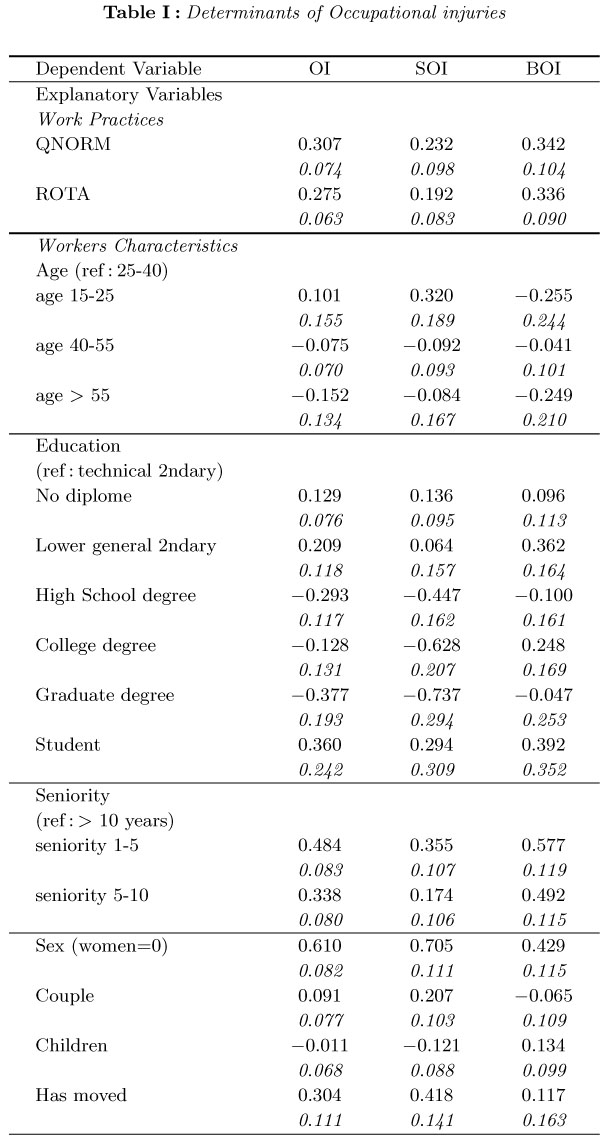
26 Considering the total risk of injury (OI) our results are consistent with what is usually found in the literature. Education reduces the probability of injury, as do seniority. Once conditioned on seniority, age has no significant impact. As expected, men have many more injuries than women which is probably due to the fact that, other things being equal, firms prefer to allocate a man rather than a woman to a dangerous task.
27 As for job characteristics, occupation is an important determinant of the risk that is borne by individuals. The category more at risk is the reference one, namely skilled manual workers. An explanation for this pattern is that risky, hence sensitive, tasks are allocated to them rather than to unskilled manuals. The size of the firm a worker is employed in does not seem to make much difference in terms of safety. In contrast, using a robot or a numerically controlled equipment is associated with a higher probability of injury while the opposite holds for using a computer. This probably reflects characteristics of the job that were not captured by occupations.
28 Overall, the picture of a high risk worker is that of a low-educated skilled manual with short tenure. In addition to these factors, the risk of injury is also strongly correlated with the use of new organizational practices, such as quality norms or job rotation. According to these first estimates, workers involved in new work practices have a 66 to 84 % higher probability of being injured at work, ceteris paribus. The pattern of results is quite similar for serious occupational injuries (SOI). Here again, education and seniority reduce the risk of injury. Being a man is still a factor of risk, and managers, middle managers and clerks do have a much lower probability of serious occupational injuries than skilled manuals. Technology has the same effect as before and here again, job rotation and quality norms are strongly and positively correlated with the risk of injury. As for minor injuries (BOI), education beyond high school does no longer act as a guarantee of safety. However, the pattern of risk by occupation and by seniority is very similar to the one for total injuries and most of the other job characteristics have no impact. Here again though, new work practices are associated with a higher probability of injuries.
29 Overall then, the risk of all types of injuries seems to be consistently and positively correlated to the use of innovative work practices. However, the method we used may suffer from sample selection bias. In order to improve on this problem, the next section provides estimates following Rubin's ``causal" method. We first estimate the probability of adopting innovative work practices, in the form of a simple logit both for quality norms and job rotation. In a second stage, we compute the so-called ``causal" estimator of the effect of both practices on the rate of injury (paragraph 4.2) and on mental strain (paragraph 4.3).
Patterns of New Work Practices and Occupational Injuries
30 Table II presents the estimated correlation between quality norms (resp. job rotation) and occupational injuries, when correcting for sample selection bias. It has the results for all injuries, as well as for serious and benign ones separately. For the sake of comparison, we present both the ``naive" estimator (see equation (2.3)) and the weighted estimator (see equation (2.4)).

31 The underlying logit equation [17] includes socio-demographic variables (workers' age, education, seniority, sex, nationality, region of residence whether people live in couple and have children), job characteristics (size of the firm, hours worked, technology used by the worker and very detailed occupation and industry dummies [18]) as well as a full set of variables controlling for position characteristics insofar as these regressors are significant. Regarding quality norms, there still is a positive correlation with total work injuries, even after correcting for sample selection bias. The coefficient is 0.024 as compared to 0.055 for the ``naive estimator". If it were necessary, this strongly supports the use of Rubin's method. Indeed, a naive estimation would greatly overstate the extent to which quality norms affect the risk of occupational injury. The gap between the two estimators is large both for quality norms and job rotation. This indicates that part of the controls we had introduced in the regressions carried out in Section 4.1 were strong determinants, both of the risk of injury and of the probability of using new work practices. In such case, correcting for sample selection bias appears to be crucial. However, a key result is that quality norms are associated with a 29 % higher probability of work injury, which is decisively not negligible. Another interesting result is that this impact is essentially due to the fact that quality norms affect the risk of benign occupational injuries. Indeed, they have no significant impact on serious injuries when correcting for sample selection bias. This is particularly interesting in the view of the results in Section 4.1. When estimating a simple logit equation, QNORM seems to be positively correlated to all types of injuries. However, the results from the ``causal" estimation show that this is due to common determinants of both the injury and the new practice variables. In contrast, quality norms do appear to be positively correlated to minor occupational injuries even after controlling for sample selection bias, with a percentage increase as high as 37 %.
32 As regards job rotation, the results are quite similar. This practice is associated with a 23 % increase in the probability of work injuries, with the effect being due, again, to a positive impact on minor occupational injuries. These are 34 % higher for workers who rotate. Here again, the coefficients are quite sizable.
33 Overall, even after controlling for sample selection bias, workers involved in new work practices appear to face a higher risk of occupational injuries with the difference with workers not involved in these practices being more than 25 %. Moreover, as evidenced below, new organizational practices are also associated with greater psychological discomfort.
Innovative Work Practices and Psychological Strain
34 As mentioned in section 3, beyond occupational injuries our database also contains information on mental strain. We use it to investigate the impact of new work practices upon a number of indicators of psychological strain. Here again, we use Rubin's ``causal" model in order to correct for potential sample selection bias. The results are presented in Table III.

35 Let us first underline that, here again, for most of the dependent variables the coefficients on both quality norms and job rotation sharply drop when correcting for sample selection bias. An exception is the impact of job rotation on the variable indicating that workers have to cope on their own with difficult situations, with the weighted estimator being 0.018 as compared to 0.005 for the naive estimator. This means that conditioning variables – i.e. worker and job characteristics – have opposite correlation patterns with the two variables. However, apart from this specific case and, to a lesser extent, that of the ``tensions with colleagues" variable, sample selection arises from positive correlations between the conditioning variables on the one hand, and new work practices and working conditions on the other hand.
36 The main result from this analysis is that both quality norms and job rotation appear to be associated with greater psychological strain. Workers using quality norms feel more stress due to uncertainty. They have to cope on their own with difficult situations more often that workers who are not involved in quality control processes. They also tend to receive more contradictory prescriptions and have to change task unexpectedly which they consider as disturbing. Therefore, quality norms and job rotation seem to be associated with a more confusing work organization rather than, as is often hypothesized, with a more efficient workplace.
37 Moreover, workers who apply quality norms are also more aware of the consequences of any error of their own, be it on the quality of the product or as regards its financial implications for the firm. Eventually, their social environment is somewhat deteriorated. They more often experience situations of tensions with their colleagues and with their hierarchy than workers who are not involved in quality norms. However, the latter do not appear to be associated with greater time pressure : QNORM is neither significantly correlated with the fact of having to hurry to carry out one's own work, nor with the feeling of lacking time in order to do one's work properly. Despite this caveat, quality norms seem to be associated with greater stress on the part of workers. The proportion of workers answering ``yes" to the psychological strain questions is from 9 to 20 % higher in the quality norm group as compared to the reference group, with the precise figure depending on the type of stress.
38 The same pattern holds for job rotation. It is positively and significantly correlated to all our indicators of psychological strain except the ``hurry up" variable. As for QNORM, workers involved in job rotation answer ``yes" to the questions about stress more often than reference workers, with differences ranging from 6 and 28 % according to the type of stress.
39 Overall, the results concerning mental strain are consistent with those obtained for occupational injuries. Working conditions of employees involved in quality norms or job rotation appear to be noticeably worse than those of workers who are not.
Conclusion
40 This paper has investigated the relationships between new work practices which are dramatically spreading in the new economy (namely quality norms and job rotation) and a series of indicators of working conditions. We first display that workers involved in any of these two innovative practices face a higher risk of work injuries than workers who are not involved. This is robust to controlling for a large number of characteristics of the individual and her post, as well as for selection bias due to observable characteristics. One conclusion of the paper is that it is important to control for such a bias in order not to overestimate the correlation between work practices and working conditions. The pattern of results is quite similar for indicators of psychological discomfort. Workers involved in new work practices face more mental strain than others. In particular they declare having to cope on their own with difficult situations, receive contradictory orders, and face situations of tensions both with their hierarchy and colleagues. So, in France by the end of the 1990s, new work practices appear to be associated with harder working conditions.
41 This should of course be confirmed by further empirical analysis. Here, more than anywhere else, the call for better data is to be made. In particular, given the lack of time dimension in our dataset, we are not able to properly assess the causality in the model. A related issue is that of firms characteristics. We attempted at capturing them using firm size, industry dummies as well as a large number of position characteristics. However, firm level data on work injuries would be of great help. Such data do exist but so far, the main obstacle lies in accessibility. Another line of investigation has to do with international comparisons. Our results seem to be consistent with studies on the U.S. On the contrary, it is quite far away from what Scandinavian experiences would suggest. More cross-country comparisons, in particular in Europe, would be useful in assessing whether the French pattern is to be found in most EU countries where working conditions appear to have deteriorated in the recent past (Merllié and Paoli, 2001).
42 Despite the previous caveats, we feel our paper brings to the forth an important, though largely neglected issue in economics, i.e. that of working conditions in the new economy This is a key element to take into account when assessing the performance of the new productive paradigms. In particular, a deterioration of working conditions be it in the form of rising work injuries or greater stress would bear important distributional consequences. In a number of countries, this would have a direct impact on public expenditure through health budgets. Moreover, work incentives are likely to be modified as taught by the growing literature on job satisfaction. Eventually, especially in Europe, damages to working conditions and confusion in the production process as felt by workers may even end up in the social rejection of the production model associated to the new economy, thus questioning its long-run viability. All these implications are complex and intricate and deserve more analysis in particular in relation with economic policy issues.
Appendix


References
- Askenazy P. (2000), "Innovations and employment : evidence from American manufacturing", chap. 6 in M. Vivarelli and M. Pianta eds, The employment impact of innovation. Evidence and Policy, Routledge, London, pp. 96-120.
- Askenazy P., E. Caroli, with V. Marcus (2001), "New organizational practices and working conditions : evidence from France in the 1990s", Couverture Orange CEPREMAP, N°2001-06
- Askenazy P. and C. Gianella (2000), « La paradoxe de productivité : les changements organisationnels facteur complémentaire à l'informatisation », Economie et Statistique, N°339-340, 9/10, pp 219-241.
- Askenazy P. (2001), "Innovative Workplace Practices and Occupational Injuries and Illnesses in the United States", Economic and Industrial Democracy, 22 (4).
- Berg P., E. Appelbaum, T. Bailey and A. Kalleberg (1996), "The Performance Effects of Modular Production in the Apparel Industry", Industrial Relations, 35(3), pp. 356-373.
- Berman E., J. Bound and Z. Griliches (1994), "Changes in the Demand for Skilled Labor Within US Manufacturing Industries : Evidence from the Annual Survey of Manufactures", Quarterly Journal of Economics 109 (2), pp. 367-398.
- Black S. and L. Lynch (1997), "How to Compete : the Impact of Workplace Practices and Information Technology on Productivity", NBER Working Paper 6120.
- Black S. and L. Lynch (2000), "What's Driving the New Economy : The Benefits of Workplace Innovation", NBER Working Paper 7479.
- Bresnahan T., E. Brynjolfsson and L. Hitt (2002), "Information Technology, Workplace Organization and the Demand for Skilled Labor : Firm-level Evidence", The Quarterly Journal of Economics, forthcoming, (NBER Working Paper 7136).
- Cappelli P. and D. Neumark (1999), "Do High Performance Work Practices Improve Establishment-Level Outcomes ?", NBER Working Paper 7374.
- Caroli E. (2001), "New Technologies, Organizational Change and the Skill Bias : What do we Know ?", in Pascal Petit and Luc Soete eds, Technoloy and the Future of European Employment, Edward Elgar, pp.259-292.
- Caroli E. and J. Van Reenen (2001), "Skill biased organizational change ? Evidence from a panel of British and French establishments", The Quarterly Journal of Economics, 106 (4), pp.1449-1492.
- Coutrot T. (2000a), « Innovations dans le travail : la pression de la concurrence internationale, l'atout des qualifications », Première Synthèse DARES, 2000.3-N° 09.2.
- Coutrot T. (2000b), « Innovations et gestion de l'emploi », Première Synthèse DARES, 2000.3 -N° 12.1.
- Crépon B. and N. Iung (1999), « Innovation, emploi et performances », document de travail INSEE N° 9904.
- Fairris D. and M. Brenner, 2001, "Workplace Transformation and the Rise in Cumulative Trauma Disorder", Journal of Labor Research, 22(1), pp.15-28.
- Fiole M., V. Passeron and M. Roger (2000), « Premières Evaluations Quantitatives des Réductions Collectives du Temps de Travail », Working Paper, DARES-Ministry of Labor.
- Gollac M. and S. Volkoff (2000), Les Conditions de Travail, Repères, Paris, La Découverte.
- Greenan N. (1996), « Progrès Technique et Changements Organisationnels : leur Impact sur l'Emploi et les Qualifications », Économie et Statistique, 298, pp. 35-44.
- Heckman J., R. Lalonde and J. A. Smith (1999), "The Economics and Econometrics of Active Labor Market Programs, in Handbook of Labor Economics, Orley Ashenfelter et David Card eds, NY, Elsevier, chap. 31, pp. 1865-2097.
- Ichinowski C. and K. Shaw (1995), "Old Dogs and New Tricks : Determinants of the Adoption of Productivity-Enhancing Work Practices", Brookings Papers on Economic Activity, Microeconomics, pp. 1-65.
- Ichinowski C., K. Shaw and G. Prennushi (1997), "The Effects of Human Resource Management Practices on Productivity : a study of steel finishing lines" American Economic Review, vo. 87, 3, 291-313.
- ILO (1998), Psychosocial and Organizational Factors, Encyclopedia of Occupational Health and Safety, ILO, Geneva.
- Merllié D. and P. Paoli (2001), Ten years of working conditions in the European Union, European Fondation for the improvement of living and working conditions, Dublin.
- OECD (1999), "New Enterprise Work Practices and their Labour Market Implications", in OCDE Employment Outlook, Chap. 4, pp. 195-241.
- Osterman P. (2000), "Work Reorganization in an Era of Restructuring : Trends in Diffusion and Effects on Employee Welfare", Industrial and Labor Relations Review, 53(2), pp.179-195.
- Ramaciotti D. and J. Perriard (1999), "Certification qualité selon ISO 9000 et fréquence des accidents du travail dans un groupe d'entreprises suisses", in Actes du XXXIVème Congrès de la SELF-CAEN, pp. 653-660.
- Rosenbaum P. and D. Rubin (1983), "The Central Role of the Propensy Score in Observational Studies for Causal Effects", Biometrika, 70 (1), pp. 41-55.
- Rubin D. (1974), "Estimating Causal Effects of Treatments in Randomized and Non Randomized Studies", Journal of Educational Psychology, 66, pp. 688-701.
- Tolsma D. (1998), "Total Quality Management", in ILO, pp.24.1-34-77.