A gendered history of the women’s suffrage movement
Translated and edited by Cadenza Academic Translations
Translator: Allan Macvicar, Editor: Faye East, Senior Editor: Mark Mellor
Pages 3 to 14
Cite this article
- JACQUEMART, Alban,
- Jacquemart, Alban.
- Jacquemart, A.
https://doi.org/10.3917/ving.133.0003
Cite this article
- Jacquemart, A.
- Jacquemart, Alban.
- JACQUEMART, Alban,
https://doi.org/10.3917/ving.133.0003
Notes
-
[1]
Christine Planté, “Les féministes saint-simoniennes: possibilités et limites d’un mouvement féministe en France au lendemain de 1830,” in Regards sur le saint-simonisme et les saint-simoniens, ed. Jean-René Derré, 73-102 (Lyon, France: Presses universitaires de Lyon, 1986).
-
[2]
Geneviève Fraisse, Les Femmes et leur histoire (Paris: Gallimard, 1998), 333–380.
-
[3]
Frédéric Chauvaud, François Dubasque, Pierre Rossignol, and Louis Vibrac, eds, Les Vies d’André Léo. Romancière, féministe et communarde (Rennes, France: Presses universitaires de Rennes, 2015).
-
[4]
See, for example, Benoîte Groult, Le féminisme au masculin (Paris: Denoël-Gonthier, 1977); Florence Rochefort and Éliane Viennot, eds, L’Engagement des hommes pour l’égalité des sexes (Saint-Étienne, France: Publications de l’Université de Saint-Étienne, 2013).
-
[5]
Laurence Klejman and Florence Rochefort, L’Égalité en marche: le féminisme sous la Troisième République (Paris: Presses de Sciences Po, 1989).
-
[6]
Christine Bard, Les Filles de Marianne: Histoire des féminismes, 1914–1940 (Paris: Fayard, 1995).
-
[7]
On this point, see also James F. McMillan, France and Women, 1789–1914: Gender, Society and Politics (London: Routledge, 2000), 188–216.
-
[8]
Joan W. Scott, Only Paradoxes to Offer: French Feminists and the Rights of Man (Cambridge, MA: Harvard University Press, 1997) [La Citoyenne paradoxale: les féministes françaises et les droits de l’homme, trans. Marie Bourdé and Colette Pratt (Paris: Albin Michel, 1998)].
-
[9]
Anne-Sarah Bouglé-Moalic, Le Vote des Françaises: Cent ans de débats, 1848–1944 (Rennes, France: Presses universitaires de Rennes, 2012).
-
[10]
The fact that there were many groups indicates that beyond a shared principle—gender equality—the feminist movement varied according to the demands made and their modi operandi.
-
[11]
Several countries granted women the right to vote before 1918: New Zealand (1893), Australia (1902), Finland (1907), Norway (1913), Iceland (1914), and Denmark (1915). In 1918, it was granted in the United Kingdom of Great Britain and Ireland, Sweden, Germany, Russia, and Poland, and in 1919 in Canada, Luxemburg, the Netherlands, the United States, Czechoslovakia and Austria.
-
[12]
See especially Joan W. Scott, “Genre: une catégorie utile d’analyse historique,” Les Cahiers du GRIF 37-38 (1986, 1988): 125–154.
-
[13]
Except for Anne-Sarah Bouglé-Moalic who has distanced herself from this concept, judging it as granting too much space “to notions of domination and hierarchy” and that it thus presents an overly homogenizing view of the categories of men and women (Bouglé-Moalic, Le Vote des Françaises, 18–19).
-
[14]
Alban Jacquemart, Les Hommes dans les mouvements féministes: socio-histoire d’un engagement improbable (Rennes, France: Presses universitaires de Rennes, 2015); Sandra S. Holton, “Manliness and Militancy: The Political Protest of Male Suffragists and the Gendering of the ‘Suffragette’ Identity,” in The Men’s Share? Masculinities, Male Support and Women’s Suffrage in Britain, 1890–1920, ed. Angela V. John and Claire Eustance (London: Routledge, 1997), 110–134.
-
[15]
Jacquemart, Les Hommes.
-
[16]
Particular attention has been given to the systematic study of the archives at the Feminism Archives Center (CAF) in Anger and the Historical Library of the City of Paris (BHVP), as well as activist magazines.
-
[17]
The definition of “feminism” as the demand for the emancipation of women, only appeared in the 1880s and only became part of general usage from the 1890s onwards (Karen Offen, “Sur l’origine des mots ‘féminisme’ et ‘féministe’,” Revue d’histoire moderne et contemporaine 34, no. 3 (1987): 492–96). We nonetheless use the term here to refer to the preceding period, most notably because those committed to gender equality in the 1860s and 1870s adopted the term when its usage became more widespread, and no one contested it. Above all, the ideological and political corpus was relatively stable for the period, so the introduction of the term “feminist” changes nothing in terms of its content.
-
[18]
Jacquemart, Les Hommes, 21–23.
-
[19]
Alice Primi, “‘Être fille de son siècle.’ L’engagement politique des femmes dans l’espace public en France et en Allemagne de 1848 à 1870,” PhD diss., Université Paris-VIII, under the direction of Michèle Riot-Sarcey, 2006, 643-644.
-
[20]
Beginning in 1869, André Léo came into conflict with Léon Richer, who proclaimed himself to be the instigator of the women’s rights movement, and left his newspaper (Primi, “‘Être fille de son siècle’,” 643–644).
-
[21]
L’Avenir des femmes 72, October 15, 1871; 77, November 19, 1871. Le Droit des femmes, banned in August 1870, could only be published again in September 1871 after a change in name to L’Avenir des femmes.
-
[22]
L’Avenir des femmes 72, October 15, 1871.
-
[23]
Le Droit des femmes 186, May 2, 1880. On the feminism supported by Hubertine Auclert, see especially Scott, Only Paradoxes to Offer.
-
[24]
We can however note the brief and marginal experience of an entirely female newspaper founded by Louise Koppe, La Femme de France, which developed a differentialist feminism emphasizing the natural superiority of women, most notably due to their reproductive ability.
-
[25]
The newspaper and Hubertine Auclert’s association were, for example, mixed-gender (the lawyers Antonin Lévrier and Léon Giraud were particularly active) and greatly benefited from the financial support of, Joseph de Gasté, a member of parliament.
-
[26]
L’Avenir des femmes 89, July 7, 1872.
-
[27]
The Société pour l’amélioration du sort de la femme [Society for the Advancement of Women], which was, however, founded by Léon Richer (this was the new name of the Association for Women’s Rights from 1874 onwards), thus revised its statutes in 1881 and indicated that while membership was open to everyone, regardless of their gender, “the board will choose internally: a woman president, two women vice-presidents, a woman secretary, a woman treasurer, and an archivist,” with the latter being either a woman or a man (National Library of France (BnF), Recueil Société pour l’amélioration du sort des femmes, 8-WZ-4257, minutes of the general meeting on January 22, 1881).
-
[28]
Articles 1, 2, and 3 of the statutes presented in La Citoyenne 164, November 1890.
-
[29]
Juliette Rennes, Le Mérite et la nature. Une controverse républicaine: l’accès des femmes aux professions de prestige, 1880–1940 (Paris: Fayard, 2007).
-
[30]
Laurence Klejman and Florence Rochefort thus emphasize that feminists came from “the petty bourgeoisie and the middle classes” (Klejman and Rochefort, L’Égalité en marche, 26).
-
[31]
In every era, the feminist movement can be divided into “radical” and “reformist” camps, both with regards to ideology and modi operandi. In the battle for ideas, the demand for women’s right to vote and to stand for election represented a demarcation line until the end of the nineteenth century, whereas the rallying of all feminist factions to suffragism shifted the boundaries. At the beginning of the twentieth century, the political divide was essentially based on issues of sexuality, with the radicals demanding sexual liberty and contraception. In terms of modi operandi, the reformists preferred legality and sought to be respected through the organization of public meetings, whereas the radicals set themselves apart by frequenting the public space more regularly in the form of protest marches and the distribution of flyers.
-
[32]
See Klejman and Rochefort, L’Égalité en marche, 272.
-
[33]
The UFSF hence indicated that “our effort will no doubt be less noisy and provocative than those of English suffragettes, but we are convinced that, in our country it would be a disaster to imitate them; we believe that, according to the proverb: ‘It is better to catch members of parliament with honey rather than vinegar’” (Bulletin trimestriel de l’UFSF 1, April 1913).
-
[34]
For a long time, the LFDF used this strategy by successively granting honorary chairmanships to Victor Hugo, Victor Schoelcher and René Viviani.
-
[35]
The national congress on women’s rights and suffrage which took place in Paris from July 26-28, 1908, was for example supported by an honorary committee with fifty members, all men (BHVP, Marie-Louise Bouglé collection, Ferdinand Buisson sub-collection, box No. 1, National Congress for women’s rights and suffrage, June 26-28, 1908). Similarly, in 1911, the UFSF formed an advisory committee composed of five women and six men, including Louis Marin, Ferdinand Buisson and Paul-Henri-Benjamin D’Estournelles de Constant, all members of parliament (La Française 195, April 2, 1911).
-
[36]
The International Association for Women’s Suffrage sought to develop the League of Electors founded in England in 1907, and in 1911 created the International Alliance of Men for Women’s Suffrage (Angela V. John and Claire Eustance, “Shared Histories–Differing Identities,” in The Men’s Share?, John and Eustance, 1–37).
-
[37]
Bulletin trimestriel de la Ligue 1 (April 1911).
-
[38]
BHVP, Marie-Louise Bouglé collection, Camille Belilon sub-collection, dossier No. 7, Germaine Malaterre-Sellier, “Le suffrage des femmes,” n. d. [after 1922].
-
[39]
In addition, Ferdinand Buisson was known for his participation at many feminist meetings and gatherings, and his archives reveal that he was in constant contact with feminists (BHVP, Marie-Louise Bouglé collection, Camille Belilon sub-collection, box No. 1, numerous letters with feminist associations, 1908-1913).
-
[40]
La Française 157, April 17, 1910.
-
[41]
La Française 293, November 8, 1913.
-
[42]
Annual general meetings, which were subject to public meetings, and public gatherings, were announced in La Française.
-
[43]
Jean Du Breuil de Saint-Germain thus published, on behalf of the League of Electors and the UFSF, a brochure entitled De l’intérêt qu’ont les hommes au suffrage des femmes.
-
[44]
CAF, Cécile Brunschvicg collection, 1 AF 181, Poster “La femme doit voter,” signed by the League of Electors for Women’s Suffrage, n. d. [between 1911 and 1914].
-
[45]
In the general meeting of 1912, or one year after its creation, of the 250 to 300 people in the audience the majority were women, mostly activists from the UFSF (La Française 229, February 25, 1912).
-
[46]
The English and American leagues were much more successful, creating local branches, but they did not survive World War I either (John and Eustance, The Men’s Share?).
-
[47]
Bulletin trimestriel de la Ligue 2-3 (July–October 1911).
-
[48]
Klejman and Rochefort, L’Égalité en marche, 277.
-
[49]
Scott, Only Paradoxes to Offer.
-
[50]
Bulletin trimestriel de la Ligue 8, June 1913.
-
[51]
However, most of the various bills discussed in Parliament in the 1920s and 1930s only proposed limited political rights, for example, in municipal elections or for women over 30 years of age (Bard, Les Filles de Marianne, 145–149).
-
[52]
The CNFF stated that there were between 150,000 and 300,000 in the 1920s and 1930s; the LFDF had 25,000 (Bard, Les Filles de Marianne, 235–237).
-
[53]
BnF, Groupes de Savoie de l’UFSF: bulletin annuel 1, 1932.
-
[54]
The detailed account was made based on the study of 108 membership lists (or notebooks) of local groups found in the CAF that indicated the gender of activists by the use of “Mr,” “Mrs,” or “Miss” or the first name (CAF, Cécile Brunschvicg collection, 1 AF 45 to 1 AF 133). Some could be counted more than once, as lists of the same group in different years were sometimes found.
-
[55]
None of the thirty-three members of the Istres group in 1918 was a man (CAF, Cécile Brunschvicg collection, 1 AF 54, List of the members of the UFSF group of Istres, 1918), while men represented 39.1 percent of the members in Gers in 1914 (CAF, Cécile Brunschvicg collection, 1 AF 73, List of the members of the UFSF group in Gers, 1914).
-
[56]
Out of 2,168 memberships on 9 different lists.
-
[57]
Out of 5,872 memberships on 48 different lists.
-
[58]
Out of 5,517 memberships on 44 different lists. 7 lists, corresponding to 8.5 percent of the total memberships, could not be dated.
-
[59]
See Olivier Fillieule and Camille Masclet, “Mouvements sociaux,” in Dictionnaire genre et science politique, ed. Laure Bereni and Catherine Achin (Paris: Presses de Sciences Po, 2013), 344–356.
-
[60]
There are exceptions, such as Georges Lhermitte, husband of Maria Vérone and shadow activist at the LFDF for almost thirty years. See Alban Jacquemart, “Georges Lhermitte, un militant singulier dans le mouvement féministe réformiste du début du 20e siècle,” in Les Féministes de la première vague, ed. Christine Bard (Rennes, France: Presses universitaires de Rennes, 2015), 89–96.
-
[61]
Neo-Malthusianism, which was established in England during the nineteenth century and advocated birth control among the working class to suppress the “reserve army” putting pressure on salaries, was developed in France at the end of the nineteenth century, primarily through the actions of Paul Robin, who founded the League of Human Regeneration in 1896. On the history of neo-Malthusianism in France, see Francis Ronsin, La Grève des ventres: propagande néo-malthusienne et baisse de la natalité en France, 19e–20 e siècles (Paris: Éd. Aubier Montaigne, 1980).
-
[62]
On the difficulties feminists faced in the Neo-Malthusian movement in France, see especially Anne Cova, Féminismes et néo-malthusianismes sous la Troisième République: “La liberté de la maternité” (Paris: L’Harmattan, 2011).
-
[63]
See Isabelle Vahé, “Jeanne Mélin (1877-1964), un parcours singulier dans la mouvance féministe et pacifiste en France au 20e siècle,” PhD thesis, Université Paris-VIII, under the direction of Yannick Ripa, 2004, 281-302.
-
[64]
The police wrote eight reports on the committee between December 26, 1917 and March 16, 1918. In each of the reports, the number of men is specified: they represented almost half of those present at the meeting on December 26, 1917 (70 men out of 150 people in total), but represented no more than a third at the following two meetings (January 2 and February 3, 1918), and were almost entirely absent in the next five (Archives of the police prefecture of Paris, Women’s Vote dossier, BA 1651, police reports).
-
[65]
The photographs of one of the group’s protests at the Bastille in May 1935 showed, for example, a group composed solely of women (BnF, Digital collections, IFN-2700074, Protests for the Women’s Vote in Paris, 1935–1936, Louise Weiss at the Bastille in May 1935).
-
[66]
Yasmine Ergas, “Le Sujet femme: le féminisme des années 1960-1980,” Histoire des femmes en Occident, vol. V: Le 20e siècle, ed. Françoise Thébaud, Georges Duby, and Michelle Perrot (Paris: Plon, 1992), 499-519.
1This article uses a gendered perspective to trace the evolution of the women’s suffrage movement within the broader landscape of French feminism from the late nineteenth century to the 1930s. By focusing on gender relations within activist groups, it becomes clear that the issue of women’s political rights gave rise to the first demands for female autonomy in mixed-gender feminist associations at the end of the nineteenth century. Similarly, the growing role of women in the struggle for their own emancipation helped disseminate suffragist demands across feminist groups during the early twentieth century.
3On April 21, 1944, the Algiers Ordinance gave women the right to vote and stand for election. This came about after several decades of intense feminist action, and more than one hundred and fifty years after the Declaration of the Rights of Woman and the Female Citizen by Olympe de Gouges. Historiography provides rich documentation on the positions taken in favor of women’s political rights throughout the nineteenth century, whether they were advanced by activists such as the Saint-Simonians [1] or the 1848 [2] and the Commune [3] revolutionaries, or less frequently, by male politicians and leading intellectuals. [4] The research conducted in the 1980s and 1990s by Laurence Klejman and Florence Rochefort [5] on the one side, and by Christine Bard [6] on the other, has filled the historical gap in relation to feminist movements (and especially the struggles for women’s political rights [7]) under the Third Republic. The work by Joan Scott [8] has brought to light the difficulties feminists faced in formulating demands that were acceptable under republican universalism, and more recently, the work by Anne-Sarah Bouglé-Moalic [9] has examined the interwoven dynamics of suffragist demands and anti-suffragist rhetoric. These studies have thus made it possible to reconstruct the long fight for women’s political rights and document the resistance set up to oppose this cause in various social spaces. They emphasize that even though women’s demands for the right to vote and to stand for election were still marginal at the end of the nineteenth century, they became central to the feminist movement [10] at the beginning of the twentieth century. They also demonstrate that the intense mobilization of feminists, which was decisive in most Western countries, [11] did not however convince French senators to vote in favor of the six bills adopted by the Chamber of Deputies between 1919 and 1936.
4Following on from the above research, the aim of the current article is to use a gendered analysis, understood here as the socio-historic process for the production and reproduction of gender categories and gender power relations, [12] to clarify the trajectory of the suffragist cause in the feminist movement from the end of the nineteenth century until the 1930s. It hence seeks to test the heuristic value of the concept of gender in order to shed new light on the history of suffragist struggles in France, and especially to understand the mechanisms that transformed an initially marginal cause into a central cause. Indeed, even though the works mentioned above are within the field of gender studies, [13] and especially the history of women, they have rarely analyzed the feminist movement in terms of gender, that is, from the perspective of the gender relations that run through feminist groups. By using a gendered approach, feminist groups can be viewed as places where gender relations operated, even though the specific goal of these groups was to transform these social relations. Studies conducted from a gender relations perspective on the suffragist movement in France, as in other national contexts, have therefore highlighted the processes that reproduced the domination taking place within mixed-gender associations. [14] With this dimension in mind, it is possible to observe that, under the Third Republic, women gradually sought to free themselves from the tutelage of men in order to define the objectives and modi operandi of a feminist movement. [15] Indeed, the study of gender relations in feminist groups reveals the slow process of women’s empowerment in comparison with men within these movements, as women gradually demanded and established their central place in the organization and definition of the struggles for their emancipation.
5Based on the study of several archives which refer to feminist campaigns, [16] this article intends to show that women’s empowerment is inextricably linked to the dissemination in feminist movements of the demand for women’s right to vote and stand for election. Indeed, it was the issue of political rights that crystallized the first demands for women’s independence at the end of the nineteenth century. From then on, these demands gradually became the rallying point for women’s empowerment within the feminist movement: women sought to defend their independence by adopting suffragist demands.
The Vote: A Central Issue in Women’s Empowerment (1870-1900)
6When feminism developed into a movement with its own associations and press at the beginning of the 1870s, [17] it was a man, Léon Richer, who occupied a key position, and gender diversity within the movement was not questioned. [18] Indeed, while women had been making feminist demands since the end of the 1860s, Léon Richer, a Republican journalist from a wealthy family who had affirmed his position in favor of women’s rights during the 1860s, succeeded in making himself the leader of the nascent movement at the expense, most notably, of novelist and journalist André Léo. [19] Léon Richer began to publish a newspaper, Le Droit des femmes, in April 1869, and a year later founded the Association for Women’s Rights [Association pour le droit des femmes]. As the organizer of public meetings, “banquets” and even feminist conferences, as well as a founder of the French League for Women’s Rights [Ligue française pour les droits des femmes—LFDF] in 1882, he, alongside author Maria Deraismes, led the feminist scene during the 1870s and 1880s. In spite of his work on behalf of the movement, women quickly began to clash with him: his position as leader posed a problem, [20] but it was the issue surrounding the right to vote in particular that brought tensions to a head. Julie Daubié, the first woman to receive a bachelor’s degree from a French university after Léon Richer helped ensure that her rights were recognized, announced that she supported the right to vote in the fall of 1871. [21] In direct opposition to Julie Daubié’s views, Léon Richer, who declared his preference for the principle of political equality between men and women, espoused a ‘civil rights first’ approach: the time would come, he explained, to insist that women, once they were free of marital and paternal tutelage, should have the right to vote and stand for election. In this way, Léon Richer sought to maintain control of the overall strategy by using his position as the founder of the movement (“I believe myself to be a man of good council in recommending prudence,” he stated). [22] This was made easier by the fact that the debate was taking place in the newspaper he edited.
7This first debate allowed Léon Richer to impose his political will for a while, but he could not suppress the aspirations of women activists to lay claim to the right to vote. Thus, Hubertine Auclert, whose father was a wealthy Republican, and who discovered feminist activism through Léon Richer, broke away from the approach advocated by the “father of feminism.” In 1877, she created her own association, “Le Droit des femmes”, and replaced Léon Richer’s approach (prudence and networking) with radical protests—demanding the right for women to vote under the same conditions as men—and modi operandi—for example, calling on women to refuse to pay taxes until they were allowed to vote. [23]
8While this radicalization of some activists did not bring about a complete break with Léon Richer, it nonetheless indicated that women were beginning to push for independence in the pursuit of their rights. The moment was not yet favorable for excluding men and creating a wholly female political movement, [24] something which seemed almost impossible given the prevailing gender relations climate, [25] but it was favorable for insisting that the fight for women’s emancipation should be led by women. In this context, Maria Deraismes (who was, however, close to Léon Richer) pointed out in 1872 that men “were not called upon by such immediate, such direct interests as our own” and for those who were asking for patience and the right political juncture, added: “I will only answer with a single sentence: ‘We have been waiting for more than six thousand years.’” [26] From this standpoint, lobbying for women to have the right to vote and stand for election acted both as a catalyst for and an indicator of this evolution: Léon Richer’s refusal to acknowledge the right to vote as a key agenda item for the feminist movement caused certain women activists to assert that the objectives and strategy of the movement must primarily be defined by women. It was in this context that limitations were placed on male participation, evidenced most notably in the way men were prevented from holding office on the executive board of certain feminist associations. [27]
9During the 1890s, which was a decade marked by the withdrawal of Léon Richer from the activist scene in 1891 due to his increasing isolation and health problems, this process of women’s empowerment strengthened. The demand for the right to vote, still marginal in feminist groups, continued to represent a primary means for asserting this independence. The League for Women’s Emancipation [Ligue de l’affranchissement des femmes], for example, which was created at the end of 1890 by Marie-Rose Astié de Valsayre, a former activist close to Hubertine Auclert, to further the suffragist cause, was open to men, but they were treated differently from women: men could only become members if they were backed by a member of the association (women did not require a patron or ‘matron’), their membership fees were higher, and finally, two out of three positions on the executive board were reserved for women (a man was the League’s administrative officer). [28] The adoption by women of leading roles in feminist groups and the continued push for the right to vote were therefore mutually supporting and occurred simultaneously: by putting women’s political rights on the agenda, Léon Richer’s intransigence was brought to light as well as the control he sought to exercise over the movement, which led women to challenge him; in turn, their subsequent empowerment invigorated the suffragist cause, which spread throughout the feminist movement at the beginning of the twentieth century.
Women’s Independence and Gender Mix (1900-1914)
10In a context where post-secondary studies and certain types of employment were gradually opening up to women, [29] and where women had access to social, cultural, and economic resources, [30] the first decade of the twentieth century saw both reformist and radical [31] women activists embed a leadership role for women in feminist groups. Thus, ‘women-only’ associations continued to develop (see, for example, the reformist National Council of French Women [Conseil national des femmes françaises—CNFF], created in 1901), and women also represented a larger proportion of the membership in mixed-gender associations, which for the most part reserved senior positions for women. At the same time, the demand for the right to vote was increasingly embraced by feminist groups: the CNFF founded a “suffrage section” in 1906, which marked the conversion of the moderate and progressive wing of feminism to the cause [32]; and the year 1909 saw the creation of the French Union for Women’s Suffrage [Union française pour le suffrage des femmes—UFSF], a mixed-gender reformist feminist association dedicated to the cause of political rights for women which rapidly attracted thousands of members. Indeed, the suffragette cause was now being furthered by all feminist groups: while some were pursuing political rights in stages (in line with strategic concerns or personal convictions) by first gaining the right for women to vote and stand in municipal elections, others were demanding the same rights as men.
11However, while women’s empowerment allowed women to take control of their political agenda and helped develop suffragist demands, women activists had to be careful not to cut themselves off from the prestigious and powerful support of men: they had to find a delicate balance. Indeed, the issue was not one of hostility towards men. On the one hand, structural inequalities between women and men meant that men’s economic, political and social resources were still necessary for feminist struggles (or at least these resources were perceived as such) because, for example, only men could change the law. On the other hand, activists who were loyal to the Republic and wanted to stay within the bounds of the law, relied on gender mix as a means to distance themselves from the radicalness of British suffragettes. [33] Women activists hence needed men and endeavored to define an appropriate role for them. The creation of honorary boards allowed feminist groups to be associated with the names of prestigious men without granting them power over the movement. [34] These boards, affiliated with a feminist group or event, grew in number and were mainly, but not exclusively, composed of men. Academics, journalists, lawyers, and politicians lent their names, thereby contributing to the credibility of the movement and its demands. [35]
12Moreover, the French Union for Women’s Suffrage (UFSF) offered men a unique way to become activists: by meeting in an exclusively male association. At the instigation of affiliate international suffrage organization, [36] the Union created the League of Electors for Women’s Suffrage [Ligue d’électeurs pour le suffrage des femmes—LESF] at the beginning of 1911. Its agenda mirrored that of the UFSF and sought to obtain “political rights in successive stages” using propaganda that demonstrated “a great spirit of wisdom and moderation.” [37] The league thus brought together many of the activists and supporters involved with suffragist associations. Its board was chaired by the radical Parisian member of parliament, Ferdinand Buisson, a “devoted apostle to women’s suffrage” [38] who in 1909 filed a report with the Chamber of Deputies in favor of the right for women to vote and stand for municipal elections. [39] Its vice-chairmen were the Republican member of parliament, Louis Marin, (who discovered feminism a short while before 1900 and who “for a few years had been very active in all feminist protests” [40]), the philosopher Léon Brunschvicg, and the lawyer Albert Chenévier. The board was supplemented by Jean Du Breuil de Saint-Germain, secretary general, and Raoul Rebour, editor of the newsletter, both activists known for their commitment to women’s rights. In addition, the first honorary board brought together twenty-seven members, consisting of activists devoted to the cause of women’s rights, such as Justin Godart, Marcel Sembat, and René Viviani, all members of parliament, and men such as Jean Jaurès, who supported (sometimes with timidity) feminist causes. However, regardless of whether or not this board included true activists or less eager supporters, its membership was nonetheless impressive (and this was its purpose), and it presented itself as an undeniable source of legitimacy and respectability for feminists. Aside from nine prominent male politicians (members of parliament and senators, including René Viviani who could be presented as a “former minister”), it comprised men of letters, lawyers, university professors, and even a pastor, Wilfred Monod. The first goal of the LESF was to undertake “propaganda action” [41] to support women’s right to vote: it edited a bulletin, organized meetings, [42] published brochures [43] and distributed posters with the slogan “A woman must vote”. [44] Despite all these efforts, the initiative was unable to mobilize many people [45] and the war led to the disappearance of the already weakened League. [46]
13Nevertheless, the disappearance of the League can also be explained by a lack of enthusiasm for it among feminists. Indeed, even though the association was affiliated with the UFSF, it nonetheless remained independent, for example, its bulletin was edited entirely by LESF members. This decision hence implies a kind of distancing of men from the feminist movement, in particular from the UFSF: it offered them an alternative space for discussion and engagement away from the watchful eyes of women. In response to criticism from some women activists who were wary of establishing a place reserved solely for men, LESF members indicated that “while it is true that women are excluded from suffrage as women, it does not at all follow that they need to press for it as women,” but as citizens of the Republic like any other citizens. [47]
14However, the UFSF members demanded women’s suffrage as women, and argued that women ought to participate in political life because of their particular characteristics and skills. [48] This was a key point in feminist (and especially suffragist) rhetoric, which attempted to steer a path between a universalist and a differentialist register: women’s political rights were demanded both because women offered unique characteristics and because they belonged to the human race, as identified by Joan W. Scott [49]. A space of engagement such as the LESF, in spite of its positive impact on legitimacy, had the major drawback of casting doubt on the independence of women, at least partially, to determine the movement’s strategic and political directions. Furthermore, the League’s bulletin hailed the entry of men onto the UFSF’s executive board as a success, thereby implicitly disapproving of the women-only aspect of the Union’s governing bodies that had prevailed to date: “With men now eligible [to sit on the UFSF executive board]—a masculinist success that our league cannot but applaud—three were elected.” [50] The expression “masculinist,” a neologism which cannot be found in any other document, also seems to mean “defense of men’s rights,” as indicated by the construction that parallels “feminist” and the meaning of the sentence. The use of this term thus leads one to think that LESF members considered the exclusion of men in feminist associations as discrimination against men, similarly, for example, to the exclusion of women from certain political parties. In other words, this expression is an implicit way of denying the political value of women-only groups, a concept which was however supported by most feminist associations.
15These points of dissension help explain why the League of Electors for Women’s Suffrage was not reestablished in the aftermath of World War One. In the eyes of women activists, the LESF experiment seems in fact to have been a relatively unsatisfactory method for linking women’s independence within the feminist movement to the participation of men. In this regard, the demand for women’s political rights once again intensified the feminization of feminist groups and the independence of women activists.
The Right to Vote: A Demand by Women for Women (1918-1939)
16After World War One, feminist activists collectively rallied behind the demand for full voting rights in all elections, [51] a demand that became central during the inter-war period and was promoted by Catholic associations as well as the National Union for the Vote for Women [Union nationale pour le vote des femmes]. Buoyed by the participation of women in the war effort and the fact that women had obtained political rights in many European countries (especially in “enemy countries” such as Germany and Austria), women activists relaunched the suffragist campaign. But their experience with the League of Electors strengthened the desire among feminists to first and foremost make their movement by women for women. Feminist associations were still mixed-gender, but their primary objective was to mobilize women. The decision to adopt this strategic direction was a direct result of the movement’s history, and became increasingly possible with the significant growth in membership of the associations: the UFSF, which now relied on a large network of local associations, boasted one hundred thousand members in the 1920s and 1930s. [52]
17What occurred in the reformist suffragist camp shows the degree to which the demand for women’s right to vote helped bolster women’s independence across the feminist movement. The UFSF groups, while appealing for the support of men, sought to encourage the awareness and thus the participation of women. Like the national organization, whose executive board was limited to women, the overwhelming majority of local groups were also led by teams made up exclusively of women. Men were certainly appreciated as members, and happily showcased by women activists: the board of the Aix-les-Bains group emphasized, for example, that it “had the good fortune to have found very active help from men, which we would like to find everywhere.” [53] But often, the texts written by local groups speak of “women members” or “women activists,” as if only women participated in the group. Hence, the activism of the UFSF groups seems to have largely depended on the action of women. Aside from the activist core of local groups, the study of the membership lists in UFSF groups, that is, those women and men who paid a membership fee, also shows a high number of women. Indeed, of the 14,816 memberships recorded between 1912 and 1939, only 1,864 men are listed, that is, 12.6 percent of the total membership. [54] Although this 12.6 average hides the 0 percent to almost 40 percent disparity [55] in male membership across the groups, and membership itself does not reflect an individual’s actual commitment to the group, this result nonetheless makes it possible to show that the participation of men at local level was limited. If we consider the figures year on year (according to available lists), we can see that the proportion of men decreased continuously between 1912 and 1939.
Proportion of men in UFSF groups between 1912 and 1939
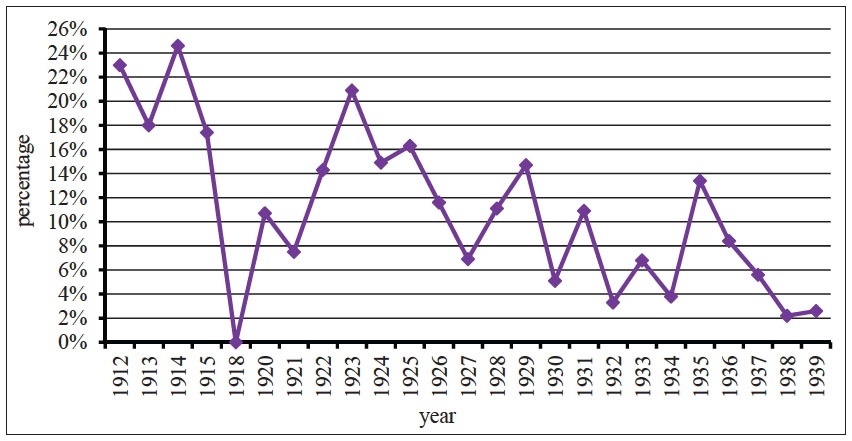
Proportion of men in UFSF groups between 1912 and 1939
18If we group these numbers by decade, the drop in the proportion of men is even sharper. Hence, until 1918, the proportion of men averaged 22.5 percent. [56] However, it was only 13.8 percent [57] in the 1920s and fell to 6.6 percent in the 1930s. [58] The suffragist campaign thus gradually became the preferred vehicle for the organization of a large movement of women, formulating demands for women and on behalf of women. While the UFSF never excluded men from its ranks and sought to channel their support, in essence it remained a mass organization that brought women together. Indeed, the considerable female membership, as well as the leadership roles in associations being monopolized by women, strengthened women’s independence in the suffragist campaign. It in fact ensured that women controlled the implementation of activist operations and the spread of the suffragist cause. This strategy no doubt somewhat reproduced the gendered division of activism, [59] with men barely participating in the routine tasks of associations, but enjoying the high visibility that came with a privileged access to the gallery section during meetings. [60] However, at the same time, it kept the control of the movement in the hands of women, as the participation of men in the suffragist cause, both locally and nationally, relied on the goodwill of women members.
19At the same time, the suffragist cause also became the main vehicle for the empowerment of radical feminists. These feminists, such as Madeleine Pelletier and Caroline Kauffmann, who found themselves isolated within the feminist movement, had sought support in other mainly masculine political groups, such as the Neo-Malthusian movement, [61] but had struggled to make feminism a central issue. [62] Alongside the demand for women’s political rights, radical feminists succeeded in building activist spaces that, while temporary and fragile, were independent both of reformist feminists and men. First it was the creation by Jeanne Mélin, a pacifist and feminist activist and daughter of a rich Republican entrepreneur, of the Council for Suffragist Action [Comité d’action suffragiste] in 1917, that enabled this radical trend to fully integrate the fight for the right to vote. [63] It resumed the use of registers of action which had been abandoned by the reformists; it also broke with political neutrality, as the Council for Suffragist Action was openly socialist and pacifist. While membership of the association was open to men, its ranks very quickly filled with women. [64] But it was especially the League of Feminine Action for Women’s Suffrage [Ligue d’action féminine pour le suffrage des femmes], founded in the second half of the 1920s at the initiative of its chairwoman, Marthe Bray, that gave visibility to the radical wing of the movement by launching a “feminist crusade” in 1926, which toured France with suffragist propaganda. While men were officially accepted, we can see a clear affirmation of women’s independence in the suffragist struggle and the efforts by women to mobilize women (moreover, the League spoke of “feminine action” on its behalf). In the 1930s, Louise Weiss, a journalist with a bachelor’s degree, formed a women-only group, The New Woman [La Femme Nouvelle], which was mainly involved in the suffragist cause. Throughout the decade, Louise Weiss and her fellow activists from the association, whose very name suggests an exclusively female group, organized public “lightning strikes” that were reported by the press. [65]
Suffragism: The Driving Force behind the Emergence of the Subject “Women”
20The gender perspective makes it possible to shed light on the feminist movement itself: by focusing on the place of men in the suffragist cause we have been able to demonstrate that the demand for the right to vote along with women’s independence in feminist groups represented two mutually supporting dynamics. In the 1870s, the right to vote revealed a point of conflict between women and men activists, which led some women activists to insist on the central place of women in the feminist movement. In return, this empowerment of women within the movement from 1880 to 1910 contributed to the spread of the suffragist cause across feminist groups. Moreover, although the demand for women’s right to vote and stand for election was supported by men, including male members of feminist associations, in the 1920s and 1930s this demand became established as a cause pursued by women for women.
21More generally, by analyzing the suffragist cause through the prism of gender we have been able to point to the gradual emergence of women as subjects in feminist campaigning: the demand for suffrage in the 1920s and 1930s transformed feminism into a cause of women, for women, on behalf of women. From this point of view, the focus on gender has also made it possible to reexamine the continuities and discontinuities of the feminist movement by emphasizing that the centrality of women, as well as the affirmation of “We, the women” [“Nous les femmes”] in the campaigns of the 1970s [66] ultimately derived more from a long process of women’s empowerment in the struggle for their emancipation than a radical historical break. Indeed, women activists in the 1970s were able to reaffirm their commitment to women-only groups and their quest for sisterhood because their forebears had gradually legitimized women as key players in the struggle for their rights.
Publisher keywords: feminist movements, French Third Republic, gender, Women’s suffrage movements
Uploaded: 01/24/2017
https://doi.org/10.3917/ving.133.0003