Territories caught between rise and decline
Social trajectories in the peri-urban mosaic
- By Marie-Hélène Bacqué,
- Éric Charmes,
- Lydie Launay,
- Stéphanie Vermeersch,
- Translated by Peter Hamilton
Pages 681 to 710
Cite this article
- BACQUÉ, Marie-Hélène,
- CHARMES, Éric,
- LAUNAY, Lydie,
- VERMEERSCH, Stéphanie,
- Translated by HAMILTON, Peter,
- Bacqué, Marie-Hélène.,
- et al.
- Bacqué, M.-H.,
- Charmes, É.,
- Launay, L.,
- Vermeersch, S.,
- Translated by Hamilton, P.
https://doi.org/10.3917/rfs.574.0681
Cite this article
- Bacqué, M.-H.,
- Charmes, É.,
- Launay, L.,
- Vermeersch, S.,
- Translated by Hamilton, P.
- Bacqué, Marie-Hélène.,
- et al.
- BACQUÉ, Marie-Hélène,
- CHARMES, Éric,
- LAUNAY, Lydie,
- VERMEERSCH, Stéphanie,
- Translated by HAMILTON, Peter,
https://doi.org/10.3917/rfs.574.0681
Notes
-
[1]
Middle Classes in the City: Social Mix or Just People Like Us? funded by the French National Research Agency and the Economic & Social Research Council (2010–2013), coordinated by Marie-Hélène Bacqué and Gary Bridge. Survey of 400 households in Ile de France (Greater Paris) and in Greater London based middle-class residents living in the city centres, the suburbs and suburban fringes.
-
[2]
Our survey focuses on the suburban belt around Paris that is specific in terms of its size, the dynamics of its housing market and the average times of daily commuting travel within the Greater Paris region. Our results are similar to work carried out in the Lyon area, but cannot be extrapolated to suburban/peri-urban areas in general, as these are diverse and can be understood only in terms of the urban dynamics that are involved in their construction.
-
[3]
Data drawn from the 2012 INSEE census.
-
[4]
Source: Recensement de la population 2012, INSEE
-
[5]
Angèle, 45, is an estate agent in a couple with an actor, the mother of two children, who arrived in Châteaufort from the 15th arrondissement of Paris in 1998, and where she “renovated a ruin” to begin with, then bought a house she had built from two old walls. She is not thinking of moving.
-
[6]
Jacqueline, 61, is retired after her career as a flight attendant, married to an engineer in the aerospace industry, and has lived in Châteaufort since 1975 in a house of 140m2. She has no plans to leave.
-
[7]
See the 2010 zoning of urban areas of INSEE, visible at www.insee.fr.
-
[8]
Ariane, 47, has lived in Châteaufort since 1994, in a house of 125 m2, after living in the 15th arrondissement of Paris and Versailles. She lives in a couple with two children and left the Parisian newspaper for which she worked to be closer to her home. She has no plans to move.
-
[9]
Jean-Marc, 50, is a property developer and his wife is a graphic designer. He has owned a house of 180m2 on a plot of 2,200m2 since 1996, when he arrived in Chateaufort from Sénart en Essonne, in order to live closer to his place of work. He intends to stay at Châteaufort.
-
[10]
Patrick, 69, recently widowed, owns a 5-room house. Now retired, he was a sales manager and his wife was a housewife. He moved to Port-Sud from a large housing estate in Massy-Palaiseau in 1970 and was one of the main leaders of the “club” and describes himself as “a simple salesman, the black sheep of the family.” A native of Paris, the son of a cook, he bought his house with the aid of a substantial mortgage in 1970.
-
[11]
Philippe, 60, is an engineer. When his second child was born in 1985, his wife, a homemaker, decided to leave the three-room apartment they rented in Créteil to buy a family home in Port-Sud. Above all, accessibility to work by car, and the possibility of buying a house in an area lived in by “senior managers”, motivated their choice. He was very involved in the collective life of the “club”, before detaching himself completely from it.
-
[12]
Ingrid, 40, holds a BTS in tourism, and her husband is a logistician on major projects. She is currently working as receptionist at a media library. Based in Port-Sud since 2006, after a period of expatriation to Austria, she owns a semi-detached house that she hopes to leave for a detached house.
-
[13]
Georges, 53, is an IT consultant. Arriving from the provinces with his wife in 1986, he first rented a five-room house in Port-Sud, then decided to become the owner of a similar house in the neighbourhood. He moved a few years later to gain another room. Very attached to Port-Sud, he is involved in its management as chairman of the co-owners’ board. One of his two sons has returned to live in Port-Sud.
-
[14]
Hervé, 75, is a retired sales manager. After living for several years in Versailles, in an apartment with his wife and three children, he bought a house in Port-Sud in 1973, attracted by the concept of a holiday village and the accessibility of the RER to Paris, where he worked for his entire career before being fired at age 52. Beyond his financial situation that would not allow him to leave, he wants to stay in Port-Sud for sentimental reasons, because he and his family have participated for many years in the collective activities of the club.
1This article discusses the image of suburban areas (sometimes referred to as “peri-urban” localities) that is currently dominant in sociology. In the recent literature on the French situation, these areas primarily seemed to be working class ones that are inhabited by manual workers and employees who have taken on homeownership (Girard 2013, Lambert 2012). Thus, and even where where the focus has been on social mobility in order to demonstrate that some upward mobility may exist (Debroux 2011), “periurbs” are always associated with the fragility of such a process, and with the desire to see the residential domain as a form of compensation for identities that are threatened in other spheres of social life (Jaillet 2004, Cartier et al. 2008). When the analysis of their attraction also takes into account the identitybased support they provide for vulnerable social identities, the push factors far outweigh the pull factors in explaining residential choice. In contemporary sociology, therefore, the peri-urban is mostly associated with one of several processes and a choice from a small set of options: either social downgrading, retreat, or withdrawal. But whichever one it is, this always involves a negative dynamic. The picture in social geography has been painted in similar colours. One of the most influential theses of recent years has been that of Lionel Rougé (2005), which has an evocative subtitle: Les “captifs” du périurbain (“Captives’ of suburbia”). In theoretical terms, the peri-urban is firstly defined in terms of the notion that there is a gradient of urbanity, a criterion that sees it as a degraded version of the city (cf. Lévy 2000, and for a discussion of this thesis see Charmes et al. 2016). In recent political and media debates, dominated by the work of Christophe Guilluy, the peri-urban area has even been presented as a site of social relegation (Guilluy 2010, for a discussion of this work see Charmes 2014).
2A trip across the English Channel is all that is needed to call such a picture into question. In Great Britain, the concept of a “peri-urban belt” does not exist as such. Suburbs and rural areas surround the towns and cities. Far from the arguments of Guilluy, the debates on the social development of these areas are dominated by the notion of rural gentrification (Phillips 1993). Admittedly, the peri-urban areas concerned by this “gentrification” far exceed the perimeters assigned by INSEE to what in France are officially described as “periurbain” areas. Nevertheless, as seen from England, the social problem that arises in the peri-urban areas is more concerned with the building of affordable housing. In London, the area that best corresponds to the peri-urban ring of Paris is largely included in the “green belt,” and the main debate that concerns urban planners is the reduction of the inflationary pressure on house prices that lead to restrictions on house-building (Richard 2010, Gant et al. 2011).
3The research on which this article is based has specifically aimed at a comparison of residential choices, practices and locality relationships within middle-class areas in London and Paris (Bacqué et al. 2015). [1] We worked in five types of neighbourhood or sector of the two metropolises, including two peri-urban areas. Our discussions about the choice of survey areas were very rich, given the differences between the two academic traditions, French and British, on the relations between the middle classes and peri-urbanization and suburbanization. The need to choose comparable units led the French team, of which the authors of this article were members, to be concerned with more affluent suburban areas than those being studied in recent years in sociology and urban geography, and thus we present here some of the results of this survey and the new insights it brings to the social and territorial dynamics in the suburban areas of Paris.
4In doing so, this article is located within a perspective that once dominated French sociological literature: the middle classes of the 1970s were linked to real “spatial conquests” in the suburbs (Vermeersch 2011), areas of residential, associational and political adventures (Bidou 1984). We propose here to return to these areas of conquest for the new middle classes. The perspective adopted here also coincides with that of a trend in social geography, where recent work has shown that, although there are many captive suburbanites, who have the painful experience of becoming disenchanted with a costly form of homeownership that requires them to make substantial sacrifices (Rougé 2005), their situations are above all very varied (Dodier 2012).
5The suburban areas not only reflect the difficulties of low-income first-time homebuyers, but much more widely the diverging social changes amongst those who make up the different segments of the middle-classes (Lojkine 2005). In this context, the challenge is how to highlight the diversity of development trajectories—those of areas as those of the individuals who reside in them—and who help to build the suburban mosaic. Suburbanization is something created not by a single process but by many. In terms of the social composition of career trajectories and social relations, nothing is directly produced or fixed. The different areas that make up the suburbanized belt of Paris have been positioned and evolved differently in the social hierarchy of the Parisian metropolis, following processes of valuation and devaluation. The development trajectories of these areas are analyzed through their objective dimensions, through the use of quantitative data, and their subjective dimensions have been captured through biographical interviews. They are obviously inseparable from the residential choices of the middle classes. They are also connected to socio-residential positions and the forms of social mobility experienced by individuals (Lahire 2004, Benoît-Guilbot 1986, Savage et al. 2005). As will be evident, representations of suburban areas and the ways in they have been occupied diverge according to the middle-class groups that are dominant within them and their change and development are strongly linked to the ways in which the inhabitants represent their own residential mobility, whether these may be active—related to the change of residence of the individual—or passive—related to the departure or arrival of new populations in the neighbourhood (Lévy 1998).
6The sectors studied in the peri-urban ring around Paris have been the commune of Châteaufort and the housing estate of Port-Sud, in Breuillet, which are described below. [2] We chose the Châteaufort case partly in terms of a comparative perspective with the gentrified villages of Surrey, in the south-eastern zone of the London Greenbelt. This small town is notable for the affluence of its population (Box 1). It is located in a wealthy area of the Île-de-France region and, with 574 housing units, of which nearly 90% are detached houses, [3] it is one of the closest municipalities to the centre of Paris to offer the living environment of typical “periurbain” village style (as defined by INSEE, nearly 9 out of 10 periurbain communes in France have less than 2,000 inhabitants). The residential complex of Port-Sud has been chosen as an extension of the area of the Île-de-France region in which Châteaufort is located. This included testing some assumptions about remoteness as a source of “captivity,” that would imply that choosing to live in a suburban area is a “forced” or constrained choice (Donzelot and Mongin 2013). Port-Sud is also not, administratively speaking, a commune itself, but a suburban complex with a private governance structure, in the form of co-ownership. Beyond the administrative differences between a municipality and a neighbourhood, the comparison between Châteaufort and Port-Sud was made possible by the fact that in both cases, the middle-class residents have at their disposal tools that they can use to control their local living environment. In addition, because of its 700 homes, Port-Sud has the advantage of being in a size category comparable to that of Châteaufort.
Box 1.—The populations studied
In Châteaufort, the majority of the interviewees amongst the 28 interviews conducted held positions of responsibility as private sector managers in businesses as diverse as the aeronautics industry, agribusiness, property development, private banking or publishing, and interior design. Some had developed their careers by starting their own business. This was particularly the case for several women, who had taken advantage of coming to live in Châteaufort to change occupations in order to strike a better balance between work and family life. In general, these respondents have a high level of education and cultural capital (higher education, engineering schools, business schools). Although several generations were represented in this sample, especially the older people who had moved to the commune during the 1970s, many respondents were between 35 and 50 years old and were parents of several children. Looking at incomes confirms the upward shift in the social structure in the Paris Region, with the majority of couples we met earning between €3,750 and €6,600 per month, and thus being in the upper sectors of the middle classes.
In Port-Sud, the population base for the 36 interviews conducted there was more heterogeneous, both in terms of socio-occupational categories and generations. Here again, private sector managers working in industry, transport and, above all, commerce were present, but they were more often middle managers than senior managers. In addition to this group, onethird of respondents were in executive positions, and many women were not working. There were more intermediate occupational categories than in Châteaufort and these are particularly well-represented among the families who have settled there in the last ten years. This greater heterogeneity of the social composition of Port-Sud that is partly due to “the archipelago of employees” (Chenu 1990) was also observed in the incomes of the couples we encountered, which varied between 2,700 and 6,600 euros per month.
In addition to these interviews, we also spoke to key informants, actors or those knowledgeable about the housing market and local policies, such as estate agents, mayors and deputy mayors in charge of urban planning, school directors and shopkeepers. We also used socio-demographic data from the INSEE population census data on the two communes studied to analyze the changes in their populations. We were not able to work at the sub-municipal level, as these two communes are not counted in the INSEE IRIS system (Ilots Regroupés pour l’Information Statistique: e.g. population units homogenised for statistical purposes) in order to respect the confidentiality standards of INSEE, which explains why, in the case of Port-Sud, we refer to the data relating to the municipality of Breuillet within which it is located. Finally, we analysed the urban planning documents of the two municipalities in order to understand their urban policies.
7We will return in the first instance to how urban studies have interpreted the urban, social and territorial restructuring of suburban areas, before proposing an empirical analysis of these changes, on the basis of the survey we conducted in these two areas.
Social and spatial restructuring in the suburbs
8The question of change in suburban areas is not unknown in urban studies. However, we will show that, until recently, researchers tended to be focused on newly constructed residential housing developments, and less on changes within them. We will continue this review of the literature by a discussion of the general evolution of the population in suburban fringe areas, by emphasizing the processes of socio-spatial differentiation that are currently at work. The background for the two monographic studies discussed in the rest of the article will thus be outlined.
Towards the study of suburban “maturity”
9Suburban studies have a long and varied history. In a context of urban sprawl and the bursting of the bounds of the cities, the rise of this “in-between” spatial category has long been the source of questions about the relations between the urban and the rural, two spatial categories previously conceptualized from a dichotomous opposition between urban and rural. Henri Lefebvre (1970) was concerned from the 1950s with this phenomenon of the “implosion-explosion” of cities and its epistemological and socio-spatial consequences: according to him, the urban could no longer be limited then to the administrative and historical boundaries of the city, and thus can no longer be understood through this classic perspective, but extended well beyond the traditional town or city and spread gradually within increasingly distant rural areas (Marchal and Stébé 2015). It is as a new hybrid form of socio-spatial configuration that makes it possible to question and revise the categories of analysis between urban and rural that the category of the suburban (“péri-urbain”) has become an academic concept (Arnould et al. 2009).
10Two waves of research have studied this hybridization of the rural by the urban. The first, in the 1970s and 1980s, focused mainly on the processes of the emergence and dissemination of the suburban areas. The pioneering work of Gérard Bauer and Jean-Michel Roux on rurbanisation (1976) emphasized the role of managers in suburbanization. Catherine Bidou (1984) was concerned with the “new middle classes,” Marie-Christine Jaillet (1982) with the mechanisms of production of lowcost housing estates. By this point some researchers had drawn up a general picture emphasizing the diversity of suburban settlement (Berger 1985). A second wave emerged from the late 1990s onwards, where we find Martine Berger (2004) and M.-C. Jaillet (2004), and a new generation of researchers who refined and updated academic knowledge about the processes of production and diffusion of the phenomenon. Later sociological works, which followed from the end of the 2000s, focused on a particular social group, the poorest first-time homebuyers, and thus shed light on the socio-spatial effects of the rise in the casualisation of employment and social inequalities, in a context of soaring property prices (Lambert 2012, Girard 2013).
11What characterises a large part of this literature, beyond the diversity of the groups being studied, is the attention paid to new housing development, which is relevant to the extent that the extensions of suburban fringes were related to the production of new detached houses (Berger 2004). Nevertheless, to try to explain the population dynamics of the suburban areas in terms of the new housing market alone is overly reductive, especially today, and this is mainly for two reasons. The first is what can be called “land Malthusianis m” (Charmes 2011). Although the suburbanization of a commune usually begins with a phase of significant quantitative growth, the suburban population—at least those involved in political bodies and local collectives (often containing a plurality of actors)—tend to limit further urbanization, with the aim of preserving the rural lifestyle that is the reason they have come there in the first place. By doing so, new house building and the markets associated with it occupy a very secondary place in the transformation of the settlement. This has notably been the case in Châteaufort (only 10% of the main residences of those who own them were completed between 1991 and 2009) [4] and also in Port-Sud, a suburban complex that has seen practically no change in its morphological structure.
12The second reason is that part of the dynamic of suburbanization is based on the symbolic redefinition of the value of the ancient heritage. This point is rarely an issue in France, but it is at the heart of debates in Great Britain. The sectors homologous to the French suburban areas are generally located within the perimeter of a green belt, where the controls over building development are very strict (Richard 2010). The villages on the outskirts of London are very well preserved and have undergone few structural changes, unlike the villages on the outskirts of Paris which, in almost all cases, have seen their ancient centres surrounded generally by larger or smaller detached houses in ribbon developments along their main arteries. In Great Britain, the importance of the classification of historic buildings is therefore much greater than in France. New building is also often carried out in strict respect of the local style. This role of the built heritage in the development of British rural areas has led some, like Martin Phillips (1993), to propose the notion of rural gentrification.
13As will be seen with Châteaufort, the symbolic revaluation of old houses is also underway in the Paris region. However, this does not guarantee the relevance of the notion of rural gentrification for the study of French suburban areas. As defined by Martin Phillips, this notion tends to reduce change in the suburban areas to the transition from rural to urban. However, for many municipalities, local political and social issues are no longer structured by this change: they are no longer caught in a process of suburbanization, because they are now suburban, and have come as such to what some researchers (Berger et al. 2014) describe as a state of “maturity,” in the sense that they have become areas with their own identity, a suburban identity, where central aspects emerge that are variously adapted to their everyday lives by their inhabitants (Marchal and Stébé 2015). The issues for these municipalities are no longer about how to define a certain relationship to rurality, but how to organize suburban life, in terms of infrastructure, services, amenities, communal life, etc.
14This leads to a final remark on French studies of the suburban domain. One could argue against the above that there are monographs on already existing suburban housing, such as La France des “petits moyens.” Enquête sur la banlieue pavillonnaire (“The France of those of modest means. A survey of suburban housing estates in the suburbs”) (Cartier et al. 2008). But the subtitle of the book makes it clear: it is a survey of a residential housing estate located in the suburbs. Many similar housing estates can be found in the “peri-urban,” yet the latter cannot be entirely reduced to the former. The hybridization between rural and urban that characterizes the periurban is not reducible to detached and semi-detached houses with gardens. In this article, beyond the question of the changes affecting housing estates, it is the changes affecting “peri-urban” territories as already constituted that are being studied. The relatively limited knowledge we have of these changes is undoubtedly due to the fact that in France the suburban has long been perceived as a transitory state between urban and rural: the small towns and peri-urban villages were supposed to be only the outposts of the urban front, destined to become a part sooner or later of the urban patchwork, like their counterparts in the suburbs. Now we know that this is not the case, and that in fact we are witnessing the perpetuation of a new morphology—where urban functions take place in rural landscapes—and, with it, the sustainable installation of new social relations within these areas (Vanier et al. 2010). Beyond peri-urbanization, we must therefore study the peri-urban in itself, in all its facets and in all its diversity. Stability in the peri-urban state, between urban and rural, does not prevent various changes. Once peri-urbanized, municipalities are transformed. They change morphologically, even if it is at a much slower rate than during the peri-urbanization phase (Vilmin 2006). They are also changing politically, even though an overall agreement has been drawn up on the objective of preserving the village-like character of the municipality (Rivière 2009). And indeed, in the final analysis, they are also changed sociologically.
Beyond the “averaging-out” process, territories that differentiate themselves from each other
15The fate of the “peri-urban” domain is intertwined with that of the middle classes. In particular, its development is closely linked to the phase of extension of the middle classes in the second half of the twentieth century. As part of the Keynesian stimulus policies that followed World War II, many states invested heavily in road infrastructure, supported the motor industry by promoting household investment in consumer durables, and encouraged home-ownership, and particularly the purchase of detached houses (Hayden 2009). These policies accompanied and even nurtured a process analyzed in particular as a dynamic of “averaging-out” (Mendras 1988), the generalization of access to material comfort favouring the development of a less demanding ethic. As many sociologists such as Pierre Bourdieu (2000) have pointed out, access to home ownership paid for by twenty-year mortgages weakens revolutionary ardour. It is in this sense that private housing estates can be considered as the areas in which the formation of a vast middle class in wealthy countries took place.
16Today, these “averaging-out” processes have reversed (Lojkine 2005). In France, as elsewhere, employment relations have been destabilized and rebuilt, in ways that are profoundly affecting the position of individuals and social groups in the relations of production. Beyond massive levels of structural unemployment, the proliferation of atypical, poorly paid, and highly precarious jobs no longer concerns only the working classes, it has also affected the lower and middle fringes of the middle classes, whose socio-occupational status has thus been weakened (Bosc 2004, Peugny 2009). This transformation of the labour market has produced new and more complex and unstable social hierarchies. There has been a splitting up of the middle classes between its lower strata who have tended to become closer to the working classes because of the difficulties they face in coping with the ongoing changes in the world of work and, on the other hand, its higher strata who, in terms of income and wealth, have managed to make the most of the globalized economy (Bouffartigue et al. 2011). The growing socio-spatial divisions within the peri-urban areas reflects these divergences (Jaillet 2013): whereas, in the 1960s and 1970s, periurbanization was associated with the great expansion of “the” French middle class and the reduction of social inequalities, in today’s terms the peri-urban reflects the break-up of this same middle class and an increase in social inequalities (Préteceille 2003, Berger 2004).
17While the centres of the metropolises are increasingly gentrified and the impoverishment of the working-class suburbs is increasing, the peri-urban is a social mosaic (Préteceille 2006). Average incomes vary greatly, this diversity being accompanied by a social specialization at different level. Admittedly, the situations of poverty and precariousness are not comparable in terms of concentration with the situations observed in the suburbs (Lapeyronnie 2008), but a broad spectrum of socio-spatial situations is covered by the peri-urban areas.
18Specific socio-spatial contrasts are particularly marked in the major cities, and especially in the Paris region. It concentrates the wealthiest households, those whose role is crucial in determining house prices. In the most sought-after communes—the peri-urban communes best situated in the western and south-western suburbs of Paris—senior managerial couples dominate settlement and their concentration is a driving force of the socio-spatial segregation of the metropolis (Cousin 2013). In other communes, away from the centres, households of manual workers and employees tend to dominate the settlement pattern (Rougé 2005, Girard 2013). This specialization is reinforced by a snowball effect (Filippi et al. 2007), as those neighbourhoods that already have a high proportion of people in senior managerial posts tend to attract others to them.
19Regarding the social specialization of the peri-urban area, three other sociospatial dimensions must also be distinguished over and above the distance to the centre that has just been mentioned (Berger 2006, Charmes 2011). First, the extension of the specializations established in the centres and near to the suburbs affect peri-urban zones by differentiating them from each other. Secondly, the presence of specific economic, political or cultural activities produces significant variations from one peri-urban commune to another, such as a situation, for example, where one residential village located close to an airport runway specialises in housing for less-affluent households whereas a neighbouring village, equally suburban, but relatively unaffected by noise and air pollution, mainly accommodates senior managers. Finally, contrasts are also observed between neighbourhoods in the same commune, affecting the whole of the suburban housing estate (Cartier et al. 2008). As Anne Lambert (2012) has shown, the economic circumstances of those living in them can vary to such an extent that even within the same housing estate the resident population can also change accordingly.
20Positions are shifting within this mosaic, and the peri-urban areas are being classified and reclassified. But how are these rankings and reclassifications carried out? Far from the media portrayal of them being areas of relegation (Guilluy 2010) the general dynamic of transformation is in fact one of gentrification (Berger 2004). One might also see the source of current representations of the peri-urban areas as less a matter of the reality of their settlement pattern than in terms of changes in the way certain groups of the middle classes are perceived, especially their lower fringes, which appear more and more weakened by the rise of precarious employment and social disaffiliation in French society since the 1980s (Castel 2009).
21This being the case, whilst certain peri-urban areas have become gentrified, as the case of Châteaufort will illustrate, others, such as Port-Sud, have tended to become more commonplace and lose their relative attraction. Although the middle classes are today very evident in these two areas, their socio-economic profiles differ, as shown by the average net incomes of each according to tax returns: they amount to €29,544 in Breuillet (as compared to €28,033 in the département of Essonne as a whole) as against €48,289 in Châteaufort (far ahead of that observed at the level of the département of Yvelines which is €34,171). In addition to these differences in income, there are distinct positions in the housing market. The price of houses for sale in Châteaufort varied between €400,000 and €550,000 in 2015, while the price of homes offered in Port-Sud varied between €260,000 and €380,000. Thus, not only do these two areas not house the same sectors of the middle classes, but they also follow different trajectories.
The gentrified village: Living in Châteaufort
From workers’ village to manager commune
22Châteaufort has been experiencing a particularly marked process of gentrification since the 1980s, coupled with significant population growth. Its population, that had remained at around 800 people since the 1960s, increased from 769 to 1,427 inhabitants between 1982 and 1990, with an average annual increase of 8%, mainly fuelled by the arrival of new residents (+6.9%). These arrivals were related to the construction of several housing estates, including that of la Perruche, composed of modern houses with private gardens and four to five room semi-detached homes, originally intended for middle managers (Photograph 2). Since then, the population has stabilised at around 1,400 inhabitants.
23The striking fact that accompanied this population growth is thus the clear change in the social structure of the settlement (Figure 1). Originally rural and working class, today Châteaufort welcomes dual income couples from the middle and upper social classes. Between 1975 and 2011, one can observe a substantial decrease in the proportion of manual workers (from 37.5% to 5.8%) and, to a lesser extent, that of employees (25% to 7.1%) and a very sharp increase in the proportion of senior managerial and professional occupations (from 12.5% to 51.3%) and intermediate occupations (from 16.1% to 29.2%).
Chateaufort, a commune gentrified over time

Chateaufort, a commune gentrified over time
24The wider urban context is also decisive. This gentrification is in fact part of the overall change in the social structure of Yvelines, which has benefited from the tertiarisation and financialisation of the economy, as have Paris and Hauts-de-Seine. (Preteceille 2003, Cousin 2014). Nevertheless, it stands out by its remarkable vigour (Figure 2), probably in connection with the fact that Châteaufort is located in an area that is attractive from the social point of view, being near Versailles among others, a very well-off town and one with highly regarded schools. Beginning in the 1980s, and over a period of barely ten years, the commune has changed from a village where the working classes were dominant, especially manual workers, to a commune where more than one property in two now belongs to the middle and upper classes. Châteaufort has become an attractive place for the middle classes, and especially its medium to upper fringes.
Châteaufort differs from the pattern of regional development
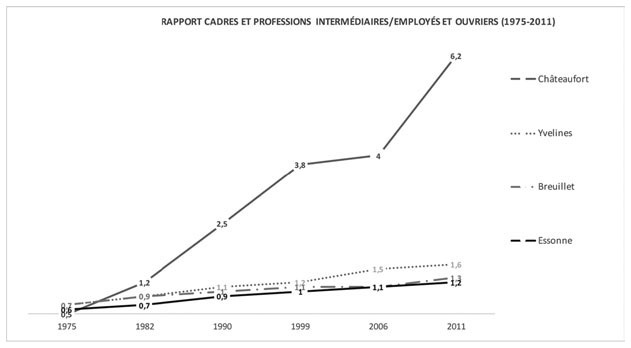
Châteaufort differs from the pattern of regional development
25An important generation effect has structured the gentrification of the village: the “Castelfortains” who have settled there since the 1990s, and even more so in the 2000s, and who accelerated the social evolution of the village, come from much more privileged backgrounds than those who settled there in the 1980s. These generational effects, which need to be repositioned within the national context, have a clear influence on residential trajectories, as Fanny Bugeja (2011) has shown. The more recent new Castelfortains thus have had access to the substantial financial or housing wealth, that is necessary to acquire housing at a high price level.
26Châteaufort thus has a clear gentrification path that, in some respects, is close to what Phillips describes as rural gentrification, since the old village core has been taken over and transformed (the older houses and the more affluent housing estates of Châteaufort have favoured forms of both economic and symbolic investment) and where the image of the area as a village has been adopted by its new inhabitants (one of the striking initiatives of these new villagers has been the revival of a “traditional” fair and the festivities that accompanied it, which promote the medieval past of the village). But Châteaufort’s transformation has also been achieved through new, rather high-end housing estates, and amongst the newcomers we do not see the typical profiles of the pioneers of gentrification who have strong cultural capital but low economic capital. The notion of gentrification seems to have been shifted in this case.
The choice of a “small village near Paris”
27Taking up residence in this “small village near Paris,” to use a formula often used by respondents, is part of aspirational residential trajectories, marked by the acquisition of a house that is itself facilitated by the sale of a previous one—few respondents were first-time buyers—and its relative distance from Paris. These residential trajectories are linked to social trajectories that are themselves on a rising scale, linked to careers as managers in the private sector or professions.
28Châteaufort is located within the Chevreuse Valley Nature Park (Parc naturel de la Vallée de Chevreuse) and the quality of the rural environment, as well as that of the old built environment, has been attracting increasing numbers of middle and upper class families. Although they made their choice within a system of varying forms of constraints, like other social categories (Authier et al. 2010), the negotiations involved nevertheless manifest priorities: the acquisition of a house, one preferably old and possibly to be renovated, with an adjoining garden, located in a rural village, valued in terms of its landscape (Photo 1).
Centre of the village of Châteaufort
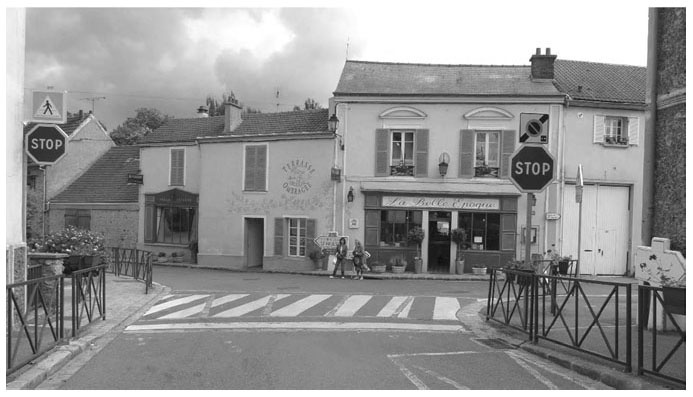
Centre of the village of Châteaufort
Note: An historic village setting restored and preserved by the municipality into which middleclass households have recently moved.29The desire to live in the countryside, in a bucolic place, is paramount. The families we met had spent at least their first years of adult life in Paris or in the western towns of the inner suburbs of the city: they can thus appreciate all the benefits that this setting can provide (calm, less polluted air, greenery, outdoor recreation, space). It seems to them a much more forgiving place, especially to raise children, than the urban setting: “I could not imagine having children in Paris because I wanted my kids to come back home muddy because they’d been wading in the river, chasing after frogs, making huts in the forest. I wanted that, I’d lived like that and I wanted that for my children. I did not want to have kids in Paris having to take the métro, I did not want that … To have to take the métro to go to school I think that … It seems to me crazy, for me going to school is going on foot, so in Paris, it’s possible too, but it’s not the same life.” (Angèle). [5]
30The urban setting is not rejected or excluded from the parameters that determine residential choice. The proximity of Paris has also been a factor in the search for housing, and as Angela also says: “We did not want to live in the city, but we did not want to go a long way from Paris, and we found that is a great compromise because we have the impression here of being 500 kilometres from Paris when we are only 25 kilometres away. We wanted the village life so we could raise our children in a green setting, in freedom, while being close to all the major facilities.” There are numerous examples of the capital being taken into account in the choice of Châteaufort; for instance Jacqueline, [6] for whom it is important to “have a little feel of the countryside not too far from Paris,” is worthy of mention as she says it is “really good here because [she] can breath” but Paris, “That’s where everything happens,” and she can go there whenever she wants.
31The choice of a rural environment is not one of isolation and rejection of the city centre, in fact it is quite the opposite. It is predetermined by the accessibility of the village by car, and thus benefiting from a privileged location at the heart of the metropolitan region. Châteaufort is located on the edge of the Saclay Plateau, which is a development area where highly skilled jobs are concentrated. Located 25 kilometres from the centre of the capital, it is one of the closest peri-urban communes of Paris. [7] The proximity to the city-centre is sought after for occupational, academic and cultural reasons. Beyond the managers who go to La Défense or Paris to work, Castelfortains can take advantage of the abundant supply of public and private facilities in Paris, such as Ariane, [8] a former journalist who now works in publishing, who plans a museum visit every month, or Jacqueline, whom as we have just stressed is particularly attached to the fact of being able to go to Paris: “I can go three times in the week or zero times, it all depends on the opportunities, and interests that I have and the time I have, if I have friends to see, my eldest daughter … Exhibitions, museums, outings of all kinds. “
32This preference for rural areas, in close proximity to a large urban centre, and coupled with daily motorized mobility carried out according to an “à la carte” rationale (Chalas 2000), is not exempt from the desire to distinguish oneself, particularly vis-à-vis other “peri-urban” people, those associated with “housing estates,” and the highly stigmatised “dormitory towns,” “All that is just a house, on a housing estate of houses all set out like rows of onions, that’s not our thing […] So we got there, and we bought an old house” (Angela). In the same way, for Jacqueline, “It’s not my thing all these houses that are alike, I would not have liked to live on a housing estate […] I like to have a house and to personalize it. So it certainly has lots of flaws and it does not look like the others but […] it’s more authentic in my opinion.” Châteaufort, of course, includes recent housing estates, but as the Perruche district illustrates so well, its organization and architecture contrast with the “everyday stuff,” and show a taste for architectural pastiche (Photograph 2). The responses of the interviewees collected when they were shown photographs of the different types of Parisian urban spaces studied during our research, are explicit about this: seen in terms of a photograph of Port-Sud (Photograph 3), the “housing estate” with its new houses “which are all alike” is a little-valued urban landscape, from which the Castelfortains differentiate themselves by highlighting the aesthetic and architectural assets that are provided by the village-style and verdant Châteaufort with its old houses. Their aesthetic tastes in terms of housing (described in terms of “authenticity,” “the charm of interiors full of defects,” the “personalization” of the old house) are quite reminiscent of those expressed by the gentrifying populations of old town centres, and particularly those from eastern Paris (Collet 2015).
The housing estate of la Perruche in Châteaufort

The housing estate of la Perruche in Châteaufort
The lake in the centre of Port-Sud, the main stereotype of the image of the neighbourhood

The lake in the centre of Port-Sud, the main stereotype of the image of the neighbourhood
33Beyond its rural and ancient character, they also favour the village way of life for its dense and reassuring local sociability. Jacqueline, who has taken an active part for twenty-five years in the medieval festival, refers to a “good life,” which is defined as “a spirit of conviviality and solidarity in the village and being able to live there in harmony with everyone.” Local life is described as particularly rich, thanks in part to its intense associative life, and conducive to the development of mutual help amongst neighbours. These networks of sociability, which are part of a strong local anchorage, unfold from activities related to the neighbourhood, regular contacts with local businesses, associations and schools. Angèle refers to a “very strong sense of belonging” to this village, which she describes as “very friendly.” She has set up a womens’ “Friday” with others: “We meet up with girlfriends, we have a lunch that stretches in general until the early evening drink between girls and then after that it ends because there is someone whose working, who’s going away, so we’re trying to do that every Friday.” This network developed from “children and then from the friend’s friends,” including through the creation of links between parents, with the school playing a vital role in social life, and one hears in Châteaufort an observation that is often made in suburban areas: the school is usually considered to be at the heart of the village community (Charmes 2011).
Safeguarding the rural village: the public construction of privileged areas
34The preservation of such a residential environment at so a short distance from Paris owes nothing to chance. In terms of control of the residential environment, the literature often focuses on co-ownership, and more broadly on private forms of local government (Le Goix and Webster 2008). Port-Sud would illustrate the limits of private management, while Châteaufort shows the usefulness of municipal regulation tools (especially land-use) for the control of residential living environment, and clearly shows the process of “clubbisation” at work in many small suburban residential communities (Charmes 2011).
35Thus, the perimeter of the school catchment area is a master asset of the commune. It reserves the nursery and primary school for the Castelfortains. It also allows children from the village to access colleges and high schools renowned for their success rates, including the Franco-German College of Buc and the Lycée Hoche in Versailles, both ranked among the top schools in France: “We had looked at the school catchment area, and we wanted our children to be in rather good schools so we knew that here it was Versailles for the lycées.” (Angèle) The maintenance of this sectorisation was also a decisive argument in the choice of joining the urban community of Versailles Grand Parc rather than the one closer to Saint-Quentin-en-Yvelines.
36In addition, Malthusian planning rules and the introduction of protection measures for undeveloped spaces severely limit the extension of new building in the commune. The creation of the Regional Nature Park (PNR—parc national régional) of the Upper Chevreuse Valley, the first of its kind in the Île-de-France, was a vehicle for mobilising Castelfortains, old and new, who actively participated in its establishment, following fifteen years of discussions, in 1985: “We have come to the point where there has not been any major construction work, there has been no development … The fortifications absorbed the shock, by which I mean the walls of Châteaufort, because it is a small Gaulish village they held up well. It didn’t move, it managed to protect itself, there was no specific construction, there was the OIN [operation of national interest] that happened, we fought for Châteaufort to stay in the park [the PNR] and we didn’t have to leave the park.” (Jean-Marc). [9]
37Urban developments within the commune are also subject to strong social control by its residents. This is evidenced by the pressure exerted by them when the town hall wanted to renovate traditional stone pavements by asphalting over them: “If you put concrete curbs everywhere, the village will lose its character, all our concern is precisely about how to keep its traditional and historical feel, so we are fighting for it.” (Jacqueline) The town hall capitulated and kept the paving stones. It was by controlling the development in and around the village that the Castelfortains contributed to the transformation of a rural and working-class village into a village of senior managers.
38This control is not just about the landscape, but also the settlement itself. The sense of being among one’s own people certainly gives rise to some reservations, but they tend to remain at the level of nuance. For Angèle, “it’s a bit of a rich persons’ ghetto, you just have to look at the faces of the kids in school, it’s nice but it’s true that a little bit of a social mix is also good because I find that raising your children in a cocoon is not the solution, they should mix a little.” In any case, the preservation of the rural living environment ensures both the commune’s attractiveness and a valuation of its housing stock that makes it inaccessible to those with the lowest incomes, who also cannot rely on obtaining any of the very limited social housing in the village.
39The challenges posed by this control over settlement extend beyond the well known issues about education or the valuation of housing assets (Cousin 2014). Thus, security is understood both as social insurance and as a guarantee of daily order. For Jacqueline, it’s nice “to know that my children will be reassured and I will be as well by knowing that in the village, they are known, that they would be protected in case of any trouble or anything else.” If the Castelfortains value their safety within the village framework, it must also be understood within the framework of the strong social homogeneity of the commune. Moreover, the sense of being amongst likeminded people is mainly experienced as the opportunity to develop stimulating and rewarding social relations, in terms of the model of the club dedicated to a selective sociability: “It’s a village […] there are a lot of middle-class people so it gives a mixture that is a little … which is very rich, that is to say that there are people who are amusing, with whom you can have fun because intellectually there are many very interesting people so it gives a richness to all the conversations, to everything that happens, that is quite nice.” (Jean Marc). These local social networks are in some cases reinvested in the occupational sphere, facilitating the re-training projects undertaken by some mothers who had formerly worked as managers, and who wanted to create a better balance between work and family life.
The routinised holiday club: “Vivre à Port-Sud”
A relative down-classing of the area
40Port-Sud followed another type of social trajectory within Breuillet. The construction of this new neighbourhood via the building of a private estate in the early 1970s is part of the growth of a suburban middle-class looking for a way of life that is closer to nature. Composed of 700 individual privately owned homes, built next to each other, it represented a novelty at that time, one exploring the model of the leisure village centred on recreational activities then in full swing (Dusserre-Bresson 2011). The estate was constructed around an artificial lake on which it is possible to practice sports such as sailing and includes private tennis courts, a swimming pool and a clubhouse. It was originally aimed at middle and senior managers working in Paris, as indicated by the many advertisements and articles published at the time when it was first being marketed. An entire page in the Journal du Dimanche (15 June 1969) boasted that it would be “A revolutionary set of facilities in Île-de-France,” described as “a new pleasure village”; or as Paris Match put it “This is not a villa on the coast but your everyday house in Paris” (21 June 1969).
41Initially, Breuillet was a village of only 2,500 inhabitants, who were mainly manual workers, including a large Portuguese community. The construction of Port-Sud, in addition to a small estate of social housing located at the other end of the town, doubled this population between 1970 and 1975, while at the same time fundamentally transforming it. From the urban as much as from the social point of view, the building of Port-Sud was based on a juxtaposition: the neighbourhood has its own RER-line railway station, located 2 kilometres from that of Breuillet, as well as its own nursery and primary schools and shopping centre. The social distance between the inhabitants of Port-Sud and those of the rest of the commune is aptly summarised by the expression “ties and slippers,” that we heard several times during our investigation.
42Forty years later, both the representations and social status of the neighbourhood have changed (for the data on this, see Figures 2 and 3, whilst bearing in mind that Port-Sud accounts for only about a quarter of the population of Breuillet). In the first place, the population has evolved, both from a generational and a socioeconomic point of view. Among the newcomers in the early 1970s, “almost a third were senior managers and almost as many were middle managers, while manual workers, mainly composed of foremen or skilled workers, did not represent more than ‘one in six households, and one in ten employees’” (Berger 2004: 37). Some of these early inhabitants left the area, and senior managers seem to be more likely to be mobile in this way, either for occupational reasons or to acquire a more individualized type of housing. There is still a relatively large group of retired managers, some of whom are very active in the co-ownership organisation. They are most often private sector managers, and less frequently senior rather than middle managers. Few of them are graduates of a Grande École, most are business managers who have climbed the ladder within their companies. The households arriving in the neighbourhood have more diverse social profiles, belonging more to the intermediate social groups: teachers, technicians, supervisors, non-commissioned officers. Hence, some former owners express the view that there has been a social downgrading in the neighbourhood which, according to Patrick, [10] is accompanied by divergent ways of life: “The real problem, the main problem, is that the village has become impoverished. […] Let’s take an example: my next-door neighbour was the director of a department store in Montlhéry, he had a good position. There were some tenants then some rather furtive landlords. In recent years, they have been Portuguese people who have a cleaning company. […] In the past, the director of the department store of Montlhéry had a parquet floor with carpet on it, and it was silent. When the Portuguese arrived, they tiled the floor ; so now when they drop a key, I hear it.” It is therefore not surprising that these residents, who wanted to see their residential situation match their socio-occupational mobility, are particularly concerned about this social diversification of the settlement, which in their eyes represents a potential vector of residential social downgrading.
A tightening of socio-occupational categories around the middle classes

A tightening of socio-occupational categories around the middle classes
43This feeling of trivialization is both fuelled and legitimized by some recent changes, notably the purchase of the supermarket by a distributor of cheap products (ED), seen by many inhabitants as something downgrading and unsuited to their consumption patterns.
44Port-Sud has also seen its relative position decline within Breuillet: although it remains populated by middle-class households, it no longer represents the most valued segment of the housing stock of the town: “When we arrived at Port-Sud, Port-Sud had a reputation as a luxury residential area. It was considered to be the wealthy part of Breuillet […] and today one has the impression that the socio-occupational level of the people who buy here now is no longer the same as those who bought here thirty years ago. (Philippe). [11]
45In fact, the Breuillet housing stock diversified with a second phase of urbanization in the early 2000s; the population expanded from 6,562 to 8,408 between 1975 and 2012, an increase of 28%. The construction of different estates of detached houses, the renovation of the old town and the construction of large family houses further away from the town centre but enjoying large gardens and the tranquility of isolation have created a larger and more diversified housing market. In comparison to these homes, the resale price of a house in Port Sud is now equivalent to that of a new house in a mid-range housing estate development. In addition, some owners have rented out their homes, which has brought a population to the neighbourhood that is perhaps less concerned with its protection.
46Finally, while the development of the county (département) of Yvelines has favoured Châteaufort, the environment of Port-Sud appears to be less affluent overall. The département of Essonne offers a set of very diverse social configurations, ranging from working class and insecure areas to gated and very affluent neighbourhoods. Thus, although the college to which the children of Port-Sud are assigned is a school considered as being without problems, it is also socially mixed, and a far cry from the elite establishments which the children of Châteaufort are able to enter. The nearest university is that of Evry, which claims to be a working-class university of the periphery, unlike that of Orsay, a university of “excellence” in the Yvelines. Finally, the direct RER rail service to Paris from Port-Sud made it an important asset in the 1970s in attracting senior managers. But today, the poor image of the RER and its use by lower status people makes it less of an attraction than it used to be.
From “holiday club” to “good value for money”
47Choosing to live in Port-Sud today is no longer about adopting the same strategy or the same type of arbitrage as in the early 1970s. For most buyers at that time, this involved a lifestyle choice: of living in a leisure village, thirty kilometres from Paris, in a relatively homogeneous social group. Port-Sud welcomed a generation of young families, senior managers or middle managers, which for many people meant being involved in the collective running of the village and for whom such a choice represented the possibility of privileged and daily access to a set of practices then considered to be distinctive and enhancing social markers within the leisure society that was then in full expansion (Dumazedier 1972). Most often, it was only the men who were making the daily commute to Paris or its suburbs, with most women living at home. “The most important thing for me, personally, privately and selfishly, was the leisure centre, that is to say that I had 20 metres from my home all that could represent a mini “Club Méditerranée,” a lake, a port with boats, a lake stocked with fish for angling, an island to be conserved, as we would say for ecology […], plus tennis and especially a clubhouse with all the dates posted there for the film club, theatre, dance evenings.” (Patrick).
48Port-Sud was not at that time just a village for managers. A small group of less affluent households only gained access to it because of credit facilities and assistance with their costs at the time when it was being marketed. But they often stayed away from what was considered to be a small “coterie,” built around a selective sociability, especially through the activities of tennis and sailing. And the dominant image and one that was distinctive for the time remains that of a yuppie holiday village, which particularly appealed to managers who would have had the opportunity to buy elsewhere. The social life of Port-Sud was intense in the early years according to these upper-middle-class first-comers. This is clear from Patrick’s words: “It was the Club Med, we met each other, we invited each other, we went to the horse club, there was a restaurant above called the Césardiaires […] You went there on a Friday or Saturday night, the room was made up of 90% of people from the village, so as you went from table to table it was: “Ah hello, how are you?” Etc. We went riding together. Whoever had a fall, everyone would go and have a glass of champagne at their home. Everyone invited each other to their home, there was a conviviality which flowed directly from the friendships that one could make at the club or the swimming pool; we had four tennis courts, and we had a children’s pool, an adult pool so in the summer, you were on the terrace, you drank a drink, you went to bathe, you came back at night, and you knew that you were going to a dance party with an orchestra. It was a club, it was a dream village.”
49Today, while the leisure society, and especially the holiday club, has become commonplace, Port-Sud is no longer such a distinctive Eldorado. For the most recent buyers, who have often been looking for a family home with a garden, the neighbourhood is first and foremost an economic compromise, as prices remain relatively moderate for the purchase of a house, and also from one point of view a lifestyle choice, between urban life and country life. Many emphasize that it is “good value for money.” We still find enthusiastic comments about the attractions of the lake, nature, and of sports and collective facilities: “When we saw Breuillet, it’s not that we fell in love with it at first sight, but more because we liked its location,” “we loved the greenery,” “with two teenagers, Port-Sud is ideal because of the pool” and more generally “for our children, the nearness of the college and its bus, they are more independent, so it was the proximity of the gym, and having a lot of things to do without having to go very far” (Ingrid) [12] But the pragmatic compromise is no longer accompanied, or much less so now, by a highly distinctive choice. Moreover, Ingrid recognizes that they were originally looking “to be fully detached … Anyway, it was OK, we had no choice.” The small size of the gardens, compensated for initially by the abundance of collective spaces reserved for leisure pursuits, has since become a particular disadvantage, and one reinforced by the sharing of concrete slabs between adjoining dwellings which increases the noise levels and the feeling of living too close to one’s neighbours
La proximité des habitations à Port-Sud
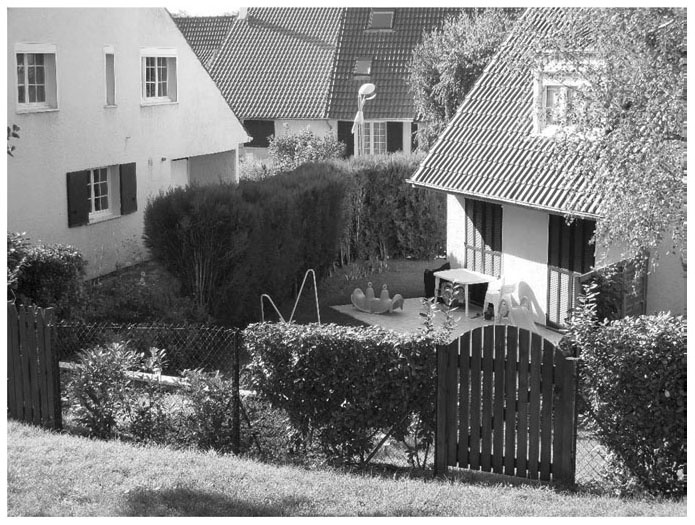
La proximité des habitations à Port-Sud
50In addition the form of Port-Sud, modelled on a holiday village concept, has aged and is not very up-gradeable, unlike Châteaufort and the renovation potential of its old houses. The image of it being an “English” or “American” neighbourhood in the 1970s has partially faded and Port-Sud is now considered to be more of a suburban “housing estate” (lotissement pavillonnaire), with all the pejorative connotations that this term conveys. While the marks of individualisation of the spaces linked to its habitat are valued, particularly by some of the middle and senior managers, the neighbourhood is now suffering from the typology of its buildings, seen as “horizontal social housing.” Although she likes Port-Sud a lot, especially for the proximity of the facilities just mentioned, Ingrid admits that “Port-Sud, and it’s mean to say it, but it’s really just horizontal social housing. It is true that all the houses are semi-detached and identical, so this is the period of the 1960s-1970s. That’s it. It is true that for our generation we can no longer have a detached and isolated house.”
51In these circumstances, the administrative regulation involved in co-ownership has become an element of conflict between two generations of owners, because it prohibits overly personal appropriations of houses and gardens. The first-comers advocate a collective model that sometimes seems too restrictive for those who settled later, and who would like to appropriate their home as a single-family house. Thus Georges [13], who moved there in 1986 says: “The minor disadvantages of the housing estate are mainly due to the fact that we cannot do exactly what we want with the external appearance of the houses, it is a form of a horizontal co-ownership where the external appearance of houses must remain homogeneous, and in particular one of the changes that we would like to do one day is to make a veranda, because in our climate one gets rather little benefit from the garden, and that is not possible, as it is not envisaged in the co-ownership regulations and, in any case, the gardens are very small.”
52Unlike the former inhabitants of Châteaufort, the Port-Sudiens who settled in the 1970s have a passive downward residential path linked to the lower attractiveness of the holiday resort concept in the upper middle classes as well as the continuation of the urbanization of Breuillet. The social class level of households remains relatively homogeneous, and Port-Sud remains a middle-class neighbourhood, but its position within the archipelago of the middle classes (Bacqué and Vermeersch 2007) has moved downwards, as Patrick underlines in his own way: “The village has been impoverished in terms of the wealth index between the very rich and the very poor. One could say that at the beginning it was on an index of 52 to 75, today one is on an index of 20 to 49.” However, the processes involved in Port-Sud cannot be broken down in a declinist manner, since the diverse forms of local anchorage, or even of domination, which have developed there suggest a more measured interpretation of the direction of the development path of the district.
The private construction of territories under stress
53This “downward” path taken by Port-Sud, of the district as much as of the relative social positions of its inhabitants, has been accompanied by the transformation of the management methods of the housing estate which, from being a private club, has become a standard form of co-ownership. The roads have been integrated into the public domain and are now managed by the municipality; the tennis courts have been absorbed into the Breuillet tennis club and are increasingly frequented by people who do not live in Port-Sud. Only the swimming pool remains private and reserved for the sole use of the inhabitants of the estate.
54This shift took place at the time when the residents of Port Sud began to take over administration of the municipality. Several officials of the Port-Sud co-ownership council or of the club subsequently took seats on the municipal council, and a few even engaged in local political careers. Here we can find some traits described by Bidou about the “adventurers of everyday life” (1984) where she showed, in the city as much as in the suburban domain, how they had become involved in local administration. But the social profile of the inhabitants of Port-Sud differs significantly from theirs. It is not a question of changing one’s life or society, but of having a pleasant life and of controlling the local environment: “We must not disfigure our village. And then, at the time, there was no attempt at all to expand our municipality. We wanted to stay in a country context, in the countryside, and not try to grow, and not try to make it into a city.” (Deputy mayor from 1977 to 1995, living in Port-Sud).
55Since 1977, all the mayors have lived in Port-Sud. At the same time, municipal policies have largely consisted of the construction of facilities (post office, old age pensioners’ home, village halls, media library, swimming pool, market) to complement those of Port-Sud, responding to the demands of the residents of the housing estate itself even though they helped the whole town. This goes against the privatization processes that are supposed to be at work in the peri-urban areas (Paquot 2009) and illuminates a municipalisation dynamic that can be analyzed both as openness and as local control.
56In any case, private management and the presence of a club at the heart of community life in Port-Sud have not been enough to maintain its rank in the hierarchy of peri-urban/suburban residential areas. Worse still, and according to the oldest inhabitants, the club has lost its attractiveness and is now encountering management difficulties: “Look at the club, it is empty, and it is usually empty. There is a small team that takes care of it, but there are no more volunteers, it does not exist anymore.” (Hervé). [14]
57Over and above the issue of the management of the club—which is a common problem in any community organisation due to the difficulty of replacing volunteers—what has arisen is the issue of the management of collective spaces of the suburban complex, that was ensured at the outset by being in the form of its co-ownership by residents. The choice of public management can be explained by several factors (Charmes 2005). The first is that the best guarantee of neutrality is offered by municipal management, which is governed by public law. Several people we met in Port-Sud stressed that they feel they are outside the club, which is responsible for managing the public facilities, sports activities, etc., which appears to them to be a relatively closed circle, working through cooptation amongst themselves. Another factor conducive to municipal management is the efficiency and lower cost of the means available to municipalities to control residential environments, including preserving agricultural and natural spaces. The last disadvantage to private management is its cost, since it comes as something superimposed on public management, which can hardly be eliminated, so that the inhabitants of a privately managed residential complex must also continue to pay local taxes.
58For the inhabitants of Port-Sud, the capture of municipal resources was thus an issue. A takeover of municipal resources has therefore been put in place, as in Châteaufort. But the latter has six times less inhabitants than Breuillet and its population appears socially more homogeneous. The degree of control exercised at the municipal level by the inhabitants of Port-Sud has obviously been commensurate with their demographic weight. While Port-Sud is an extension of Breuillet, that has become a small town over the years, Châteaufort presents all the attributes of a true village, with a mairie (town hall) at its centre.
59* * *
The middle classes in the peri-urban mosaic
60A sociology of the peri-urban domain allows us to understand not only the way in which this type of space emerges, and is thus inscribed in both time and social change, but also the way in which it influences peoples’ residential and social trajectories, and social identities. Although the parallelism of social and spatial outcomes highlighted here should not lead to a kind of geographical determinism, this article confirms to what extent the relationship with a locality is part of the processes of classification and construction of social borders which are symbolically marked in social practices, and physically in space (Savage et al. 2005).
61These issues about classification do not only concern the relative position of “peri-urban” spaces compared to other urban locations, especially the centres and the suburbs, but they are also internal to the peri-urban. The two areas we have discussed here thus highlight different, if not divergent, trajectories within the peri-urban areas. These differences are based as much on local factors, linked in particular to the nature of the housing stock, the fluctuations in heritage values and transport facilities, as on the contrasting changes in the wider areas of which Châteaufort and Port Sud are parts. The two cases presented here are only illustrations of a more general dynamic, which has seen the emergence of a “peri-urban” mosaic evolving and asserting a social and territorial hierarchy. This sociological diversification of the peri-urban area is, in our view, evidence of the normalization and maturation of an urban model, as observed in more populated areas such as new towns (Vermeersch 2005). In any case, peri-urbanization cannot be reduced merely to the negative images of it that have emerged in France in public debates. Although the residential areas of first-time buyers may be part of the peri-urban domain (Lambert 2012, Girard 2013), they are only a part that it would be reductive to see as representing the whole.
62Classification games within the peri-urban mosaic can be understood in terms of the social impact of residential choices (Authier et al. 2010). In the peri-urban areas, these choices are no longer reducible simply to the ownership of a detached house (Lambert 2012) or to the search for a protective togetherness (Donzelot 2004). In the two cases studied, the choice of living in a peri-urban area results not only from a combination of economic, family and occupational factors, but also from lifestyles and residential habitus (Bacqué and Vermeersch 2013) that are sufficiently mature to be transmitted today and to favour a strong anchoring in these areas (Imbert et al. 2011). Beyond the fact of living in an individual house, these habitus indeed include a relationship to the area and the living environment. When the peri-urban location is chosen, the proximity of the natural world seems to be a predominant factor, as well as the possibility of investing in a sociability of neighbourliness. The local involvement of the inhabitants in associational activities or in municipal administration also characterizes the methods by which the middle classes anchor themselves within the peri-urban areas, a finding which refers to the descriptions of the peri-urban villages made by Bidou (1984) at the end of the 1970s. This local commitment is of course not free of power relations nor of the desire to control the neighbourhood, but the case of Port-Sud shows that social closure and togetherness, besides the fact that they do not exclusively characterize those living in peri-urban territories (Collet 2015, Charmes et al. 2016), cannot fully define social relationships: the municipalisation dynamic that is taking place bears witness to a relationship to the local area that is much more ambivalent. Moreover, and this is undoubtedly the main contribution of this article, there is no (or no longer?) a specifically peri-urban habitus, but many forms of habitus: the cases of Châteaufort and Breuillet show that, at the same time as they are getting denser, the forms of habitus and peri-urban lifestyles are diversifying.
Areas caught between rise and decline: social trajectories in the suburban mosaic
63This sociological diversification of peri-urban areas must of course be considered more generally in view of the social changes that have taken place in French society since the 1980s, which have resulted in, among other things, processes of diversification and even fragmentation of the middle classes. Suburban territories, formerly considered as terrains of middle-class conquest (Jaillet 1982, 2004), have diversified as the latter are broken down into increasingly differentiated strata. It should be remembered that, with a high cultural capital and a high level of education, the households encountered in Châteaufort, mostly working couples, have followed upward career trajectories as senior managers in the private sector, and risen to higher social positions in the middle classes. The inhabitants of Port-Sud have followed more diverse social trajectories, and gravitated around the average, in positions more often interpreted as being prey to some uncertainty in the future. The perspective of increasing “moyennisation” (“middling-out”) put forward in the 1970s (Mendras 1988) has now moved away (Damon 2015); the recurrence of economic and social inequalities over the past two decades (Piketty 2013) has profoundly changed the structure of a group that may have been considered as tending towards homogeneity only under the simultaneous effect of a temporary convergence of living conditions and a sudden interest of the academic field in a new social category then in full expansion. Today, the term “middle classes” describes a broad spectrum in sociooccupational and income terms, and many studies have already emphasized the heterogeneity of this “class” that has been variously described as an “archipelago,” a “nebula,” or as “multi-polarized” (Bosc 2004, Lojkine 2005). Although the inhabitants of Port-Sud much like those of Châteaufort see themselves as located “in the middle” of the social space, “neither poor nor rich,” they do not belong to the same middle classes. We can thus wonder if this “archipelago of the middle classes,” which deploys diverse social, cultural and urban practices, still shares a common body. The rationale of social reproduction and distinction (Bourdieu 1979) is a good illustration of these changes. At a certain level of abstraction, it remains shared. At the same time, it unfolds in very different forms, particularly according to the territorial contexts in which it is embedded (Bacqué et al. 2015). The diversity of the middle classes is thus expressed in their relationship to space and in their residential choices. Their habitants and residential trajectories—passive or active—are part of their social positioning.
References
- Arnould, P., Bonerandi, E., Gillette, C., 2009. “Rural/urbain” in J.-M. Stébé, H. Marchal, eds, Traité sur la ville. Paris: Presses Universitaires de France.
- Authier, J-Y., Bonvalet, C., LévY, J.-P., eds, 2010. Élire domicile, la construction sociale des choix résidentiels. Lyon : Presses Universitaires de Lyon.
- Bacqué, M.-H., Bridge, G., Benson, M., Butler, T., Charmes, É., Fijalkow, Y., Jackson, E., Launay, L., Vermeersch, S., 2015. The Middle Classes and the City: A Study of Paris and London. London: Palgrave Macmillan.
- Bacqué, M.-H., Vermeersch, S., 2007. Changer la vie. Les couches moyennes et l’héritage de mai 68. Paris: Éditions de l’Atelier.
- Bacqué, M.-H., Vermeersch, S., 2013. “Les classes moyennes dans l’espace urbain: choix résidentiels et pratiques urbaines,” Sociologie et Sociétés 45(2): 63–85.
- Bauer, G., Roux, J.-M., 1976. La rurbanisation ou la ville éparpillée. Paris: Le Seuil.
- Benoit-Guilbot, O., 1986. “Quartiers-dortoirs ou quartiers-villages? Constitution d’images et enjeux de stratégies localisées” in L’Esprit des lieux. Localités et changement social en France. Paris: Éditions du CNRS, pp. 127–56.
- Berger, M., 1985. “Comportements et pratiques des sociétés périurbaines,” Géographie Sociale 2: 133–9.
- Berger, M., 2004, Les périurbains de Paris. De la ville dense à la métropole éclatée. Paris: CNRS Éditions.
- Berger, M., 2006. “Périurbanisation et accentuation des logiques ségrégatives en Île-de-France,” Hérodote 122: 198–211.
- Berger, M., Aragau, C., Rougé, L., 2014. “Vers une maturité des territoires périurbains? Développement des mobilités de proximité et renforcement de l’ancrage dans l’ouest francilien,” EchoGéo [online], 27 | 2014, posted online 2 April 2014, consulteed 28 September 2016: http://echogeo.revues.org/13683; DOI: 10.4000/echogeo.13683.
- Bidou, C., 1984. Les aventuriers du quotidien. Essai sur les nouvelles classes moyennes. Paris: Presses universitaires de France.
- Bosc, S., 2004. Stratification et classes sociales, la société française en mutation. Paris: Armand Colin.
- Bouffartigue, P, Gadea, C., Pochic, S., eds, 2011. Cadres, classes moyennes: vers l’éclatement? Paris: Armand Colin.
- Bourdieu, P., 1979. La distinction sociale. Critique sociale du jugement. Paris: Éditions de Minuit.
- Bourdieu, P., 2000. Les structures sociales de l’économie. Paris: Le Seuil.
- Bugeja, F., 2011. “Les inégalités d’accès à la propriété et leurs déterminants institutionnels. Étude comparative entre la France et le Royaume-Uni (1980–2005),” Revue Française de Sociologie 52(1): 37–69.
- Cartier, M., Coutant, I., Masclet, O., Siblot, Y., 2008. La France des “petits-moyens.” Enquête sur la banlieue pavillonnaire. Paris: La Découverte.
- Castel, R., 2009. La montée des incertitudes : travail, protections, statut de l’individu. Paris: Le Seuil.
- Chalas, Y., 2000. L’Invention de la ville. Paris: Anthropos.
- Charmes, É., 2005. La vie périurbaine face à la menace des gated communities. Paris: L’Harmattan.
- Charmes, É., 2011. La ville émiettée. Essai sur la clubbisation de la vie urbaine. Paris: Presses Universitaires de France.
- Charmes, É., 2014. “Une France contre l’autre?” La vie des idées, 5 November, [online]: http://www.laviedesidees.fr/Une-France-contre-l-autre.html.
- Charmes, É., Launay, L., Vermeersch, S., 2016. “Le périurbain n’est pas une version dégradée de la ville” dans É. Charmes, M.-H. Bacqué, eds, Mixité sociale, et après? Paris: Presses Universitaires de France, pp. 81–96.
- Chauvel, L., 1998. Le destin des générations. Structure sociale et cohortes en France au XXe siècle. Paris: Presses universitaires de France.
- Chenu, A., 1990. L’archipel des employés. Paris: INSEE.
- Collet, A., 2015. Rester bourgeois. Les quartiers populaires, nouveaux chantiers de la distinction. Paris: La Découverte.
- Cousin, B., 2014. “Entre-soi mais chacun chez soi. L’agrégation affinitaire des cadres parisiens dans les espaces refondés,” Actes de la Recherche en Sciences Sociales 204: 88–101.
- Cousin, B., 2013. “Ségrégation résidentielle et quartiers refondés. Usages de la comparaison entre Paris et Milan,” Sociologie du Travail 55(2): 214–36.
- Damon, J., 2015. “Le logement des classes moyennes en France : un déclassement objectif, subjectif et politique,” Environnement Urbain/Urban Environment [online] 9 | 2015, posted online 19 October 2015, consulted 29 September: http://eue.revues.org/621.
- Debroux, J., 2011. “Stratégies résidentielles et position sociale : l’exemple des localisations périurbaines,” Espaces et Sociétés 144–5: 121–39.
- Dodier, R., 2012. Habiter les espaces périurbains. Rennes: Presses Universitaires de Rennes.
- Donzelot, J., Mongin, O., 2013. “Tous périurbains! Tous urbains! Introduction,” Esprit 3(March/April): 18–22.
- Dumazedier, 1972. Vers une civilisation du loisir? Paris: Le Seuil.
- Dusserre-Bresson, Q., 2011. Le nouveau village de Port-Sud. 1970–1990: 40 ans d’évolutions. Mémoire de Master Ville Architecture, Urbanisme et Environnement, Université Paris Nanterre.
- Filippi, B., Nabos, H., Funes, C., Tutin, C., 2007. Marchés du logement et fractures urbaines en Île-de-France. Paris: PUCA, Ministère de l’Équipement.
- Gant, R., Robinson, G., Fazal, S., 2011. “Land-Use Change in the “Edgelands”: Policies and Pressures in London’s Rural-Urban Fringe,” Land Use Policy 28(1): 266–79.
- Girard, V., ed., 2013. “Propriété et classes populaires,” Politix 101.
- Guilluy, C., 2010. Fractures françaises. Paris: François Bourin Éditeur.
- Hayden, D., 2009. Building Suburbia: Green Fields and Urban Growth, 1820– 2000. New York, NY: Penguin Random House.
- Imbert, C., Brune, A., Rozenholc, C., 2011. “Les villes nouvelles franciliennes : un exemple de périphéries urbaines en cours de maturation,” Espace Populations Sociétés 3: 591–602, [online], 2011/3 | 2011, posted online 31 December 2013, consulted 29 September 2016: http://eps.revues.org/4728; DOI: 10.4000/eps.4728.
- Jaillet, M.-C., 1982. Les pavillonneurs : la production de la maison individuelle dans la région toulousaine. Paris: Éditions du CNRS.
- Jaillet, M.-C., 2004. “L’espace périurbain : un univers pour les classes moyennes,” Esprit March–April: 40–65.
- Jaillet, M.-C., 2013. “Peut-on encore vivre en ville? L’exemple de Toulouse,” Esprit March–April: 40–62.
- Lahire, B., 2004. La culture des individus. Dissonances culturelles et distinction de soi. Paris: La Découverte.
- Lambert, A., 2012. “Tous propriétaires !”Politiques urbaines et parcours d’accédants dans les lotissements périurbains (des années 1970 à 2010), Doctorate in sociology, EHESS.
- Lapeyronnie, D., 2008. Ghetto urbain. Ségrégation, pauvreté, violence en France aujourd’hui. Paris: Robert Laffont.
- Lefebvre, H., 1970. La révolution urbaine. Paris: Gallimard.
- Legoix, R., Webster, C. J., 2008. “Gated Communities,” Geography Compass 2(4): 1189–214.
- Lévy, J., 2000. Le tournant géographique. Paris: Belin.
- Lévy, J.-P., 1998. “Dynamique du peuplement résidentiel,” Sociétés Contemporaines 29: 43–72.
- Lojkine, J., 2005. L’adieu à la classe moyenne. Paris: La Dispute.
- Marchal, H., Stébé, J.-M., 2015. “La multiplication des centralités à l’heure de la périurbanisation,” L’Année Sociologique 65(1): 247–71.
- Mendras, H., 1988. La seconde révolution française, 1965–1984. Paris: Gallimard.
- Paquot, T., 2009. Ghettos de riches. Tour du monde des enclaves résidentielles sécurisées. Paris: Perrin.
- Peugny, C., 2009. Le déclassement. Paris: Grasset.
- Phillips, M., 1993. “Gentrification and the Processes of Class Colonisation,” Journal of Rural Studies 9(2): 123–40.
- Piketty, T., 2013. Le capital au 21e siècle. Paris: Le Seuil.
- Préteceille, E., 2003. La division sociale de l’espace francilien. Typologie socioprofessionnelle 1999 et transformations de l’espace résidentiel 1990–1999, Research report for the Direction Régionale de l’Équipement d’Île-de-France.
- Préteceille, E., 2006. “La ségrégation contre la cohésion sociale: la métropole parisienne” in H. Lagrange, ed., L’épreuve des inégalités. Paris: Presses Universitaires de France, pp. 195–245.
- Richard, F., 2010. “La gentrification des “espaces naturels” en Angleterre: après le front écologique, l’occupation?” L’Espace politique, [online] 9 | 2009-3, posted online 20 January 2010, consulted 29 September 2016: http://espacepolitique.revues.org/1478; DOI: 10.4000/espacepolitique.1478.
- Rivière, J., 2009. Le pavillon et l’isoloir. Géographie sociale et électorale des espaces périurbains français (1968–2008). À travers les cas de trois aires urbaines moyennes (Caen, Metz et Perpignan), Doctoral thesis, Université de Caen-Basse-Normandie.
- Rougé, L., 2005. Accession à la propriété et modes de vie en maison individuelle des familles modestes installées en périurbain lointain toulousain. Les “captifs” du périurbain? Doctorate in geography, Université de Toulouse-Le Mirail.
- Savage, M., Bagnall, G., Longhurst, B., 2005. Globalization and Belonging. London: Sage.
- Vanier, M., Lajarge, R., Cordobes, S., 2010. “Pour des périurbains assumés,” Territoires 2040(2): 21–32.
- Vermeersch, S., 2005. Le projet socio-urbain des villes nouvelles: expérimentations et obsolescence, with the participation of V. Biau, I. Chesneau, A. Flamand, Report for the Programme Interministériel d’Histoire et d’Évaluation des Villes Nouvelles françaises, Mission du Patrimoine Ethnologique, Ministère de la Culture.
- Vermeersch, S., 2011. “Bien vivre au-delà du “périph” : les compromis des classes moyennes,” Sociétés Contemporaines 83: 131–54.
- Vilmin, T., 2006. Le système local de l’urbanisation en maisons individuelles. Étude de cas en Île-de-France. Logiville: Report for PUCA, Ministère de l’Équipement.
Publisher keywords: Breuillet, Chateaufort, Île-de-France, middle classes, peri-urban, port-sud, territorial dynamics, trajectories
Uploaded: 11/30/2016
https://doi.org/10.3917/rfs.574.0681