Late childbearing continues to increase in developed countries
- By Éva Beaujouan
- and Tomás Sobotka
Pages 1 to 4
Cite this article
- BEAUJOUAN, Éva
- and SOBOTKA, Tomás,
- Beaujouan, Éva.
- et al.
- Beaujouan, É.
- and Sobotka, T.
https://doi.org/10.3917/popsoc.562.0001
Cite this article
- Beaujouan, É.
- and Sobotka, T.
- Beaujouan, Éva.
- et al.
- BEAUJOUAN, Éva
- and SOBOTKA, Tomás,
https://doi.org/10.3917/popsoc.562.0001
Delayed childbearing represents a profound change in reproductive behaviour and concerns all developed countries. One of its consequences is a growing number of births to women aged 40 and over. Éva Beaujouan and Tomáš Sobotka compare the situation today in different countries, situate it in the context of historical trends, and discuss the advantages and disadvantages of having children later in life.
1 The “biological clock” ticks louder for many women from age 40 onwards. Infertility rates increase sharply, and the share of women unable to conceive jumps from 17% at age 40 to 56% at age 45 [1]. Pregnancy complications become more frequent, with more than half of initiated pregnancies ending in miscarriage among women aged 42 or older [2]. In vitro fertilization (IVF) using women’s own eggs is ineffective after age 40, and the share of IVF cycles resulting in live-birth delivery drops below 10% among women aged 41–42 [3]. In addition, age 40 is often regarded as a normative age limit for childbearing. In a survey conducted in 2006–2007, a majority of Europeans indicated that by age 40 women are too old to consider having children [4].
2 Yet late childbearing was frequent until the mid-twentieth century. Large families were common, and many women continued to bear children until becoming infertile. But with the rapid decrease in family size, late childbearing fell throughout most of the twentieth century in highly developed countries. For instance, in France, almost one in four women born in 1930 had four or more children, dropping to one in ten women born around 1965 [5].
Box: Data
Sources
- Eurostat, 2018, data on births and fertility rates retrieved in October 2018 from
http://ec.europa.eu/eurostat/data/database.
- HFD, 2018, data on births and fertility rates retrieved in October 2018 from the Human Fertility Database;
www.humanfertility.org.
- Yoo, S. H. and T. Sobotka, 2018. “Ultra-low fertility in South Korea: The role of the tempo effect “. Demographic Research 38 (22): 549-576.

The fall and subsequent rise in fertility rates above age 40
3 In the mid-twentieth century, as larger families were becoming less common, cumulative fertility rates at ages 40 and above decreased to around 0.1–0.2 births per woman in most European countries, Canada, the United States, and Japan. By the 1980s, they plummeted to a low of 0.01–0.03 births per woman (Figure 1). A similar but later fall also took place in East Asian countries. Effective birth control contributed significantly to the sharp decline in childbearing at higher reproductive ages in the 1960s–1970s [6]. As the first generation of women postponing motherhood was reaching their forties, fertility trends at late reproductive ages reversed. In most of the analysed countries, the cumulative fertility rates at ages 40 and over gradually climbed to a range between 0.03 (in South Korea and Ukraine) and 0.09 (in Italy and Spain) births per woman in 2016 – still very low as measured from a long-term perspective, but three to four times above their lowest levels. In Ireland, where late fertility is most common, the cumulated fertility for women aged 40 and over rose to 0.12 births per woman. In 2014, fertility rates among women aged 40 and over accounted for 2% of the total fertility rate in some countries of Eastern and Southeastern Europe and in South Korea, 3–4% in most Western European countries, United States, and Japan, and 6% in Italy and Spain (Table). First births at later reproductive ages remain infrequent, but their increase over time has been impressive. In 1984, women aged 40 and over contributed fewer than 0.5% of first-birth rates in most low-fertility countries. By 2014, this share had reached around 2% or higher in most countries, with Spain reporting 4.5% and Italy 4.7%.
Share of births among women aged 40+ (first births and total births)*
| 1984 | 2014 | |||
| First births | All births | First births | All births | |
| Western Europe | ||||
| Austria | 0.3 | 1.3 | 2.2 | 3.6 |
| Finland | 0.6 | 2.1 | 2.0 | 3.9 |
| France | n/a | 1.4 | n/a | 3.7 |
| Germany | n/a | 1.0 | 2.2 | 3.9 |
| Ireland | n/a | 2.6 | n/a | 6.2 |
| Netherlands | 0.4 | 1.2 | 1.9 | 3.0 |
| Norway | 0.4 | 1.2 | 1.9 | 3.4 |
| Sweden | 0.4 | 1.6 | 2.4 | 4.1 |
| Switzerland | n/a | 1.2 | 3.6 | 4.8 |
| uk | 0.4 | 1.4 | 2.6 | 4.1 |
| Southern Europe | ||||
| Italy | 0.7 | 1.9 | 4.7 | 6.0 |
| Portugal | 0.7 | 2.8 | 2.3 | 4.2 |
| Spain | 1.5 | 3.4 | 4.5 | 6.1 |
| Central and Eastern Europe | ||||
| Belarus | 0.3 | 1.1 | 0.5 | 1.7 |
| Czechia | 0.1 | 0.5 | 0.9 | 2.4 |
| Hungary | 0.2 | 0.7 | 1.5 | 3.2 |
| Lithuania | 0.6 | 2.2 | 0.7 | 2.5 |
| Poland | 0.3 | 1.6 | 0.8 | 2.5 |
| Russia | 0.3 | 1.1 | 0.7 | 2.4 |
| Slovenia | 0.4 | 1.2 | 1.4 | 2.5 |
| Ukraine | 0.2 | 1.0 | 0.5 | 1.9 |
| East Asia | ||||
| Japan | 0.3 | 0.5 | 3.0 | 3.8 |
| South Korea | 0.3 | 1.1 | 1.4 | 2.3 |
| Taiwan | 0.3 | 0.6 | 1.8 | 3.0 |
| North America, Australia | ||||
| Australia | n/a | 1.3 | n/a | 4.3 |
| Canada | 0.4 | 0.9 | n/a | 3.6 |
| United States | 0.3 | 1.1 | 1.8 | 3.1 |

Share of births among women aged 40+ (first births and total births)*
*Computed from the distribution of fertility rates by age, calendar year, and birth orderLate fertility increasingly dominated by first and second births
4 The fall in family size and the continuing shift to later parenthood have transformed the profile of late births. In the past, few women had their first or second child at age 40 or over. Most “older mothers” would give birth to their fourth, fifth, or later child (Figure 2). In the mid-1970s, first and second births typically accounted for about one out of five births to mothers aged 40 and over (except in Japan, where their share was much higher). Today, however, the majority of births to older mothers in most countries are first and second births (Figure 2). The transformation was especially rapid in Spain, where the share of fifth and later births to women aged 40+ plunged from 42% to below 3% between 1975 and 2015. Similarly low shares of fifth and later births are found in South Korea and Japan.
Births among women aged 40+ by birth order (in %) in selected low-fertility countries representing broader regions, 1975 and 2015
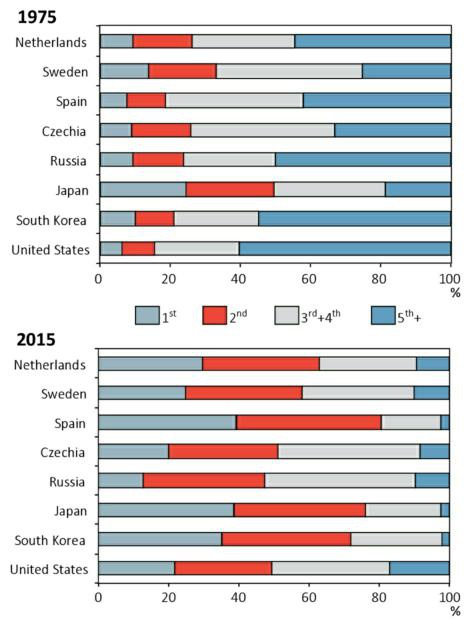
Births among women aged 40+ by birth order (in %) in selected low-fertility countries representing broader regions, 1975 and 2015
Assisted reproduction’s contribution to fertility rates at advanced ages
5 Part of the increase in late childbearing is due to the spread of in vitro fertilization. But women at later reproductive ages who use IVF face a number of challenges, including the low effectiveness of IVF and its high costs, as IVF cycles are not usually covered by medical insurance among women aged 40 and over [7]. In addition, legal regulation of IVF varies widely, with some countries specifying a maximum age for its use, prohibiting egg or sperm donation, and limiting IVF to heterosexual women living with a partner (or even to married women only). A survey of IVF regulations in 13 European countries in 2009 showed that Austria, Germany, and Italy considerably restrict access to IVF, whereas Belgium, Finland, Greece, and the United Kingdom allowed wide access to assisted reproductive technologies [7]. The United States also has liberal legislation on IVF use.
Percentage of live births conceived through IVF by age of mother, United States, 2015
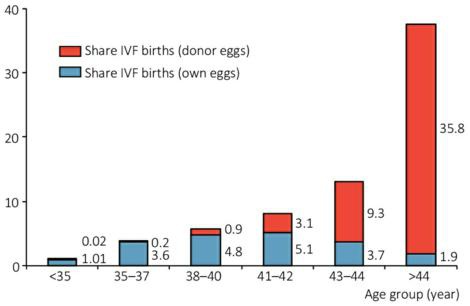
Percentage of live births conceived through IVF by age of mother, United States, 2015
.6 Despite these limitations, IVF among women aged 40 and over has been rising across developed countries. Many women past age 40 opt to use donor eggs from younger women, which results in high rates of pregnancies and live-birth deliveries, even at very late reproductive and post-reproductive ages. In the United States, IVF accounted for 11% of all live births among women aged 40 and over in 2015, and 1.8% of all live births. The contribution of assisted reproduction was especially large among women aged 44 and over, with most IVF live births having been conceived using donor eggs (Figure 3). IVF use with donor eggs also allows pregnancies and births at post-reproductive ages, challenging the “traditional” boundaries of the reproductive span imposed by infertility and menopause. The media often cover births among women past age 50. While pregnancies and births remain rare at these ages, their numbers have been soaring. EU countries recorded 1,293 births to women aged 50 and over in 2016, up from 287 in 2002 (Eurostat, 2018). In the United States, the number of “very late” births jumped from 144 in 1997 to 786 in 2016 (HFD, 2018).
The future of late and very late childbearing
7 The postponement of parenthood has become a defining feature of fertility trends in the more developed countries over the past four decades. It has been driven by a number of interrelated forces, including greater access to and longer pursuit of education, gender “revolution”, changes in partnership formation and dissolution (delayed unions, higher dissolution rates, and higher numbers of second unions later in life) and by growing economic uncertainty among young adults. The representation of parenthood at older ages is also changing, as its visibility and acceptance become more widespread. In research and in the media, multifaceted debates on delayed motherhood reveal both its advantages and disadvantages. Some view late parenthood as a positive experience. Older parents may provide children with higher living standards and greater family stability, thus improving their life chances. However, delayed parenthood is also often portrayed as risky, potentially endangering the mother’s or child (ren)’s health, or leading to involuntary childlessness.
8 Late parenthood is likely to continue its upward trend thanks to socioeconomic and cultural change. Women who postpone childbearing tend to have more education and work experience than those who have children earlier in life, with more sustained career progress and lower wage loss due to motherhood [8]. The share of women in their late 30s and early 40s who are childless or who have one child has been increasing in most countries, and many of them still desire to have a child in the future [9]. Furthermore, the technology of egg freezing (cryopreservation) for potential future use has progressed from an experimental stage and has become more widely available over the last decade. In the United States, 46,000 assisted reproduction cycles were performed for “egg banking” purposes in 2015, up from around 1,000 in 2006 (CDC, 2017). Most women undergoing egg or embryo cryopreservation are in their mid- or late-thirties, and many plan to use their eggs in their forties or even fifties. As childbearing past age 40 becomes ever more common, it is important for women and men to be better informed about the advantages and disadvantages involved in having children later in life.
References
- 1. Leridon H., 2008, “A new estimate of permanent sterility by age: Sterility defined as the inability to conceive”, Population Studies 62 (1), pp. 15–24.
- 2. Andersen A.M.N., Wohlfahrt J., Christens P., Olsen J. and Melbye M., 2000, “Maternal age and fetal loss: Population based register linkage study”, BMJ 320 (7251), pp. 1708–1712.
- 3. CDC, 2017, 2015 Assisted Reproductive Technology: National Summary Report, Atlanta, GA, Centers for Disease Control and Prevention, US Dept of Health and Human Services.
- 4. Billari F.C., Goisis A., Liefbroer A.C., Settersten R.A., Aassve A., Hagestad G. and Spéder Z., 2011, “Social age deadlines for the childbearing of women and men”, Human Reproduction 26 (3), pp. 616–622.
- 5. Brée S. and Grieve M., 2017, “Changes in family size over the generations in France (1850–1966)”, Population 72 (2), pp. 297–332.
- 6. Prioux F., 2005, “Late fertility in Europe: Some comparative and historical data”, Revue d’épidémiologie et de santé publique, 53, pp. 2S3–2S11.
- 7. Berg Brigham, K., Cadier, B. and Chevreul, K., 2012, “The diversity of regulation and public financing of IVF in Europe and its impact on utilization”, Human Reproduction 28 (3), pp. 666–675.
- 8. Bratti M., 2015. “Fertility postponement and labour market outcomes. Postponed childbearing increases women’s labour market attachment but may reduce overall fertility”, IZA World of Labor 2015: 117.
- 9. Sobotka T. and Beaujouan É., 2018, “Late motherhood in low-fertility countries: Reproductive intentions, trends and consequences” in Stoop D. (ed.), Preventing Age-Related Fertility Loss, Cham, Springer, pp. 11–29.
