Informal-formal sector and urban space in Bafoussam (Cameroon): Municipal solid waste collection
- By Rolande Christelle Makamté Kakeu-Tardy,
- Translated from the French by Madeleine Velguth
Pages 261 to 281
Cite this article
- MAKAMTÉ KAKEU-TARDY, Rolande Christelle,
- Translated from the French by VELGUTH, Madeleine,
- Makamté Kakeu-Tardy, Rolande Christelle.,
- et al.
- Makamté Kakeu-Tardy, R.-C.,
- Translated from the French by Velguth, M.
https://doi.org/10.3917/eg.473.0261
Cite this article
- Makamté Kakeu-Tardy, R.-C.,
- Translated from the French by Velguth, M.
- Makamté Kakeu-Tardy, Rolande Christelle.,
- et al.
- MAKAMTÉ KAKEU-TARDY, Rolande Christelle,
- Translated from the French by VELGUTH, Madeleine,
https://doi.org/10.3917/eg.473.0261
Notes
-
[1]
In the present study, solid municipal waste includes:
- solid household waste: organic waste, recyclable objects, plastics and any other reusable solid object;
- community waste: salvageable solid material abandoned on the public thoroughfare.
-
[2]
Hysacam is a subsidiary of the Grandjouan group, an associate of SITA, an international aeronautics company.
-
[3]
Cercle international pour la promotion de la création [International Circle for the Promotion of Creation].
-
[4]
Contract No. 000328/M/MINMAP/DGM AS/DMSPI/CE8/CEA8/ya/2 014 issued in a direct agreement procedure on authorization No. 00002861/L/PR/MINIMAP/ DGMAS/h-ng/ of 05/27/2014 with the company Hygiene et salubrité du Cameroun (Hysacam) for the collection, transportation and treatment of household waste, sweeping and cleaning of streets, public places and markets of the city of Bafoussam.
-
[5]
In informal conversations with collection teams, an example of monthly wage scales mentioned by several employees was estimated at more or less 100,000 FCFA (145 euros) for some drivers and more or less 50,000 FCFA (72.5 euros) for some garbage collectors. The wages rise with the employee’s seniority or are reduced following a penalty. Exact figures are difficult to obtain because of the sensitivity of the subject.
-
[6]
Twenty-five FCFA = four euro centimes.
-
[7]
One hundred FCFA = fifteen euro centimes.
-
[8]
Three hundred euros.
-
[9]
One euro and fifty centimes.
-
[10]
See note 4.
Introduction
1Informal collectors of solid municipal waste include independents and micro-enterprises for waste sorting and storage (Durand, 2012). [1] They are often active alongside the waste pickers formally employed by the municipality or by a company engaged in waste collection, sorting and recycling. In Bafoussam, Hysacam is a private company authorized by the state and it operates in partnership with the public sector. The municipality controls its service and contributes toward financing it. [2] As they collect waste in the city, the collectors of the informal and formal sectors work alongside each other. In fact, the informal waste sector was excluded from the municipal waste dump around 2010 and its practitioners withdrew into the city’s streets and neighbourhoods. Several authors have approached the question of the marginalization of informal waste pickers and the process of formalizing waste management in the cities of the South (Wilson et al., 2006; Oumar, 2007; Nzeadibe, 2009; Corteel, Le Lay, 2012). They studied the informal sector’s functioning in the city’s spaces. However, there is still a lack of knowledge concerning possible interactions with the formal solid waste sector in a context of formalizing and privatizing this system. The network-based organization of informal waste actors started in the West African countries neighbouring Cameroon, but experienced inadequacies in terms of associative, legal and financial integration when confronted with unclean cities (Ada, 2006). The present paper brings out the relationship prevailing over the past few years between the informal pickers of municipal solid waste and the collectors from the formal sector who are employees of the public-private partnership in Bafoussam.
2To achieve this, I adopt a qualitative research method following the theoretical approach of Urban Political Ecology, which takes into account not only interrelations between actors and the power struggle around management of the urban environment (Benjaminsen, Svarstad, 2009; Heynen, 2014), but also the definition of the city as an always interconnected social and environmental product (Heynen et al., 2006), thus including in my research a consideration of the (co)production of urban space. After a review of work related to the representation of the informal waste sector, I describe the process of the informal pickers’ change of space, having left the municipal dump for the city streets of Bafoussam. I then identify these waste pickers, their stakes and their link with the formal sector. Finally, I analyse the itinerary of the garbage sorters, their practice of recovering solid waste, their work spaces and their participation in the production of the African urban space.
The informal waste sector in the urban space of the South: toward formalization?
3According to Adrien Fauve and Cécile Gintrac (2009), the production of urban space features three principal types of actors: planners, developers and builders. In developing countries, this making of the city implies its transformation by society (Piermay, 2003), particularly the city dweller, whose action contributes considerably to the organization of the urban space (Yemmafouo, 2013). In Sub-Saharan Africa, the city dwellers of the informal sector play a major role, using, in particular, irregular or informal means of access to land or real estate(Piermay, 2002; Clerc, 2010; Meyer, 2016). Beyond the construction of real estate, however, the modes of urban production extend to the management of the urban environment, including the sector of municipal garbage collection. The activities of waste recovery consist of hand sorting objects from the waste dump, households, businesses, government or industry for reuse, recycling or adding value to these objects pulled out of the mix (Oumar, 2007) or simply to get rid of them. Historically, the activity of waste recovery dates back to the 19th century, imported from the West, particularly Europe, before emerging in Africa a century later in a period of economic crisis (Ada, 2006). In Gabon, for example, while it was originally conducted by few foreigners or people suffering from mental illnesses, these were then joined by city dwellers of all ethnic origins, ages and sexes, as is the case in Cameroon today. The 1990s saw a boom in the informal sector in large Sub-Saharan and even Arab African cities (Monqid, 2011), for reasons of survival in the face of an acute economic and social crisis. This invasion of waste actors in the 20th century also concerns NGOs, associative groups and/or service providers hired in the context of “good governance” principles. The emergence of these actors follows the imposition of structural adjustment programs by the International Monetary Fund and the World Bank through the privatization of public services (Dorier-Apprill, Meynet, 2005). In some cases, this privatization has had a devastating impact on the economy of the informal actors (Fahmi, 2005). Research on waste salvagers in Africa generally follows three principal approaches.
4A first wave of studies emphasizes the informal aspect and poverty in the urban environment, highlighting poor work and health conditions (Wilson et al., 2006; Oumar, 2007; Nzeadibe, 2009). The extent of health risks, particularly at waste dumps, resulted in projects to formalize the sector and move informal collectors to safer parts of the city (Carré, 2012; Durand, 2012). Moreover, this analytic perspective presents a rather demeaning image of these workers (Corteel, Le Lay, 2012), waste being perceived as degrading and dirty (Cissé, 2012). They are sometimes seen as illegals (Neuwirth, 2012), exercising a survival activity that concerns only vulnerable populations living on the fringe of the city (Moreno Sainz, 2010; Florin, 2015), which gives this sector a poor image in need of improvement (Matter, 2013).
5However, a second corpus of work stresses the importance of informal workers, considering them as crucial actors in a city’s waste management system. For example, Harinaivo A. Andrianisa et al. (2016), as well as Anthony Egbu and Decklan Okoroigwe (2015) show the prime role played by the informal sector in pre-collecting household garbage and loading trucks. Here, these collectors work chiefly within neighbourhoods, particularly with households where they are often less exposed to health risks than in dumps. In Latin America, the image of this activity in cities can vary according to the metropolitan waste management system’s economic or environmental stakes. In Lima, Mathieu Durand (2012) calls this system of informal activity self-management, because it is organized by populations chiefly for environmental reasons in neighbourhoods underserved by the municipal service. As described by M. Durand (2012), the informal collectors or recyclers operate without legal authorization, either directly in neighbourhoods not served by the formal system, or in the streets of affluent neighbourhoods during the night, in order to sort recyclable waste before the municipal truck comes by. According to this author, informal collectors’ opportunity to obtain approval is very limited in Peru, for it is given based on criteria of health and environmental protection that at times conforms to European norms. Marie-Noëlle Carré (2012) asserts that in Buenos Aires the economic factor is more important than the issue of delivery in waste collection service. In this Argentine metropolis, sharing the territory between informal pickers and formal waste collectors arouses conflict because the added value of the tonnage is reduced, while the income of the garbage men is based on it. Given that development levels are not always the same in metropolises and cities of average size, the nature and quantity of waste can vary from one city to another. In other words, this approach to the waste recovery sector claims that the informal collectors would thus contribute to sustainable development (Ezeah et al., 2013).
6The third corpus is more recent, seeing the informal sector as an element to be connected to the formal sector in order to make the waste management system more effective. Along these lines, some authors study the feasibility of integrating the informal and formal sectors (Wilson et al., 2006; Yates, Gutberlet, 2011; Paul et al., 2012; Zapata Campos, Zapata, 2014). Other scholars confine themselves to the idea of coexistence between informal and formal collectors. Indeed, while David C. Wilson et al. (2009) speak of the win-win relationship between the two categories of actors, Mescharch W. Katusiimeh et al., (2013)emphasize the competitive character of the informal and formal waste sectors, particularly when private sector collectors go door-to-door as much as do those of the informal sector, while the public service collects waste at a distance with specialized equipment such as waste bins and dump trucks.
7Furthermore, the idea of formalizing the informal sector joins this third corpus, especially in studies done in Latin America. On that subject, Mathieu Durand (2012) takes as starting point a consideration of waste management in the Peruvian capital and similar research to maintain that developing cities would be well advised to concentrate on better articulation between the formal and informal sectors rather than put their financial and human efforts into suppressing the illegal system. He emphasizes a tendency to institutionalize the relationship between the two systems under a form of shared management, crystallized by associating their assets, consisting of the efficiency of the formal sector and the field experiences of the informal pickers. The limits of this formula have, however, been mentioned: it places the waste sector into a situation of illegality. Therefore, this idea of formalization is sometimes advanced from a more attractive point of view, particularly that of service durability. In the case of Buenos Aires, it has been shown that dividing the work territory between the two sectors caused conflicts around waste that had become rare and therefore profitable, and this rarity led to regulation of waste territories and a redefinition of the status of the salvagers. Thus, the formation of partnerships between the state and cooperatives was encouraged, and the revision of management contracts was considered with a rate now defined according to the area cleaned up and not according to the quantity of waste collected. This partial institutionalization of salvagers, but not of the entire chain of the informal system, eased tensions between informal and formal sectors operating in the same territory.
8In this analytical framework, power relations often come to the fore. To be specific, Julian Yates and Jutta Gutberlet (2011) studied the local political context in which municipal waste management is integrated in Diadema, Brazil. They are particularly interested in the unequal power relationships in situations of conflict between formal and informal actors, among them the municipality and recyclers of organic waste, such as community gardeners. They suggest integrating recycling programmes into municipal models of waste management, forming professional relationships between the formal and informal parties, which are encouraged to organize themselves better as cooperatives. The political implications of the link between these actors often result in the production of space in the cities of the South. For example, in Delhi, René Véron (2006) has shown how policies of air pollution management in the city resulted in a process of peri-urbanization, an illustration of the co-production of society and the urban environment often seen only as a residue of capitalist production. In Latin America, the creation of an “ecological belt” in the city of Buenos Aires (which is expanding) has made it possible to protect city dwellers from the health impacts of waste landfills in the city (Carré, Negrão, 2015). Along the same lines, in Guayaquil, Ecuador, water is managed in the framework of a politico-economic and ecological process integrated into urbanization (Swyngedouw, 1997). Through a reading of the city and its extension via water, this author has shown its circulation and management. In Africa, in two medium-sized cities of northern Cameroon (Garoua and Maroua), Émilie Guitard (2012) shows how the volume of piles of municipal refuse accumulated in a given local area results in an affirmation of the power of the authority of that area. In Yaoundé, the political capital of the country, the political dimension of garbage was noted during the years of economic crisis and urban management when, in the 1990s, dealing with waste or making it a subject of research constituted a risk for the scholar. Indeed, the huge and increasing number of garbage bins in this capital’s urban space was such that the very publication of the word “garbage” in Yaoundé’s daily newspaper rang out as a reminder of the incompetence of the public authorities in charge of this service (Zoa, 1996). Since then, the largely informal or associative waste service addresses the concerns of the local citizens (Ngambi, 2016).
9The focus is thus on the connection between informal and formal sectors and the challenges of resource, politics and power surrounding waste. This paper follows that approach to study the relation between informal waste pickers and formal waste collectors as well as the part they play in the production of African urban space.
Research materials and methods
Selection of the study site
10This case study focuses on the city of Bafoussam (fig. 1), including the three districts (Bafoussam I, II and III), making it an urban community created in 2008 and consisting of some seventy neighbourhoods. A secondary city and the capital of the West Region of Cameroon, Bafoussam is the third francophone city of Cameroon (after Douala and Yaoundé), economically and politically influential in the region. Bafoussam is the chief city of the highlands region, better known as “Bamiléké country”. This city has important interurban dealings with the country’s two large metropolises and with its sub-region, which makes of it a true intermediary city.
Location of the city: Bafoussam in Cameroon

Location of the city: Bafoussam in Cameroon
11The medium size of the city, its institutional context and the social factor were considered in the choice of this study site as subject of a doctoral thesis from which the present paper was drawn. With nearly 500,000 inhabitants, Bafoussam is among the cities of Sub-Saharan Africa where the vast majority of the continent’s urban population lives. Such cities are exposed to the challenges of contemporary urban growth. While urban waste management is first and foremost the responsibility of the urban community, waste service is conducted by Hysacam, a private company operating under a publicprivate partnership.
12In point of fact, the waste management system in Cameroon has seen institutional changes in the past few decades, going from municipal autonomy to privatization of the service. Hysacam entered the picture in Douala in 1969 and has been working in Yaoundé since 1979. In 2006, forty years later, this company established itself in other cities of the country. Despite the existence of rare studies like those of Mpakam Hernanie Grelle et al. (2006) and Célestin Defor et al. (2015), little is known about the informal sector, and even less about their relations with the waste collectors employed by Hysacam. Furthermore, common initiative groups came into being initiated by an environmental NGO (CIPCRE [3]), operating in several residential neighbourhoods. In order to analyse a sector often considered the work site of less educated people, the knowledge of local dialects by the author was an asset for the phases of collecting and analysing narratives and field interviews.
Data collection
13Data presented in this article resulted from fieldwork conducted by the author in 2015 and 2016 in Bafoussam. About thirty semi-structured interviews were conducted with informal waste pickers encountered in various neighbourhoods of the city. These focused on their profiles, the organization of their work, their relations with other actors, as well as their access to and occupation of their work space in the city. The respondents included young local children and adults or individuals who had temporarily migrated from the countryside or a neighbouring city in search of means of subsistence. Additionally, formal collectors were also questioned, but more often in the form of focus groups, since this category of sorters works, on one hand, in groups organized by a local non-governmental organization aiming to create value from organic matter through composting and, on the other, for the private waste management company in partnership with the municipality to ensure general urban cleanliness. This double perspective of “informals” and “formals” proves enriching for this research, as most studies had approached it from a single viewpoint. In order to preserve their anonymity, the respondents are not explicitly cited in this text. Furthermore, participant observation conducted with the private waste management company in Bafoussam made it possible to take a closer look at the practices of waste recovery by the collectors of the private sector and their interaction with the informal sector. Finally, existing literature and data from municipal archives, particularly reports of studies on the city of Bafoussam, were also used in writing this paper.
Bafoussam and waste recovery
14In general, the state of the job market in Cameroon shows insecure employment and an expansion of the informal sector with a proliferation of small-scale jobs that should be organized rather than checked (Fodouop, 1991). In fact, national statistics document the high unemployment rate in urban environments (14.1%), with peaks in the capitals (17.9% in Yaoundé and 16% in Douala). The Cameroon National Institute of Statistics assesses the unemployment rate of the country at 4.4%, a figure that would be higher if the informal sector did not account for nearly 90% of the people in search of a job (INS, 2011).
15While its urban functions are mainly residential, commercial, agricultural and industrial, the city of Bafoussam abounds in numerous informal activities, apparent along the streets as commercial activities reaching from 70 to 90% of non-agricultural employment. (Communauté urbaine de Bafoussam, 2013).
16In this medium-sized city, the changing modes of consumption and demographic growth may explain the increasing production of solid waste per inhabitant, estimated nowadays to be more than 0.57 kilograms per day (Ngnikam, Tanawa, 2006, p. 126). Moreover, the population has increased from 282,800 inhabitants in 2005 (BUCREP, 2010) to nearly 400,000 these past few years, over an urban area of more than 5,000 hectares [13.3 sq.m.] (Yemmafouo, Sufo, 2011). According to the urban development master plan (Communauté urbaine de Bafoussam, 2013), urban waste essentially comes from households, businesses and the city’s twenty or so industries. As in the capitals and several other cities of the country, the Hysacam company, hired by the state and the urban community in a public-private partnership, is officially responsible for collecting solid waste in Bafoussam’s entire urban area. [4] It also dumps it into a controlled landfill on the eastern edge of the city. The company’s work specifications show that its employees are organized into fifteen waste collection teams, with four to five teams assigned to each of the three district communes. A team of Hysacam collectors consists of a driver and two garbage collectors (or three, depending on the type of truck, photo 1). Trucks without compacting devices need a third garbage collector in the top of the vehicle to receive and empty the household garbage bins.
Waste collection by a team of Hysacam employees
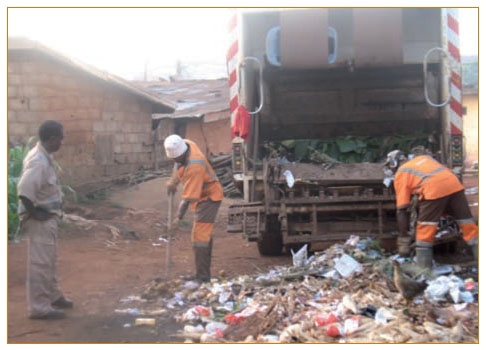
Waste collection by a team of Hysacam employees
At left, a driver and, at right two garbage collectors in their service uniforms.17According to interviews with the company’s managers, Hysacam is the leader of the waste collection system with a staff of 200 whereas the other sectors employ only about fifty for the informal sector and about fifteen for the basic communities associated with the local NGO. Besides Hysacam’s administrative employees, including the department heads and supervisors of the collecting teams, the company has 26 drivers and 107 cleaners (sweepers, garbage collectors, rakers). In actual fact, the street sweepers are in this group of employees, but the present paper focuses on the approximately forty garbage collectors working on trucks. In this company, drivers often began as garbage collectors and improved their skill level by training to drive trucks. This skill gives them the status of driver along with corresponding wages. [5] The collection team works in the morning or afternoon for a total of seven hours per session, and this in a certain race for garbage (Makamté Kakeu-Tardy, Véron, 2019).
18The private company Hysacam works in partnership with the urban community that controls the effectiveness of the service and contributes about 15% of the revenue of the private sector, the remaining 85% coming from the state. There are also community organizations operating in some of the city’s neighbourhoods, salvaging organic matter to makecompost reserved for sale. As to the type of waste produced in Bafoussam, nearly 70% is organic, 15% paper or plastic, 10% textile, 3% scrap metal and 2% glass (Communauté urbaine de Bafoussam, 2013). Direct observation shows that the formal and informal sectors actively take part in the collection of this solid waste in Bafoussam.
Informal waste pickers in conquest of other spaces in Bafoussam
19Whereas the activity of salvaging municipal solid waste in African cities is generally more intense at authorized dump sites (Zoa, 1996; Cissé, 2012), in Bafoussam it seems more present on streets and in neighbourhoods. Located in the Banefo neighbourhood, four kilometres from the city centre, the municipal dump is indeed the terminus of solid waste collected by the formal sector. The site of this outlying neighbourhood is invaded by mountains of garbage stored in piles destined for a local landfill (photo 2). At its creation around 2000 by the municipality, this site received a great number of informal workers who sorted and sold recyclable objects. They often cooperated with industrial recycling companies located outside the city, based particularly in Douala, the country’s economic capital. Then the informal sector workers were expelled from this dump. The partnership contract with the private company Hysacam specifies that it has the exclusive right to collect, transport and dump municipal solid waste in Cameroon (Makamté Kakeu-Tardy, Véron, 2019). As a matter of fact, the municipalities formerly in charge of this service showed the limits of their management abilities in the course of the 1990s, in terms of equipment and human and financial resources. Thus, with large compactor trucks, modern technology enables this company, chief actor of waste management in Cameroon, to bring the city’s collected waste to the municipal dump. According to an interview with an agent of Hysacam employed in the municipal dumping sector since its creation, the site was strictly closed to informal collectors because of reprehensible acts.
Mountain of garbage at the dump site
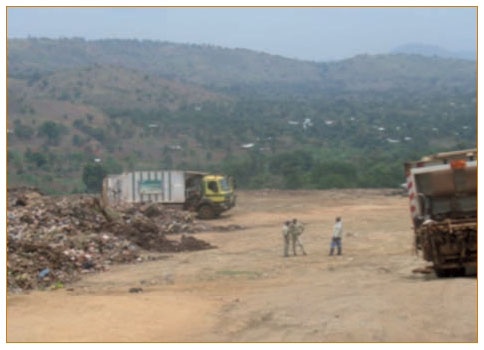
Mountain of garbage at the dump site
20They were said to have started fires in this space, among other things by burning damaged tires and garbage accumulated in the dump in order to make it easier to extract metal objects. As told by this department head, the aim of these fires was to recuperate wire and similar objects, material “of value” constituting the rare pearl of their collection industry. Since then, and after many warnings from the municipal authorities, the site has been closed to all informal pickers and later fenced off with hedges (photo 3). The city streets have become the only survival refuge of Bafoussam’s informal pickers, unless a true community of salvagers is created, as well organized as those in large cities like Douala, but this is still only a plan.
Hedges planted along the dump

Hedges planted along the dump
The vegetation separates the national highway from the dump site.Itinerancy and sedentarism of informal waste collectors in the urban space
Itinerant collectors or small-scale informal collectors
21Thus, in Bafoussam, in the 2000s, informal workers left the municipal dump, located on the city’s outskirts. A great majority of collectors formerly sorted the solid waste on site, whether recyclable or reusable for commercial ends, this being their means of subsistence. As access to this dump site had become exclusively formal, the informal collectors invaded Bafoussam’s other spaces and thus the densely populated neighbourhoods became their principal worksites.
22In this city, the salvagers move along the streets with their collection equipment. These are young children not attending school, and adults, but also schoolchildren and students, some doing this work daily and others during school holidays. Their salvaging activity consists of sorting solid waste of value to be recycled. Their work equipment essentially consists of a two-wheeled cart called a “pousse-pousse” that they push along the streets. Without a very precise itinerary, the salvagers criss-cross various city neighbourhoods. This category of waste collectors in Bafoussam is composed exclusively of men, some fifty of them, who collect a great variety of recyclable solid materials, among them iron and plastic objects for a market in which they sometimes compete with each other. Then these ambulant sorters take their waste to one of the informal deposit points for recyclable objects, held by the city’s sedentary salvagers. At these sites for specific sorting, the process of salvage and sale of recyclable material takes place between itinerant collectors and sedentary buyers, also called “patrons” – bosses. The latter then send the sorted products to specialized industrial companies. Most often, these companies come from Douala. Each party seeks profit in this chain of sorting and selling salvaged objects. Collecting along the streets, the ambulant salvagers have no fixed worksite in the city. They alert potential sellers of recyclable material with a shout to let them know they are coming through the neighbourhood, using a local expression whose meaning is understood by everyone: “Bâta, bâta, bâta,” which means “Babouches made of plastic or flimsy material,” as if asking “Would you have recyclable objects to throw away or sell?” Households have thus learned to pre-sort their waste in order to earn a few FCFA francs when the informal collectors pass.
23In the evening after collecting, the salvager usually goes to a deposit point where resale takes place with a buyer or “patron.” The choice of depot depends on a number of factors, such as the work relationship between the itinerant and sedentary persons, or with other ambulant collectors in the city, the distance to the deposit site, the type of waste (photos 4 and 5) sought by the buyer, and the price agreed upon with him. Thus, informal collectors tend to specialize in a particular type of recyclable waste and collaborate with producers and collectors of the type of urban waste that interests them. This informal organization by field of solid waste salvage in the city seems unchanged in Central Africa since the appearance of the activity in West Africa a century ago, which supports the idea of a persistence of the informal sector and its way of functioning in the urban waste management system in Sub-Saharan Africa. In Libreville, Gabon, a more cosmopolitan capital city, the ambulant salvagers are immigrants, specialized by nationality, among others Nigerians for automobile scrap and Malians for pots and pans (Ada, 2006).
Some objects recovered at Bafoussam

Some objects recovered at Bafoussam
Scrap metal, bâtabâta (plastic babouches), motherboards (electronic waste), beer bottles and cans, leather, shoes, glasses, etc.Informal collector, itinerant on the streets of Bafoussam

Informal collector, itinerant on the streets of Bafoussam
“I collect mainly welded objects, given the demand of my patron. We function like a food chain: there’s the patron of the patron of my patron.”
25Through this market of recyclable material, salvagers give garbage value, making it a resource contributing to economic systems operating in Africa for the past several decades. Among the various materials salvaged in Bafoussam, we find iron, leather, plastic, glass, aluminium, copper, bronze, and cosmetic cream jars. These objects are bought from households at relatively low prices depending on the object’s symbolic value. For example, a small jar is often bought for 25 FCFA, [6] but an empty beer bottle or a pile of iron are sold for variable prices: 100 FCFA, [7] 500 FCFA, 1,000 FCFA, 2,000 FCFA, 10,000 FCFA. The price can be assessed by eye measurement or on a scale. When these recyclable objects are resold at the deposit point, the itinerant salvager often gets double the price he paid. The yield depends upon the frequency of collection and negotiation of the price. There are several depots scattered about the city, but also several negotiation formulas between the “patrons” of these sites and the ambulant collectors. Before the beginning of the service, the patron can, with the agreement of the collector, estimate a daily set price and give it to him as business capital and remuneration. The set price is thus often given to the collector “before” the service to enable him to buy recyclable waste from households and other sources of recyclable waste, such as woodworking shops. The city’s garage owners do the same with informal collectors, in order to get rid of their heavy or bulky waste. On this subject, an ambulant sorter said the following:
“My deposit place is located at the ‘camp sable.’ It’s also called ‘dépôt de la gloire.’ That’s where they give me money. The boss gives you a sum of money, you determine that base with him according to what you can collect during the day or a defined period. [For example, 200,000 FCFA [8]] You are going to buy and come back with waste up to this amount. If you collect more than that, the rest of the money is yours, and so the surplus is for you. There are several depots in the city: three at camp sable, Tougang village, grand goudron, Tougangville and SOCADA.”
27According to some itinerant salvagers, the monthly market value of this informal activity in the city could reach 100,000 FCFA, but remains fairly variable according to the regularity of the activity and supply and demand. However, speaking of one’s wages or monthly earnings is often as sensitive as it is awkward in Cameroonian society, even more so when it concerns individuals practicing an informal activity. In this network of the informal waste market, the itinerant is usually associated with a single “patron” according to the type of waste handled by the latter. But he can also work at different deposit sites, collaborating with other salvagers interested in waste of a different kind. In that case, there is an intermediary market between collectors sorting different types of waste on their itinerary.
Sedentary salvagers or small sellers of recyclable waste
28The sedentary salvagers of solid waste are considered intermediaries; they are called “patrons” by the small informal collectors and set up shop at precise points of the city of Bafoussam (photo 6). While it may seem to be a misuse of language, the title of “patron,” given to the sedentary receivers or buyers of recyclable waste, is often used in Cameroon to designate the immediate superior who pays the wage or remuneration.
Work space of patrons and waste salvagers
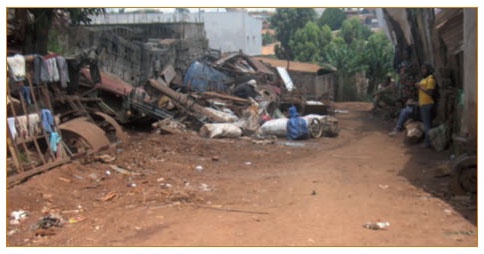
Work space of patrons and waste salvagers
29In the informal waste sector, the “patron” is the person who buys the recyclable objects or who pays a certain amount of money to collectors and, in turn, resells them to the large recycling companies of the country’s economic and industrial capital. Coming from Douala regularly, these companies go to the depot sites in Bafoussam to bargain for pre-sorted recyclable material, principally scrap metal and beer bottles which are very valuable in this recycling chain.
30These waste salvagers emphasize their participation in the fight against unsanitary conditions in the city, given that the actors of the public-private partnership, according to their contract, are not particularly interested in this special household waste, which would be strewn all over the dump sites if not preceded by this sorting work. Purchasers also come from abroad, among other places neighbouring countries like Nigeria, which seems to be one of the regular buyers.
“We sell some to the Nigerians, who come to Bafoussam, about 100 kilogrammes per week. That makes it possible to pay the rent, family life, food.”
32While many of the itinerants come from various parts of the country, most of Bafoussam’s sedentary salvagers are natives of the city who may have been in this activity for some twenty years and for whom it is the only or principal job. In fact, some intermediaries of recyclable material depots have, in the course of their informal career, gone from the status of ambulant salvager to that of “patron.” The existence of this commerce predates the closing of the official dump to primary salvagers. Most of the sorters who left the dump joined and invaded the space of the few informal collectors who must have already existed in the city’s neighbourhoods.
33These itinerant collectors bring the objects they find to the sedentary ones at their salvage point, which they consider their work space, having at times occupied the site for several years, though often with a private lease agreement with a neighbourhood property owner, as shown by the following two excerpts of interviews with patrons or sedentary waste salvagers in Bafoussam:
“This is our space; we rent this place from the proprietor. We pay taxes to the commune.”
“We’re veterans in the neighbourhood. We’ve been working in salvage since 1996. This is our deposit point for resale of waste to big companies from Douala. The Indians also buy some! We take apart cars to salvage the iron. Besides the children who bring us their sorted waste, there are trucks of individuals who come here regularly to deliver scrap metal.”
The nongovernmental organization and composting in three Bafoussam neighbourhoods
36The informal waste sector works alongside some actors of the formal waste sector, among them CIPCRE, a local NGO active chiefly in the field of agricultural production and which is also an actor in household waste management in Bafoussam. In some neighbourhoods, this NGO has set up common initiative groups (GIC) going door-to-door to households to collect garbage for composting. Then the sorting and composting activity takes place in their work space. This concerns three different neighbourhoods of the city, which will be presented in the next few paragraphs. These small associations are generally composed of a maximum of five persons of both sexes. Interviews, and at times focus groups, were conducted with the three common initiative groups still involved today in the activity of garbage composting in Bafoussam. The exchanges concerned the context in which the group was created, the process of occupying space in the city, the organization of waste collection, the way of managing the residue left after sorting the compostable matter, and their relationship with the informal sector.
37Formerly, the municipality saw to cleaning the city of Bafoussam, until the economic crisis of the 1990s. After that, huge heaps of filth accumulated in the city. Thus, around 1995 and for a five-year term, a composting project was launched and supported by the French Development Agency (AFD), a public entity of the French government specializing in relations with countries of the South. This agency later renewed the project until 2002, with the major objectives of sanitizing the city and also selling compost to farmers.
38At first, five teams had been formed in five different city neighbourhoods, but only three have been able to survive with the modest income of their production and sales efforts. The price of a bag of compost is 1,000 FCFA, [9] and the monthly revenue constitutes the wages of the association members. The compost is sold to local farmers who come from large plantations of food crops in the region’s countryside. Since the end of the project, these teams pursue their activities with a reduced staff, due to lack of subsidies. But the groups at times benefit from technical support and work equipment (boots, wheelbarrows, gloves). Located on more than 500 square metres rented in the neighbourhoods of Kouogouo (4,049 inhabitants), Bamendzi (7,336 inhabitants) and Banengo (8,927 inhabitants), they conduct their activity in the urban space. Independently of the NGO, they now do door-to-door manual collection, and sort mixtures of garbage from households to which they sometimes distribute their weekly collection calendar in advance. After this collection, the organic waste is transported to one of the composting sites with the help of rudimentary material (wheelbarrow or cart), followed by the phases of sorting, sifting, composting and sale on site.
39These other actors of the waste salvage sector are linked to the informal collectors by the recyclable refuse separated from the matter to be composted. On these composting sites, the groups sort the recyclable material. Field surveys have not gone into the daily detail of these links because there was less interaction than with the formal collectors of Bafoussam’s private waste management company. This company collects what is refused at the various composting sites, often after informal pickers have passed.
The waste sector in Bafoussam: toward “formalization” or “informalization”?
40Hysacam communicates regularly but indirectly with the informal sector. This private company has been working in Cameroon for several decades, with the aim of mastering urban hygiene and sanitation. Collection methods with dump and compactor trucks are one of the reasons for its success. Therefore, this company was chosen to work first in Douala, beginning in 1969, and then in Yaoundé, the country’s political capital, ten years later.
41It was only in 2006 that this service spread to medium-sized cities, beginning in Bafoussam, where Hysacam is in charge of ensuring the cleanliness of the city in public spaces including streets, crossroads and gardens. [10] But Hysacam cannot always manage to get to spontaneous neighbourhoods or those set back from roads fit for driving (Grelle et al., 2006). This difficulty creates an opening favouring the emergence and integration of alternative waste management systems, such as the NGO to create value from organic waste, and the informal sector to recycle waste collected in areas of the city that the Hysacam trucks cannot easily reach. Currently, Hysacam is in charge of collecting household waste of all types. All the household garbage it gets is mixed in the truck and dumped out at the municipal dump. According to field observations, the garbage collectors intervene subtly in the informal chain, thus giving rise to an interaction of the two sectors.
The authorized actors, the formal-informal waste market and sharing the urban space
42Bafoussam’s urban space is a place where city dwellers meet, but also city actors in the course of their daily exercise of urban management. While the Hysacam company drives through the entire city on its principal and secondary streets to collect garbage, the informal pickers are omnipresent, especially in working-class residential neighbourhoods or at unofficial dumping points. The informal pickers go door-to-door in planned, residential neighbourhoods like Kamkop and Tamdja. In these upscale neighbourhoods, they find more salvageable “products” than in poor or working-class neighbourhoods where households themselves, lacking the financial means to buy new ones, salvage material like plastic bottles. The informal pickers who regularly go into working-class neighbourhoods like Tougang are attracted by the number of unofficial dumps. Another favorite itinerary of these small itinerant collectors is that of the routes of Hysacam trucks, favouring meetings to salvage recyclable material possibly sorted in advance and stored separately in their dump truck (photo 7). This service makes it possible for formal collectors to add to their monthly wages, considered to be too low, thanks to this informal waste market.
Informal itinerant collector with his pousse-pousse waiting for the Hysacam truck to pass

Informal itinerant collector with his pousse-pousse waiting for the Hysacam truck to pass
43Whereas the first contract with Hysacam, in 2009, specified a dozen collection routes in the city, that of 2014 shows the expansion of its space of intervention which has now risen to a total of fifteen routes. This increase in the number of collection zones shows that Hysacam is acquiring new spaces and/or new resources. The spread of formal collectors over the extent of the city and its waste indicates their influence in the sector and their power over waste. Thus, we must be somewhat cautious about the notion of competition between waste actors as proposed by Mersharch W. Katusiimeh et al. (2013) for the door-to-door collection system, which joins the collection paths of the two categories of informal and formal sector actors. Indeed, the Hysacam company is officially authorized to accede to all zones of the city in search of garbage, even if it does not always have the means to do this because of the condition of the urban street network (Makamté Kakeu-Tardy, forthcoming), unlike the informal collectors perceived as resourceful hustlers. Nevertheless, the latter assert the important role they play in the service of waste collection by the flexibility of their urban mobility, their access to neighbourhoods via all kinds of service roads, including tertiary roads and pedestrian paths.
Interactions, conflicts and power around “resources”
44According to field observations in Bafoussam, collaborations between actors of the formal and informal sectors take place daily along the itinerary of the waste collecting trucks, so essentially on the principal streets. Sometimes, in advance of or outside the working hours of the garbage men, salvagers go to the truck while they are collecting on one route or another to buy the recyclable material available on the truck. This formalinformal waste market gives rise to conflicts within the formal collection teams. In the case of Buenos Aires, informal and formal waste actors are faced with a resource likely to become rarer, and strengthen the power of the formal sector over the city and garbage. Unlike the relations of conflict in Latin America, the case of Bafoussam presents a particular situation where a conflict arises within the same formal collective team.
45The Hysacam truck drivers are not always in favour of these transactions conducted by their teammates, who rather ought to concentrate on increasing tonnage, that is, their chief daily collection goal, source of their principal remuneration (Makamté Kakeu-Tardy, Véron, 2019).Interviews conducted with truck drivers show the more difficult conditions in which the most senior drivers worked as garbage men during Hysacam’s first contract with Bafoussam, working nine hours per day instead of the today’s seven. This explains, to some extent, their impatience with the garbage men under Hysacam’s present second contract, who thus reduce the time devoted to collection in favour of a supplementary salvage activity in which recyclable waste is sold to informal collectors. A driver expresses his dismay with regard to his garbage men as follows:
“When you see a guy from 2006, all this work is nothing for him [For an employee working here since 2006, waste collection tasks are not so difficult today].”
47Another driver, impatient to get to the end of his route of daily collection, told of his sometimes-tense daily relations with his garbage men:
“With Hysacam... in the field, if you don’t produce or don’t work well in the field, you’re near the way out... You have to work, do what they ask you to do, that’s all. While they make [put] pressure on me upstream, I also put pressure on those [my garbage men] who are there in back, because it’s together, the three of us, that we’re going to reach the expected goals [reach the goal of ten tonnes of garbage per day]. For me [as for my own task] it’s not [a matter of] strength, I’m lucky, I know how to handle the wheel, I have to drive them normally. They also have to pick up the garbage quickly so that we leave [advance] as quickly, there [so that] the work goes well, [for] it’s teamwork, each person has to do his part. And I told them that if they notice that I’m very slow, they should call out to me.”
49Beyond the daily goal, another reason for this conflict between private employees, also concerning earnings, is related to the fact that most of the drivers do not want to participate in the informal market because of their status as “superior” to that of the garbage men in terms of skills and wages. When the truck driver is opposed to these illegal transactions, the team’s harmony is disrupted, and the effectiveness of the waste collection service in the entire city is at times impaired. This conflict can be resolved by reaching an agreement within the team. Concerned with the goal of tonnage, the company’s top-level management steers clear of this sub-trade of waste. However, many of these heads of teams are generally understanding in spite of everything because they too, at their level, are interested in supplementary earnings outside their hours of service. According to field interviews, the truck drivers engage in a secondary activity in the city, most often connected with interurban transportation. These activities take place during the slack spells of waste service so they can earn extra money. Only the method of supplying the informal sector with recyclable material by the Hysacam collectors was identifiable in the course of participant observations. The informal collectors do not bring garbage to Hysacam, but only collect their recyclable waste. On the other hand, the NGO groups collect everything at the households, sort the organic matter for composting and set aside the rest of the garbage for the Hysacam truck. However, this appropriation of the urban space is evolving in accordance with the status of the informal collectors at the municipal dump. According to interviews with agents working at the Bafoussam dump, an Association des récupérateurs au Cameroun (ARC [Association of pickers in Cameroon]) was recently created. Informal collectors are beginning to register with it by submitting a dossier to the private company after agreement by the municipality. This association is already operational in the country’s two large cities and is beginning to contact medium-sized cities like Bafoussam. Field interviews indicate that four applications have been submitted and a dozen pickers have shown interest in submitting theirs. It will no longer be a matter of free access. Controlled access to the waste dump would include a certain number of conditions, among others respect of the site’s safety regulations, use of individual protection equipment (boots, ear plugs, masks, gloves, uniforms), and a definition and proportion of the types of waste accessible to the pickers.
50Field interviews also show Hysacam’s interest in organic waste with a view to methanization. According to the same sources organic garbage intended for methanization represents 60% of the recyclable waste: these are facts that show the authority of the municipality and the private company over the waste sector, including over the informal actors. Furthermore, this power relationship between the two sectors accounts for the conditions of the process of the municipality’s recognition of the informal sector and the beginnings of a formalization of shared management.
Purchase and sale of recyclable waste between an informal collector and a Hysacam employee in uniform

Purchase and sale of recyclable waste between an informal collector and a Hysacam employee in uniform
51In general, Bafoussam’s various actors in waste are not always all interested in the same “resources.” While the private formal sector collects a mixture of garbage of all types, without necessitating a sorting phase beforehand, the informal pickers are specifically interested in solid recyclable waste that they must sort according to the demand of their patron in the salvaging chain, whereas the community organizations for composting sort only the organic garbage. The work spaces of these actors overlap at the site where garbage is collected or negotiated, at households and public spaces. However, it seems that some Hysacam collectors vie for the same “resources” as the informal pickers, for profit, which can result in competition. Photo 8 shows a meeting of informal and formal collectors on a secondary road in Bafoussam with their respective work tools: the “pousse-pousse” for the itinerant collector and the truck for the Hysacam employee.
52While working, the formal collectors sort the recyclable waste in the tipper of their truck to sell it to informal pickers. Price negotiations take place rather discretely behind the dump truck.
53The scenario is similar at the composting sites. The local community groups, after going door-to-door to collect household waste with manual tools, select the organic matter and set aside the recyclable material that the informal salvagers pick up when the Hysacam truck comes by. In sum, as figure 2 indicates, there is a strong tie between the formal and informal solid waste sectors in Bafoussam; the garbage men of the private company Hysacam operate in a tacit garbage market with the itinerant salvagers of the informal sector for resource purposes. These interrelations between public and private actors maintain a collaboration of profit sharing with the informal pickers and community groups operating in Bafoussam’s urban space. This calls to mind a process of formalization of the informal waste sector, analysed by several authors, among them David C. Wilson et al. (2006), Johannes G. Paul et al. (2012) Marie José Zapata Campos and Patrik Zapata (2014), as well as Mathieu Durand (2012).
Interactions of the informal-formal sectors in Bafoussam

Interactions of the informal-formal sectors in Bafoussam
Conclusion
54For more than a century, the solid waste management system of the African city has included the informal sector. Today, this sector figures prominently and has tended, in the past few decades, to show a cyclical evolution of its functioning in the urban space. After leaving the dump site on the urban periphery for other spaces of the city where the informal works alongside the formal sector, a return to a controlled dump remains conceivable. In an interactive manner, both informal and formal salvagers take part in the production of the Cameroonian urban space through the process of collecting and negotiating recyclable garbage and the appropriation of sites in the city’s neighbourhoods. Compared to existing work on the competitive link between the formal and informal urban waste sectors (Katusiimeh et al., 2013), the results of the present research make it possible to state that recyclable waste connects informal pickers to the collectors of the private company in a relationship revealing not only a competition around sorting recyclable waste, but also an affiliation. The actors of these sectors at different scales are motivated by economic stakes around the same “resource”, which they discuss and negotiate in work spaces that overlap. From an environmental point of view, and as suggested by research focused on other cities of the South (Matter, 2013), sorting garbage at the source would be an initiative to encourage in Cameroonian cities in order the assist the private company Hysacam in the management of waste and thus of the urban environment. Beyond the collaborations and the power that exist in Bafoussam’s recyclable waste management system, the borders between the informal and formal sectors remain ill-defined, particularly when Hysacam employees engage in various other informal activities in the city. The present study has shown that beyond the competition between the two sectors, there are synergies. These alliances are seen as obstacles to the work specifications of the formal sector employees, expected to work without respite according to a precise time schedule. Indeed, this conduct demanded of the formal collectors is how the company reaches its goals and limits conflicts within a given collection team seeking remuneration or supplementary earnings linked to waste. These are the socio-economic and institutional implications that complicate the integration of the informal into the formal sector, despite the synergies that are likely to persist in the city.
Acknowledgements
This paperis part of the results of my doctoral research, supported in large part by the Swiss Government Excellence Scholarship Programme and the University of Lausanne. I thank Professor René Véron for his insightful comments, as well as the reviewers of this journal for their relevant suggestions. Thanks also to the respondents of Bafoussam who participated in the interviews during my fieldwork. Nevertheless, I am solely responsible for the contents of the paper.References
- Ada C. (2006). “Réseaux sociaux et déchets solides dans les villes gabonaises”. Netcom, vol. 20, no. 3-4, p. 183-194.
- Andrianisa H.A., Brou Y.O.K., Séhi Bi A. (2016). “Role and importance of informal collectors in the municipal waste pre-collection system in Abidjan, Côte d’Ivoire”. Habitat International, vol. 53, p. 265-273.
- Benjaminsen T.A., Svarstad H. (2009). “Qu’est-ce que la ‘ political ecology’ ?”. Natures Sciences Sociétés, vol. 17, no. 1, p. 3-11.
- Bureau central du recensement de la population (Bucrep)(2010). Troisième recensement général de la population et de l’habitat. Cameroon: Bucrep, rapport de présentation des résultats définitifs 2005, 68 p. http://www.bucrep.cm/index.php/fr/ressources-et-documentations/telechargement/category/20-prsentation-des-rsultats
- Carré M.-N. (2012). “La gestion des déchets à Buenos Aires : vers l’émergence d’un service ‘durable’ ?” Flux, no. 87-1, p. 29-38.
- Carré M.-N., Negrão M.P. (2015). “Les déchets et l’aménagement des territoires de Buenos Aires et Rio de Janeiro”. Espaces et sociétés, no. 160-161, p. 17-36.
- Cissé O. (2012). Les Décharges d’ordures en Afrique. Mbeubeuss à Dakar au Sénégal. Paris: Karthala, coll. “Hommes et sociétés”, 328 p.
- Clerc V. (2010). “Du formel à l’informel dans la fabrique de la ville. Politiques foncières et marchés immobiliers à Phnom Penh”. Espaces et sociétés, no. 143-3, p. 63-79.
- Communauté urbaine de Bafoussam (2013). Plan d’urbanisme directeur de la ville de Bafoussam, horizon 2026. Yaoundé: ministère de l’Habitat et du Développement urbain, Breit consulting’s report, 116 p.
- Corteel D., Le Lay S. (2012). “Introduction. Travailler aux abords des déchets : un clair-obscur contemporain”. In Corteel D., Le Lay S., Les Travailleurs des déchets. Paris: Éditions Érès, p. 15-32.
- Defo C., Fonkou, T., Mabou, P.B., Nana P., Manjeli Y. (2015). “Collecte et évacuation des boues de vidange dans la ville de Bafoussam, Cameroun (Afrique centrale)”. VertigO, vol. 15, no. 1. https://journals.openedition.org/vertigo/15994
- Dorier-Apprill É., Meynet C. (2005). “Les Ong : acteurs d’une ‘gestion disputée’ des services de base dans les villes africaines ?”. Autrepart, no. 35-3, p. 19-37. https://www.cairn.info/revue-autrepart-2005-3-p-19.htm
- Durand M. (2012). “La gestion des déchets dans une ville en développement : comment tirer profit des difficultés actuelles à Lima ?”. Flux, no. 87-1, p. 18-28.
- Egbu A., Okoroigwe D. (2015). “Informal collection of household solid waste in three towns of Anambra State, Nigeria”. Present Environment and Sustainable Development, vol. 8, no. 2, p. 101-116.
- Ezeah C., Fazakerley J.A., Roberts C.L. (2013). “Emerging trends in informal sector recycling in developing and transition countries”. Waste Management, vol. 33, no. 11, p. 2509-2519.
- Fahmi W.S. (2005). “The impact of privatization of solid waste management on the Zabaleen garbage collectors of Cairo”. Environment and Urbanization, vol. 17, no. 2, p. 155-170.
- Fauve A., Gintrac C. (2009). “Production de l’espace urbain et mise en scène du pouvoir dans deux capitales ‘présidentielles’ d’Asie centrale”. L’Espace politique, no. 8-1. https://journals.openedition.org/espacepolitique/1376?file=1
- Florin B. (2015). “Les récupérateurs de déchets à Casablanca : l’‘inclusion perverse’ de travailleurs à la marge”. Sociologie et société, vol. 47, no. 1, p. 73-96.
- Fodouop K.F. (1991). Les Petits Métiers de rue et l’emploi. Le cas de Yaoundé. Yaounde: Éditions Sopecam, coll. “Idées”, 164 p.
- Grelle M.H., Kabeyne K.B.V, Kenmogne K.G.R, Tatietse T., Ekodeck G.E. (2006). “L’accès a l’eau potable et a l’assainissement dans les villes des pays en developpement : cas de Basoussam (Cameroun)”. VertigO, vol. 7, no. 2. https://journals.openedition.org/vertigo/2377
- Guitard É. (2012). “Le chef et le tas d’ordures : la gestion des déchets comme arène politique et attribut du pouvoir au Cameroun”. Politique africaine, no. 127-3, p. 155.177. https://www.cairn.info/revue-politique-africaine-2012-3-page-155.htm
- Heynen N. (2014). “Urban political ecology I: The urban century”. Progress in Human Geography, vol. 38, no. 4, p. 598-604.
- Heynen N., Kaika M., Swyngedouw E. (2006). In the Nature of Cities: Urban Political Ecology and the Politics of Urban Metabolism. London, New York: Routledge, Questioning cities series, 272 p.
- Institut national de la statistique du Cameroun (Ins)(2011). Deuxième enquête sur l’emploi et le secteur informel au Cameroun (EESI 2). Phase 2 : enquête sur le secteur informel. Yaounde: Ins du Cameroun, 118 p. http://www.stat.cm/downloads/EESI/2010/Phase2/Rapport_principal Phase2_EESI2_2010_Fr_05juin2012.pdf
- Katusiimeh M.W., Burger K., Mol A.P.J. (2013). “Informal waste collection and its co-existence with the formal waste sector: The case of Kampala, Uganda”. Habitat International, vol. 38, p. 1-9.
- Makamté Kakeu-Tardy R.C. (forthcoming). “L’accès à la collecte des ordures ménagères à Bafoussam: une analyse des facteurs de production des inégalités”. In Collectif, La Géographie à l’épreuve des dynamiques socio-environnementales. Bifurcations-implications.
- Makamté Kakeu-Tardy R.C., Véron R. (2019). “Hunting for tonnage: Waste workers’ incentives in a public-private partnership in Bafoussam, Cameroon”. International Journal of Urban Sustainable Development, vol. 11, no. 2, p. 1-8.
- Matter A. (2013). “Improving the informal recycling sector through segregation of waste in the household”. Habitat iInternational, vol. 38, p. 150-156.
- Meyer U. (2016). Négocier l’accès, la propriété et l’autorité publique en marge de la ville. Enjeux fonciers à Niamey et production d’État au Niger. Lausanne: University of Lausanne, PhD thesis in geography, 346 p.
- Monqid S. (2011). “La gestion des déchets ménagers au Caire : les habitants en question”. Égypte/ Monde arabe, document 8, p. 85-105.
- Moreno Sainz M.L.M. (2010). “Les récupérateurs de déchets à Buenos Aires : de l’exclusion à l’intégration sociale ?” Autrepart, no. 43-3, p. 25-39.
- Neuwirth R. (2012). Stealth of Nations: The Global Rise of the Informal Economy. New York: Pantheon Book, 290 p.
- Ngambi J.R. (2016). “Les pratiques populaires à la rescousse de la salubrité urbaine : la précollecte, un service alternatif aux insuffisances du système formel de gestion des déchets à Yaoundé”. Cybergeo, article 789. https://journals.openedition.org/cybergeo/27782
- Ngnikam E., Tanawa É. (2006). Les Villes d’Afrique face à leurs déchets. Belfort: University of Technology of Belfort-Montbéliard, coll. “Chantiers”, 288 p.
- Nzeadibe T.C. (2009). ‘’Solid waste reforms and informal recycling in Enugu urban area, Nigeria”. Habitat International, vol. 33, no 1, p. 93-99.
- Ouma C. (2007). L’Argent des déchets. L’économie informelle à Dakar. Paris: Karthala Éditions, coll. “Hommes et sociétés”, 166 p.
- Paul J.G., Arce-Jaque J., Ravena N., Villamor S.P. (2012). “Integration of the informal sector into municipal solid waste management in the Philippines – What does it need?” Waste Management, vol. 32, no. 11, 2018-2028.
- Piermay J.-L. (2002). “L’invention de la ville en Afrique subsaharienn’e’. Historiens et Géographes, no. 379, p. 59-65.
- Piermay J.-L. (2003). “La production de l’espace urbain en Afrique centrale”. L’Information géographique, vol. 67, no. 1, p. 62-65.
- Swyngedouw E. (1997). “Power, nature, and the city. The conquest of water and the political ecology of urbanization in Guayaquil, Ecuador: 1880-1990”. Environnement and Planning A: Economy and Space, vol. 29, no. 2, p. 311-332.
- Véron R. (2006). “Remaking urban environments: The political ecology of air pollution in Delhi”. Environnement and Planning A: Economy and Space, vol. 38, no. 11, p. 2093-2109.
- Wilson D.C., Araba A.O., Chinwah K., Cheeseman C.R. (2009). “Building recycling rates through the informal sector”. Waste Management, vol. 29, no. 2, p. 629 635.
- Wilson D.C., Velis C., Cheeseman C. (2006). “Role of informal sector recycling in waste management in developing countries”. Habitat International, vol. 30, no. 4, p. 797-808.
- Yates J.S., Gutberlet J. (2011). “Enhancing livelihoods and the urban environment: The local political framework for integrated organic waste management in Diadema, Brazil”. Journal of Development Studies, vol. 47, no. 4, p. 639-656.
- Yemmafouo A. (2013). Urbanisation et espaces périurbains en Afrique subsaharienne: Pratiques à l’Ouest-Cameroun. Paris: Éditions L’Harmattan, 264 p.
- Yemmafouo A, Sufo N.R. (2011). “Gouvernance du patrimoine foncier traditionnel à l’épreuve de l’étalement urbain : cas du village Bamougoum face à la ville de Bafoussam (Ouest-Cameroun)”. International Journal of Advanced Studies and Researche in Africa, vol. 2, no. 2, p. 117-130. http://ijasra.org/media/vol2/issue2/vol2_issue2_1.pdf
- Zapata Campos M.J., Zapata P. (2014). “The travel of global ideas of waste management. The case of Managua and its informal settlements”. Habitat International, vol. 41, p. 41-49. https://www.sciencedirect.com/science/article/pii/S0197397513000660
- Zoa A.-S. (1996). Les Ordures à Yaoundé. Urbanisation, environnement et politique au Cameroun. Paris: Éditions L’Harmattan, 192 p.
Website
- Hysacam: L’Histoire d’Hysacam. https://www.hysacam-proprete.com/node/13.
Publisher keywords: informal sector, solid waste, urban space, value creation
Uploaded: 12/12/2018
https://doi.org/10.3917/eg.473.0261