The Central African Imbroglio
The state, rebels and bandits
Pages 119 to 148
Cite this article
- CHAUVIN, Emmanuel
- and SEIGNOBOS, Christian,
- Chauvin, Emmanuel.
- et al.
- Chauvin, E.
- and Seignobos, C.
https://doi.org/10.3917/afco.248.0119
Cite this article
- Chauvin, E.
- and Seignobos, C.
- Chauvin, Emmanuel.
- et al.
- CHAUVIN, Emmanuel
- and SEIGNOBOS, Christian,
https://doi.org/10.3917/afco.248.0119
Notes
-
[1]
“Liberators”: the name of the rebellion that brought François Bozizé to power in March 2003.
-
[2]
Zargina are road bandits who operate with masked faces, previously painted blue (a colour translated as azraq in literary Arabic, from whence the name zargina).
-
[3]
Seleka (Sango): coalition; is thought to come from the expression sè lé ka (Sango) which literally means “state-to give fruit-exchange” (“that which results in an exchange”) (according to Bouquiaux et al., 1978).
-
[4]
The term “Chadian Mbororo” is commonly used in CAR. Its use is a way to reject this community from the national imagination while also recalling the very recent nature of its members’ arrival in the country. Chadian herders are also called “Mbabara” in CAR, a different pronunciation of the term Mbororo, which allows for a differentiation to be made with herders from Cameroon. The Mbororo from Cameroon and Chad are both Muslim.
-
[5]
In 2010, there were an estimated 65 000 Mbororo refugees in Cameroon; 15 000 in the Democratic Republic of the Congo; 15 000 in Chad; 10 000 in Nigeria; and 6 000 in Sudan (Ankogui-Mpoko et al., 2010). In 1988, the General Census of the Population and Housing (RGHP) estimated there were 135 000 people of Mbororo ethnicity in CAR.
-
[6]
Anti-balaka (Sango): anti-machete; a mix of the terms “anti” (French) et ba (Sango). Ba: machete, coupe-coupe (Bouquiaux et al., 1978). Another, more plausible explanation is: “Anti-balles” (anti-bullet) “laka” (an occult protection against automated Kalashnikov 1947 AK-47s) (Niewiadowski, 2014).
-
[7]
The “Pastoral crises and the Zargina” and the “Creation and logistics of zargina bases from 2000 to 2012” sections are based on interviews conducted by Christian Seignobos with Mbororo refugees and Gbaya peoples from Meiganga, Garoua-Boulai and Bertoua (Cameroon) between 2009 and 2012, mostly in the entourage of Mal Adamou Hodji and other former armoured archers from the national self-defence. The “Baaba Ladde episode” section is partially based on communication between the Multinational Force of the Economic Community of Central African States (FOMAC, January-March 2010) and Christian Seignobos. The “Rebellions in the northern regions (2005-2013)”, “APRD, a rebel army”, “The militias, from the presidency to the rebellion” and “From the rebellions to the government (the “Liberators” and Seleka)” sections are based on interviews conducted by Emmanuel Chauvin in CAR from July to November 2010 (Bangui, Paoua); in Cameroon from July to December 2011 (Yaoundé, Meiganga); in Chad in August 2012 (N’Djamena, Goré); and in France (Paris) in 2013.
-
[8]
The Aku—a Hausa term of salutation—were the last to arrive. They were labelled as such by the Wodaabe and Jaafun due to their ties with the Hausa region where their lineage of reference remained. They are also called Daneeji, a reference to their white zebu.
-
[9]
Lamido (Fulani): a Fulani chief who leads a lamidat, a Fulani principality.
-
[10]
Ardo (Fulani): designates an Mbororo chief at the head of a group of related or allied pastoralists. Those named by the government were said to “wear a turban”.
-
[11]
Biibe Woyla (Fulani): sons of the north.
-
[12]
This nomadic herding community between Kanem and Baguirmi was estimated to have 70 000 members at the time (Seignobos, research, 1975-1976, Chad).
-
[13]
In Cameroon and Nigeria, the settled Fulani, settled Fulbe and Fulbe belong to ancient principalities that date back to the conquest by the Fulani empire of Sokoto in the early 19th century.
-
[14]
Codo: from “commando”. In the early 1980s, the Central African “Mbabaka codos” allied with the “green codos” from Logone and the “red codos” from the Moyen-Chari region (Chad). In Cameroon, they are accused of perpetrating the first bandit attacks on roadways with automatic weapons.
-
[15]
APRD is the only armed group that actually followed the DDR programme (Disarmament, Demobilization, Reintegration). Launched in 2008 and piloted by the United Nations Development Programme (UNDP), DDR was a fiasco for five other rebellions, like all programmes of this type conducted in CAR since 1997.
-
[16]
The Yulu and one part of the Sara-Kaba comprise the Christian minority in Vakaga.
-
[17]
FCFA: franc of the Communauté financière africaine (currency of the African financial community).
-
[18]
Other commonly heard synonyms for the French word “base” are the Fulani terms sangeere or sanyeere, a Fulani war camp or camp used for regrouping slaves. It is a very common geographic name in the north of Cameroon, but it is also used in CAR, near Koui and Sanguéré-Lim, a legacy from the lamidat in Ngaoundéré.
-
[19]
From groups of refugees from the Bertoua and Meiganga regions.
-
[20]
The other bases near Berberati are thought to have been specialized in controlling diamond extraction sites.
-
[21]
These were Mbororo cowherds forced by teams at the nearby camps to bring in stolen cattle. In the end, they proved to be valuable informants.
-
[22]
A.D., an Mbororo from the Meiganga region, claimed he was forced to feed the base’s occupants with his own cattle and that he was commissioned three times to deliver ransom payments. He could see the base from a distance, but once he reached the first control post, he was blindfolded or forced to walk with his eyes on the ground.
-
[23]
Godobé (Sango): a lowlife, an errant young person who engages in petty theft (Bouquiaux et al., 1978).
-
[24]
A region where many had long worked as highwaymen and bandits. “In Kaga-Bandoro, out of ten zargina eight were from Oudda, meaning they were Fulani”, Le Confident newspaper (2004, translated here).
-
[25]
Since 2008, in the context of the FOMAC, the Mission for the consolidation of peace in Central African Republic (MICOPAX) has overseen the security side of DDR (checking fighter lists, recovering weapons, protecting civilian staff in the programme, etc.).
-
[26]
Janjaweed: militiamen loyal to the Sudanese government in the war in Darfur in the 2000s.
-
[27]
In former APRD territory, the self-defence movements were coordinated by the Groupe de revendication sur la paix (GRP—Peace demands group) which got involved when the Seleka got violent. The violence perpetrated by the former forces loyal to Bozizé—still fresh in people’s minds—worked against any possible alliance between them and militias from the south west, however.
-
[28]
For example, in May 2013, the African anti-jihadist alliance (AAAJ) was created and formed a league that included the Self-defence movement of Gbayas of the Celestial Church of Christ, the Front pour la libération et l’indépendance de la Sangha Mbaéré (movement for the liberation and independence of Sangha Mbaéré), Union of Bandas from Bambari and Bria, and the Rassemblement oubanguien yakoma (union of Yakoma from Ubangi). It was unclear whether this movement had any real control on the ground or whether it was an empty shell.
-
[29]
An undetermined amount of the livestock roaming in the south of Chad and in CAR may belong to high ranked officials in the Chadian army (“commanders’ herds”).
1The imbroglio in Central African Republic (CAR) is emblematic of the state of decay in this central African country. The overlap and entanglement between different armed groups makes it difficult to distinguish between loyalist factions, rebels, ex-“liberators”, [1] zargina [2] and opportunist groups claiming to act in the name of self-defence. And yet, contrary to certain media reports and political discourse, CAR is not entirely in the clutches of chaos or on the verge of anarchy. In the footsteps of other research (Geffray, 1990; Menkhaus, 2008), this article shows that political checks nonetheless exist in the areas affected by armed conflict and state failure. It more specifically addresses the fusion of the state apparatus, rebels and zargina groups. Previously, the government apparatus concentrated its control around Bangui and other major cities, the rebellions controlled a large portion of village territory in the north of the country, and the zargina had a network of bases in the bush. In the 2000s, an intermixing of these elements began to occur. Fighters moved from one armed group to another, and some groups combined rebel activity, banditry and militia-style self-defence. The rise of the Seleka [3] in March 2013 sealed the fate of CAR as a grab bag of factions and disparate groups. Rebel practices and banditry have indeed become intricately entangled within the state apparatus.
2We will address this gradual fusion although we will not cover all forms of insecurity here, such as the mutinies (Chauvin, 2009), attempted coup d’état in 2001 (Leaba, 2001; Porgès, 2001), and the widespread poaching and violence committed by the Lord’s Resistance Army (LRA) (map 1). The long-term prospects for the Central African state apparatus deserve to be the focus of separate research. Let us simply recall that the state is structurally concentrated in the capital city of Bangui, an urban macrocephaly, and only sporadically present elsewhere in the country’s hinterland—all in a context of low population density, poverty and regional inequalities in development.
3We can consider that the political situation began to erode in the 1980s and 1990s. There was confrontation in the countryside between two migratory groups of Mbororo herders: the first from the west (Mbororo who had become Central Africans) and the second, more recent and descended from the north (“Chadian” Mbororo [4]) who formed the mainstay of the zargina gangs and drove the Central African Mbororo to flee towards Cameroon. [5] In March 2003, François Bozizé (2003-2013) overthrew Ange-Félix Patassé (1993-2003) in a coup d’état. Following the 2005 presidential election, zargina bases continued to flourish in rural outskirts while rebellions formed and began to control villages in the northern part of the country. Over the years, new competition appeared: government and rebel militias, like the anti-balaka groups, [6] and bandit-rebels, like the troops of Baaba Ladde, right up to the arrival of the Seleka, the apex of the imbroglio we will attempt to present here. [7]
Conflict in Central African Republic: internal dynamics and exogenous trends. Seventeen years of irregular conflict, banditry and raids (1996-2013)

Conflict in Central African Republic: internal dynamics and exogenous trends. Seventeen years of irregular conflict, banditry and raids (1996-2013)
The downside of this map is also its strongpoint – its synthesis. It was compiled based on interviews, press reviews (France, Cameroon, CAR) and census data. Mapping a long time-frame makes it necessary to set and simplify the dynamics behind conflicts. Leaving white areas inside CAR is somewhat misleading since over the past seventeen years, no region has been spared from armed violence, except for the dense forest. Nevertheless, removing certain details allows others to appear.Pastoral crises and the Zargina
4The first Mbororo migrations from the west and their arrival in CAR starting in the 1920s. The first groups of Mbororo arrived in Ubangi-Shari between the early 1920s and the 1970s. Their point of origin varied: the Wodaabe came from Borno while the Jaafun and Aku were primarily from Hausa areas and Bauchi. [8] These largescale migrations all followed a binary cycle model. Initially, disparate groups united around the same livestock and shared pastoral practices. They left a region together and followed the same migratory path towards other grazing grounds. Such migration took place over decades, with its pioneers and its rear guard.
5The Wodaabe left Borno for the south just prior to the colonial conquest. They crossed the Benue River and then followed the Faro River. The Jaafun followed a similar route after a halt in the pastures flooded annually by the Benue River. They reached Adamawa in search of high altitude pastures and alkaline springs. They amassed in Lompta. The Aku, who followed several decades later, embarked on the same migratory paths. A pastoral front formed and the Aku pushed the other Mbororo out of Lompta. The Wodaabe and Jaafun moved eastward. They were squeezed off the Adamawa Plateau following a re-pastoralization by the Fulani. The colonial government sought to contain them in the Mbéré department, near the Ubangi border. Persecuted by the Fulani lamido [9] of Ngaoundéré, they entered Ubangi via Ngaoui. In the final stages of this migratory movement, Aku herders arrived in CAR via the Diamaré department and southern Chad (Boutrais, 1988) (map 2).
6The Ubangi government welcomed the arrival of these herders to supply its cities with meat. The Mbororo discovered exceptional grazing grounds for the rainy season, devoid of flies, and optimal conditions in which their livestock could practically look after itself. This in turn led to a race to conquer pasture lands, with the Wodaabe always one step ahead and the Jaafun close on their heels. The Jaafun tried to lock the Wodaabe out of certain pastoral areas, resulting in the latter forcing their way in. The government was unsure how to intervene. It should be noted that, from the beginning and until independence, relations between Mbororo herders and farmers—notably the Gbaya—were always described as peaceful. After 1945, herding authorities got involved with Mbororo nomadic herders regarding tsetse fly control. Veterinarian Jean Desrotour was the pioneer of this initiative, from 1946 to 1970, when Jean-Bedel Bokassa (1966-1979) ended the operation with a catastrophic “agrarian reform”. Governor Guérillot created the rural municipalities in 1950. Desrotour suggested adding herding municipalities for the Mbororo to “provide them with a home”. For this to work, it would be necessary to put ardos [10] in charge since they were already recognized as a sort of “hereditary mayor”. While the march towards independence had begun, the democratic process was still on hold. The new municipalities included the rainy season grazing grounds (ruumirde), the cornerstone of social life for all nomadic pastoralists (Seignobos, 2008; Martin-Granel, 2013). The Ijje family—the great ardo of the Jaafun in Ouham—already named lamido of the Mbororo by governor Félix Éboué in 1943, was excessively privileged by the colonial government, however, to the detriment of Wodaabe ardos. These herding municipalities—the origins of the National Federation of Central African Livestock Farmers (FNEC)—offered the Mbororo an opportunity for social and political integration they had never had in any country before—a detail that continues to stoke the resentment of present day Mbororo refugees in Cameroon.
When the Central African Republic became pastoral. The migration of two branches of Fulani herders towards CAR (1920-2000)

When the Central African Republic became pastoral. The migration of two branches of Fulani herders towards CAR (1920-2000)
Within this large migratory movement, each Mbororo lineage followed a different route. Spatial-temporary proximity within this migration helped forge a sense of Wodaabe, Jaafun and Aku identity. The relief and hydrographic network were discussed and herders took such details into account in establishing their migratory paths (e.g., trypanosomiasis, dry season grazing grounds). The borders of the herding municipalities of Pombolo and Yaloké in CAR could not be drawn due to a lack of data. We know more about the channels followed from Cameroon than about those arriving from Chad.7The irruption of “Chadian” Mbororo. Since 2008, Mbororo who have fled to Cameroon send out scouts who regularly report on security conditions. They carefully study the entourage around state authorities in Bangui who, under François Bozizé—and barely any better in 2013 under Michel Djotodia—have never been particularly accepting of them. What is most offensive to them today, however, is their de-possession of pasture lands by herders from Chad. The refugees in Cameroon are now less angry with the government in Bangui for having chased them out of CAR than they are with both the “Chadian” Mbororo and zargina for having conducted a long-handed political project aimed at evicting them from their pastoral paradise.
8The “Chadian” Mbororo are just as diverse as the groups from Cameroon. These communities of Cameroonian and Chadian herders have shared origins via the large Mbororo fractions from Niger. But the numerous deviations in their lineage, the substitutions of heritage livestock, and interaction with other herders and other native populations have made the communities foreign to each other. The recently arrived Mbororo have a different identity, acquired during their long sojourn in Chad, and do not share the same pastoral history as those from CAR. Among the “Chadians”, we can list the Biibe Woyla, [11] Hontorbe, Anagamba and, especially, the Uuda’en among whom the most energetic zargina leaders were recruited. Each of these communities perpetuates its own migratory legend. Among the Uuda’en, Ardo Dandulu is said to be the first to have crossed the Chadian border into CAR in the early 1970s; for the Jaafun, Ardo Ijje was the first to cross the Cameroonian border in 1923.
9The “Chadian” groups have remained exclusively attached to their lifestyle as cattle and sheep herders. In the 1960s, they showed how well organized they were and had powerful representatives in N’Djamena that were recognized by the government. Ardo and Kaydal (chiefs and convoy leaders) crossed paths in their vast caravanserais when they came to collect documents, tax receipts and receipts for the tax on livestock—and to report problems encountered in their pastures. [12] They shared the same rainy season grazing lands on the Bahr el Gazal River, around the alkaline ponds in Kodordé, just beyond the Tubu groups they had rejected. During the dry season, they dispersed throughout the Lake Chad-Madiagho-Dourbali triangle.
10The drought of 1972-1973, followed by that of 1983-1984, compounded by an epizooty of cattle plague drove one part of these “Chadian” herders southward. They advanced in stages, making their dry season grazing zones home for the rainy season too. Unable to go westward due to the regularly closed border with Cameroon or to go east due to the presence of large groups of Arab herders, they had no choice but to migrate southward along a trajectory that gradually led them to CAR. From their tough fights with the Tubu and innumerable conflicts with Arab herders present before them in southern Chad, the Uuda’en and Biibe Woyla became renowned for their violence. To better resist against insecurity tied to competition with other herders and also to the rise of militarized banditry, they sought to arm themselves.
11The Biibe Woyla and Uuda’en were deemed crude and not very religious by the Central African Mbororo, but they nevertheless suffered less than their denigrators, the Jaafun, Wodaabe and Aku communities. The latter had always lived within Fulani lamidats in both Nigeria and Cameroon. They were subjected to the emollient influence of settled Fulani [13] whose religious faith was increasingly pronounced, to their disinterest for the profession of arms and to the application of koranic law which interfered with herders’ “traditional” pastoral practices. They found themselves caught between a pulaaku (the behavioural code for Mbororo, almost religious in nature) in decline and a poorly assimilated Islam. The youth were drawn towards urban living, which led them away from herding despite it being the foundation of their Mbororo identity (Seignobos, 2011).
12It was as such that, almost caricaturally, Mbororo communities from the west—caught in the clutches of a triple crisis of authority, religion and pastoralism—found themselves facing off with other, Chadian communities from the north whose cohesion was intact. Ardo authority had not been compromised among the latter and the younger generations were not in the throes of revolt. That is how the confrontation, called fitna (fitinaaji in Fulani)—internal war—between these two nomadic worlds became unequal.
13Zargina and anti-zargina. The groups of zargina in operation were most often a mix of Arabic-speaking Chadian ex-military, Uuda’en Mbororo and local informants. Local business people acting as receivers or facilitators for funding and arms were also sometimes armed and in the field (Seignobos, 2013). It is as such that Arabs and the Uuda’en helped crystallize the identity with which Mbororo refugees in Cameroon identify (Seignobos, 2011).
14Comprised of Central African Mbororo, the anti-zargina movement began in the early 1990s with a group of allied Wodaabe led by Umaru Almaran, Adamu Ooji and Amadu Jaamuuji. They decided to take up arms against those who stole livestock and took hostages for ransom. The selection was made amongst the Gaw (archers), but it was aimed above all at upright individuals; seeking out “acquaintances” (anndal) was a priority, in other words securing occult protection. They formed the first brigades of “armoured archers” or “anti-zargina” groups. The government of Ange-Félix Patassé noticed them and supplied them with 4-wheel drive vehicles and military trucks. They began to operate officially, with mission orders, and provided a report after each action. Sub-prefectures were provided with a list of anti-zargina. Following the death of Umaru Almaran, Ooji took over and found himself in charge of 500 to 600 archers, with their weapons: double-convex bows and poisonous arrows. The lieutenants were for the most part Wodaabe (eight), although there were also three Jaafun and one settled Fulani.
15The mayors of pastoral municipalities—almost all Jaafun—were meant to support and feed the archers in the field. In 2001-2002, the mayors of these municipalities and certain sub-prefects worked together in Bangui to gain control over self-defence and protest the autonomy of the army of “antis”, to have them divided and placed under local command. This stifled the movement’s momentum and cohesion, and slowed the drive to pursue the very mobile zargina gangs. The “antis” felt betrayed. Ooji was now only their “teacher”. Old conflicts between the Jaafun and Wodaabe resurfaced, no longer regarding pastures but rather concerning issues of leadership. Always politically astute, the Jaafun took the upper hand once again over the Wodaabe, most of whose fighters withdrew and crossed the Cameroonian border. Their departure was facilitated by the fact that their repeated requests to use automatic weapons had not been heeded in Bangui. The race for “invocations” (occult protection) was also common among these groups of bush fighters: at least one quarter of the income of the zargina and anti-zargina was spent on charms, philtres and powders acquired from Mallums. All parties were convinced that the advantage gained by the zargina over the archers in the early 2000s was because the former had been able to buy better protection and support from important religious figures. Above all, however, a large share of anti-zargina dropped out of the fight in 2003 after Bozizé rose to power. According to their leader, Mal Adamu Ooji, “they would be unable to fight against both the ferocious beasts in the bush and those in the cities.” In other words, the “liberators” who had come from Chad to put Bozizé in place had actually identified and subsequently enlisted certain zargina who soon donned military uniforms. This was the opening scene of the first act of the current imbroglio.
16The zargina as such regained influence. They avenged themselves and pursued the Gaw—beware any Mbororo caught with a bow. The “antis” continued to fight (Munié, 2010), but as auxiliaries or scouts alongside the army or to help merchant convoys travel to large markets. Just as the zargina phenomenon began to also affect farming villages, another front opened with a different set of issues pitting rebels against loyalists.
The rebellions in the northern regions (2005-2013)
17The number of anti-Bozizé rebellions increased after 2005: The People’s Army for the Restoration of Democracy (APRD), the Democratic Front of the Central African People (FDPC), the Convention of Patriots for Justice and Peace (CPJP) and the Union of Democratic Forces for Unity (UFDR) (map 1). The insurgents had a few things in common: they contested the legitimacy of François Bozizé, but had no real capacity to oppose him; they were poorly equipped (homemade weapons, motorcycles and a few pick-up trucks) and had no strong external support. They were based in different regions. In the north-west, APRD formed a growing and united front whereas in the north-east the rebellions were divided around the sharing of resources.
18APRD and the quest for the north west. While exiled in Togo, Ange-Félix Patassé had instructed the former mayor of Beboura to create the APRD. The rebel core of the group was composed of Central African ex-military, militiamen recruited by Patassé during the mutinies (Karako, Balawa and Sarawi militias), and members of the Societé centrafricaine de protection et de surveillance (SCPS), a security company responsible for protecting the president in the late 1990s. A few “codos”, [14] former “southern” Chadian rebels and “northern” Central African rebels, like General Doumro, also joined APRD to share their guerrilla experience.
19Beyond weapons, the rebellion’s policy approach involved finding a popular support base. Patassé had a large audience in north-western CAR (Ouham, Ouham-Pendé), the electoral stronghold of his Movement for the Liberation of the Central African People (MLPC). He received over 80% of votes in the presidential elections in 1981, 1993 and 1999 (Mehler, Cruz, 2000; Chauvin, 2009). Of the ten deputies from Ouham-Pendé in 2007, eight were MLPC members. APRD also leveraged ethnic solidarity. Patassé was born to a Suma-Kaba father and a Kaba mother, respectively from Markounda and Paoua. His wife was a Suma-Kaba born in the village of Nana-Bakassa. Kaba speakers are part of the vast linguistic body of Sara languages which spans from south-central Chad to northern CAR. One of the three Kaba settlement areas in CAR is located north of Paoua. Most Suma-Kaba speakers are concentrated in a much smaller area between the Sara zones in the north and Gbaya zones in the south; on a larger scale, between the “Kaba” settlement area (Paoua) and the Gbeya region (a Gbaya ethnic sub-group).
20The first APRD territorial expansion occurred in the “Kaba” regions of Paoua and Suma-Kaba. In June 2005, the first APRD base camp opened in the village of Nana Barya. There were attacks between Markounda, Bojomo and Dokavi between June and December. In early January 2006, APRD progressed towards the Chadian border via Beboura, Bemal and Bétoko before returning southward to Beteine. From there, the rebels reached Begouladjé via an old Central African Cotton Company (Sococa) route.
21By mid-2006, political and ethnic support for Ange-Félix Patassé was no longer sufficient to pursue territorial expansion in the east and west. Its expansion was blocked by Chad to the north and by the Gbaya region, loyal to Bozizé, to the south. The rebellion as such had to negotiate its expansion through different channels. Around Kabo, leaders of APRD and the FDPC, a small rebellion led by Abdoulaye Miskine, came to a shared territorial agreement. FDPC withdrew from the southern periphery of Kabo in exchange for control of the Bekayanga-Sido road, a main corridor towards Chad; this enabled a handful of senior APRD officials, seconded by young Kaba recruits, to occupy the Batangafo-Kabo route in May 2006, after having followed the Ouham River. APRD was further able to multiply its territorial gains by offering local populations protection from the zargina. In 2006, security was affected by an increase in attacks against villagers by highwaymen, without such attacks spurring any government reaction. Fully aware of concerns about rising insecurity, APRD leaders offered village chiefs their protection (Chauvin, 2011). That is how the rebels gained control of the Batangafo-Ouandago-Kaga Bandoro road section east of Paoua. On the western front, they occupied the Pendé-Pougol-Ndim and Pougoul-Koundjouli sectors in late 2006. The first quarter of 2007 saw further movement south of Paoua (Gouzé-Bavara-Taley and Gouzé-Gani, between January and March 2007) and in the Karre Mountains along the Cameroonian border (Gono-Mann-Bang).
22Before its dissolution in 2012, [15] APRD was a united military front that leveraged different registers (political, ethnic, security) to conquer a vast territory between Cameroon and the city of Kaga Bandoro, Chad and the Gbaya region.
23Rivalry between the rebellions in the north-east. Prior to the creation of the Seleka, competition for control over resources in north-eastern CAR (Vakaga, Bamingui-Bangoran, Haute-Kotto) was a source of division among armed groups.
24Yaya Ramadan was an influential religious leader, the village chief of Tiringoulou and the local representative of the Gula ethnicity; he crystallized the tension between Central African farmers on the one hand, and Sudanese poachers and herders on the other hand. Starting in 1984, he created a self-defence group (GAD) composed of 250 to 300 men to monitor the movement of herders and control poachers. This type of village militia flourished in Vakaga between 1996 and 2005. Yaya Ramadan had the support of two former presidents: André Kolingba (1981-1993) and Ange-Félix Patassé. The European Commission even periodically called on Ramadan’s GAD to assist its “supervisor-trackers” in their pursuit against poaching. The assassination of Yaya Ramadan in 2002 resulted in a cycle of revenge between Central Africans and Sudanese that lasted until 2005 and resulted in several hundred deaths and burned villages.
25At the root of such violence was competition for land related to poaching and grazing grounds. Despite increased demand for pastoral land since the 1970s due notably to drought and ongoing conflicts in Chad and Sudan, there is still a great deal of available land in north-eastern CAR. The population density does not exceed one inhabitant per square kilometre on average (2003). Since the 1980s, however, Sudanese poaching and nomadic herding have come to loggerheads with anti-poaching measures and sport hunting, activities made lucrative by the European Commission’s programme for the conservation of wildlife. Village hunting zones (ZCV) have notably been created near large protected areas. Sport hunting companies pay taxes to the municipalities and villages within the ZCVs.
26There is overlap between inter-ethnic tensions in the north-east and conflicts between Central Africans and Sudanese. Gula, Runga (and Sara-Kaba) self-defence groups accuse the Kara (and Yulu [16]) of supporting Sudanese herders: Heymat, Ta’aisha, Beni Halbah and Ndajimia (from the Darfur region). In part modelled on the ethnic distribution, municipal boundaries became more rigid (less trade, road blocks) between the Vokouma area dominated by the Yulu, the primarily Gula-Runga (Sikikédé, Aïfa) Ouandja areas, and Ridina which has a concentration of Kara people. The unequal distribution of ecological annuities further spurred this division (Roulet, 2005). Yaya Ramadan was a very useful intermediary for project managers in Bangui. He directed jobs and income from anti-poaching activities and the ZCVs towards the municipality of Ridina and the Gula (tens of thousands of CFA francs [17] each year).
27Between 2005 and 2007, the nature of conflict in the Vakaga region changed. It began to resemble an internal insurrection. Through the intermediary of Joseph Kalité, a former minister from Ndiffa, Ange-Félix Patassé mobilized self-defence groups and “anti-poaching rangers” to form a rebellion. UFDR quickly outgrew the trusteeship of the former president, however, and made the weak state presence in north-eastern CAR the focus of its insurrection. Yet this regional unity against the central authorities was shattered in 2007 following the signing of a peace treaty between François Bozizé and UFDR military leader Zacharia Damane. François Bozizé then turned to UFDR to stabilize the Vakaga region. Political leaders in the north-eastern region thus disagreed once again over the sharing of resources. Zacharia Damane imposed the hegemony of his ethnic group (Gula) within UFDR and over the control of diamonds through the taxation of collectors and the employment of teams of miners in the mines of Ouadda and Sam Ouandja (ICG, 2010). In 2008, Damane extended his influence towards the Bria mines and monopolized the diamond market to the benefit of the Gula. An armed anti-Damane group—FURCA (Force for the unification of CAR) or “Black Camp”, was created by Oumar Younouss, a former diamond buyer from the Sodiam corporation. A few months later, Runga diamond collectors decided to form a new rebellion—CPJP—opposed to the pro-Damane and François Bozizé UFDR. Moreover, in 2009, Ahamat Mustapha, the mayor of Birao since 2005, headed an ephemeral Kara militia. In the name of the Am-Gabo lineage, the first to hold the keys to the city, it opposed Ramadan Toukouch, a mayoral candidate supported by François Bozizé and the pro-Damane UFDR.
28On the eve of the creation of the Seleka, north eastern CAR was as such divided into different rebel hubs, all equally versatile: the primarily Runga CPJP (Ndélé), UFDR under Gula control (Tiringoulou), and the Kara militia (Birao). More broadly, armed groups, zargina and rebels had seized power throughout the Central African countryside. The zargina created networks of bases implanted in sparsely populated and largely inaccessible zones while the rebels controlled villages.
Zargina bases and the rebellions: who controlled what?
29The creation and logistics of zargina bases from 2000 to 2012. Like camps or sorts of landmarks speckled along the border, zargina “bases” [18] were located quite close to Cameroon and farther away from Chad due to the APRD presence. They thrived on the fringes neglected by the government in Bangui and their gangs crossed the border to carry out raids in Cameroon. They also acted as a sort of trap to loot Mbororo herders, particularly as they fled CAR between 2003 and 2009.
30Bases were built in remote areas that were nonetheless strategic for controlling roads, certain markets and grazing lands. Roaming camps gravitated around the central bases, with different degrees of interdependence between them. They were ideally located near places that could be exploited: markets for pillaging, roads to be ambushed, herders to steal from, and also to look out for potential danger. Each base had its own command and was in touch with the others via mobile phone. They exchanged notes in Ajamiya, Arabic and French (map 3).
31The “elements” who worked on these bases could be lent out or transferred “like soldiers” (bana sooje) to other bases or at the request of the concerned parties. “Furlough” was granted to travel off-base—i.e. to cities. The influence of zargina from the deflated ranks of the Chadian army was detectable. Most of these men were from urban areas. They could be found holed up in hotels near markets or bus stations.
32The bases shared the services of Chadian blacksmiths whose expertise is legendary for repairing weapons. It was common for money and weapons adapted to specific operations to be loaned. Advances on the anticipated bounty of razzias were also granted, as were loans when funds were tight. These groups purchased a large majority of their food. Otherwise, some bases were subservient to or at least associated with wholesalers or transporters in Ngaoundéré, Garoua Boulaï, Bertoua (Cameroon) and Moundou (Chad), or even, in CAR, with certain Arab merchants in Bozoum, Paoua and Bocaranga for the Bilakaré base. We managed to get information [19] about six of the ten largest zargina bases. [20]
33The Gaza base was created in 2004, between Berberati and Carnot. Our Mbororo informants estimated the number of occupants on these bases by their daily meat consumption per head of cattle. [21] Given the estimated need for two to three cows per day on average, they believed there were between 140 and 180 occupants. Zargina were known for their meat-based diet. Some men married women from the local population (Gbaya). These women brought news and supplied information, and they facilitated alliances with certain villages which were then spared. Gaza was alleged to have gained control over certain diamond placer mines after having chased out the Malian-Guineans, after which the zargina continued the equally brutal treatment of female workers.
34The “garrison” of the Dika base in the municipality of Béa-Nana changed often. Half Arab, half Chadian Mbororo, the base appears to have been run collegially by a joint leadership. Many of its members married Gbaya women who ensured the supply of food, alcohol and medicine from Garoua-Boulaï, and continued to act as message bearers. When the base was captured, the zargina who had time to flee left behind their wives and children. When the Central African army scoured the neighbouring villages and searched the homes of “collaborators’” families, women who had photos of zargina were arrested along with their fathers, and some were killed.
35Located in the municipality of Niem-Yelowa near the Cameroonian border, the Safou base was famous for its leader—“the red”, Mboodeeri—who, for some, was a legendary, brave and beautiful bandit while, according to others, “he had light skin but a dark heart.” The base was twice dispersed by a company of archers led by Adamu Jaamuuji and military men. It was specialized in abducting the children of herders. In Bafou, Cameroon, Mboodeeri and his gang kidnapped five teenagers and a woman in January 2008. After having crossed the Lom River, they stopped at the marsh creek in Ibbi, CAR, not far from Safou, in theory out of reach of anyone pursuing them. But the Cameroonian “anti-gang” forces—the Rapid Intervention Brigade (BIR)—were on their tail. They crossed the border and killed Mboodeeri while he was swimming. His body was publicly displayed in Ngaoui, Cameroon.
36The Sangoldoro base (Koui municipality) was founded in 2006. It was home to a hundred zargina, a mix of Uuda’en and Arabs. Its chief was nicknamed “string of fire” (ɓoggol yiite) and was particularly feared. He forbade relationships with local women, preferring instead to have a network of informers posted in the villages. Aside from highway robbery and child abductions, this group also controlled a certain number of markets in the region and even created its own market at the bottom of its hill. The market helped the local economy. Dozens of Gbaya merchants came by motorcycle to sell there, since zargina were reputed for being spendthrifts. In 2007, an army detachment comprised of Adamu Jaamuuji and forty-five armoured archers attacked the camp by night. The zargina were warned of the approaching trucks and escaped without suffering any losses. They returned to the site a few months later. The base was evacuated again in 2009.
37Further north, the Konkaya base opened in 2004 at the border between the Koui and Mbili municipalities. It was perched atop a hill and had a broad view over the horizon. The chief was nicknamed “wig”—ngellaasa—and, along with part of his men, wore a toupee. According to Cameroonian Mbororo, these were renegades from their ranks. Unlike Arabs passing through the region, the local Mbororo “close their faces.” Affiliates in this gang had to prove their extreme violence. While the core was composed of roughly thirty individuals, there were sometimes over three hundred people present at the camp for festivities. [22] The base was protected by a zeriba of very thick thorn bushes and there were no women or markets.
38The Bilakaré base north of Bozoum was also created in 2004. It was reputed to be the largest, with 400 to 450 people constantly transiting through, most of whom were Chadian Arabs, former “liberators” and Uuda’en. This veritable zargina headquarters was led by Alhadji Godobé, [23] which was actually a triumvirate composed of a Nigerian, an Arab and a Fulani. Many zargina lived here with uninhibited women in a perpetual party state, further enhanced by the presence of musicians. Even a football pitch was created. This base recalled the hideouts of the infamous sonngooɓe (highway bandits) of the pre-colonial period (Saïbou Issa, 2001). Bilakaré got its supplies directly from the largest market in the region, near Mbaiboum, Cameroon. Young local cross-border motorcycle taxi drivers—“cascadeurs” or “stunt men”—fulfilled this task. The zargina even distributed yellow jerseys to their collaborators to be able to identify them more easily from a distance. Armoured archers were set on taking down this base and managed to kill several leaders, although they never managed to destroy it entirely. The zargina always returned to the strategically located site. Bilakaré was flanked by several advanced outposts, like the one on the Ndim-Pougol road, where certain hills around Bowara offered a panoramic view that made it possible to control long stretches of road and confidently manage ambushes.
Implantation of the zargina model in CAR. Highwaymen bases (2000-2012)
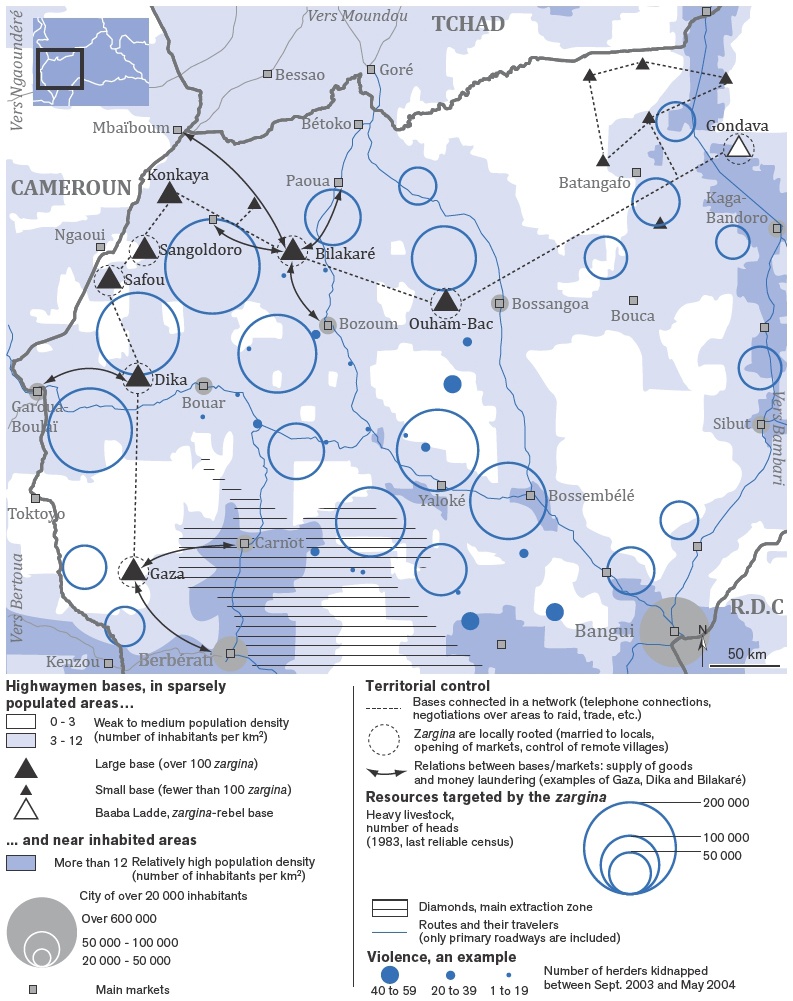
Implantation of the zargina model in CAR. Highwaymen bases (2000-2012)
This map shows the localization strategy of road bandits in the region: set up bases in sparsely populated zones that were poorly controlled by the government, without straying too far from targets (herders, diamond traders, tourists) and places from which to steal (cities, neighbouring countries). Only the main zargina bases are shown. The map of abductions reported by some herders over a short time span offers insight into the nature of this kidnapping “industry”.39When the Central African army bombed and then invaded Bilakaré, the zargina still had plenty of time to evacuate, although they were forced to leave some things behind. President Bozizé basked in the glory of this “bombing” of a symbolic site by inviting a television station from Bangui that obligingly filmed the camp and the goods pillaged by the zargina: motorcycles, televisions, boxes of clothing and shoes, etc. The army campaign was led by Francis Bozizé, the president’s son, assisted by elements from the French special forces. The bases very temporarily disbanded, their population dissipating within the cities of Chad and Cameroon where some districts were home to dormant bases. But this system of predation via a network of more or less hierarchically organized bases around which raids were organized was a criminogenic model that, in the reigning ambient disorder, would soon merge with the Seleka.
40APRD, a rebel army. APRD worked like a veritable little army within the Central African state, exerting domination over part of the country’s north-west. While it did not have any secessionist claims, the rebel headquarters set up administrative divisions and checkpoints (bases, road blocks) to ensure the control of local villages (map 4).
41Between 2005 and 2009, APRD was directed by General Doumro, a former Chadian “codo” recruited in the early days of the rebellion by Sylvain Patassé, son of the former president. Accused of pilfering numerous taxes for his personal benefit, he was later replaced by Bertin Wafio, a former teacher and APRD “colonel”. From 2008 until its official dissolution in 2012, Jean-Jacques Demafouth, a former Defence Minister under Ange-Félix Patassé, oversaw the political branch of the rebellion.
42APRD territory was divided into two types of areas: “military regions” and “zones”, respectively led by colonels and commanders (“zone-coms”). Following the ousting of Laurent Djim-Woei Bebiti, accused of assassinating a FNEC representative, Bertin Wafio took charge of “military regions #1 and #2.” These regions were located between Cameroon in the east and the Nana-Barya wildlife reserve in the west. Maradas Lacoué led “military region #3,” centred around Batangafo. This former military nurse claimed to want social justice and a better distribution of resources between the different territories. He travelled on foot or horseback and wanted to “incarnate the people’s man” and lead “a Chinese-style revolution.” The rebels also relied on the existing administrative layout. APRD appointed mayors in five out of eight municipalities in the Paoua sub-prefecture (Bah Bessar, Banh, Bimbi, Mia-Pendé and Nana-Barya). More broadly, the rebellion forced pro-government mayors, deputies and chiefs out of its territory. It constantly pressured local political representatives, notably mayors, in charge of collecting local taxes.
The APRD rebellion: a state within the state. The layout of rebel territory in north-western CAR (2005-2012)
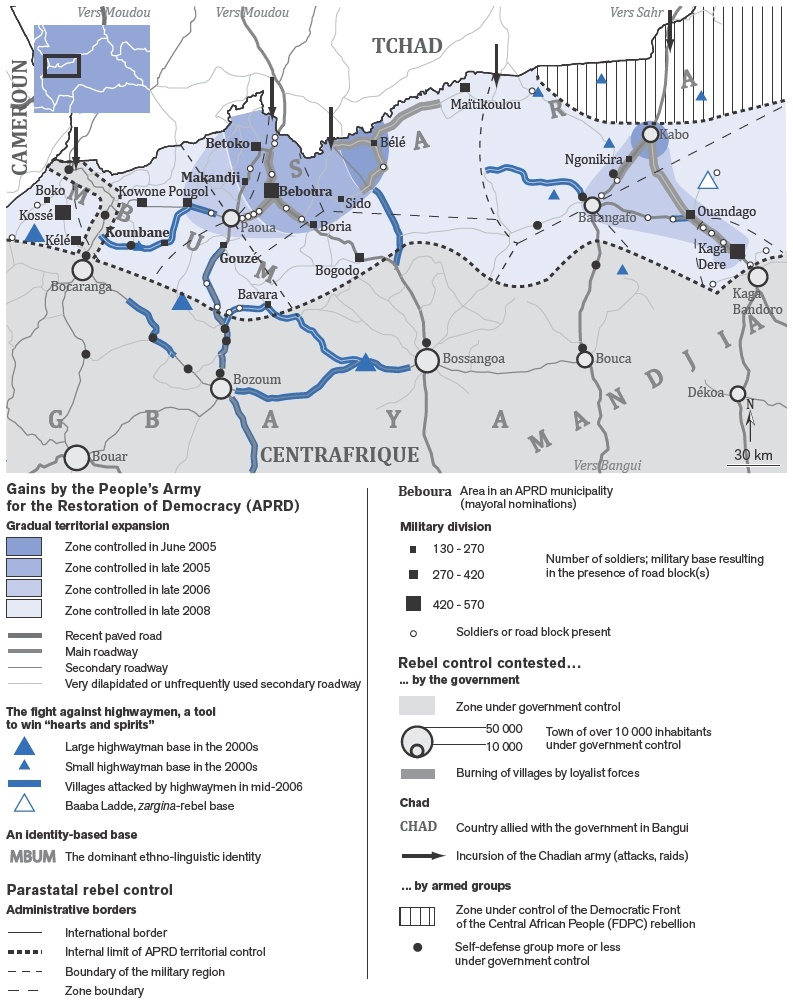
The APRD rebellion: a state within the state. The layout of rebel territory in north-western CAR (2005-2012)
The rebel areas were not vast “grey zones” but rather proper, well-organized territories. Some readers may be concerned that this map could be misappropriated for political ends. The risk is limited given that the rebellion agreed to research being conducted on its territory, along with the official dissolution of APRD and the relatively widespread knowledge of this information in CAR. We were not able to locate the APRD base in Maraze. On this map, like the others, the geographic names are the same as those found on regional maps issued by the Institut géographique national (France), the most recent of their kind for CAR (created in the 1960s and 1970s).43While the Bozizé government defended the cities, APRD bases provided control in the villages. The north-west region is very rural, with an urbanization rate of 16.8% in the Ouham, Ouham-Pendé and Nana Gribizi prefectures versus 37.8% at the national scale (according to the 2003 RGPH). The rebellion as such had most of the population under its wing. The three largest “bases” (Kaga Déré, Béboura, Kossé) were the headquarters of the colonels. There were seventeen smaller bases spread in such a way that each “zone” had between one and three command centres. There were also “bases” implanted a few hundred metres from rural towns—the most populated villages, that offered numerous services (schools, health clinics, markets, etc.). The average village size in APRD territory was 260 inhabitants, with 1 108 villages in total. Roughly 32% of the population nevertheless lived in a rural town with over 700 inhabitants, of which there were 124 in total. There were more than fourteen rebel “bases” located in these rural towns whose population reached 2 500 inhabitants in some cases (Bétoko) (calculated based on the 2003 RGPH). The “bases” were encampments where combatants lived in makeshift buildings—houses and “sheds” made of wood and straw. The soldiers’ wives and girlfriends looked after the rebellion on the home front: farming, managing the harvest, cooking, transporting water, etc.
44Outside the villages, APRD controlled the circulation of people and goods. During the period of open conflict (2005-2008), the destruction of bridges and the erection of road blocks limited the infiltration of loyalist forces. More broadly, road blocks allowed people to be filtered and the collection of taxes on vehicles and goods (Chauvin, 2012). These were concentrated around “bases” which were themselves located along the main throughways of north-western CAR: Bangui-Sahr (Chad), with alternate routes via Batangafo and Kaga Bandoro, and Bangui-Moundou (Chad), with alternate routes via Bozoum and Bossangoa. The government retained control over one vital route: the main Bangui-Bocaranga-Mbaiboum (Cameroon) axis. Kousseri aside, Mbaiboum was the largest cross-border market in the sub-region and its influence extended all the way to the Democratic Republic of the Congo. APRD contented itself with bases located at two of its junctions: the Ngonon-Man-Ngoundaye and Ndim-Pougol-Paoua sections. The other APRD camps were located on secondary routes which structured local traffic, such as the Baba-Bakassa-Bélé-Maïtikoulou, Létélé-Kounbane-Pougol and Taley-Bavara-Gouzé routes. Moreover, there was a particularly large number of road blocks near the Chadian border, at the interface with the loyalist zone, on the outskirts of government-held cities and near Baaba Ladde’s territory (Gondava). Road blocks were comprised of wooden beams supported by two poles in the ground, making them a particularly light and mobile means of surveillance. Combatants would sit under a mango tree and stand up when a vehicle approached. They would question drivers regarding their identity, where they were from and where they were going, as well as the nature and quantity of goods they were transporting.
45It was the soldiers themselves who ran these checkpoints and controls on a daily basis. It is estimated there were between 1 000 and 6 000 of them. Most APRD members were men (5% women), young (between 20 and 35 years old), with limited education (primary school) (UNDP, 2011). Before joining the ranks of APRD, most worked as farmers, occasionally as merchants or, more rarely, were students. Most were posted within a twenty- to thirty-kilometre radius of their village. Beyond joining to support Patassé or out of ethnic solidarity, their motivations for taking up arms were diverse: e.g., to take revenge for the pillaging and exactions committed by François Bozizé’s troops, to combat highway robbery or as a means of survival.
46The APRD army was divided into companies that theoretically each had eight sections with twenty-two elements. The gendarmerie (“brigade”) was responsible for maintaining order and prison administration. Gendarmes notably supervised “correctional centres”—sorts of prisons, such as in Bétoko. Justice was served directly by the colonels. The main sentences were imprisonment and beatings (e.g., sentences of fifty lashes). APRD fighters were not spared when an offense or crime was reported to the colonels. Border guards oversaw taxing motor vehicles that passed through the rebel zone. There were at least five border posts along the main transportation routes for international goods. The posts in Gouzé, Bétoko, Bémal and Bodoli were located on one of the two main roads between Bangui and Chad. The Bozoye 3 post allowed the flow of goods between the city of Paoua and the large caravanserai market in Mbaiboum to be controlled. APRD also had outposts, “commissioners” and “scouts” in government-controlled cities. The former were civilians officially recognized as liaison agents. They kept the rebel movement supplied with manufactured goods from markets in the sub-region (motorcycles, telephones, etc.). They represented the rebellion at meetings with visiting representatives from inter-governmental and non-governmental organizations. “Scouts” were informal collaborators responsible for gathering information about government-controlled zones, such as Paoua, Bocaranga, Kaga Bandoro and Bossangoa. Lastly, other individuals worked for the rebellion as farmers and merchants. In the Kaga Déré military region, there were three companies of soldier-workers specialized in agriculture, fishing and hunting (European Union, 2010). Moreover, merchants bought bags of food supplies at low cost in the villages, which were then given to transporters who took them to be sold in Bangui and Berberati.
47APRD as such provided tenuous socio-territorial control to part of north-western CAR and its population. It reproduced measures used by the state, such as administrative divisions, road blocks and the constitution of civilian and military groups. Unlike the state, however, whose influence was concentrated in cities, APRD planted its roots in rural areas. APRD was the most organized, tight-knit and disciplined of the Central African rebellions. The line between rebellion and banditry was less clear-cut in some of the other armed groups.
New competitors
48The Baaba Ladde episode. The zargina “bases” on the western border with DRC had barely been dispersed when new insecurity concerns arose on the northern border, in addition to the rebellions already underway. In late 2009, a group of Uuda’en, led by a certain Baaba Ladde, began to be talked about. After having drawn attention as leaders or actors in most of the zargina gangs, the Chadian Uuda’en formed a communitarian “army” that aimed to serve a single cause. This recent change was quite surprising since in Chad, the Uuda’en had been practically absent from the wars of Hissène Habré and Goukouni Oueddei. They emerged in the most recent wars of Idriss Déby, however. They gradually became aware of the strength of their community, dispersed between Lake Chad, CAR and Nyala, Sudan, and they were no longer willing to simply play a minor role in the Gouran, Arab and Zaghawa columns. “Enlightened elements” who had served in the Chadian army naturally became the leaders. Their discourse was vehement, inspired by that of previous Chadian rebellions.
49When the “army” of Baaba Ladde—the leader of an odd Popular Front for Recovery (FPR)—appeared on horseback at the Chadian-Central African border, there was no doubt about its origins. Baaba Ladde was indeed in charge of several hundred men armed with assault rifles, most of which were AK-47s. They were even said to have rocket-launchers and several heavy machine-guns carried by donkeys, as well as munitions stored in leather bags, just like the caravans of donkey drivers described by Passarge in 1893 (2010, p. 203, 209). This group of Uuda’en and Biibe-Woyla travelled with their families and livestock. It was a veritable armed nomadic movement. Some 3 500 people sub-divided into three encampments ready to assist each other decided to set up in the Kaga-Bandoro region. [24] At their head was Baaba Ladde, “father of the bush”—a nickname for lions—, which also sounded like a zargina name. Baaba Ladde’s real name was Mahamat (or Oumar) Abdul Kader and he had apparently been a staff sergeant in the Chadian gendarmerie. It is believed that under Idriss Déby he fought in Darfur before getting involved in the mobilization and organization of the Uuda’en in 2007-2008. He spoke and read Arabic and French.
50When the Chadian Mbororo appeared as another element among the rebel movements, they posed a veritable problem for the FOMAC, based in Bangui, whose mandate was notably to disarm rebel groups. [25] APRD and FDPC refused to lay down their weapons so long as the Mbororo remained armed—and the latter were not willing to back down.
51Over the course of 2010, the government in Bangui requested an audience with Mahamat Abdul Kader to hear his demands. The latter stated on national radio that he was rebelling against Idriss Déby, accused of persecuting the Mbororo. He accused Idriss Déby of executing an important Uuda’en representative in N’Djamena in 2009 in order to snub out the growing dissent of the Uuda’en-Biibe Woyla. This was problematic for Bangui: this Mbororo was opposed to the godfather of General-President Bozizé. He was arrested and sent to N’Djamena.
52Baaba Ladde escaped, however—or someone let him escape—from the camp where he was being held prisoner. Weakened, he handed control to one of his younger men who called himself “General Ramadan”. This Mbororo party was an armed group that toed the line between banditry and rebel movement. It was composed of nomadic herders but was heavily equipped militarily, and it aimed to carve out pastoral lands for itself while continuing to function like a cross-border criminal gang. The group continued to be called zargina by neighbouring Central African communities and their encampments were still referred to as “zargina bases”. The group did not seem particularly concerned with religion, despite the somewhat unclear discourse attributed to Baaba Ladde. For FOMAC observers, this was quite possibly the only positive point amongst all the problems the group posed.
53Their demands were also somewhat unclear. But they had access to weapons and their leader, Baaba Ladde, engaged in a Chadian professionalization of the rebellion; he inaugurated the “underground bush” phase, a waiting game during which the group demanded a political position in exchange for its opportunist support (Debos, 2013). Would the current government of Idriss Déby allow itself to be won over like in the past? While it was busy enough trying to politically balance the large warring factions, without having to consider yet another competitor, it could also not afford to anger the Mbororo community which had become particularly agitated, with some of its members even having joined the Janjaweed [26] in Darfur. So, it offered Baaba Ladde a position in the Prime Minister’s Office in N’Djamena. Now, the Uuda’en, who had remained militarily in the shadows of the Arab khachimbet (clans) with whom they shared the same language and often even the same grazing grounds during the dry season in Chad, wanted to use politics to defend their interests.
54In January 2012, loyalist troops supported by a Chadian contingent attacked an FPR base in Gondava, north of Kaga-Bandoro. Some people wanted to see this as nothing more than the dispersion of a bunch of bandits disguised as “fake Resistance fighters”. Despite being scattered throughout the bush, some of Baaba Ladde’s elements were able to reconnect and join the multi-faceted Seleka—in which the only common trait among its various components was Islam, for lack of anything better.
The militias, from the presidency to the rebellion
55The anti-balaka groups that made headlines in December 2013 were part of a continuum of Central African militias over the past fifty years. Such militias are comprised of civilians and have always served presidents to counterbalance the power of the army deemed to be a breeding grounds for putschists. Their members come from urban districts or villages that are faithful to a leader from the same ethnic group and they round out the presidential guard to ensure tight security around the president, to counter insurrections and combat insecurity. Since the 2000s, militias have also been used by defeated presidents to form rebel groups.
56Under Bokassa, the “Abeilles” (“bees”)—the state militia of the president-emperor—dominated the Central African Armed Forces (FACA). Under Kolingba, the “Bees” were replaced by the entirely Yakoma éléments blindés autonomes (EBA—autonomous armoured force). Following the election of Patassé in 1993, he put the EBA elements back into the regular army and sent them to combat “highwaymen” in the countryside, far from the presidential palace. During the army mutinies (1996-1998), Patassé created the Karako, Balawa and Sarawi militias in the Boy-Rabe, Combattant and Sara districts of Bangui (1 500 young men) (Chauvin, 2009). In the early 2000s, he put Abdoulaye Miskine in charge of forming a militia to combat highway robbery after the archers were dissolved. Abdoulaye Miskine (Martin Koumtamadji) was the traditional healer of Ange-Félix Patassé responsible for treating his physical mobility problems. His militia had 300 to 600 men recruited in the Combattant district of Bangui. In his fight against highwaymen, Miskine exerted indiscriminate repression against herders in northern CAR and cattle merchants in the large cities, all accused of complicity with the bandits. Some people saw this as an anti-Muslim attitude connected to the assassination of his father by a Fulani. Miskine was born in the village of Ndinaba (Chad), but was raised by his mother in Sido (CAR) after his father was killed. Regardless, the assassination of nomadic Chadian herders and Central African merchants of Chadian origin did not go unnoticed. Some people joined the rebellion led by François Bozizé (the “liberators”), which had the support of N’Djamena, as a means to seek revenge for a murder in their family or community. This was notably the case for Abakar Sabone, a former Patassé advisor who became Bozizé’s aide-de-camp. In 2002, while Bozizé’s rebellion was growing, Miskine’s militia shifted from combating highway robbery to becoming a counter-insurrectional tool. After Bozizé’s putsch in 2003 and his election in 2005, Patassé reactivated his militias to form the rebel core of APRD, of Abdoulaye Miskine’s FDPC and of UFDR.
57In 2008, François Bozizé relaunched a campaign against highway robbery, while also seeking to contain APRD within the limited confines of the north west. He relied on comités d’autodéfense villageois (CAD—village self-defence committees), also called anti-balaka. At the time, there were roughly 35 000 people already more or less involved in a CAD (Niewiadowski, 2014). Zargina, rebellions, the lack of civilian protection by the security forces and violence committed by the presidential guard bolstered the ranks of these private village security groups composed primarily of farmers equipped with machetes and homemade hunting rifles. Local authorities in western CAR (Bossangoa, Bocaranga, Bossembélé, etc.) played an important role in the pro-Bozizé politicization of anti-balaka groups. For villagers, joining sides with the loyalist authorities provided one opportunity among others to gain protection from insecurity and pillaging. The government notably helped with the creation of CADs in southern areas (between Taley and Bozoum) and in APRD territory (between Kounbane and Bocaranga-Ndim).
58Between December 2012 and mid-March 2013, the authority of François Bozizé took a blow as successive cities in the north fell to the Seleka. A Central African president once again leveraged the army-militia opposition: François Bozizé decried the treason of the army and its inability to combat the rebels in speeches in Sango on 31 December 2012 and 8 March 2013. In a speech on 28 December, he asked the population to defend itself and people to prepare their arrows and machetes. The effect was immediate. Road blocks manned by young, armed civilians popped up throughout Bangui to track the infiltration of the Seleka. Muslims and people who did not speak Sango were suspected of collaborating with the movement.
59After Michel Djotodia seized power in March 2013 and even more so after May, armed civilian groups flourished across most of western CAR. The groups were autonomous but most fought the pillaging and violence committed by the Seleka. Some former military men and politicians who had remained faithful to Bozizé nevertheless coordinated some of the anti-balaka groups in the field. Clan, ethnicity and region were the main types of identity used to create a bond between militiamen at the inter-village level. Ultra-nationalist discourse targeting the Seleka and Muslims as foreign jihadists worked to unite anti-balaka fighters in south-western CAR [27] and in some of the northern districts of Bangui. [28] The strategy was based on harassing the Seleka and Muslim community through ambushes, the pillaging of shops, destroying mosques and committing widely publicized assassinations. Between September and December 2013, anti-balaka groups attacked the cities of Bouca, Bossangoa, Bouar and Bangui. Certain anti-balaka groups gradually shifted from ensuring village self-defence to being pro-Bozizé governmental militias to engaging in a full-on anti-Seleka insurrection tainted with religious extremism.
60From the rebellions to the government (the “Liberators” and the Seleka). In March 2013, Michel Djotodia’s Seleka took charge of the Central Africa state. The putsch was conducted in a manner identical to the one used ten years prior by François Bozizé’s “Liberators”: form a rebellion in a rural area; recruit foreign mercenaries to ensure its military superiority; conduct raids in key towns near the capital; negotiate the passivity of the inter-African peacekeeping forces and notably of the Chadian contingent; seize Bangui. A policy of “permissive pillaging” allowed the rebel leaders to keep their “parents” (family, ethnic groups, regions of origin) and mercenaries happy. Government offices, humanitarian camps, religious missions, cotton factories, rice factories, sugar factories, businesses, and mining and hunting companies were the targets of a vast set of raids. Quickly, the new president proved incapable of controlling his troops or of incorporating them into the army. Mercenaries and some of the ex-rebels turned instead to banditry. They went to work collecting the spoils of war in defeated areas. Building materials, manufactured goods, cattle and crops were targeted, notably in the native region of the former president.
61In 2003 and 2013, history almost repeated itself, but there were nevertheless differences between the “liberators” and the Seleka. François Bozizé had recruited Arabic-speaking Chadians from Salamat to create the “liberators”, with support from N’Djamena. Nourredine Adam, Mohamed Moussa Dhaffane and Michel Djotodia united the rebellions of the north east (UFDR, CPJP) to form the core of the Seleka. Since 2006, all three had refused to negotiate their surrender with François Bozizé. While it is estimated that UFDR had 1 700 soldiers in 2010, the Seleka had 5 000 to 7 000 men when it arrived in Bangui. Recruitment was widespread: former “liberators”, people close to Baaba Ladde, zargina, Sudanese Janjaweed and Chadian warlords. Three months later, the Seleka had roughly 20 000 men. A show of cash or the promise of inclusion in the army were enough to recruit hordes of young Central Africans from villages in the north east and poor districts in Bangui. UFDR and CPJP had only a limited number of vehicles and automatic weapons. In March 2013, large columns of pick-up trucks and “technicals” reminiscent of the Toyota War in the Sahel or conflicts in East Africa entered Bangui. The Seleka received funding for military equipment from Central African diamond traders who had been betrayed by François Bozizé during operation Closing Gate—a government “hold up” against eight of eleven diamond buying offices (ICG, 2013). Moreover, Noureddine Adam, one of the main Seleka leaders, managed to secure the support of Chad. Sudan is thought to have provided the rebellion with Chinese AK-47s manufactured under licence in Khartoum. Several scenarios may explain this. Reconciled since 2010, the two large neighbours to the north needed to recycle their soldiers, notably the Janjaweed and Dadjo militias. The embers of the system of regional conflict in Chad-Darfur (Marchal, 2006) were exported to CAR. N’Djamena intervened abroad to assert its regional leadership (Magrin, 2013), but also to prevent the creation of a Chadian rebellion in neighbouring countries and to protect its oil fields. The inability of François Bozizé to lead a peace process and control the country’s northern regions meant there was a threat that a Chadian rebellion could be formed in CAR. Chad also had a few economic interests in its neighbour to the south. In a short-term perspective, CAR was a reservoir for herders which notably made it possible to defuse the tension with farmers in the south of Chad. [29] Idriss Déby signed an agreement with Michel Djotodia in May 2013 regarding the trade of wood in exchange for oil (Niewiadowski, 2014). In a long-term perspective, the suspected Central African oil reserves (between Markounda and Boromata; near Tiringoulou), which could be connected to the Chad-Cameroon oil pipeline, were also quite coveted. Authorities in Khartoum feared a repeat of the secessionist scenario that had played out in other regions and notably in Darfur. The creation of an independent South Sudan curbed the windfall from Sudanese oil. Support for the Seleka was as such a double investment: political, to control Darfur from north eastern CAR, and economic, since major Sudanese investors were involved in the diamond industry in Bangui.
62Several months after the coup, the Seleka was still a three-sided player alternating between state apparatus, rebellion and banditry. On the one hand, Michel Djotodia formed a relatively balanced government with figures from the opposition and civil society—albeit thirteen of the thirty-five ministers were from Bamingui-Bangoran (CPJP, Runga) and Vakaga (UFDR, Gula). People close to the president oversaw key portfolios: mining, security, defence and international cooperation. But Central African politicians have always relied on ethno-regionalism. On the other hand, outside of Bangui, the government functioned like a rebellion. Military commanders (equivalent to the rebel “zone-coms”) were appointed in twelve of the sixteen Central African regions. Their bases were in cities. Vakaga, Bamingui-Bangoran and Haut-Kotto—the areas in which the rebellion originated—, as well as Haut-Mbomou, where the LRA and the Ugandan army were present, were not under official military command. When commanders spoke neither Sango nor French, they were seconded by former members of the Central African army. Gendarmes, police and civil servants were under the authority of commanders. Violence was used as a means of counter-insurrection against anti-balaka groups. Alongside this, numerous groups and warlords perpetuated the evolution of the zargina model as they widely looted and terrorized the population to impose their presence. The Seleka ramped up the degree of violence to the extreme (massacres, torture and the burning of homes in response to any protest against its pillaging).
63After the arrival of the Seleka, confrontation in CAR very quickly became motivated by religion, plotting Christians against Muslims. Roughly 80% of Central Africans are Christians, mainly Protestants, with a strong rise in evangelicalism in recent years, including Pentecostalism. Muslims represent roughly 10% of the population and are very present in the regions from which the Seleka originates (86% in Vakaga, 44% in Bamingui Bangoran, according to the 2003 RGPH). In CAR, the term “Arab” designates all Muslims involved in commerce in cities, whether they were born in CAR or abroad. A large majority of this group is of Chadian origin, from Salamat (hence the common expression “Chadian Arabs”). Some arrived in CAR in the early 20th century, when the colonial administration encouraged them to engage in the cattle trade to supply Bangui with meat from Chad. Later, “the most entrepreneurial of their children diversified their businesses and economic endeavours (selling manufactured goods, certified coffee buyers, real estate, transportation, etc.)” (Arditi, 2000, p. 26, translated here). The Fulani, Mbororo and Fulbe constitute most of the remaining Muslim community. Until the 2000s, relations between Christians and Muslims were described as part of a social and economic symbiosis, although, some Christian farmers already complained that Muslims dominated the most profitable sectors of the economy. Trade and transportation in the cities and large villages are controlled by “Chadian Arabs” and Fulani from the Garoua and Maroua regions (Cameroon). Many gold and diamond placer mines are controlled by Muslims originally from West Africa. Collectors are often Fulani, Hausa and Arab. In villages, some Mbororo, wealthy from their large troops, are known for their extravagant behaviour. Conversely, access to the public service has always been more restricted for Muslims than for Christians, although such discrimination is insidious. The taking of Bangui by the Seleka was a political catalyst for religious antagonism. Within this rebellion, Islam was the only thing that united the disparate groups. Muslims were spared the violence perpetrated by the Seleka, whereas Christian symbols such as missions were the target of plunder. Chadian Mbororo herders—already incriminated as zargina—were involved in the violence and plunder perpetrated by the Seleka. Some villagers, like Mbororo refugees in Cameroon, interpreted this as a strategy to conquer their territory, to “make space” or, in other words, to expand their grazing grounds (HRW, 2013). Part of the Christian population felt it had been stripped of political power, a feeling that was exploited by François Bozizé in his last, ultra-nationalist speeches. Starting in December 2013, the anti-balaka leagues committed massacres against Muslims which in turn provoked a massive exodus of the latter towards Chad, Cameroon, Nigeria and West Africa.
Conclusion
64Within the span of a few years, the spatiality of armed conflict in CAR evolved from a separation between the state apparatus in urban areas, rebels in the countryside and zargina bases in the bush to a mash-up of these elements within the Seleka. The alliances and antagonism between the different armed groups are volatile, although identity-based divisions (ethnic, regional, religious, national), the control of resources (livestock and diamonds, notably) and the state apparatus remain the driving force behind the violence. Amidst this imbroglio, France engaged in military operation “Sangaris” (December 2013). While France has virtually no economic interests in CAR, the intervention was driven by the fear of seeing a former colony become a stage for massacre and a possible playing field for Islamists. The initial goal of the military operation was to neutralize the Seleka and secure Bangui and other cities along the main routes towards Cameroon and Chad. Two bureaucrats—Catherine Samba-Panza and André Nzapayéké—were placed at the head of the government to replace Michel Djotodia in January 2014. The Seleka was in part pushed towards north eastern CAR, Chad and Sudan. Engaging in a context of constant anamorphosis is not without risk. The united anti-balaka groups used the eviction of the Seleka as an opportunity for religious cleansing against Muslims starting in December 2013. Successfully restoring security to a country that has been deeply divided and ravaged by seventeen years of armed conflict will be no easy challenge.
Bibliography
- Arditi, C. (2000), « Rapport de la mission d’identification des actions d’appui à la commercialisation des produits vivriers », Bangui, ACDA.
- Ankogui-Mpoko, G., Passingring, K., Ganota, B., Kadekoy-Tigague, D. (2010), « Insécurité, mobilité et migration des éleveurs dans les savanes d’Afrique centrale », in L. Seiny-Boukar, P. Boumard, Actes du colloque « Savanes africaines en développement : innover pour durer » (20-23 avril 2009, Garoua), N’Djaména/Montpellier, PRASAC/CIRAD.
- Boutrais, J. (1977), « Une conséquence de la sécheresse : les migrations d’éleveurs vers les plateaux camerounais », Drought in Africa : Sécheresse en Afrique, Londres, International African Institute, p. 127-139.
- Boutrais, J. (1978), Deux Études sur l’élevage en zone tropical humide (Cameroun), Paris, ORSTOM.
- Boutrais, J., Crouail, J. (1986), « Les projets de développement de l’élevage en Centrafrique », Dynamiques des systèmes agraires : l’exercice du développement, Paris, ORSTOM, p. 71-92.
- Boutrais, J. (1988), Des Peuls en savanes humides : développement pastoral dans l’ouest centrafricain, Paris, ORSTOM.
- Boutrais, J. (1990), « Les savanes humides, dernier refuge pastoral : l’exemple des Wodaabe, Mbororo de Centrafrique », Genève Afrique, n° 28, p. 65-90.
- Bouquiaux, L., Kobozo, J.-M., Diki-Kidiri, M. (1978), Dictionnaire sango-français, Paris, Selaf.
- Chauvin, É. (2009), « Rivalités ethniques et guerre urbaine au cœur de l’Afrique – Bangui (1996-2001) », Enjeux, n° 40, p. 30-38.
- Chauvin, É. (2011), Les Agriculteurs de la région de Paoua face aux conflits armés (Centrafrique), Paris/Bangui, université Paris-1/Première urgence.
- Chauvin, É. (2012), « Conflits armés, mobilités sous contraintes et recompositions des échanges vivriers dans le nord-ouest de la Centrafrique », « Communication et échanges dans le bassin du lac Tchad », XVe colloque pluridisciplinaire du réseau Méga-Tchad, 13-15 septembre 2012, Naples.
- Debos, M. (2013), Le Métier des armes au Tchad, le gouvernement de l’entre-guerres, Paris, Karthala.
- Geffray, C. (1990), La Cause des armes au Mozambique. Anthropologie d’une guerre civile, Paris, Karthala/CREDU.
- Human Rights Watch (2013), « Je peux encore sentir l’odeur des morts ». La crise oubliée des droits humains en République centrafricaine, États-Unis.
- International Crisis Group (2010), « De dangereuses petites pierres : les diamants en République centrafricaine », rapport Afrique de Crisis group, n° 167, p. 1-34.
- International Crisis Group (2013), « République centrafricaine : les urgences de la transition », rapport Afrique de Crisis group, n° 203, p. 1-46.
- Leaba, O. (2001), « La crise centrafricaine de l’été 2001 », Politique africaine, n° 84, p. 163-175.
- Magrin, G. (2013), « Les ressorts de l’intervention militaire tchadienne au Mali », EchoGéo, 28 juin.
- Marchal, R. (2006), « Tchad/Darfour : vers un système de conflits », Politique africaine, n° 102, p. 135-154.
- Martin-Granel, P. (2013), Jean Desrotour, Baba ti Mbororo, le père des Mbororo (1921-2002), Arles, Éditions de Catimini.
- Mehler, A., Cruz, V. (2000), « République centrafricaine : la démocratie n’est pas un vaccin, politique formelle et informelle », L’Afrique politique, p. 197-208.
- Menkhaus, K. (2008), « Arrangements sécuritaires locaux dans les régions somalies de la Corne de l’Afrique », Politique africaine, n° 111, p. 22-43.
- Munié, V. (2010), « Chez les éleveurs peuls de Centrafrique, arcs contre kalachnikovs », Le Monde Magazine, 7 août, p. 18-23.
- Niewiadowski, D. (2014), « La République centrafricaine : le naufrage d’un État, l’agonie d’une Nation », Afrilex, p. 1-68.
- Passarge, S. (2010), Adamawa. Rapport de l’expédition du comité allemand pour le Cameroun au cours des années 1893-1894, Paris, Karthala.
- Porgès, L. (2001), « Le coup d’État de mai 2001 en Centrafrique : un événement presque ignoré », Afrique contemporaine, n° 200, p. 34-49.
- Programme des Nations unies pour le développement (2011), « Programme de Désarmement Démobilisation et Réintégration (DDR) des éléments des groupes politico-militaires en République centrafricaine », rapport annuel, Bangui.
- Romier, G. (1999), « Peuls mbororo de Centrafrique. Une installation récente, un avenir incertain », in R. Botte, J. Boutrais, J. Schmitz, Figures peules, Paris, Karthala, p. 463-480.
- Roulet, P.-A. (2005), Étude socio-économique dans les préfectures de la Vakaga et Bamingui-Bangoran. Nord-est de la République centrafricaine, Bangui, Coopi/Cybertacker Foundation/Union européenne.
- Saïbou, I. (2001), « Sonngoobe, bandits justiciers dans la plaine du Diamaré (Nord-Cameroun) sous l’administration », Ngaoundéré-Anthropos, vol. VI, p. 137-154.
- Seignobos, C. (2008), La Question mbororo. Réfugiés de la RCA au Cameroun, Yaoundé/Paris, HCR/SCAC/IRD.
- Seignobos, C. (2011), « Le phénomène zargina dans le nord du Cameroun, coupeurs de route et prises d’otages, la crise des sociétés pastorales mbororo », Afrique contemporaine, n° 239, p. 37-50.
- Seignobos, C. (2011), « Le pulaaku, ultime recours contre les coupeurs de route. Province du Nord du Cameroun », Afrique contemporaine, n° 240, p. 13-23.
- Seignobos, C. (2013), « L’enrichissement par la razzia dans le bassin du lac Tchad du XIXe siècle à 2012 », in C. Baroin, C. Michel, Richesse et Sociétés. Actes du 9e colloque de la Maison archéologie et ethnologie René-Ginouvès, Paris, De Boccard.
- Spittaels, S., Hilgert, F. (2009), Cartographie des motivations derrière les conflits : la République centrafricaine, n.d, Ipis/Fatal Transactions.
- Union européenne (2010), Atlas du profil socio-sécuritaire du nord-ouest et des stratégies de réinsertion sociale et professionnelle des ex-combattants dans les pôles de développement (RSS, DDR), Bangui, Délégation de l’Union européenne en Centrafrique.
Publisher keywords: Central African Republic, Conflicts, Highwaymen, Militias, Pastoralism, Rebellions, Territorial control, Zargina
Uploaded: 06/25/2014
https://doi.org/10.3917/afco.248.0119